
Determine the necessary mass, volume, or concentration for preparing a solution.
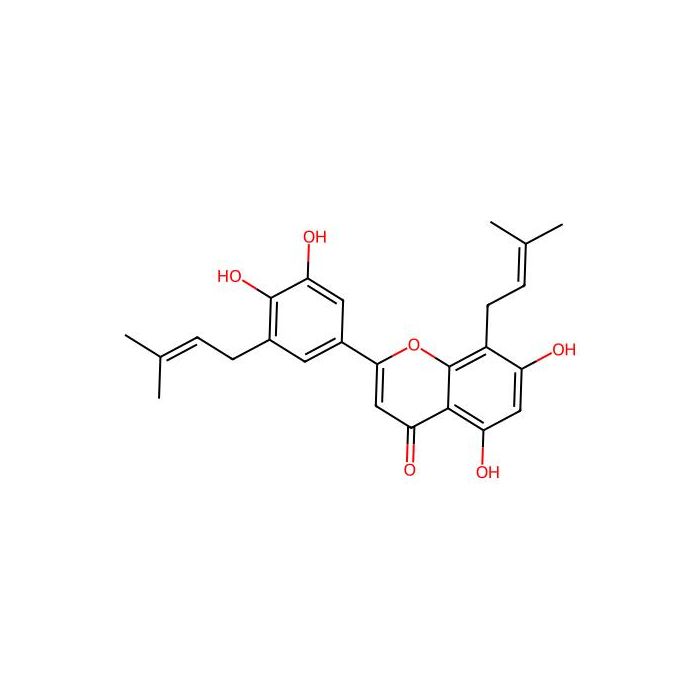
Epimedokoreanin B , CAS No.161068-53-7
AVAILABLE TO ORDER
Storage
Protected from light,Store at -20°C
Shipped In
Ice chest + Ice pads
for sensitive chromatographic and analytical workflows requiring minimal baseline interference.
Protected from light,Store at -20°C Ships Ice chest + Ice pads Check lot-specific COA for exact specifications.
SDS, COA, datasheet, and spec sheet available for download. Lot-specific COA accessible via lot number lookup.
Cited in 0 peer-reviewed publications across chromatography, organic synthesis, and cross-coupling reactions.
Epimedokoreanin B is a natural flavonoid with anticancer, anti-inflammatory and antibacterial effects. Epimedokoreanin B inhibits the growth of lung cancer cells through endoplasmic reticulum stress-mediated apoptosis accompanied by autophagosome accumulation. Epimedokoreanin B is an anti-periodontitis agent that inhibits gingipains and Porphyromonas gingivalis growth and biofilm formation .
In Vitro
Epimedokoreanin B (compound6; 3.13-25 μM; 48 hours) shows significate inhibitory effect on proliferation against lung cancer cell A549, Calu1 and H1299. Epimedokoreanin B displays no toxic on human bronchial epithelial cells BEAS-2B.\nEpimedokoreanin B treatment inhibits cell proliferation and migration accompanied by cytoplasmic vacuolation in A549 and NCI-H292 cells. Atophagosome accumulation accompanied with autophagy flux blocking is observed in Epimedokoreanin B treated cells, this was consistent with the occurrence of ER stress. Epimedokoreanin B (5 μM; 24 hours) inhibits CD163 expression and IL-10 production, which are known M2 markers, suggesting that Epimedokoreanin B inhibits M2 polarization in human monocyte-derived macrophages (HMDMs). Epimedokoreanin B suppresses STAT3 activation in HMDMs . MCE has not independently confirmed the accuracy of these methods. They are for reference only. Cell Cytotoxicity AssayCell Line: A549, Calu1 and H1299 cells Concentration: 3.13 μM, 6.25 μM, 12.5 μM and 25.0 μM Incubation Time: 48 hours Result: Showed significate inhibitory effect on proliferation against lung cancer cell A549, Calu1 and H1299. Western Blot Analysis Cell Line: Human monocyte-derived macrophages (HMDMs) Concentration: 5 μM Incubation Time: 24 hours Result: Significantly suppressed IL-10-induced JAK1/STAT3 activation.and H1299.
In Vivo
Epimedokoreanin B (20 mg/kg; p.o; thrice a week; for 17 days) inhibits tumor growth in an LM8 tumor-bearing murine model. MCE has not independently confirmed the accuracy of these methods. They are for reference only. Animal Model: Female C3H mice (8-10 weeks old) injected with LM8 cellsDosage: 20 mg/kg Administration: Oral administration; thrice a week; for 17 days Result: Inhibited tumor growth.
Form:Solid
| Canonical Smiles | CC(=CCC1=C(C(=CC(=C1)C2=CC(=O)C3=C(C=C(C(=C3O2)CC=C(C)C)O)O)O)O)C |
|---|---|
| IUPAC Name | 2-[3,4-dihydroxy-5-(3-methylbut-2-enyl)phenyl]-5,7-dihydroxy-8-(3-methylbut-2-enyl)chromen-4-one |
| InChIKey | QLZMBCVLWOJASJ-UHFFFAOYSA-N |
| INCHI | 1S/C25H26O6/c1-13(2)5-7-15-9-16(10-21(29)24(15)30)22-12-20(28)23-19(27)11-18(26)17(25(23)31-22)8-6-14(3)4/h5-6,9-12,26-27,29-30H,7-8H2,1-4H3 |
| Isomeric SMILES | CC(=CCC1=C(C(=CC(=C1)C2=CC(=O)C3=C(C=C(C(=C3O2)CC=C(C)C)O)O)O)O)C |
| PubChem CID | 21147600 |
| MeSH Entry Terms | 2-(3,4-dihydroxy-5-(3-methylbut-2-enyl)phenyl)-5,7-dihydroxy-8-(3-methylbut-2-enyl)chromen-4-one;epimedokoreanin B |
| Molecular Weight | 422.47 |
Comprehensive hazard, handling, storage, and regulatory compliance document.
Download SDS →Lot-specific quality data. Enter your lot number to retrieve the exact COA.
Look up COA →Full quality attributes and acceptance criteria for this grade.
View spec sheet →Taxonomy Tree
| Kingdom | Organic compounds |
|---|---|
| Superclass | Phenylpropanoids and polyketides |
| Class | Flavonoids |
| Subclass | Flavones |
| Intermediate Tree Nodes | Not available |
| Direct Parent | 8-prenylated flavones |
| Alternative Parents | 3'-prenylated flavones 3'-hydroxyflavonoids 4'-hydroxyflavonoids 5-hydroxyflavonoids 7-hydroxyflavonoids Chromones Catechols 1-hydroxy-2-unsubstituted benzenoids Pyranones and derivatives 1-hydroxy-4-unsubstituted benzenoids Benzene and substituted derivatives Vinylogous acids Heteroaromatic compounds Oxacyclic compounds Hydrocarbon derivatives Organic oxides Organooxygen compounds |
| Molecular Framework | Aromatic heteropolycyclic compounds |
| Substituents | 8-prenylated flavone - 3'-prenylated flavone - 3'-hydroxyflavonoid - 4'-hydroxyflavonoid - 5-hydroxyflavonoid - 7-hydroxyflavonoid - Hydroxyflavonoid - Chromone - Benzopyran - 1-benzopyran - Catechol - 1-hydroxy-4-unsubstituted benzenoid - 1-hydroxy-2-unsubstituted benzenoid - Phenol - Pyranone - Monocyclic benzene moiety - Benzenoid - Pyran - Vinylogous acid - Heteroaromatic compound - Organoheterocyclic compound - Oxacycle - Organic oxygen compound - Organic oxide - Organooxygen compound - Hydrocarbon derivative - Aromatic heteropolycyclic compound |
| Description | This compound belongs to the class of organic compounds known as 8-prenylated flavones. These are flavones that features a C5-isoprenoid substituent at the 8-position. |
| External Descriptors | Flavones and Flavonols |
| Molecular Weight | 422.500 g/mol |
|---|---|
| XLogP3 | 6.200 |
| Hydrogen Bond Donor Count | 4 |
| Hydrogen Bond Acceptor Count | 6 |
| Rotatable Bond Count | 5 |
| Exact Mass | 422.173 Da |
| Monoisotopic Mass | 422.173 Da |
| Topological Polar Surface Area | 107.000 Ų |
| Heavy Atom Count | 31 |
| Formal Charge | 0 |
| Complexity | 745.000 |
| Isotope Atom Count | 0 |
| Defined Atom Stereocenter Count | 0 |
| Undefined Atom Stereocenter Count | 0 |
| Defined Bond Stereocenter Count | 0 |
| Undefined Bond Stereocenter Count | 0 |
| The total count of all stereochemical bonds | 0 |
| Covalently-Bonded Unit Count | 1 |