This compound belongs to the class of organic compounds known as fatty acid esters. These are carboxylic ester derivatives of a fatty acid.
External Descriptors
Not available
1. Djoumbou Feunang Y, Eisner R, Knox C, Chepelev L, Hastings J, Owen G, Fahy E, Steinbeck C, Subramanian S, Bolton E, Greiner R, and Wishart DS. ClassyFire: Automated Chemical Classification With A Comprehensive, Computable Taxonomy. Journal of Cheminformatics, 2016, 8:61.
Determine the necessary mass, volume, or concentration for preparing a solution.
Dilution Calculator
Determine the dilution needed to prepare a stock solution.
Reconstitution Calculator
Reviews
Customer Reviews
Application Protocols
No manufacturer-validated application protocols are provided for this item. As a general chemical reagent, protocol details depend on the intended transformation.
Examples (literature/general):
GC reference standard: Prepare ~1000 μg/mL in hexane or isooctane; inject 1 μL under standard temperature program for C8 esters. Verify linearity and response factors.
Enzymatic hydrolysis assay: Dissolve the ester in minimal acetonitrile or ethanol (≤1% v/v final). Incubate with esterase in buffered aqueous medium at 25–37 °C; monitor acid formation by HPLC or pH-stat.
Always validate solvent vehicles, concentrations, and detection methods for your specific instrumentation and assay. For certified analytical use or validated methods, consult the CoA/Spec Sheet or develop method suitability per your lab’s SOPs.
Biological Roles
Item-specific biological data are not provided. The following remarks are general and for research context only.
As a simple aliphatic ethyl ester, Ethyl 4-methylvalerate has no intrinsic biological role. In biological systems, nonspecific esterases can hydrolyze such esters to yield 4-methylpentanoic acid and ethanol (literature/general biochemistry).
Hydrolysis products:
4-Methylpentanoic acid (a branched-chain carboxylic acid) may undergo further metabolism via activation to its CoA thioester before oxidative or degradative pathways, albeit at rates influenced by branching (general trend: branching can slow β-oxidation relative to straight chains).
Ethanol is rapidly metabolized via alcohol and aldehyde dehydrogenases.
Utility in studies: Branched esters are sometimes used as model substrates for enzyme specificity assays (esterases/lipases) or as hydrophobic probes in partitioning and membrane interaction studies (no clinical claims).
No pharmacodynamic, pharmacokinetic, or toxicity claims are made here; consult primary literature and SDS for hazard and exposure information.
Buffer Applications
This compound is a hydrophobic ester and is not used as a buffering agent. It lacks acid/base functionalities in the aqueous pH range that would support buffer capacity. For experiments requiring buffers, select appropriate systems (e.g., phosphate, Tris, HEPES) and use this ester only as a solute or substrate as needed.
If dissolving the ester into buffered aqueous media, consider co-solvents or emulsifiers (e.g., ≤2% ethanol, DMSO, or nonionic surfactants) and validate that the vehicle does not interfere with your assay.
Green Alternatives
While Ethyl 4-methylvalerate itself is a target/reagent rather than a process solvent, greener choices can be made in its synthesis, handling, and substitution where appropriate.
Greener sourcing and synthesis (literature/general):
Biocatalytic esterification: Lipase-catalyzed coupling of 4-methylpentanoic acid with bio-ethanol in solvent-free systems or green solvents (2-MeTHF, CPME) at mild temperatures; enables high selectivity and reduced waste.
Process intensification: Use of reactive distillation to continuously remove ethanol/water and drive equilibrium, reducing catalyst loadings and energy.
Renewable feedstocks: Employ bio-based ethanol and, where available, bio-derived 4-methylpentanoic acid to improve carbon intensity.
Substitution considerations:
If the role is merely as a hydrophobic ester in a formulation study, consider straight-chain analogs (e.g., ethyl hexanoate) with better-known biodegradation profiles and more abundant LCI data.
For solvent needs during reactions with this substrate, prefer greener media such as 2-MeTHF over THF, or EtOAc over chlorinated solvents, balancing solubility and safety.
Compact comparison (literature):
2-MeTHF vs THF: Similar polarity; 2-MeTHF offers higher bp, lower peroxide tendency, and bio-based routes.
EtOAc vs DCM: EtOAc is biodegradable with lower toxicity; suitable for extractions and as a reaction medium for ester transformations.
Note: Any substitution must preserve required reactivity/selectivity; verify kinetics and partitioning before scale-up.
Pharmaceutical Uses
Item-specific pharmacopeial status or excipient grade is not provided.
General context (no medical or therapeutic claims):
Aliphatic ethyl esters may serve as model hydrophobic compounds in formulation research (e.g., studying partitioning, volatility, or fragrance performance in topical prototypes) but Ethyl 4-methylvalerate is not a standard pharmacopeial excipient to our knowledge (literature).
For any use in GMP or regulated settings, verify compliance (residual solvents, purity assay, elemental impurities) and assess extractables/leachables with your specific container-closure system.
Item-specific note:
Grade/purity: Not specified for this item; refer to CoA/Spec Sheet.
Regulatory listings (USP/NF/Ph.Eur.): Not specified for this item; refer to CoA/Spec Sheet.
Physical Properties
Item-specific measured specifications are not provided in the Product Data. Do not treat any values below as product specifications; consult the item’s CoA/Spec Sheet for certified data.
Phase/appearance: Not specified for this item; refer to CoA/Spec Sheet.
Boiling point: Typical BP 162–168 °C at 1 atm (literature for C8 ethyl branched esters; values vary by isomer and purity).
Melting point: Often remains liquid well below 0 °C; specific MP not widely reported (literature: < −60 °C typical for similar esters).
Density (20/25 °C): ~0.86–0.88 g/mL (literature, comparable to ethyl hexanoate/isomers).
Refractive index (nD20): ~1.400–1.407 (literature ranges for isomeric C8 ethyl esters).
Vapor pressure: Low at ambient; increases with temperature (literature qualitative).
LogP (octanol/water): Estimated 2.7–3.1 (literature/estimations for C8 aliphatic esters).
Water solubility: Low; expected <1 g/L at 20–25 °C (literature for comparable aliphatic ethyl esters). Miscible with common organic solvents (alcohols, ethers, hydrocarbons, chlorinated solvents).
UV cutoff: Not specified for this item; refer to CoA/Spec Sheet.
Notes:
The branched structure slightly lowers BP and density relative to the straight-chain isomer (ethyl hexanoate). Actual values depend on isomeric purity and measurement method.
Quality & Grades
Item-specific grade/purity: Not specified for this item; refer to CoA/Spec Sheet.
Guidance on grades and implications (general information for ester reagents):
Analytical/Reagent grade: Typically controls on acidity (free acid), water, and volatile impurities; suitable for synthesis and routine analytical prep.
High-purity or GC grade: Tight hydrocarbon/ester profile, low non-volatile residue, and often low UV background—useful when the ester is used as a reference standard or in trace analysis.
Stabilizers: Aliphatic ethyl esters typically do not require stabilizers; however, trace antioxidant or acid scavengers are occasionally present in flavor/fragrance contexts. If present, they should be disclosed on the CoA.
Impurity considerations: Common impurities include the parent acid (4-methylpentanoic acid), ethanol/isopropanol, and positional/isomeric esters formed during synthesis. Residual solvents (e.g., hexane, toluene) can appear depending on process.
Recommendations:
For catalytic or moisture-sensitive transformations (e.g., alkoxide-catalyzed transesterifications), verify water and acid content on the CoA.
If using as a quantitative standard, confirm assay method (e.g., GC area %, qNMR) and impurity thresholds with the provided Spec Sheet.
Reaction & Applications
Ethyl 4-methylvalerate serves as a versatile aliphatic ester substrate in synthesis and method development.
Representative application areas (literature/general):
Hydrolysis and saponification: Conversion to 4-methylpentanoic acid using aqueous base (NaOH/KOH) or acid catalysis for kinetic studies of ester cleavage and for acid preparation.
Transesterification: Exchange of the ethyl group for other alcohols (MeOH, i-PrOH, benzyl alcohol) under acid (H2SO4, p-TsOH) or base (alkoxides) catalysis; widely used to demonstrate regio/isomer effects on rate.
Reductions:
LiAlH4 or BH3·THF to the corresponding diol equivalent (4-methyl-1-pentanol) via full ester reduction.
DIBAL-H at low temperature (≤ −78 °C) to the aldehyde (4-methylpentanal) under controlled conditions.
Amidation: Conversion to the amide via activation (e.g., DCC/DMAP with the acid form) or via direct aminolysis with strong nucleophiles or catalysts.
Reference/standard: Useful as a GC/MS retention-time or response-factor standard for branched C8 esters and in aroma chemistry method development (no end-use claims).
Practical tips:
Remove residual parent acid to prevent acid-catalyzed side reactions; pre-wash with mild bicarbonate can reduce acidity before moisture-sensitive steps.
For base-catalyzed transesterifications, thoroughly dry the ester and solvent (molecular sieves) to suppress hydrolysis.
Monitor reactions by GC or 1H NMR; the ethyl group quartet/triplet (≈4.1 ppm/1.25 ppm) provides a convenient handle for conversion tracking.
Reaction Conditions
Representative conditions for common transformations of Ethyl 4-methylvalerate (literature/general guidance; optimize for your system):
Saponification (to 4-methylpentanoic acid):
Solvent: EtOH/H2O (1:1) or aqueous MeOH.
Base: 1–2 equiv NaOH or KOH.
Temperature/time: Reflux 1–4 h (monitor by TLC/GC).
Workup: Evaporate alcohol, acidify to pH ~2 (HCl), extract with EtOAc. Typical yields: 85–95% for simple esters.
Acid-catalyzed hydrolysis:
Catalyst: Dilute H2SO4 (1–5 wt%).
Solvent: Aqueous acetone or neat water (biphasic).
Temperature: 60–80 °C until completion. Yields often 70–90% depending on phase management.
Transesterification (to methyl/benzyl esters):
Base: NaOMe (0.05–0.2 equiv) in MeOH; 25–40 °C, 1–6 h. Drive to completion by excess ROH and removal of EtOH.
Acid: p-TsOH (1–5 mol%) with ROH as solvent; remove water by molecular sieves or Dean–Stark (if toluene/azeotrope is used). Yields frequently >85%.
Reduction to aldehyde (DIBAL-H):
Solvent: Toluene or CH2Cl2, rigorously dry.
Conditions: −78 °C, 1.0–1.2 equiv DIBAL-H, slow addition; quench with MeOH, then Rochelle’s salt at 0–5 °C. Typical isolated yields 60–85%.
Reduction to alcohol (LiAlH4):
Solvent: Anhydrous THF or Et2O.
Conditions: 0–25 °C, 1–2 h with 1.2–1.5 equiv LAH; careful aqueous quench. Typical yields 80–95%.
Analytical monitoring:
GC-FID or GC–MS with nonpolar columns (e.g., DB-5, 30 m × 0.25 mm) provides clear separation from acid/alcohol components.
Caveats:
Moisture promotes hydrolysis; dry reagents and apparatus improve reproducibility.
Branching may subtly influence rates vs straight-chain analogs; re-optimize catalyst loadings accordingly.
Safety & Handling
Always review the SDS for authoritative safety information. The Product Data do not list GHS details for this item; therefore, treat the guidance below as general best practice for aliphatic ethyl esters.
GHS classification (item-specific): Not specified for this item; refer to SDS.
Signal word / H-statements / pictograms: Not specified for this item; refer to SDS.
General hazards and precautions (literature/experience-based):
Flammability: Many C8 aliphatic esters are combustible liquids with moderate flash points. Keep away from heat, sparks, open flames, and hot surfaces.
Exposure routes: Vapors, skin, and eye contact. May cause irritation upon prolonged exposure.
PPE: Use chemical-resistant gloves (e.g., nitrile), safety glasses or goggles, and lab coat. Handle in a fume hood to minimize inhalation.
Handling: Avoid breathing vapors/mists. Use only with adequate ventilation. Prevent release to the environment.
Incompatibilities: Strong oxidizers (risk of exotherm), strong acids/bases (hydrolysis/transesterification), and reactive metals for solvent-wet conditions.
First-aid overview:
Inhalation: Move to fresh air. Seek medical attention if symptoms persist.
Skin: Wash with soap and water. Remove contaminated clothing.
Eyes: Rinse cautiously with water for several minutes. Remove contact lenses if present and easy to do.
Ingestion: Rinse mouth. Do not induce vomiting; seek medical advice.
Spill/Fire response: For small spills, absorb with inert material (vermiculite) and dispose per regulations. Use alcohol-resistant foam, dry chemical, or CO2 for fire-fighting.
Storage (per Product Data): Store at room temperature. Keep container tightly closed in a cool, well-ventilated, dry place, away from incompatible materials.
Solvent Selection
This product is a hydrophobic ester reagent and is not typically used as a bulk reaction solvent. Choose an external solvent appropriate to your transformation and analytical needs.
Organic solvents: Miscible or highly soluble in nonpolar and moderately polar organics (e.g., hexanes, toluene, diethyl ether, THF, acetone, ethanol, dichloromethane).
When dissolving Ethyl 4-methylvalerate:
Nonpolar matrices: Hexanes or heptane provide rapid dissolution and are ideal for GC sample prep.
Moderately polar systems: EtOAc, MTBE, or THF are effective for reactions (e.g., reductions, transesterifications) where co-solubility with reagents is needed.
Aqueous workups: Partition strongly into organic phase (e.g., Et2O/MTBE/EtOAc). Add brine to break emulsions.
Comparison notes (literature/general):
Versus straight-chain ethyl hexanoate, the branched ester exhibits slightly lower polarity and marginally lower boiling point, facilitating somewhat easier removal by evaporation.
For photometric or HPLC contexts, use low-UV solvents (e.g., acetonitrile, ethanol) and verify absorbance background; specific UV cutoff for this item is not specified.
Storage & Reconstitution
Storage conditions (from Product Data): Store at room temperature. Ship under normal conditions.
Container: Keep tightly closed in original amber glass or compatible container to limit volatilization and oxidation. Employ PTFE-lined caps where possible.
Atmosphere: For long-term storage, maintaining a dry, inert headspace (nitrogen/argon) helps minimize hydrolysis, especially in humid environments (general guidance).
Stability considerations (general): Aliphatic ethyl esters are reasonably stable but slowly hydrolyze in the presence of moisture, acids, or bases. Avoid prolonged exposure to strong light and heat.
Reconstitution: Not applicable—typically supplied as a neat liquid. If dilution is required, use dry, compatible organic solvents (e.g., hexanes, EtOAc, THF) and prepare fresh working solutions.
Freeze–thaw: Not applicable.
Inspection: If an acidic odor intensifies over time, test for free acid content (e.g., GC, acid number) before critical applications.
For definitive stability data, impurity limits, and assay, consult the product’s CoA/Spec Sheet. Research use only.
Structure & Identity
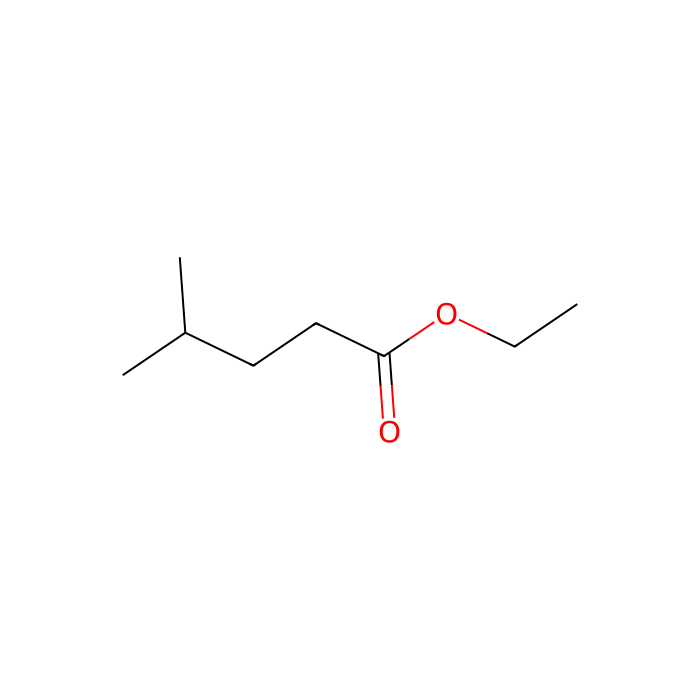
Ethyl 4-methylvalerate is a branched, aliphatic ethyl ester derived from 4-methylpentanoic acid.
Item-specific identifiers (from Product Data):
CAS: 25415-67-2
SKU: E169064
Storage: Room temperature (as provided)
Shipped: Normal (as provided)
InChIKey: Not specified for this item; refer to CoA/Spec Sheet.
SMILES: Not specified for this item; refer to CoA/Spec Sheet.
Computed/literature identity (for reference; not item specification):
Preferred name (IUPAC): Ethyl 4-methylpentanoate (literature)
Carbon skeleton: Saturated C8 chain with one methyl branch at the γ-position relative to the carbonyl (4-position from the carbonyl carbon).
2D depiction in words: An ethoxy group bound to a carbonyl carbon (ester), followed by a three-carbon chain terminating in an isobutyl-like fragment (–CH2–CH(CH3)–CH3); no rings, no heteroatoms beyond the ester oxygens, and no stereogenic centers.
Synthetic Utility
As a branched aliphatic ethyl ester, Ethyl 4-methylvalerate is a convenient substrate and intermediate in several common transformations.
Key reactivity (literature/general):
Ester hydrolysis: Base- or acid-catalyzed to yield 4-methylpentanoic acid; useful for kinetics and for preparing the corresponding acid/amides.
Transesterification/Interchange: Swap the ethyl group for alternative alcohols using acid (p-TsOH, H2SO4) or base (alkoxide) catalysts; water removal or molecular sieves improve conversions.
Reductive routes:
LiAlH4 or NaBH4 (with activators) to the alcohol (4-methyl-1-pentanol).
DIBAL-H at low temperature to aldehyde (4-methylpentanal), enabling further elaboration (e.g., Wittig, aldol).
α-Deprotonation/Claisen chemistry: The methylene α to the carbonyl can be deprotonated with strong bases (LDA/NaH) to engage in Claisen condensations or alkylations when used in mixed-ester strategies.
Aminolysis: Conversion to secondary/tertiary amides or imides under appropriate catalytic or activating conditions.
Retrosynthetic value:
Provides access to branched C6 acid, aldehyde, and alcohol manifolds, enabling synthesis of branched surfactant fragments, pheromone analogs, or odorants (no end-use claims), where the γ-methyl branching impacts physical properties and selectivity.
Target Specificity
This is a small-molecule chemical and not a biological targeting reagent. No antigen/epitope or isotype applies.
Item-specific targeting data: Not applicable.
For biochemical experiments, any observed specificity (e.g., enzyme substrate preference) must be determined empirically for your system.
Frequently Asked Questions
What is the purity of this product, and how is it determined?
This product is supplied at ≥97% purity, determined by gas chromatography (GC). Lot-specific values are stated on the Certificate of Analysis.
How should this product be stored?
Store at room temperature.
How is this product shipped?
This product ships under standard ambient conditions. No temperature-controlled packaging is required.
What are the CAS number, molecular formula and molecular weight?
The CAS Number is 25415-67-2, the molecular formula is C8H16O2, and the molecular weight is 144.21 g/mol. InChIKey OFQRUTMGVBMTFQ-UHFFFAOYSA-N.
What documentation is provided?
Available product documentation, including Certificates of Analysis (COA), Safety Data Sheets (SDS), and specification sheets, is shown in the product document area. Document availability and access follow the current site policy.
We use cookies to ensure the website functions properly and, where permitted, to improve your experience. You can manage your preferences at any time in Settings. Learn more in our Cookie Policy.
Shall we send you a message when we have discounts available?
Remind me later
Thank you! Please check your email inbox to confirm.
Products are supplied to verified businesses, institutions, and qualified professionals for research and development use only. Not for use in humans, animals, diagnosis, or therapy.

 D2116264