Determine the necessary mass, volume, or concentration for preparing a solution.
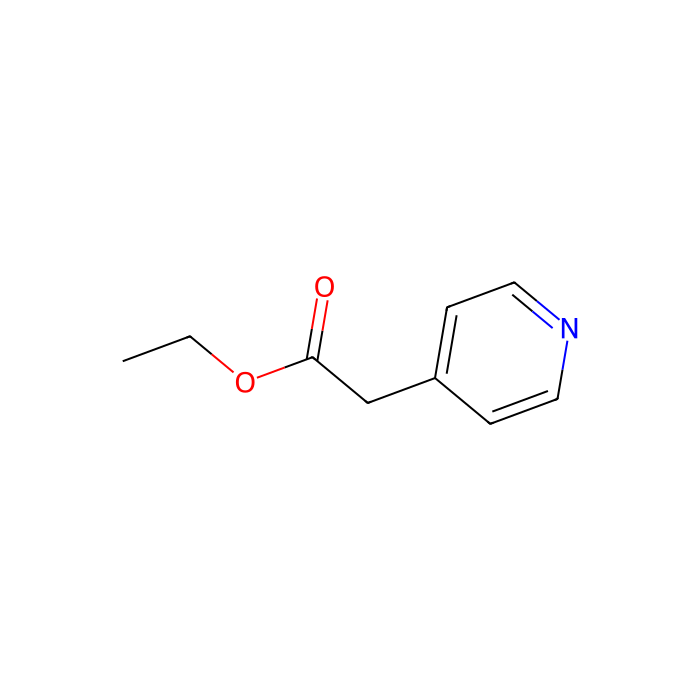
Ethyl 4-pyridylacetate is an ethyl ester of 4-pyridyl acetic acid. Its hydrochloride salt was used to prepare the starting material required for the synthesis of 2,2-dideutero-1-azabicyclo(2,2,2)-octane. It participates as a reagent in the synthesis of triarylethane phosphodiesterase 4 inhibitors
Ethyl 4-pyridylacetate is a pyridine-based compound used for the grafting onto the self-adhesive gold substrates. It may be used for the the following: As a starting material in the synthesis of 4-piperidylethanol. As a reactant in the synthesis of 4-(pyridyl) isosteres of meperidine. As a starting material in the synthesis of ethyl-4-piperidylacetate.
Taxonomy Tree
| Kingdom | Organic compounds |
|---|---|
| Superclass | Organoheterocyclic compounds |
| Class | Pyridines and derivatives |
| Subclass | Not available |
| Intermediate Tree Nodes | Not available |
| Direct Parent | Pyridines and derivatives |
| Alternative Parents | Heteroaromatic compounds Carboxylic acid esters Monocarboxylic acids and derivatives Azacyclic compounds Organopnictogen compounds Organonitrogen compounds Organic oxides Hydrocarbon derivatives Carbonyl compounds |
| Molecular Framework | Aromatic heteromonocyclic compounds |
| Substituents | Pyridine - Heteroaromatic compound - Carboxylic acid ester - Azacycle - Monocarboxylic acid or derivatives - Carboxylic acid derivative - Organic nitrogen compound - Organic oxygen compound - Organopnictogen compound - Organic oxide - Hydrocarbon derivative - Organooxygen compound - Organonitrogen compound - Carbonyl group - Aromatic heteromonocyclic compound |
| Description | This compound belongs to the class of organic compounds known as pyridines and derivatives. These are compounds containing a pyridine ring, which is a six-member aromatic heterocycle which consists of one nitrogen atom and five carbon atoms. |
| External Descriptors | Not available |
Find and download the COA for your product by matching the lot number on the packaging.
| Lot Number | Certificate Type | Date | Item |
|---|---|---|---|
| Certificate of Analysis | Nov 12, 2025 | E100811 | |
| Certificate of Analysis | Jan 06, 2025 | E100811 | |
| Certificate of Analysis | Sep 05, 2024 | E100811 | |
| Certificate of Analysis | Jun 17, 2022 | E100811 | |
| Certificate of Analysis | Jun 17, 2022 | E100811 | |
| Certificate of Analysis | Jun 17, 2022 | E100811 | |
| Certificate of Analysis | Jun 17, 2022 | E100811 | |
| Certificate of Analysis | Jun 17, 2022 | E100811 | |
| Certificate of Analysis | Jun 17, 2022 | E100811 |
| Solubility | Soluble in water and hot ethanol. |
|---|---|
| Sensitivity | air sensitive |
| Freezing Point(°C) | 19 °C |
| Refractive Index | 1.499 |
| Flash Point(°F) | 235.4 °F |
| Flash Point(°C) | 113 °C |
| Boil Point(°C) | 127-128°C |
| Melt Point(°C) | 18-19°C |
| Molecular Weight | 165.190 g/mol |
| XLogP3 | 0.700 |
| Hydrogen Bond Donor Count | 0 |
| Hydrogen Bond Acceptor Count | 3 |
| Rotatable Bond Count | 4 |
| Exact Mass | 165.079 Da |
| Monoisotopic Mass | 165.079 Da |
| Topological Polar Surface Area | 39.200 Ų |
| Heavy Atom Count | 12 |
| Formal Charge | 0 |
| Complexity | 141.000 |
| Isotope Atom Count | 0 |
| Defined Atom Stereocenter Count | 0 |
| Undefined Atom Stereocenter Count | 0 |
| Defined Bond Stereocenter Count | 0 |
| Undefined Bond Stereocenter Count | 0 |
| The total count of all stereochemical bonds | 0 |
| Covalently-Bonded Unit Count | 1 |