
Technical Articles: Reagent Chemistry, Synthesis & Bioscience Guides
Isocyanate-Functional Silane Coupling Agents: Structural Features, Classification, Applications, and Selection
Isocyanate-Functional Silane Coupling Agents: Structural Features, Classification, Applications, and Selection
Introduction
Isocyanate-functional silane coupling agents contain both an isocyanate group and a hydrolyzable silane group. The isocyanate group can react with components containing active hydrogen, thereby introducing the silane structure into resin or polymer systems. The silane group, after hydrolysis, can form silanols and then further condense or bond to hydroxyl sites on inorganic surfaces. For this reason, such materials are commonly used in systems where organic resins coexist with inorganic substrates or inorganic fillers, such as adhesives, sealants, coatings, and composite materials.
When selecting this type of material, three levels of judgment usually need to be considered together. First, determine whether the system contains active hydrogen sites that can react with the isocyanate group, because this determines whether the material can participate in reactions in the organic phase. Second, determine whether the inorganic substrate surface provides conditions favorable for hydrolysis and condensation of the silane group and for the formation of a stable interfacial bond. Finally, determine whether the specific product structure matches the process arrangement. Methoxy-type and ethoxy-type structures mainly affect hydrolysis rate, stability after addition, and formulation usable time, while masked-isocyanate-related structures mainly determine whether the isocyanate functionality reacts directly after mixing or is released to become reactive only under conditions such as heating.
1. Definition and Structural Features of Isocyanate-Functional Silane Coupling Agents
1.1 What are isocyanate-functional silane coupling agents
Isocyanate-functional silane coupling agents are a class of functional silane coupling agents that contain both an isocyanate group and a hydrolyzable silane group in the same molecule. The isocyanate group serves as the organic reactive end of the molecule and can react with groups containing active hydrogen, such as hydroxyl, amino, and thiol groups. The silane end usually bears hydrolyzable groups such as methoxy or ethoxy groups, which form silanols after hydrolysis and can then further condense or bond to hydroxyl sites on inorganic surfaces. Because both of these structural elements are present in the same molecule, isocyanate-functional silane coupling agents can participate in reactions within organic systems and also in interfacial bonding between organic and inorganic phases.
1.2 Basic structural components of isocyanate-functional silane coupling agents
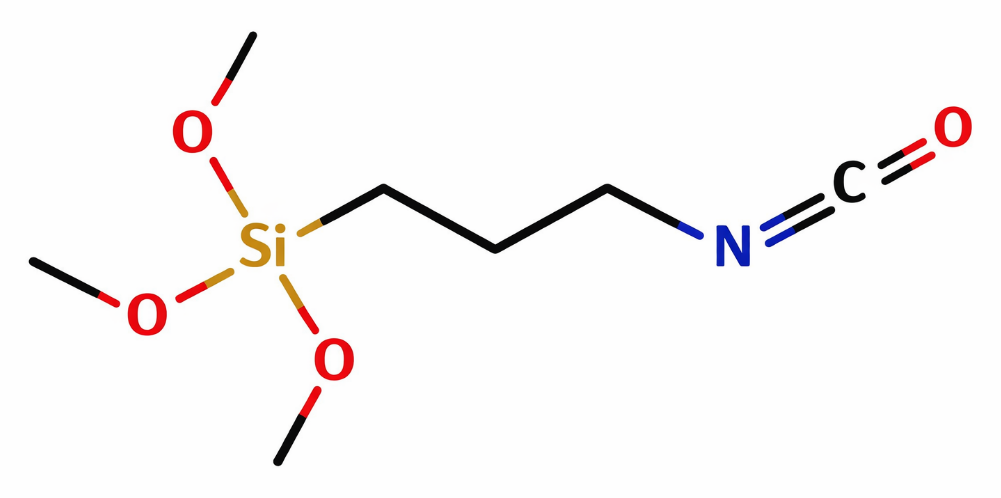
Isocyanate-functional silane coupling agents can usually be viewed as consisting of three parts: the isocyanate reactive end, the organic linking chain, and the hydrolyzable silane end. The first determines reactivity toward active-hydrogen-containing components in the organic system, the middle chain connects the two functional parts within the same molecule, and the last determines hydrolysis, condensation, and bonding behavior toward inorganic surfaces.
Structural part | Typical structural feature | Main role |
Isocyanate reactive end | –NCO | Serves as the organic reactive end and can react with groups containing active hydrogen, such as hydroxyl, amino, and thiol groups |
Organic linking chain | Commonly an organic chain such as propyl | Connects the isocyanate end and the silane end, bringing both structural parts into the same molecule |
Hydrolyzable silane end | Commonly Si(OR)₃ or Si(OR)₂, where OR is usually methoxy or ethoxy | Forms silanols after hydrolysis and then further condenses or bonds to hydroxyl sites on inorganic surfaces |
Taking 3-isocyanatopropyltrimethoxysilane (CAS No. 15396-00-6) as an example, the basic structure of an isocyanate-functional silane coupling agent can be seen clearly: one end is an isocyanate group, the other end is a hydrolyzable silane group, and the middle is a linking chain.
1.3 Structural features of isocyanate-functional silane coupling agents
Structural feature | Specific manifestation | Structural significance |
Two types of functional ends in one molecule | The molecule contains both an isocyanate group and a hydrolyzable silane end | Enables the same molecule to have both organic reactivity and interfacial bonding capability |
The isocyanate group is the organic reactive end | It can react with groups containing active hydrogen, such as hydroxyl, amino, and thiol groups | Determines its ability to participate in reactions within resin or polymer systems |
The silane end bears hydrolyzable alkoxy groups | Commonly trimethoxy or triethoxy, and dialkoxy structures are also seen | Determines its ability to participate in bonding to inorganic surfaces after hydrolysis and condensation |
Different alkoxy groups | Commonly methoxy-type and ethoxy-type | The two differ in hydrolysis rate and stability after addition |
A linking chain is usually present in the molecule | Commonly an organic chain such as propyl, connecting the isocyanate end and the silane end | Brings the two functional parts together in the same molecule |
Further structural subtypes are possible | Common types include trialkoxy, dialkoxy, and masked-isocyanate-related types | Reflect differences in silane-end structure and in the state of the isocyanate end |
2. Classification of Isocyanate-Functional Silane Coupling Agents and Characteristics of Each Category
Classification dimension | Common type | Category characteristics |
By the state of the isocyanate end | Free isocyanate type | The molecule retains a free isocyanate group and can directly react with active-hydrogen-containing groups such as hydroxyl and amino groups, while also retaining the interfacial function of the silane end |
By the state of the isocyanate end | Blocked isocyanate type | The isocyanate group is first present in a blocked form and releases reactivity only under conditions such as heating, allowing it to be pre-blended with resins or components that can react with isocyanates |
By silane-end structure | Trialkoxy type | Usually has relatively high reactivity, higher crosslink density after condensation, and stronger bonding ability to inorganic materials |
By silane-end structure | Dialkoxy type | Usually shows relatively good stability after hydrolysis, and the condensation products tend to have a more linear structure |
By alkoxy group type | Methoxy type | Hydrolysis is usually faster |
By alkoxy group type | Ethoxy type | Hydrolysis is slower, and compositional stability after addition is usually better |
3. Typical Applications of Isocyanate-Functional Silane Coupling Agents, Corresponding Product Categories, and Mechanisms of Action
Typical application | Corresponding product category | Mechanism of action |
Moisture-curing polyurethane adhesives, sealants, and coatings | Free isocyanate trimethoxy type, free isocyanate triethoxy type | The isocyanate end reacts with active-hydrogen-containing components in the system, such as hydroxyl, amino, and thiol groups, thereby introducing the silane structure into the resin or polymer. Under moisture, the silane end then undergoes hydrolysis and condensation and forms interfacial bonding with inorganic surfaces such as glass and metal oxide layers, thereby improving adhesion |
Adhesion promotion in coating systems | Free isocyanate trimethoxy type, free isocyanate triethoxy type | The isocyanate end participates in resin reactions, while the silane end forms siloxane bonds or an interfacial layer on the surface of the inorganic substrate, creating a chemical connection between the organic coating and the inorganic surface and thereby improving adhesion |
Silane-modified polyurethane, polyaspartate, and other modified resin systems | Free isocyanate trimethoxy type, free isocyanate triethoxy type | The isocyanate end reacts with active-hydrogen sites on the polymer chain to achieve grafting or end-capping. The introduced alkoxysilane end can subsequently continue to hydrolyze and condense, forming a silane-modified resin structure |
Silane-modified polymer hot-melt adhesives | Free isocyanate trimethoxy type, free isocyanate triethoxy type | The isocyanate-functional silane is first grafted onto a hydroxyl-containing polymer to form a silane-modified polymer that can subsequently undergo further moisture curing. Later condensation through the silane end increases gel content and heat-resistant shear-holding capability |
Polyurethane filled systems and composite systems | Free isocyanate type | One portion can treat the surface of inorganic fillers through the silane end, while another portion reacts with the polyurethane system through the isocyanate end, thereby linking the filler to the resin interface and improving interfacial bonding |
Systems that are pre-blended first and then reacted upon heating | Blocked isocyanate type | The isocyanate group is first present in a blocked form and can be blended at room temperature with resins or formulation components that react with isocyanates. After heating, deblocking occurs, releasing isocyanate reactivity and allowing it to participate in system reactions |
4. Precautions for the Use of Isocyanate-Functional Silane Coupling Agents
4.1 Keep the material protected from moisture throughout use, and use it up as soon as possible after opening.
Isocyanate-functional silanes undergo hydrolysis and gradually deteriorate upon contact with water or moisture, so exposure time should be minimized during use. Unused material should be sealed immediately, and if necessary, the air in the container can be replaced with dry nitrogen. Systems into which the material has already been added, or systems in which grafting has already occurred, should also be stored under low-humidity and light-protected conditions.
4.2 Do not directly add water for pre-hydrolysis in the way commonly used for ordinary silanes.
Isocyanate-functional silanes are not suitable for treatment methods that first induce hydrolysis by adding water. The isocyanate group reacts with water to first form an unstable intermediate, then releases carbon dioxide, and further forms amines and urea by-products, which can readily lead to viscosity increase, loss of activity, or performance decline.
4.3 Maintain ventilation during handling and use appropriate personal protective equipment.
During use, adequate ventilation should be ensured to avoid inhalation of vapors and their hydrolysis products, and direct contact with skin and eyes should be avoided. Protective equipment such as gloves and safety goggles should be worn during operation.
5. Classification, Features, and Applications of Representative Isocyanate-Functional Silane Coupling Agents and Related Structural Chemicals
Classification | CAS No. | Aladdin Cat. No. | Name | Specification or Purity | Product Features and Applications |
Free isocyanate trimethoxysilane | 15396-00-6 | 3-Isocyanatopropyltrimethoxysilane | ≥97% | A representative free isocyanate trimethoxysilane. It can be used in studies of interfacial coupling between hydroxyl- or amino-containing systems and inorganic surfaces such as glass, metal oxide layers, and silica. It can also be used to compare the performance of trimethoxy structures in hydrolysis rate, interfacial layer formation, and adhesion promotion | |
Free isocyanate triethoxysilane | 24801-88-5 | Isocyanatopropyltriethoxysilane | ≥95% | A representative free isocyanate triethoxysilane. It can be used in studies of coupling and adhesion promotion between hydroxyl- or amino-containing resin systems and inorganic substrates. It can also be used to compare the performance of triethoxy structures in hydrolysis rate, formulation stability, and interfacial formation processes | |
Carbamate-type related silane (trimethoxy type) | 23432-62-4 | Methyl [3-(trimethoxysilyl)propyl]carbamate | — | A carbamate-type trimethoxy-related structure without a free –NCO group. It can serve as a blocked-isocyanate-related reference material for comparing free isocyanate structures and carbamate-type structures in reactivity, storage stability, and interfacial layer formation | |
Carbamate-type related silane (triethoxy type) | 17945-05-0 | Ethyl [3-(triethoxysilyl)propyl]carbamate | ≥97% | A carbamate-type triethoxy-related structure without a free –NCO group. It can serve as a blocked-isocyanate-related reference material for comparing triethoxy- and trimethoxy-related structures in hydrolysis rate, storage stability, and interfacial layer formation processes | |
Poly-silane-site related structure with an isocyanurate backbone | 26115-70-8 | Tris[3-(trimethoxysilyl)propyl] Isocyanurate | ≥95% | A multi-silane-site related structure with an isocyanurate backbone. It can be used to investigate the influence of multi-silane-site structures on interfacial layer construction and adhesion promotion, and can also be used in studies related to interfacial coupling between polyimides and silicon materials or to adhesion promotion in hot-melt adhesives |
References
[1] Plueddemann EP. Silane Coupling Agents. 2nd ed. New York: Springer; 1991. doi:10.1007/978-1-4899-2070-6.
[2] Arkles B, Maddox A, Singh M, Zazyczny J, Matisons J. Silane Coupling Agents: Connecting Across Boundaries. 3rd ed. Morrisville, PA: Gelest, Inc.; 2014.
[3] Shin-Etsu Chemical Co., Ltd. Silane Coupling Agents. 2023.
[4] Momentive Performance Materials Inc. Silquest A-Link 25 and Silquest A-Link 35. 2021-10-13.
[5] Sivakumar P, Du SM, Selter M, Daye J, Cho J. Improved adhesion of polyurethane-based nanocomposite coatings to tin surface through silane coupling agents. International Journal of Adhesion and Adhesives. 2021;110:102948. doi:10.1016/j.ijadhadh.2021.102948.
[6] Wen J, Wilkes GL. Organic/Inorganic Hybrid Network Materials by the Sol-Gel Approach. Chemistry of Materials. 1996;8(8):1667-1681. doi:10.1021/cm9601143.
More related articles are provided below: