
Thietanes: Promising Small-Ring Building Blocks with Tunable Physicochemical Properties through Sulfur Oxidation-State Control
Thietanes: Promising Small-Ring Building Blocks with Tunable Physicochemical Properties through Sulfur Oxidation-State Control
1 Research Background: Why Thietanes Deserve Attention
1.1 Core Research Discussed in This Article
This article focuses on the ChemRxiv preprint “Functionalized Thietanes: an Overlooked Class of Building Blocks for Drug Discovery” by Stepaniuk, Gavrylenko, Vashchenko, Doroshenko, Sirosh, Grygorenko, and co-workers. The study reports the synthesis of a series of functionalized thietane building blocks and compares the effects of different sulfur oxidation states on pKa (acid dissociation constant) and LogD (distribution coefficient).
The significance of this work lies not in the synthesis of a single molecule, but in the presentation of a clear medicinal chemistry design concept:
By interconverting among the S(II), S(IV), and S(VI) oxidation levels, thietanes can modulate the lipophilicity, polarity, and acid–base properties of model compounds while retaining the connectivity of the four-membered ring scaffold.
1.2 Needs in Medicinal Chemistry
During lead optimization, researchers frequently encounter the following challenges:
Optimization challenge | Potential consequence | Required structural adjustment |
Excessively high LogD | Poor aqueous solubility, increased nonspecific binding, and greater clearance liability | Reduce lipophilicity and increase local polarity |
Excessively basic amine | High degree of protonation, potentially affecting distribution, permeability, and safety | Lower the pKa of the amine |
Excessively planar molecule | Insufficient three-dimensionality, potentially limiting selectivity and developability | Introduce a rigid sp³-rich small ring |
Major scaffold replacement leads to loss of activity | Disruption of the original binding conformation | Preserve the overall spatial framework as much as possible while adjusting only local properties |
This is where four-membered-ring building blocks are particularly valuable. They are compact and rigid and can alter molecular properties through relatively small structural changes. Cyclobutanes, oxetanes, and azetidines are already widely used in drug discovery. Thietanes have historically received less attention, but their oxidizable sulfur atom provides a broader range of opportunities for property modulation.
2 Structural Basis: Thietanes Are Not Ordinary Sulfur-Containing Small Rings
2.1 Comparison of Common Four-Membered Rings
Thietane is a saturated four-membered sulfur heterocycle and can be viewed structurally as a cyclobutane in which one carbon atom has been replaced by sulfur. Its key distinction from oxetanes and azetidines is that the ring sulfur atom can undergo further oxidation to form a sulfoxide or sulfone.
Four-membered-ring type | Molecular formula | Simplified structure / SMILES | Main structural features | Significance in drug design |
Cyclobutane | C₄H₈ | C1CCC1 | Hydrophobic, rigid small ring | Increases sp³ character and hydrophobic contacts |
Oxetane | C₃H₆O | C1CCO1 | Oxygen-containing and relatively polar | Can reduce lipophilicity and improve certain physicochemical properties |
Azetidine | C₃H₇N | C1CCN1 | Nitrogen-containing and capable of serving as a basic center | Can be incorporated into amine-containing pharmacophores |
Thietane | C₃H₆S | S1CCC1 | Sulfur-containing and oxidizable | Enables modulation of lipophilicity and acid–base properties through changes in sulfur oxidation state |
2.2 Sulfur Oxidation Levels and Core Structural Changes
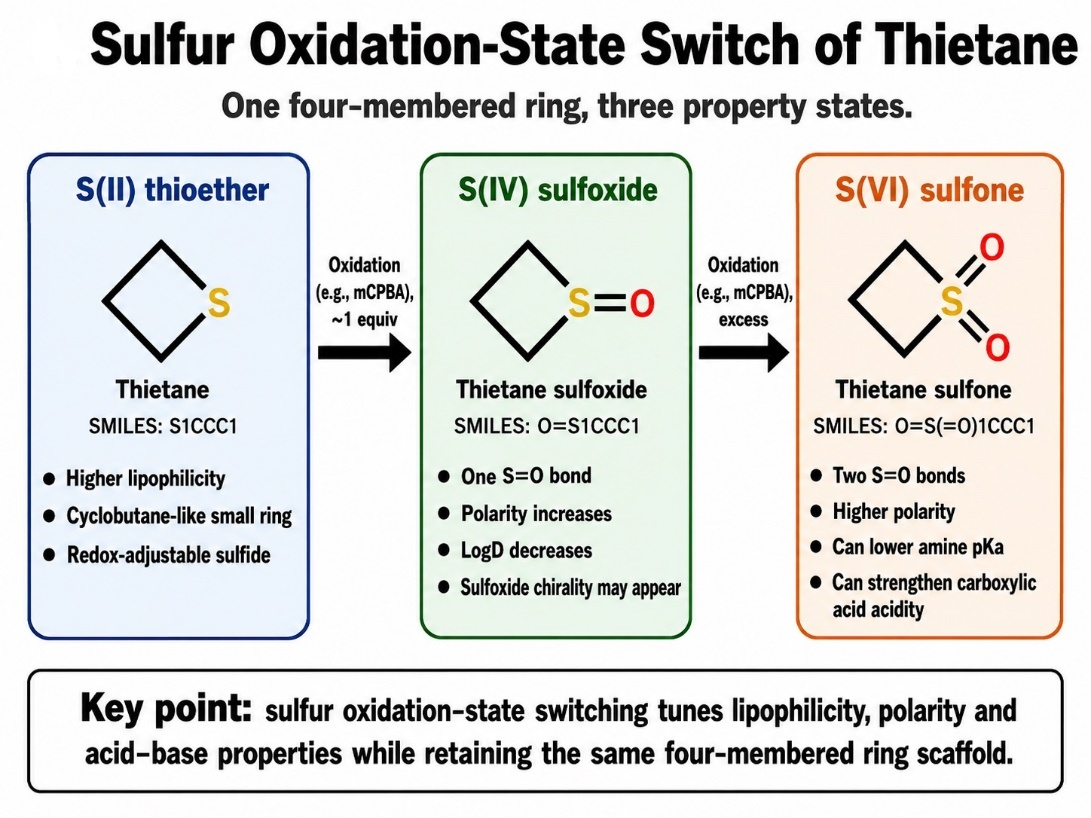
The defining feature of thietanes is that the ring sulfur atom can be oxidized stepwise while the four-membered carbon framework remains intact. The literature commonly uses S(II), S(IV), and S(VI) to describe the sulfide, sulfoxide, and sulfone oxidation levels, respectively.
Stepwise oxidation pathway
Thietane [S(II), sulfide]
↓ Controlled selective oxidation
Thietane sulfoxide [S(IV), sulfoxide]
↓ Further oxidation
Thietane sulfone [S(VI), sulfone]
Sulfur oxidation level | Compound type | Molecular formula | SMILES | Core structural change | Main properties and design significance |
S(II) | Thietane, sulfide form | C₃H₆S | S1CCC1 | No S=O bond is present | In the model series evaluated in the study, lipophilicity was similar to that of the corresponding cyclobutane controls; it may be used as a rigid hydrophobic small ring and also serves as the starting state for further oxidation |
S(IV) | Thietane sulfoxide | C₃H₆OS | O=S1CCC1 | One S=O bond is introduced | Local dipole and polarity increase; in the model series evaluated in the study, lipophilicity was lower than that of the S(II) form; the sulfur atom may become a stereogenic center |
S(VI) | Thietane sulfone | C₃H₆O₂S | O=S1(=O)CCC1 | Two S=O bonds are introduced | Polarity is higher than in the S(II) form, and lipophilicity was reduced in the model series evaluated in the study; the acid–base properties of corresponding amine- or carboxylic-acid-containing model compounds can be substantially altered |
Key concept
The fundamental nature of this transformation is the stepwise transfer of oxygen atoms to the ring sulfur atom rather than ring opening or scaffold rearrangement. As the sulfide is converted into the sulfoxide and then the sulfone, the newly introduced S=O bonds alter the local dipole, charge distribution, and inductive electronic effects. This enables the same thietane scaffold to cover a range of lipophilicity, polarity, and acid–base properties.
3 Synthetic Significance: Addressing the Limited Availability of Thietane Building Blocks
3.1 Key Factors That Previously Limited the Use of Thietanes
Thietanes have not been incorporated into drug design as widely as oxetanes and azetidines. One important reason is the limited availability of functionalized building blocks and the lack of scalable, well-characterized synthetic methods.
Structure–activity relationship studies, or SAR studies, in medicinal chemistry typically require a series of comparable molecules:
① Comparison of functional groups such as carboxylic acids, amines, alcohols, and halides at the same position;
② Comparison of analogues with different lipophilicity and polarity on the same scaffold;
③ Comparison of 3-substituted and 3,3-disubstituted structures within the same small-ring system;
④ Comparison of the S(II), S(IV), and S(VI) oxidation states within the same sulfur-containing fragment.
If a class of building blocks can only be prepared on a small scale or lacks functional groups suitable for incorporation into drug-like molecules, it is difficult to use in practical medicinal chemistry programs.
3.2 Synthetic Problems Addressed by the Study
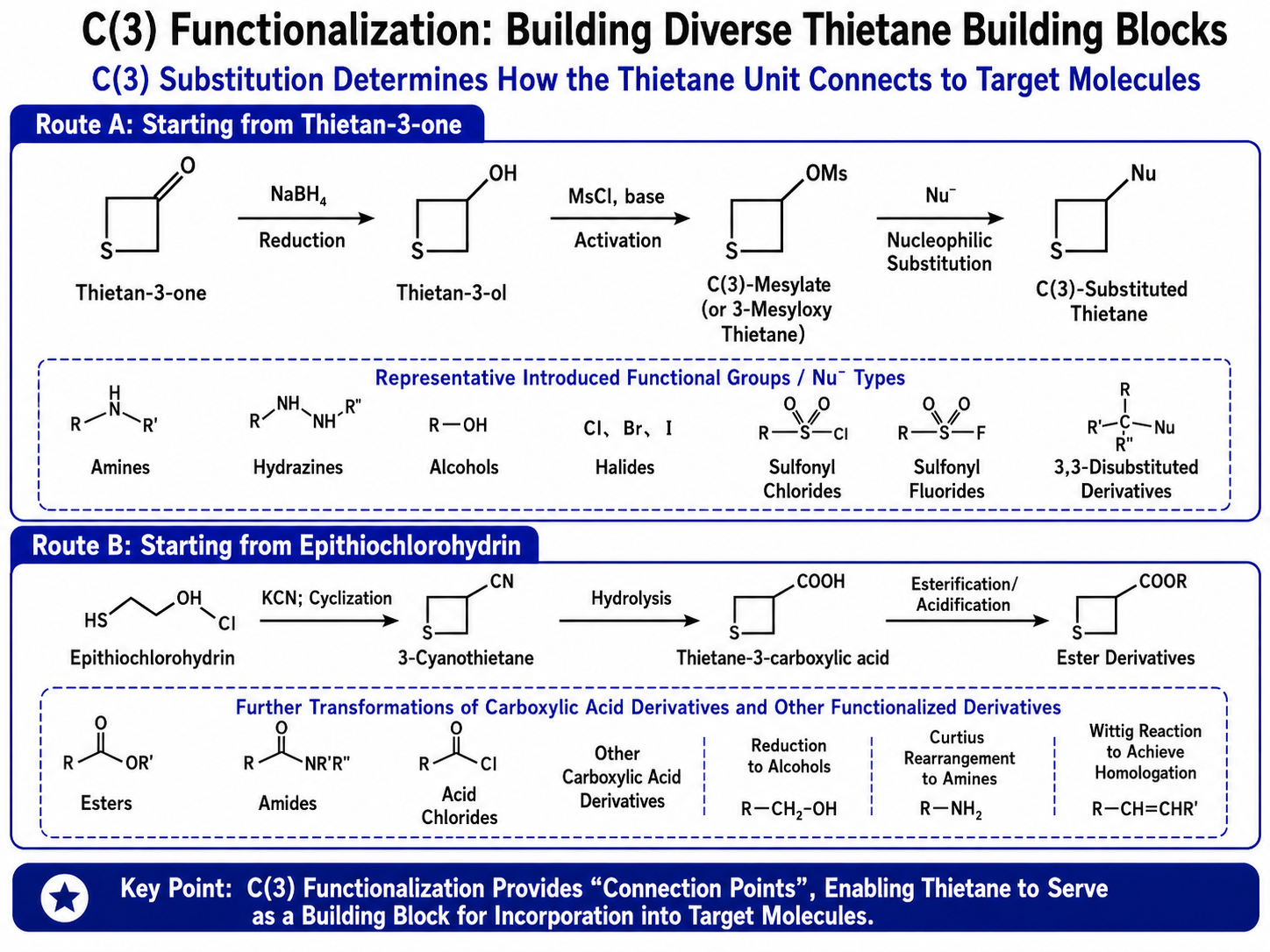
Stepaniuk and co-workers used readily available starting materials, including thietan-3-one and epithiochlorohydrin, to prepare multiple classes of functionalized thietane derivatives. The study primarily covered the following structural types:
Building-block type | Representative functional group | Medicinal chemistry application |
Carboxylic acids | —CO₂H | Amide coupling, design of acidic fragments, and polarity modulation |
Amines | —NH₂, —NHR | Amide formation, sulfonamide formation, and modulation of basic centers |
Alcohols | —OH | Esterification, etherification, and further conversion into leaving groups |
Halides | —Br, —I | Alkylation reactions and attachment of other pharmacophores |
Sulfonyl halides | —SO₂Cl, —SO₂F | Construction of sulfonamides, sulfonyl fluorides, and related structures |
3,3-Disubstituted derivatives | Double substitution at C(3) | Increased steric occupancy and conformational restriction |
4 Property Trends: Sulfur Oxidation State Significantly Influences the Physicochemical Properties and Design Applications of Thietanes
4.1 Changes in Lipophilicity: S(II) Resembles Cyclobutane, Whereas S(IV) and S(VI) Are Markedly More Polar
LogD is an important parameter used in drug design to assess distribution between aqueous and lipid phases. An excessively high LogD generally indicates strong lipophilicity and may be associated with poor aqueous solubility and increased nonspecific binding. Conversely, an excessively low LogD may impair membrane permeability. Drug optimization therefore requires a controllable LogD rather than simply maximizing or minimizing it.
Comparisons among model compounds in this study showed that the lipophilicity of thietane derivatives is closely related to sulfur oxidation state.
Sulfur oxidation state | Structural type | LogD trend | Design implication |
S(II) | Sulfide | In the tested models, lipophilicity was similar to that of the corresponding cyclobutane controls | May serve as an analogue of a hydrophobic small ring |
S(IV) | Sulfoxide | Lipophilicity was markedly reduced relative to S(II) | Suitable for moderate polarity adjustment |
S(VI) | Sulfone | Lipophilicity was markedly reduced relative to S(II) | Suitable for lowering LogD and increasing local polarity |
These results indicate that thietanes can serve two distinct roles:
① The S(II) form can be used to retain the characteristics of a hydrophobic small ring;
② The S(IV) and S(VI) forms can be used to reduce lipophilicity and increase molecular polarity.
It should be noted that the specific LogD values of S(IV) and S(VI) compounds are also influenced by substituents, functional groups, and assay conditions. Their lipophilicity therefore does not necessarily follow a strictly monotonic trend in every case. What can be stated more generally is that, relative to the S(II) sulfide form, the S(IV) sulfoxide and S(VI) sulfone forms typically exhibit higher polarity and lower lipophilicity.
4.2 Changes in Acid–Base Properties: Higher Oxidation States Alter pKa
The pKa of a molecule determines its degree of ionization under physiological pH conditions. For amines, medicinal chemists generally use the pKa of the conjugate acid, also denoted pKaH, to describe amine basicity.
For amine-containing compounds, an excessively high pKa may result in a high degree of protonation, potentially affecting membrane permeability, tissue distribution, and safety. For carboxylic acids, changes in pKa can influence solubility, ionization state, and protein-binding interactions. The study showed that increasing the sulfur oxidation state produced clear changes in acid–base properties:
Functional-group type | Change in oxidation state | Direction of pKa change | Significance in drug design |
Carboxylic acid | S(II) → S(IV) → S(VI) | Acidity increases and pKa decreases | Can increase the degree of ionization at a given pH; the effect on actual solubility must still be evaluated experimentally |
Amine | S(II) → S(IV) → S(VI) | Basicity decreases and conjugate-acid pKa, or pKaH, decreases | Can be used to adjust the protonation state of an amine; the actual effects on distribution, permeability, and safety must still be evaluated experimentally |
Among the model compounds tested, the pKa of an S(VI) sulfone carboxylic acid was approximately 3.22, while that of an S(IV) sulfoxide carboxylic acid was approximately 3.72. The conjugate-acid pKa of an S(VI) sulfone amine was approximately 5.41, substantially lower than that of the corresponding cyclobutylamine.
These results indicate that sulfur oxidation state is not merely a structural modification but can directly contribute to the control of molecular ionization state.
5 Value in Drug Design: Modulating Physicochemical Properties within the Same Scaffold
5.1 Core Advantages of Thietanes
From a drug-design perspective, a major advantage of thietanes can be summarized as follows:
by changing the sulfur oxidation state, medicinal chemists can systematically adjust lipophilicity, polarity, and pKa while retaining the connectivity of the four-membered ring scaffold.
This differs from simply replacing the scaffold. A major scaffold change may disrupt the original binding conformation and lead to loss of activity, whereas modulation of the sulfur oxidation state offers a way to optimize molecular properties without changing the connectivity of the four-membered ring.
Design requirement | Thietane form to consider | Design objective |
Retain the function of a hydrophobic small ring | S(II) sulfide form | Mimic cyclobutane or another hydrophobic small ring |
Lower LogD | S(IV) sulfoxide or S(VI) sulfone | Increase polarity and improve lipid–water distribution |
Lower amine pKa | S(VI) sulfone-containing amine | Reduce amine basicity |
Increase carboxylic-acid acidity | S(IV) or S(VI) carboxylic acid | Increase the degree of ionization |
Increase molecular three-dimensionality | 3-Substituted or 3,3-disubstituted thietane | Increase rigidity and spatial occupancy |
Compare analogues systematically | Matched S(II), S(IV), and S(VI) series | Establish structure–property relationships |
5.2 Differences from Oxetanes
Oxetanes are frequently used to reduce lipophilicity, increase three-dimensionality, and modulate physicochemical properties. Thietanes resemble oxetanes in that both are saturated four-membered heterocycles. The key difference is that thietanes can undergo further oxidation.
Comparison item | Oxetane | Thietane |
Ring heteroatom | O | S |
Variation in oxidation state | Essentially fixed | Can exist at the S(II), S(IV), and S(VI) oxidation levels |
Mode of property modulation | Primarily determined by the oxygen-containing ring itself | Can be modulated by changing the sulfur oxidation state |
Design characteristics | Small, polar, and three-dimensional | Small, oxidizable, and tunable in lipophilicity and pKa |
6 Examples of Incorporation into Drug-Like Structures
6.1 Significance of Sulfacetamide Analogues
The study incorporated 3,3-disubstituted aminothietanes into structures related to the classical antibacterial drug sulfacetamide, generating thietane-containing analogues. These experiments primarily demonstrated that:
① Functionalized thietanes can be incorporated into drug-like molecules;
② Aminothietanes can participate in the construction of sulfonamide structures;
③ Thietanes in different sulfur oxidation states can be used in analogue design;
④ This class of building blocks is operationally feasible for use in medicinal chemistry research.
This example primarily demonstrates the feasibility of incorporating thietane building blocks and constructing corresponding analogues. It does not, by itself, establish that the resulting analogues have superior biological activity or developability compared with sulfacetamide.
7 Practical Guidance: When Should Thietanes Be Prioritized?
7.1 Suitable Use Cases
Thietanes may be considered for the following drug-design challenges:
Project challenge | Recommended thietane type | Rationale |
Molecular LogD is too high | S(IV) or S(VI) oxidation state | Increases polarity and reduces lipophilicity |
Amine pKa is too high | S(VI) sulfone-containing amine | Reduces amine basicity |
A hydrophobic small ring is required, but additional tuning capacity is desirable | S(II) sulfide form | Resembles cyclobutane while retaining the option for further oxidation |
Greater three-dimensionality is required | 3-Substituted or 3,3-disubstituted thietane | Provides a rigid sp³-rich structure |
An oxetane does not provide the desired effect | S(IV) or S(VI) thietane | Provides different polarity and electronic effects |
A systematic SAR study is required | Matched S(II), S(IV), and S(VI) series | Facilitates the establishment of structure–property relationships |
7.2 Important Considerations in Use
Although thietanes offer useful opportunities for property modulation, they are not universal replacement fragments. Several points should be considered in practical molecular design.
① S(IV) Sulfoxides May Introduce Stereochemical Complexity
When the two ring-carbon pathways attached to the sulfoxide sulfur atom are nonequivalent, sulfur may become a stereogenic center, giving rise to enantiomers or diastereomers.
If an S(IV) form is incorporated into a candidate structure, the feasibility of isomer separation, configurational stability, and potential pharmacological differences between stereoisomers should be evaluated.
② The High Polarity of the S(VI) Sulfone Form May Not Suit Every Molecule
Sulfones generally increase local polarity. In corresponding amine-containing models, they may also reduce amine basicity. However, the increase in polarity may adversely affect membrane permeability.
The decision to use the S(VI) form should therefore be based on absorption, distribution, metabolism, and excretion data, collectively referred to as ADME data.
③ The S(II) Form May Be Susceptible to Metabolic Oxidation
Sulfides may undergo metabolic S-oxidation in vivo to form sulfoxides or sulfones. When an S(II) thietane is used in a candidate compound, metabolic stability and the properties of its oxidative metabolites should therefore be evaluated.
④ Thietanes Should Not Be Used Solely for Structural Novelty
Thietanes are more appropriately used to address clearly defined physicochemical-property challenges, such as lowering LogD, adjusting pKa, increasing sp³ character, or establishing matched comparisons among different sulfur oxidation states within the same scaffold.
8 Classification and Research Applications of Chemicals Related to Thietane Building Blocks
Table 1. Core Thietane Starting Materials and Functionalized Building Blocks
Category | CAS No. | Aladdin Catalog No. | Name | Specification or Purity | Product Features and Applications |
Thietane parent scaffold | 287-27-4 | Trimethylene sulfide | ≥98% (GC) | Parent thietane scaffold; used for the preparation of sulfide-, sulfoxide-, and sulfone-state derivatives and for fundamental research on sulfur-containing four-membered rings. | |
S(VI) amine salt | 1422344-24-8 | 3-Aminothietane 1,1-dioxide hydrochloride | ≥98% | Sulfone-state aminothietane salt; used in amidation, sulfonamide formation, amine-linked conjugation, and studies of basicity modulation. | |
S(VI) amine | 88511-13-1 | 3-Amino-1-thietane-1,1-dione | ≥97% | Sulfone-state aminothietane building block; used to construct amide, urea, carbamate, and sulfonamide derivatives. | |
Bifunctional building block | 138650-26-7 | 3-Aminothietane-3-carboxylic acid | ≥97% | A rigid four-membered-ring building block bearing both amino and carboxyl groups; used in amino acid analogues, peptidomimetics, and bidirectional coupling studies. | |
3,3-Disubstituted alcohol building block | 27832-57-1 | 3-Methylthietan-3-ol | ≥97% | A 3,3-disubstituted sulfur-containing four-membered-ring intermediate; used for hydroxyl activation, nucleophilic substitution, and the preparation of derivatives at different sulfur oxidation states. | |
S(VI) alcohol | 22524-35-2 | 3-Hydroxythietane 1,1-dioxide | ≥97% | Sulfone-state thietane alcohol building block; used for mesylation, halogenation, amination, and the construction of highly polar linking groups. | |
Protected amine building block | 943437-98-7 | tert-Butyl N-(thietan-3-yl)carbamate | ≥97% | Protected aminothietane building block; used in coupling reactions, deprotection, and structure–activity relationship studies of sulfur-containing four-membered rings. | |
S(II) carboxylic acid | 765-55-9 | Thietane-3-carboxylic acid | ≥97% | Sulfide-state carboxylic acid building block; used in amide coupling, esterification, and comparative studies of the acidity and lipophilicity of carboxylic acids at different sulfur oxidation states. | |
S(II) alcohol | 10304-16-2 | Thietan-3-ol | ≥97% | Sulfide-state thietane alcohol building block; suitable for nucleophilic substitution after hydroxyl activation and can also be oxidized to the corresponding sulfoxide and sulfone derivatives. | |
Sulfur-containing small-ring starting material | 3221-15-6 | 2-(Chloromethyl)thiirane | ≥95% | Epithiochlorohydrin-type starting material; used in cyclization to prepare 3-cyanothietane and subsequent carboxylic acid building blocks. | |
S(VI) carboxylic acid | 13129-21-0 | Thietane-3-carboxylic acid 1,1-dioxide | ≥95% | Sulfone-state carboxylic acid building block; used in amide coupling, acid dissociation constant measurements, and studies of relationships between sulfur oxidation state and physicochemical properties. | |
S(VI) parent scaffold | 5687-92-3 | Thietane 1,1-dioxide | ≥95% | Sulfone-state thietane parent scaffold; used in the synthesis of highly polar sulfur-containing four-membered-ring derivatives and in oxidation-state comparison studies. | |
Core carbonyl starting material | 22131-92-6 | Thietan-3-one | — | Core starting material for functionalization at C(3); used in reduction, reductive amination, hydrazone formation, olefination, and the synthesis of 3,3-disubstituted building blocks. |
Table 2. Cyclobutane, Oxetane, and Azetidine Reference Building Blocks
Category | CAS No. | Aladdin Catalog No. | Name | Specification or Purity | Product Features and Applications |
Cyclobutane carbonyl reference | 1191-95-3 | Cyclobutanone | ≥99% | Carbocyclic four-membered-ring carbonyl starting material; used to compare reactivity and scaffold effects with thietan-3-one and oxetan-3-one. | |
Protected azetidine carboxylic acid | 142253-55-2 | 1-Boc-azetidine-3-carboxylic acid | ≥98% | Protected nitrogen-containing four-membered-ring carboxylic acid; used in amide coupling and in comparisons among nitrogen-, oxygen-, and sulfur-containing four-membered-ring scaffolds. | |
Azetidine carboxylic acid | 36476-78-5 | Azetidine-3-carboxylic acid | ≥98% | Nitrogen-containing four-membered-ring carboxylic acid reference building block; used to compare carboxylic acid acidity, molecular polarity, and structure–activity relationships. | |
Cyclobutane keto acid building block | 23761-23-1 | 3-Oxocyclobutane-1-carboxylic acid | ≥97% | Carbocyclic building block containing both ketone and carboxylic acid functionalities; used in reductive amination, carbonyl transformations, and the synthesis of small-ring carboxylic acid derivatives. | |
Oxetane amine | 21635-88-1 | Oxetan-3-amine | ≥97% | Oxygen-containing four-membered-ring amine building block; used in amide and sulfonamide construction and for comparison of basicity with sulfone-state aminothietanes. | |
Azetidine alcohol salt | 18621-18-6 | Azetidin-3-ol hydrochloride | ≥97% | Nitrogen-containing four-membered-ring alcohol salt; used for hydroxyl derivatization, construction of nitrogen-containing small-ring linkers, and scaffold comparison studies. | |
Azetidine carbonyl starting material | 17557-84-5 | Azetidin-3-one hydrochloride | ≥97% | Nitrogen-containing four-membered-ring carbonyl starting material; used in reductive amination, carbonyl addition, and comparative reactivity studies of four-membered rings containing different heteroatoms. | |
Cyclobutane amine salt | 6291-01-6 | Cyclobutylamine hydrochloride | ≥96% | Carbocyclic amine reference compound; used to compare the basicity and lipophilicity of cyclobutylamine, oxetan-3-amine, and aminothietanes. | |
Oxetane alcohol | 7748-36-9 | Oxetan-3-ol | ≥95% | Oxygen-containing four-membered-ring alcohol building block; used in hydroxyl activation, etherification, esterification, and the construction of polar small-ring fragments. | |
Oxetane carbonyl starting material | 6704-31-0 | Oxetan-3-one | ≥95% | Core oxygen-containing four-membered-ring carbonyl starting material; used in reduction, reductive amination, olefination, and the synthesis of oxetane derivatives. | |
Oxetane carboxylic acid | 114012-41-8 | Oxetane-3-carboxylic acid | ≥95% | Oxygen-containing four-membered-ring carboxylic acid building block; used in amide coupling and for comparison of acidity and lipophilicity with thietane carboxylic acids. | |
Oxetane amine salt | 491588-41-1 | Oxetan-3-amine hydrochloride | ≥95% | Oxygen-containing four-membered-ring amine salt; used in amidation, sulfonamide formation, and comparative acid–base studies of different four-membered-ring amines. |
Table 3. Reagents for Sulfur Oxidation-State Control, Reduction, and Catalysis
Category | CAS No. | Aladdin Catalog No. | Name | Specification or Purity | Product Features and Applications |
Catalytic hydrogenation reagent | 7440-05-3 | Palladium, powder, 99+ | Suitable for analysis, guaranteed reagent, ≥99% | Used for the catalytic hydrogenation of nitro groups, azides, and unsaturated bonds; applicable to the synthesis of aminothietanes and sulfonamide analogues. | |
Metal reducing agent | 7440-66-6 | Zinc | Ph. Eur., puriss. p.a., ACS, granular | Can be combined with ammonium chloride to form a reducing system for nitro reduction and mild functional-group transformations in sulfur-containing drug-like molecules. | |
Selective oxidant | 7790-28-5 | Sodium periodate | Chemically pure (CP), ≥98% | Can be used for the selective oxidation of certain sulfides to sulfoxides; used in the study for the preparation of representative S(IV) thietane derivatives. | |
Additive for reduction systems | 12125-02-9 | Ammonium chloride | ACS, ≥99.5% | Used as a proton source and reaction additive in zinc-mediated reduction systems; applicable to nitro reduction and late-stage transformations of drug-like molecules. | |
Carbonyl reducing agent | 16940-66-2 | S432207 | Sodium borohydride (regulated explosive precursor) | purum p.a., ≥96% | Used to reduce thietan-3-one to thietan-3-ol and also applicable to the reduction of other small-ring ketones. |
Carboxylic acid reducing agent | 14044-65-6 | B110263 | Borane–tetrahydrofuran complex | 1.0 M in THF, containing 5 mmol sodium borohydride as stabilizer | Used for the selective reduction of thietane carboxylic acids to the corresponding alcohols, providing intermediates for halogenation, amination, and sulfonylation. |
Sulfur oxidant | 937-14-4 | 3-Chloroperoxybenzoic acid (mCPBA) | ≥85% | Can be used to oxidize sulfides to sulfoxides or sulfones. Product selectivity depends on the substrate, oxidant loading, temperature, and reaction time; used in the study for the preparation of representative sulfone derivatives. |
Table 4. Reagents for C(3) Functionalization, Homologation, and Rearrangement
Category | CAS No. | Aladdin Catalog No. | Name | Specification or Purity | Product Features and Applications |
Amination reagent | 593-51-1 | Methylammonium chloride (methylamine hydrochloride, MACl) | Suitable for synthesis | Releases methylamine upon treatment with base; used in nucleophilic substitution, reductive amination, and the preparation of N-methyl aminothietane derivatives. | |
Cyano-containing olefination reagent | 16640-68-9 | (Triphenylphosphoranylidene)acetonitrile | ≥98% (HPLC) | Used in carbonyl olefination to introduce a nitrile-containing side chain; the nitrile can subsequently be reduced to an amine or hydrolyzed to a carboxylic acid. | |
Sulfonamide-forming reagent | 98-74-8 | 4-Nitrobenzenesulfonyl chloride | ≥98% | Used for sulfonamide formation with aminothietanes and for the construction of sulfacetamide-related analogues. | |
Amidation auxiliary | 6638-79-5 | N,O-Dimethylhydroxylamine hydrochloride | ≥98% | Used to prepare Weinreb amides; reaction with organometallic reagents can afford thietane-substituted ketone intermediates. | |
Ester-containing olefination reagent | 1099-45-2 | Ethyl (triphenylphosphoranylidene)acetate | ≥98% | Used in carbonyl olefination to introduce an unsaturated ester side chain, providing precursors for homologated thietane carboxylic acid and alcohol derivatives. | |
Hydrazine derivative reagent | 870-46-2 | tert-Butyl carbazate | ≥98% | Used to prepare thietan-3-one hydrazone intermediates and protected hydrazine derivatives, which can undergo subsequent reduction and deprotection. | |
Rearrangement reagent for amine synthesis | 26386-88-9 | Diphenyl phosphoryl azide (DPPA) | ≥97% | Used to convert carboxylic acids into amines through the Curtius rearrangement; suitable for the synthesis of 3,3-disubstituted aminothietane building blocks. |
Table 5. Sulfonamide Application References and Control Standards
Category | CAS No. | Aladdin Catalog No. | Name | Specification or Purity | Product Features and Applications |
Sulfonamide parent-scaffold reference standard | 63-74-1 | Sulfanilamide | AR, Moligand™, ≥99% | Used as a reference for the sulfonamide pharmacophore, for content determination, and in the design of sulfur-containing four-membered-ring sulfonamide analogues. | |
Drug-structure reference standard | 144-80-9 | Sulfacetamide | Moligand™, ≥98% | Used as the parent structural and analytical reference for sulfacetamide and for the evaluation of thietane-containing bioisosteric analogues. | |
Drug salt-form reference standard | 6209-17-2 | Sulfacetamide sodium monohydrate | ≥98% | Used as a salt-form reference for sulfacetamide, as well as for content analysis, solubility studies, and related pharmaceutical quality research. |
Note: The products listed above are representative Aladdin products relevant to scientific research and formulation studies. Additional information on specifications, grades, and certificates of analysis can be found on the Aladdin website by searching by product name, CAS number, or catalog number.
References
[1] Stepaniuk, O. O.; Gavrylenko, O. V.; Vashchenko, B. V.; Doroshenko, I. O.; Sirosh, R. Y.; Ogurok, V. M.; Tarasiuk, T. M.; Volosiuk, V. V.; Lesyk, D.; Holota, Y.; Borysko, P.; Zhersh, S.; Tolmachov, A. O.; Grygorenko, O. O. Functionalized Thietanes: an Overlooked Class of Building Blocks for Drug Discovery. ChemRxiv, 2025. DOI: 10.26434/chemrxiv-2025-scr74.
[2] Francisco, K. R.; Ballatore, C. Thietanes and Derivatives thereof in Medicinal Chemistry. Current Topics in Medicinal Chemistry, 2022, 22(15), 1219–1234. DOI: 10.2174/1568026622666220511154228.
[3] Rojas, J. J.; Bull, J. A. Oxetanes in Drug Discovery Campaigns. Journal of Medicinal Chemistry, 2023, 66(18), 12697–12709. DOI: 10.1021/acs.jmedchem.3c01101.
[4] Xu, J. Recent Synthesis of Thietanes. Beilstein Journal of Organic Chemistry, 2020, 16, 1357–1410.
For more related articles, see below:
Oxetane: Property-Window Optimization and a Building-Block Selection Guide (Tables 1–4)
Cyclic isomers--Azabicyclic molecular building blocks to aid drug design