
Technical Articles: Reagent Chemistry, Synthesis & Bioscience Guides
Aminosilanes: Structural Features, Classification, Mechanisms of Action, and Typical Applications
Aminosilanes: Structural Features, Classification, Mechanisms of Action, and Typical Applications
1. What Are Aminosilanes
Aminosilanes generally refer to a class of organofunctional silanes that contain both amino functional groups and hydrolyzable silane groups within the same molecule, and they are also commonly referred to as amino-functional silane coupling agents. In these molecules, the amino group can participate in reactions with organic systems such as resins, adhesives, and sealants, or affect interfacial compatibility through polar interactions. The methoxy, ethoxy, and other silane groups in the molecule can undergo hydrolysis in the presence of water to form silanols, which can then further condense with hydroxyl sites on the surfaces of glass, silica, metal oxides, and certain mineral fillers, thereby connecting the organic phase with the inorganic phase. In essence, aminosilanes are a class of silane materials that combine organic reactivity with the ability to bond to inorganic surfaces, and they are commonly used for coupling, adhesion promotion, and surface modification.
2. Structural Components and Reaction Characteristics of Aminosilanes
Aminosilanes can generally be described as bifunctional organosilanes containing both an amino-functional organic end and a hydrolyzable silane end. A common structural expression is H₂N-(organic linker)-Si(OR)₃, or related structures in which the amino group is further extended.
Structural Part | Structural Feature | Reaction Characteristics Resulting from the Structure |
Amino functional group | Located at the organic end of the molecule; most commonly a primary amine, but it can also be extended to structures such as aminoethylaminopropyl groups containing two nitrogen atoms. | Provides the organic reactive site within the molecule; can exhibit nucleophilicity and basicity, and can react with electrophilic groups such as epoxides and isocyanates. |
Organic linking chain | The amino group and the silicon atom are usually connected by an alkylene chain, most commonly a propyl linker, and additional nitrogen atoms may be introduced into the chain to form a longer amino chain segment. | Places the amino end and the silane end within the same molecule while retaining molecular flexibility and spatial separation, allowing amino reactivity and silane-end hydrolysis-condensation reactivity to coexist. |
Silicon-centered core | The silicon atom is bonded to an organic group on one side and multiple hydrolyzable substituents on the other, forming the structural core of the entire class of aminosilanes. | Enables the same molecule to possess both organic-end reactivity and silane-end reactivity, showing the typical characteristics of a bifunctional structure. |
Hydrolyzable groups | Usually alkoxy groups such as methoxy and ethoxy, commonly in the form of trialkoxysilanes. | Can first undergo hydrolysis to form silanols and then further condense to form siloxane bonds, thus showing typical hydrolysis and condensation behavior. |
3. Classification, Characteristics, and Representative Products of Aminosilanes
Classification | Key Structural Features for Identification | Category Characteristics | Representative Products |
Monoamino aminosilanes | Contain one amino site in the molecule, typically an aminopropyl group linked to one trialkoxysilane end | The most basic structure, with a single amino site; common forms include triethoxy and trimethoxy types | 3-Aminopropyltriethoxysilane; 3-Aminopropyltrimethoxysilane |
Diamino aminosilanes | Contain two nitrogen atoms in the molecule, commonly aminoethylaminopropyl linked to one trialkoxysilane end | Compared with the monoamino type, the number of amino sites increases, and both molecular polarity and the number of reactive sites are higher | N-(2-Aminoethyl)-3-aminopropyltrimethoxysilane |
Triamino aminosilanes | Contain three amino sites in the molecule, while still retaining one trialkoxysilane end | Belong to amino silanes with high amino functionality, with a further increase in the number of amino groups in the molecule | N''-(2-Aminoethyl)-N'-(2-aminoethyl)-N-(3-aminopropyl)trimethoxysilane |
Bis-silane aminosilanes | Contain two silane ends within the same molecule, commonly with a secondary amine linking two silylpropyl groups | Each molecule contains two silicon-centered units and more hydrolyzable groups, with clear two-ended structural characteristics | Bis(3-trimethoxysilylpropyl)amine |
Oligomeric aminosilanes | Not a single small-molecule monomer, but an oligomeric siloxane-type aminosilane | The molecular form changes from monomer to oligomer, commonly appearing as amino-functional oligomeric siloxanes or silsesquioxanes | γ-Aminopropyl silsesquioxane oligomer aqueous solution; amino-functional oligomeric siloxane |
4. Structural, Reactive, and Preparation Comparison of Three Representative Aminosilanes
Classification | Product Name (CAS) | Structural Features | Reaction Characteristics | Preparation |
Monoamino type | 3-Aminopropyltriethoxysilane (919-30-2) | Contains 1 reactive primary amine site; has the shortest amino chain segment and represents the most basic monoamino structure; the silane end is triethoxy. | Mainly undergoes single-site reactions, and the stoichiometric relationship is relatively clear. | A common preparation route is the reaction of 3-chloropropyltriethoxysilane with excess ammonia; the main by-product is ammonium chloride, with a single by-product salt type, and downstream processing mainly involves salt precipitation, filtration, distillation, and ammonia recovery. |
Diamino type | N-(2-Aminoethyl)-3-aminopropyltrimethoxysilane (1760-24-3) | Contains 2 reactive amino sites, typically regarded as 1 primary amine plus 1 secondary amine; the amino chain segment is longer than that of the monoamino type, and the silane end is trimethoxy. | Can undergo sequential reactions, and after the first reaction one amino site may still remain. | A common preparation route is the reaction of 3-chloropropyl alkoxysilane with excess ethylenediamine; in addition to the target product, disubstituted by-products must also be controlled, and the ethylenediamine hydrochloride by-product phase and ethylenediamine recovery must be handled, so the separation steps are clearly more numerous than for the monoamino type. |
Triamino type | 3-(Trimethoxysilyl)propyl diethylenetriamine (35141-30-1) | Contains 3 reactive amino sites, namely 1 primary amine plus 2 internal secondary amines; has the longest polyamine chain segment, the highest amino density, and a trimethoxy silane end. | Multipoint reaction behavior is more pronounced, and multiple amine sites usually remain after reaction. | A longer diethylenetriamine chain segment must be introduced; judging from preparation and commercial supply, this type is commonly available at the technical/95% grade, reflecting the need in production to balance by-product control, purification depth, and cost. |
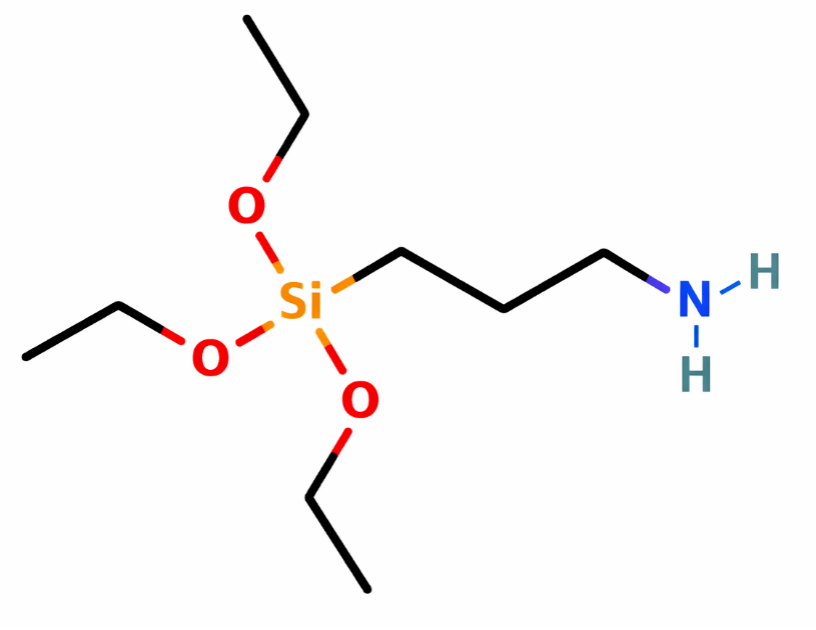
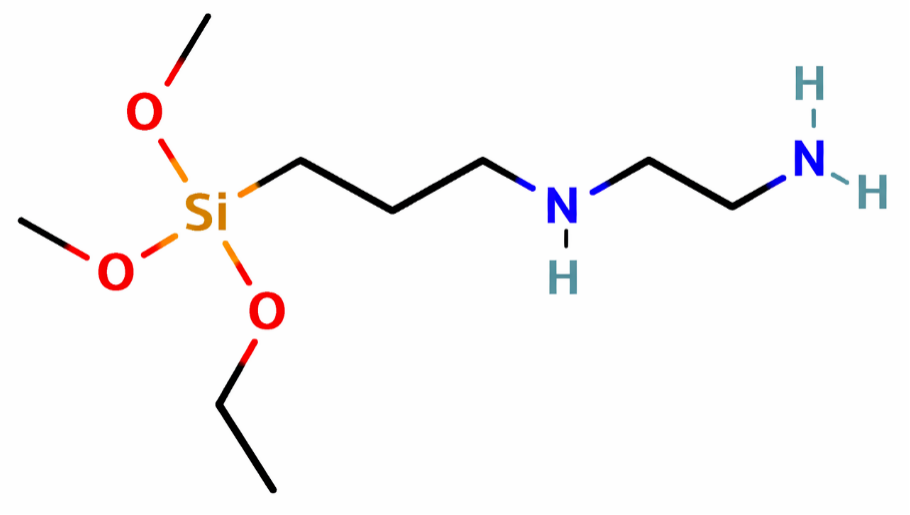
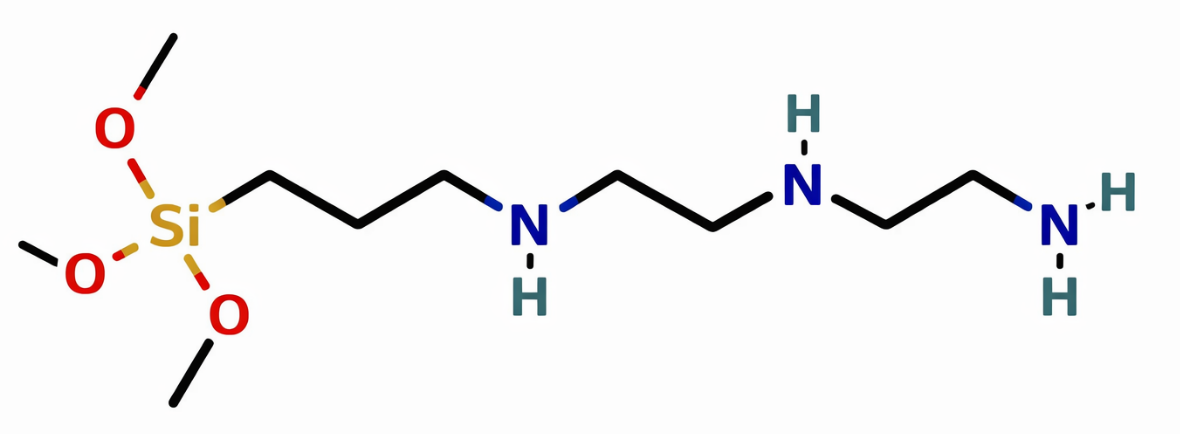
To facilitate a more intuitive comparison of the differences among monoamino, diamino, and triamino aminosilanes in terms of amino group number, amino chain length, and silane-end type, the structural formulas of 3-aminopropyltriethoxysilane (monoamino), N-(2-aminoethyl)-3-aminopropyltrimethoxysilane (diamino), and 3-(trimethoxysilyl)propyl diethylenetriamine (triamino) are shown below.
5. Typical Applications and Mechanisms of Action of Aminosilanes
Application Area | Main Problem Addressed | Mechanism of Action |
Adhesives, sealants, and primers | Improve adhesion between inorganic substrates such as glass, aluminum, and steel and organic systems, improve wet adhesion retention, and improve pigment and filler dispersion. | The alkoxysilane end first hydrolyzes to form silanols, which then form chemical bonds with hydroxyl groups on inorganic surfaces; the amino end then bonds with reactive components in resins or sealant systems, or enhances interfacial polar interactions, thereby connecting the inorganic surface with the organic phase. |
Paints, coatings, and anticorrosive primers | Address insufficient coating adhesion to substrates such as metals and glass, as well as loss of adhesion and susceptibility to corrosion under hot and humid conditions. | Aminosilanes may be used either as coating additives or first formulated into primers for substrate pretreatment. In multicomponent coatings, if direct addition readily causes side reactions, a primer route may be used first to establish a silane-bonded layer on the substrate surface, after which the amino end forms a stable interfacial bridge with the coating resin. In two-component (2K) waterborne epoxy systems, aminosilanes may also serve as crosslinking-promoting components to improve adhesion and corrosion resistance. |
Glass fiber-reinforced resins and composites | Improve interfacial bonding between glass fibers and resins and reduce losses in strength and electrical performance after moisture exposure. | The silane end bonds to the glass fiber surface, while the amino end links to the thermosetting or thermoplastic resin matrix, making load transfer more effective and improving the retention of mechanical and electrical properties under wet conditions. |
Mineral filler-filled resins and halogen-free flame-retardant (HFFR) cable compounds | Address poor wetting and poor dispersion of inorganic fillers, as well as performance decline when filler loading is increased. | Aminosilanes first form an organophilic interfacial layer on the mineral filler surface, reducing the interfacial mismatch between the filler surface and the polymer; at the same time, the amino end enhances interaction with the resin, thereby improving wetting, dispersion, and the physical and electrical properties of the composite. |
Glass wool, mineral wool, and other insulation materials | Improve the moisture resistance of phenolic binder systems and improve recovery after compression. | The silane end bonds to the mineral fiber surface, while the amino end enhances interfacial bonding with the phenolic binder, making the fiber-resin bonding layer more stable under humid conditions. |
Foundry resins and abrasives | Improve the bonding strength between resins and casting sand or abrasive particles, and improve water resistance. | Aminosilanes first form a bonded layer on the sand or abrasive surface and then establish interfacial bonding with phenolic and other resin binder systems, thereby enhancing adhesion between particles and resin. |
Cure-related systems | Used to improve adhesion, interfacial reactions, and post-cure performance in epoxy, polyurethane, and hybrid systems, or to balance application performance with storage stability. | Aminosilanes can react through their amino groups with reactive groups such as epoxides and isocyanates, while also forming a bonded layer with inorganic substrate surfaces through the silane end to improve adhesion; in some epoxy, polyurethane, and hybrid systems, they can simultaneously serve as interfacial reactive components and adhesion-promoting components. |
Metal ion coordination/chelation-type surface functionalization | Address the limitation of ordinary coupling layers that provide only adhesion but lack metal ion binding sites. | This route usually does not use the ordinary monoamino silane itself, but rather derivatives formed by further introducing aminocarboxylate coordination structures into an aminosilane; the silane end is responsible for anchoring the molecule to the surface, while the retained multidentate coordination sites are used for binding metal ions. |
6. Precautions When Using Aminosilanes
6.1 Storage and solution preparation should be protected from moisture, and treatment solutions should be prepared fresh whenever possible.
Aminosilanes hydrolyze upon contact with water and continue to undergo condensation; once prepared, treatment solutions are prone to changes in condition upon standing. In experimental work, prolonged exposure to air should be avoided. If a treatment solution becomes turbid, more viscous, stratified, or shows precipitation, it is generally not suitable for continued use.
6.2 Do not directly apply generic weak-acid hydrolysis conditions to aminosilanes.
When preparing aminosilane solutions, whether acetic acid should be added, whether prehydrolysis is required, and how the pH should be set must all be determined according to the specific product. Different products do not hydrolyze in the same way: some require prehydrolysis under weakly acidic conditions with the participation of acetic acid, while others can undergo self-catalyzed hydrolysis, although pH adjustment may still be needed to improve hydrolysate stability. Before solution preparation, the technical data for the specific product should be checked first, with particular attention to the hydrolysis method, pH range, and stability after preparation, and only then should the mode of use and allowable use time be determined.
6.3 During solution preparation, the addition sequence, stirring, and temperature rise should be controlled.
When aminosilanes are added to water-containing systems, heat is released and the corresponding alcohols are liberated. In experiments, they should be added slowly with stirring maintained throughout; on scale-up in particular, excessive local concentration and localized overheating should be prevented.
6.4 Diluent selection must take both solubility and reactivity into account.
Different aminosilanes are not equally compatible with all solvents. Some monoamino silanes are not recommended for dilution with ketones; some diamino methoxy silanes, although they can be formulated into certain organic systems, may still react with ketones or esters. When determining a diluent, one must not judge only by whether a homogeneous solution can be obtained; the reactivity information in the product technical data must also be checked, together with a preliminary assessment of the storage stability of the main formulation.
6.5 In surface treatment, both substrate condition and process conditions should be controlled.
The substrate surface should be clean, and the treatment solution should be able to wet the surface uniformly. If the liquid shrinks into droplets on the surface rather than forming a continuous film, the cleaning method or treatment solution conditions should be adjusted first. The concentration of the treatment solution, contact time, and drying or curing conditions should also be screened, and the next step should be taken only after the treatment layer has stabilized.
6.6 For powders or fillers, surface moisture and mixing uniformity are the key points.
Powder surface treatment relies on adsorbed surface water to trigger hydrolysis. If the surface is too dry, the reaction will be incomplete; if there is excessive local moisture or poor mixing uniformity, premature condensation, agglomeration, or uneven treatment can easily occur.
6.7 Manage drying and curing processes as involving flammable alcohol vapors.
During hydrolysis and curing, aminosilanes release methanol or ethanol. During heat treatment, proper ventilation should be ensured, and direct heating under unsuitable enclosed conditions should be avoided.
7. Classification, Characteristics, and Applications of Representative Aminosilanes and Related Structural Chemicals
Classification | CAS No. | Aladdin Catalog No. | Name | Specification or Purity | Product Features and Applications |
Monoamino type (triethoxy type) | 919-30-2 | (3-Aminopropyl)triethoxysilane(APTS) | ≥99% | A fundamental monoamino aminosilane that can be used for amination of glass, silica, metal oxides, and similar surfaces, and is also commonly used for interfacial coupling, primers, and adhesion promotion between glass fiber, mineral fillers, and resins. | |
Monoamino type (trimethoxy type) | 13822-56-5 | (3-Aminopropyl)trimethoxysilane | Chloride ion ≤13 ppm | A fundamental monoamino trimethoxy silane suitable for surface amination of glass, silica gel, oxide particles, and porous supports, and also commonly used in coating primers, filler treatment, and surface grafting. | |
Monoamino type (trihydroxy/hydrolyzed form) | 58160-99-9 | 3-Aminopropylsilanetriol | 22-25% aqueous solution | A hydrolyzed-form monoamino silane aqueous solution suitable for surface amination of glass and oxide surfaces in waterborne systems and for pretreatment of hydrophilic substrates, reducing the need for on-site prehydrolysis. | |
Monoamino type (methyldiethoxy type) | 3179-76-8 | 3-Aminopropyl(diethoxy)methylsilane | ≥97% | Contains one amino site and two hydrolyzable sites, and is commonly used in interfacial modification and primer studies where control of surface-layer condensation and retention of some organic-phase flexibility are needed. | |
Sterically hindered monoamino type (trimethoxy type) | 157923-74-5 | 4-Amino-3,3-dimethylbutyltrimethoxysilane | ≥97% | A sterically hindered primary amine-type aminosilane commonly used in elastic adhesives, sealants, and interfacial treatment systems that need to balance amine reactivity with appearance stability. | |
Aromatic amine type (trimethoxy type) | 3068-76-6 | Trimethoxy[3-(phenylamino)propyl]silane | ≥98%(T) | An aromatic amine-type aminosilane that can be used to introduce aromatic amine interfacial layers and is suitable for surface modification studies involving heat-resistant resins, laminated structures, and high-temperature conditions. | |
Diamino type (triethoxy type) | 5089-72-5 | 3-(2-Aminoethylamino)propyltriethoxysilane | ≥96% | Contains two amino sites and is suitable for epoxy, polyurethane, and inorganic filler surface treatment systems requiring dual-point reactions or relatively high amine density; the triethoxy end also helps moderate the hydrolysis rate. | |
Diamino type (trimethoxy type) | 1760-24-3 | N-[3-(Trimethoxysilyl)propyl]ethylenediamine | ≥95% | A diamino trimethoxy silane commonly used for high-density surface amination of glass, silica gel, magnetic particles, and oxides, and also for interfacial coupling and primers in epoxy systems. | |
Diamino type (methyldimethoxy type) | 3069-29-2 | 3-(2-Aminoethylamino)propyldimethoxymethylsilane | ≥96% | Combines two amine sites with fewer hydrolyzable sites, making it suitable for filler treatment and interfacial modification where amine density should be retained while controlling the degree of surface-layer condensation. | |
Diamino type (methyldiethoxy type) | 70240-34-5 | N-(3-(Diethoxymethylsilyl)propyl)ethylenediamine | — | Combines two amine sites with a methyldiethoxy silane end, and is suitable for interfacial treatment, surface grafting, and primer studies where dual-amine functionality is needed but excessively rapid hydrolysis at the silane end is not desired. | |
Triamino type (trimethoxy type) | 35141-30-1 | 3-[2-(2-Aminoethylamino)ethylamino]propyl-trimethoxysilane | ≥90% | A triamino silane suitable for support functionalization and adsorbent construction requiring relatively high surface amine density, as well as for studies of multipoint interfacial interactions with epoxies or inorganic fillers. | |
Tertiary amine type (trimethoxy type) | 2530-86-1 | [3-(N,N-Dimethylamino)propyl]trimethoxysilane | ≥96% | A tertiary amine-type aminosilane that can be used to introduce tertiary amine basic sites onto the surfaces of silica, glass, or porous supports, and is suitable for catalyst site immobilization, surface charge regulation, and construction of basic functional layers. | |
Bis-silane type (triethoxy type) | 13497-18-2 | Bis(3-(triethoxysilyl)propyl)amine | ≥95% | Combines dual silane ends with a secondary amine bridge, and can be used in adhesives, sealants, primers, metal primers, filler pretreatment, and composite interfacial reinforcement. | |
Bis-silane type (trimethoxy type) | 82985-35-1 | Bis[3-(trimethoxysilyl)propyl]amine | ≥90% | Combines dual-point bonding characteristics with trimethoxy silane ends, and can be used in surface treatment studies for composites, aerogels, or other systems requiring improved interfacial layer robustness. |
Note: The above are representative Aladdin products. For more product specifications, search the Aladdin official website by product name/CAS/catalog number.
References
[1] Plueddemann EP. Silane Coupling Agents. 2nd ed. New York: Plenum Press; 1991. doi:10.1007/978-1-4899-2070-6.
[2] Arkles B. Tailoring surfaces with silanes. Chemtech. 1977;7(12):766-778.
[3] Arkles B. Silane Coupling Agents: Connecting Across Boundaries. 3rd ed. Morrisville, PA: Gelest, Inc.; 2014.
[4] Gelest, Inc. Applying a Silane Coupling Agent. Morrisville, PA: Gelest, Inc.
[5] Evonik Operations GmbH. Dynasylan® AMEO. Technical Data Sheet. 2024.
[6] Evonik Operations GmbH. Dynasylan® DAMO. Technical Data Sheet. 2025.
[7] Evonik Operations GmbH. Dynasylan® TRIAMO. Technical Data Sheet. 2025.
[8] Momentive Performance Materials Inc. Silquest A-1100™. Technical Data Sheet.
[9] Evonik Operations GmbH. Dynasylan® Primers: Examples for the Formulation of Silane Primers for Paints and Coatings. Technical Information 1408.
For more related articles, please see below: