Iron is one of the essential elements for the human body and plays an important role in metabolism and overall health. Insufficient iron levels in the blood can lead to iron deficiency anemia. Iron is present in all cells of the human body, including various tissues, organs, and endocrine glands. The liver, spleen, and lung tissues are relatively rich in iron. The adult body contains 3–5 g of iron, most of which exists as protein complexes, with a very small portion in ionic form. Ferrous ions (Fe²⁺) are key components of heme and hemoglobin and also play important roles in many biochemical reactions. This kit employs a colorimetric method for the quantitative determination of Fe²⁺ in animal and plant tissues, serum/plasma, or other liquids. Under acidic conditions, Fe²⁺ in the sample reacts with tripyridyltriazine (TPTZ) to form a blue complex that has a maximum absorbance at 593 nm. The concentration of Fe²⁺ is then determined by measuring the absorbance at this wavelength.
| F1515875 | Component | 48T | 96T | Storage conditions | | F1515875A | Buffer Solution | 15 mL | 30 mL | 2-8℃. Store in the dark | | F1515875B | Chromogenic Solution | 7 mL | 14 mL | 2-8℃. Store in the dark | | F1515875C | Ferrous Ion Standard(40mM) | 0.5 mL | 1 mL | 2-8℃. Store in the dark | | F1515875D | Standard diluent | 5 mL | 10 mL | 2-8℃. Store in the dark | | F1515875E | Extraction Buffer | 15 mL | 30 mL | 2-8℃. Store in the dark |
|
Protocol
1. Sample Preparation
(1) Tissue: Add 0.1 mL of extraction buffer per 0.01 g of tissue. Homogenize using a homogenizer or mortar and pestle on ice. Then incubate on ice for 15 minutes, inverting and mixing every 3 minutes to ensure complete cell lysis. Centrifuge at 10,000 × g for 10 minutes at 4°C. Collect the supernatant and keep on ice.
(2) Serum/plasma or other liquid samples: Mix 55 μL of sample with 165 μL of Buffer Solution (i.e., 4‑fold dilution) and keep on ice. If the sample is turbid, centrifuge at 5,000 × g for 5 minutes at 4°C and collect the supernatant for analysis.
Note: The extraction buffer provided with this kit is not compatible with BCA protein assays. For protein concentration determination, we recommend Aladdin’s Ready‑to‑Use Bradford Protein Assay Kit (Detergent Compatible) (B1509656). To ensure that the sample values fall within the standard curve range, it is recommended to perform a preliminary experiment with multiple dilution factors for the sample to determine the approximate concentration of ferrous ions. If the values are not within the standard curve range, please adjust the dilution factor or the amount of sample. The sample diluent is Buffer Solution; serum/plasma or other liquid samples have already been diluted 4‑fold during sample processing and usually do not require further dilution.
2. Standard Curve Preparation
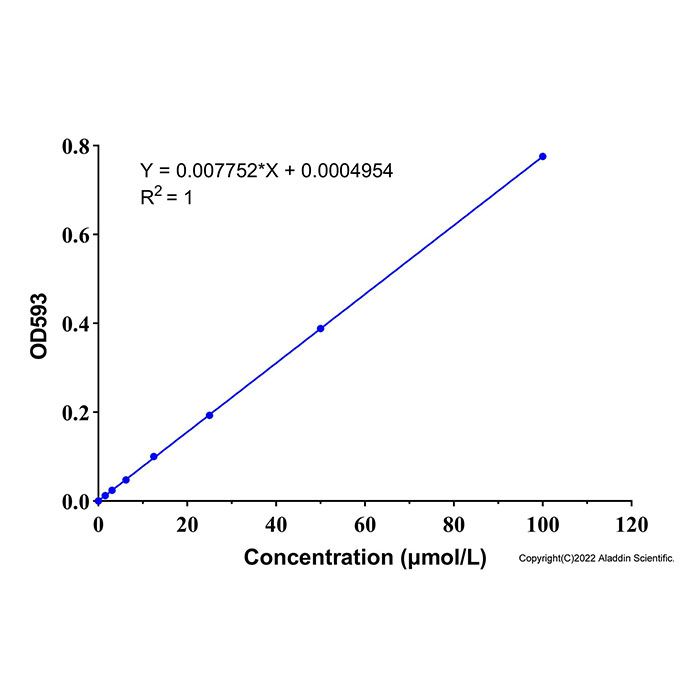
Dilute the 40 mmol/L (40,000 μmol/L) standard with standard diluent to obtain the following concentrations: 100, 50, 25, 12.5, 6.25, 3.125, 1.5625 μmol/L. Prepare fresh before use.
A recommended dilution scheme is shown below:
| No. | Pre‑dilution Conc. (μmol/L) | Std. Volume (μL) | Standard diluent Volume (μL) | Final Conc. (μmol/L) | | 1 | 40000 | 10 | 990 | 400 | | 2 | 400 | 150 | 450 | 100 | | 3 | 100 | 300 | 300 | 50 | | 4 | 50 | 300 | 300 | 25 | | 5 | 25 | 300 | 300 | 12.5 | | 6 | 12.5 | 300 | 300 | 6.25 | | 7 | 6.25 | 300 | 300 | 3.125 | | 8 | 3.125 | 300 | 300 | 1.5625 |
|
Note: Each standard tube requires 200 μL of diluted standard for the subsequent assay (do not measure absorbance at this step).
3. Sample Measurement
(1) Pre‑warm the microplate reader for at least 30 min. Set the wavelength to 593 nm.
(2) Prepare the reaction mixtures as shown below. Include a blank control (no sample).
| Reagent (μL) | Blank | Standard | Sample | | Sample (μL) | 0 | 0 | 200 | | Standard (μL) | 0 | 200 | 0 | | Buffer Solution (μL) | 200 | 0 | 0 | | Chromogenic Solution (μL) | 100 | 100 | 100 |
|
(3) Mix thoroughly and incubate at 37°C for 20 minutes. Transfer 200 μL of the supernatant to the corresponding wells of a microplate. Measure the absorbance of each well at 593 nm. Record the blank absorbance as Abₗₐₙₖ, the standard as Aₛₜₐₙdₐᵣd, and the sample as Aₛₐₘₚₗₑ. Calculate: ΔAₛₐₘₚₗₑ = Aₛₐₘₚₗₑ – Abₗₐₙₖ , ΔAₛₜₐₙdₐᵣd = Aₛₜₐₙdₐᵣd – Abₗₐₙₖ.
4. Calculation of Fe²⁺ Content
(1) Standard curve: Plot the standard concentration (x‑axis) against ΔAₛₜₐₙdₐᵣd (y‑axis) to obtain the linear equation. Substitute ΔAₛₐₘₚₗₑ into the equation to calculate the sample concentration Cₛₐₘₚₗₑ (μmol/L).
(2) Fe²⁺ concentration calculation:
For serum/plasma or other liquid samples: Fe²⁺ content (μmol/L) = Cₛₐₘₚₗₑ × 4 × f
For tissue samples:
Based on tissue wet weight: Fe²⁺ content (μmol/kg wet weight) = Cₛₐₘₚₗₑ × f ÷ (m / V)
Based on protein concentration: Fe²⁺ content (nmol/mg protein) = Cₛₐₘₚₗₑ × f ÷ Cₚᵣ
Note:
f = dilution factor before measurement;
m = tissue wet weight (g);
V = volume of Extraction Buffer added (mL);
Cₚᵣ = protein concentration of the sample (mg/mL).
Precautions:
1. Avoid contact of samples and reagents with iron materials to prevent contamination.
2. Fresh samples are recommended. Fe²⁺ is easily oxidized; prolonged storage or repeated freeze‑thaw cycles may compromise accuracy.
3. If the sample reading exceeds the highest standard, dilute the sample and repeat the assay.
4. Before formal testing, a preliminary experiment using 2–3 samples with expected large differences is recommended.
5. For your safety and health, wear a lab coat and disposable gloves during operation.
Results Presentation
Typical standard curve: