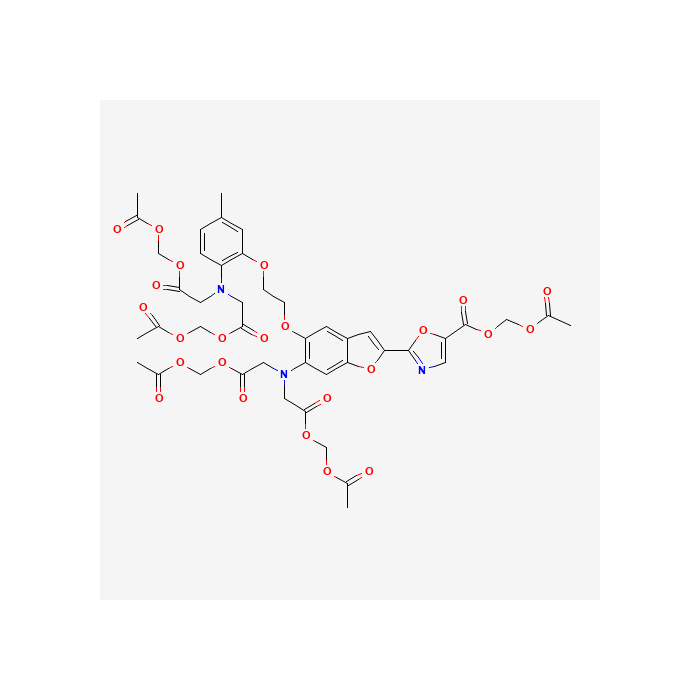
Fura-2 is a specific fluorescent indicator for intracellular calcium ions (Ca²⁺), and it is one of the most commonly used fluorescent probes for detecting intracellular calcium ion concentration.Fura-2 AM is a cell-permeable fluorescent dye. It exhibits weak fluorescence, with a maximum excitation wavelength of 369 nm and a maximum emission wavelength of 478 nm. Notably, its fluorescence intensity does not change with variations in calcium ion concentration. After entering cells, Fura-2 AM can be cleaved by intracellular esterases to form Fura-2, which is then trapped inside the cells. When Fura-2 binds to calcium ions, its maximum excitation wavelength is 335 nm (the maximum excitation wavelength varies with ion concentration), and the maximum emission wavelength is 505 nm. For practical detection, the recommended excitation wavelength is 340 nm and the emission wavelength is 510 nm. For dual-wavelength detection, the recommended excitation wavelengths are 340 nm and 380 nm.
This Fura-2 AM (Calcium Fluorescent Probe) is a stock solution formulated in anhydrous DMSO, with a concentration of 2 mM.
For intracellular calcium ion detection, the commonly used concentration of Fura-2 AM is 0.5–5 μM. Typically, probe loading can be achieved by incubating cells with an appropriate solution containing 0.5–5 μM Fura-2 AM at 4–37 °C for 15–60 minutes.
Usage Instructions
The following method is for reference only:
1. Dilute this product with HBSS buffer (containing calcium and magnesium) to prepare a 1 μM Fura-2AM working solution.
2. Remove the culture medium from the cultured cells, wash the cells, and rinse them 3 times with HBSS buffer. (If serum-containing medium is used, esterases in the serum will decompose the AM moiety, thereby reducing the efficiency of Fura-2AM entering the cells. Additionally, phenol red-containing medium may slightly increase the background value, so residual medium should be removed as much as possible before adding the working solution.)
*Note: This Fura-2AM may solidify and adhere to the bottom, wall, or inner cap of the centrifuge tube at low temperatures (e.g., 4°C or in an ice bath). Incubate it in a 20–25°C water bath for a short while until fully dissolved before use.
3. Add an appropriate amount of Fura-2AM working solution, sufficient to cover the cells.
4. Incubate for 15–60 minutes, then remove the Fura-2AM working solution. (For the first incubation, use 30 minutes and check the fluorescence effect: if there is excessive cell death, shorten the time; if the fluorescence intensity is too weak, prolong the time.)
5. Wash the cells 3 times with HBSS buffer, then incubate the cells in HBSS buffer for 20–30 minutes to ensure complete de-esterification of the AM moiety inside the cells.
6. Use these cells for fluorescent calcium ion detection.
7. Detection: Use excitation wavelengths of 380 nm (for free calcium) and 340 nm (for bound calcium), with an emission wavelength of 510 nm.
*Note: Labeling conditions vary by cell type. Please determine the optimal conditions before each experiment.
Precautions:
1. This Fura-2AM may solidify and adhere to the bottom, wall, or inner cap of the centrifuge tube at low temperatures (e.g., 4°C or in an ice bath). Incubate it in a 20–25°C water bath for a short while until fully dissolved before use.
2. For better staining results, HEPES-BSA buffercan be used instead of HBSS buffer.
3. All fluorescent dyes are subject to quenching; please keep the reagent away from light as much as possible to slow down fluorescence quenching.
4. For your safety and health, please wear a lab coat and disposable gloves during operation.

 ZJ26F0131150