Determine the necessary mass, volume, or concentration for preparing a solution.
Taxonomy Tree
| Kingdom | Organic compounds |
|---|---|
| Superclass | Organic oxygen compounds |
| Class | Organooxygen compounds |
| Subclass | Carbohydrates and carbohydrate conjugates |
| Intermediate Tree Nodes | Aminosaccharides |
| Direct Parent | Aminoglycosides |
| Alternative Parents | Macrolides and analogues O-glycosyl compounds Oxanes Monosaccharides Tertiary alcohols Trialkylamines Secondary alcohols 1,2-aminoalcohols Amino acids and derivatives Carboxylic acid esters Lactones Polyols Acetals Oxacyclic compounds Azacyclic compounds Monocarboxylic acids and derivatives Dialkyl ethers Carbonyl compounds Hydrocarbon derivatives Organic oxides Organopnictogen compounds |
| Molecular Framework | Aliphatic heteromonocyclic compounds |
| Substituents | Aminoglycoside core - Macrolide - Glycosyl compound - O-glycosyl compound - Monosaccharide - Oxane - Tertiary alcohol - 1,2-aminoalcohol - Amino acid or derivatives - Carboxylic acid ester - Lactone - Secondary alcohol - Tertiary amine - Tertiary aliphatic amine - Oxacycle - Acetal - Monocarboxylic acid or derivatives - Organoheterocyclic compound - Polyol - Azacycle - Ether - Dialkyl ether - Carboxylic acid derivative - Organic nitrogen compound - Alcohol - Carbonyl group - Organonitrogen compound - Organopnictogen compound - Amine - Organic oxide - Hydrocarbon derivative - Aliphatic heteromonocyclic compound |
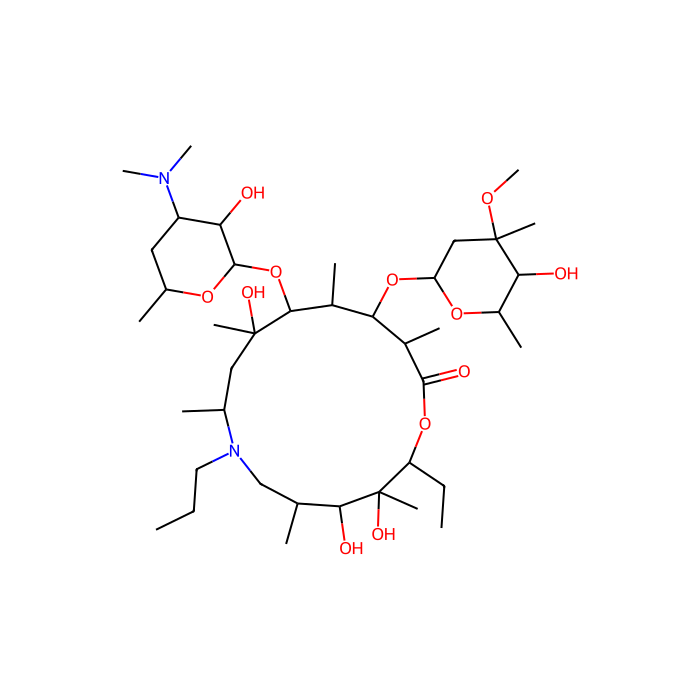
| Description | This compound belongs to the class of organic compounds known as aminoglycosides. These are molecules or a portion of a molecule composed of amino-modified sugars. |
| External Descriptors | Not available |
Find and download the COA for your product by matching the lot number on the packaging.
| Lot Number | Certificate Type | Date | Item |
|---|---|---|---|
| Certificate of Analysis | Oct 14, 2025 | G333703 | |
| Certificate of Analysis | Oct 14, 2025 | G333703 | |
| Certificate of Analysis | Sep 11, 2025 | G333703 | |
| Certificate of Analysis | Sep 11, 2025 | G333703 | |
| Certificate of Analysis | Sep 11, 2025 | G333703 | |
| Certificate of Analysis | Sep 11, 2025 | G333703 | |
| Certificate of Analysis | Jul 22, 2022 | G333703 |
| Solubility | Chloroform (Slightly), Methanol (Slightly) |
|---|---|
| Sensitivity | Hygroscopic |
| Melt Point | 119-125° C |
| Molecular Weight | 777 |
| XLogP3 | 4.900 |
| Hydrogen Bond Donor Count | 5 |
| Hydrogen Bond Acceptor Count | 14 |
| Rotatable Bond Count | 9 |
| Exact Mass | 776.54 Da |
| Monoisotopic Mass | 776.54 Da |
| Topological Polar Surface Area | 180.000 Ų |
| Heavy Atom Count | 54 |
| Formal Charge | 0 |
| Complexity | 1180.000 |
| Isotope Atom Count | 0 |
| Defined Atom Stereocenter Count | 18 |
| Undefined Atom Stereocenter Count | 0 |
| Defined Bond Stereocenter Count | 0 |
| Undefined Bond Stereocenter Count | 0 |
| The total count of all stereochemical bonds | 0 |
| Covalently-Bonded Unit Count | 1 |
H225:Highly Flammable liquid and vapor
H319:Causes serious eye irritation
H302+H312+H332:Harmful if swallowed, in contact with skin or if inhaled
P210:Keep away from heat, hot surface, sparks, open flames and other ignition sources. - No smoking.
P233:Keep container tightly closed.
P240:Ground/bond container and receiving equipment.
P241:Use explosion-proof [electrical/ventilating/lighting/.../] equipment.
P242:Use only non-sparking tools.
P243:Take precautionary measures against static discharge.
P261:Avoid breathing dust/fume/gas/mist/vapors/spray.
P264:Wash hands [and …] thoroughly after handling.
P270:Do not eat, drink or smoke when using this product.
P271:Use only outdoors or in a well-ventilated area.
P280:Wear protective gloves/protective clothing/eye protection/face protection.
P303+P361+P353:IF ON SKIN (or hair): Take off Immediately all contaminated clothing. Rinse SKIN with water [or shower].
P305+P351+P338:IF IN EYES: Rinse cautiously with water for several minutes. Remove contact lenses if present and easy to do - continue rinsing.
P337+P313:IF eye irritation persists: Get medical advice/attention.
P370+P378:In case of fire: Use ... to extinguish.
P403+P235:Store in a well-ventilated place. Keep cool.
P501:Dispose of contents/container to an approved waste disposal plant.
P301+P312+P330:IF SWALLOWED: Call a POISON CENTER/ doctor if you feel unwell. Rinse mouth.
P304+P340+P312:IF INHALED: Remove person to fresh air and keep comfortable for breathing.Call a POISON CENTER or doctor. if you feel unwell.
No item-specific, validated protocols are provided. The following are general, literature-style workflows for macrolide research; adapt to your system.
Always confirm solvent compatibility and exposure limits for your biological system. Sterilize working solutions by 0.22 µm filtration where needed.
General macrolide/azalide biology (no clinical claims):
Use this material as a research tool compound to interrogate ribosome function, study resistance determinants, and benchmark analytical methods (e.g., LC-MS/MS in complex matrices). For in vitro work, maintain consistent pH and protein content to ensure reproducible apparent potency.
This product is not a buffering reagent. However, buffer conditions strongly influence its solubility and assay performance.
Practical guidance (general):
Recipes and exact concentrations depend on your assay and organism/system; verify compatibility with cells/enzymes and maintain consistent pH/ionic strength to ensure reproducibility.
As a complex macrolide analyte/standard, “green alternatives” center on solvent and workflow choices rather than replacing the active itself.
Greener solvent choices (general guidance):
Mini-comparison (general; not product specs):
Operational improvements:
Note: The choice of greener solvents must not compromise analyte stability; macrolide glycosidic and ketal linkages are sensitive to strong acid/base and prolonged heating.
Context for formulation and manufacturing research (no therapeutic/clinical claims):
Item-specific physico-chemical data:
General/literature expectations for macrolide/azalide solids (for planning only; not product specifications):
Use notes:
Guidance on quality considerations for macrolide research materials (general):
Stabilizers/inhibitors: Not specified for this item; refer to CoA/Spec Sheet.
This compound is not typically used as a general-purpose reagent or solvent; it is a complex macrolide used primarily as a reference standard, analytical control, or bioactive probe in microbiology and chemical biology research.
Research applications (general):
Analytical chemistry considerations:
Because of its size and functionality, gamithromycin is rarely employed in synthetic transformations as a building block; see “Synthetic Utility” for limited derivatization notes.
This compound is not commonly used as a reagent in standard organic reactions. Where chemical modification is pursued (general guidance):
Expected yields are highly transformation- and site-dependent for complex natural products; plan for modest yields with careful optimization and extensive analytical verification.
General laboratory safety guidance for macrolide powders (general chemistry knowledge):
Gamithromycin is a large, amphiphilic, weakly basic macrolide. Practical dissolution strategy (general guidance):
Comparison (general):
Tips:
Best practices (general):
If the exact salt/form and stability-indicating methods are critical for your application, consult the CoA/Spec Sheet for batch-specific details.
SKU: G333703
Product name: Gamithromycin
Structural description (general chemistry knowledge):
Notes:
Gamithromycin is not a routine synthetic building block; however, as a richly functionalized macrolide it supports selective derivatization for probe and SAR studies (general chemistry guidance):
Caveats:
This listing is a small-molecule macrolide, not an antibody or biologic; therefore, antigen/epitope/clone/isotype information does not apply.
General target interaction (biochemical context):
For detailed binding constants or species selectivity, consult primary literature specific to gamithromycin or closely related azalides.