≥98% for sensitive chromatographic and analytical workflows requiring minimal baseline interference.
🌡
Storage & shipping
Store at -20°C Ships Ice chest + Ice pads Check lot-specific COA for exact specifications.
📋
Quality documents
SDS, COA, datasheet, and spec sheet available for download. Lot-specific COA accessible via lot number lookup.
📚
Literature proof
Cited in 0 peer-reviewed publications across chromatography, organic synthesis, and cross-coupling reactions.
Specifications
Product Name
Gap19, CAS No.1507930-57-5
Specifications & Purity
≥98%
Biochemical and Physiological Mechanisms
Selective connexin 43 (Cx43) hemichannel blocker; has no effect on gap junction coupling or Panx-1 channels. Reduces mitochondrial potassium influx in cardiomyocytes and attenuates glutamate-triggered ATP release in primary astrocytes. Modestly reduces in
Sequence
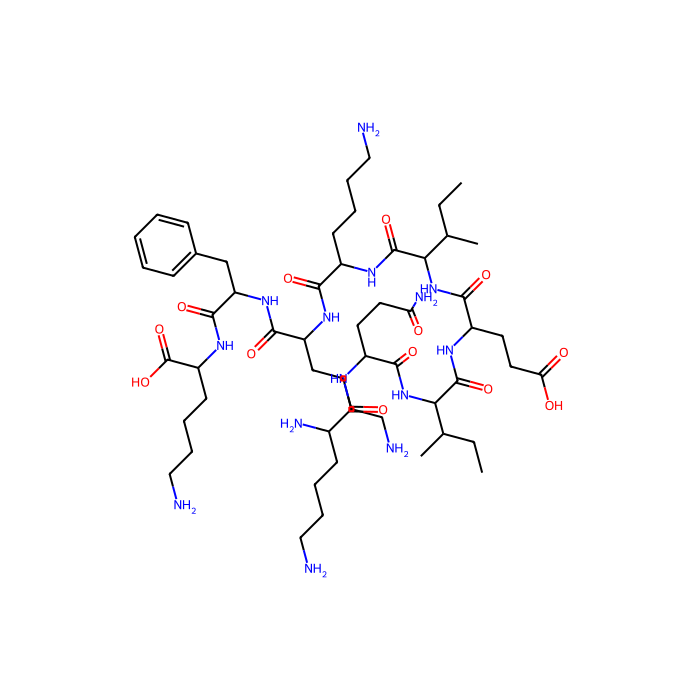
KQIEIKKFK
Action Type
INHIBITOR
CAS
1507930-57-5
Molecule Type
Small molecule
Storage and Shipping
Storage
Store at -20°C
Shipped In
Ice chest + Ice pads
Documentation
📋 Safety Data Sheet (SDS)
Comprehensive hazard, handling, storage, and regulatory compliance document.
This compound belongs to the class of organic compounds known as oligopeptides. These are organic compounds containing a sequence of between three and ten alpha-amino acids joined by peptide bonds.
External Descriptors
Not available
1. Djoumbou Feunang Y, Eisner R, Knox C, Chepelev L, Hastings J, Owen G, Fahy E, Steinbeck C, Subramanian S, Bolton E, Greiner R, and Wishart DS. ClassyFire: Automated Chemical Classification With A Comprehensive, Computable Taxonomy. Journal of Cheminformatics, 2016, 8:61.
Determine the necessary mass, volume, or concentration for preparing a solution.
Dilution Calculator
Determine the dilution needed to prepare a stock solution.
Reconstitution Calculator
Reviews
Customer Reviews
Application Protocols
Item-specific (from Product Data)
Not specified for this item; no tested applications or recommended dilutions are provided.
General guidance (not item-specific)
Establish assay-specific dose–response and time-course. Include appropriate negative/vehicle controls and, where relevant, orthogonal readouts (e.g., electrophysiology, dye uptake assays).
Filter-sterilize solutions if required by your workflow and sequence stability. Use low-binding plasticware to minimize adsorption for low-concentration work.
Biological Roles
Item-specific (from Product Data)
No biological role claims are specified for this item. Research use only.
General/literature context for the name “Gap19” (not item-specific)
The literature commonly refers to “Gap19” as a short peptide tool used to study connexin-mediated cell–cell communication, particularly in the context of hemichannels associated with connexin43. Such tools are exploited to dissect contributions of channel opening/closing to cellular signaling, ion homeostasis, and small-molecule exchange.
As a peptide probe, its biological effects, selectivity, and kinetics can depend on sequence, concentration, cell type, and experimental conditions. Verification of target engagement typically involves electrophysiological measures, dye permeability assays, or genetic controls.
Important caveat: precise sequence, modifications, and formulation control the observed biology; consult the item’s CoA and validate in your system. No medical or therapeutic claims are made; this product is for laboratory research use only.
Buffer Applications
Not typically applicable.
Rationale: This catalog entry is a small research peptide, not a buffering agent. It does not constitute a classical buffer system and is not used to set or maintain pH.
Practical note: Prepare and use in appropriate biological buffers (e.g., PBS, HEPES) suitable for your assay, ensuring compatibility with cells/tissues and with the peptide’s solubility and stability. Specific buffer recipes and pH ranges are application-dependent and not specified for this item.
Green Alternatives
Context
For a small research peptide, “green alternatives” relate more to handling and formulation than replacement by another solvent or reagent.
Practical sustainability considerations (general, not item-specific)
Diluent selection: Prefer aqueous buffers over organic solvents when solubility permits to minimize VOCs and hazardous waste.
Stock solution strategy: Use high-concentration stocks to reduce container count and cold-chain volume; aliquot to extend shelf life and reduce waste.
Packaging/waste: Consolidate orders to reduce cold-pack materials; recycle secondary packaging where supported.
Process choice: If synthesizing related peptides in-house, consider microwave-assisted SPPS, greener coupling reagents, and solvent recycling systems (literature practices), though this does not apply directly to the use of the catalogued item.
Alternatives within the research toolbox
Where the biological question allows, genetic or optogenetic approaches can complement or reduce reliance on repeated peptide dosing. Trade-offs include development time, specialized equipment, and different off-target profiles.
Pharmaceutical Uses
Item-specific (from Product Data)
No pharmacopeial status, formulation role, or excipient information is provided for this item.
General guidance (not item-specific)
This material is designated For research use only and is not intended for human or veterinary use, clinical diagnostics, or as a drug substance/excipient.
In preclinical research settings, bioactive peptides are sometimes used as tool compounds to probe mechanisms in vitro or in ex vivo models. Any formulation considerations (vehicle, tonicity adjusters, sterile filtration) are strictly for laboratory studies and must follow institutional approvals.
If translational formulation studies are performed in research contexts, critical specifications would include identity, purity, counterion content, endotoxin level, sterility, and stability-indicating methods—none of which are specified here and must be verified from the CoA/SDS for this specific item.
Physical Properties
Item-specific (from Product Data)
Appearance: Not specified for this item; refer to CoA/Spec Sheet.
Molecular Weight: Not specified for this item; refer to CoA/Spec Sheet.
Molecular Formula: Not specified for this item; refer to CoA/Spec Sheet.
Other specifications (mp/bp, density, solubility, logP, pKa, refractive index): Not specified for this item; refer to CoA/Spec Sheet.
General/literature context (not item-specific)
Short research peptides are typically obtained as amorphous white to off-white solids or lyophilized powders.
Solubility (literature, sequence-dependent): Many short peptides are soluble in water, aqueous buffers (e.g., PBS), or in DMSO if hydrophobic content is high. Adjusting pH or adding small amounts of organic cosolvent can aid dissolution.
Hygroscopicity: Peptides can be moderately hygroscopic; exposure to ambient moisture may affect handling and weigh-out.
Counterions/salt form: Peptide trifluoroacetate (TFA) salts are common; alternative counterions (e.g., acetate, HCl) may be used depending on synthesis and purification. The salt form can influence apparent mass and solubility (literature).
Quality & Grades
Item-specific (from Product Data)
Grade/Purity: Not specified for this item; refer to CoA/Spec Sheet.
How to interpret typical peptide grades (general, not item-specific)
Crude vs. purified: Research peptides are often supplied as purified materials with HPLC purity (e.g., >90–98% by analytical HPLC). Purity level impacts background effects and dose–response sharpness in cell assays.
Counterion content and residual solvents: TFA, water, and residual acetonitrile may be present from purification; high-quality grades report these values on the CoA.
Identity confirmation: Typically established by LC–MS and sometimes HRMS; amino acid analysis or sequencing can provide orthogonal confirmation. For bioactive peptides, correct terminal modifications (e.g., free amine/acid vs. acetyl/amidated) are critical.
Implications for use: Higher purity reduces confounding effects in sensitive biological readouts. If your work is quantitative, request or consult the CoA for exact purity, salt form, water content, and extinction coefficients (if applicable).
Reaction & Applications
Item-specific (from Product Data)
Manufacturer Applications: Not specified beyond listing; no item-specific application details provided.
General/literature context for a peptide named “Gap19” (not item-specific)
In the scientific literature, “Gap19” denotes a short peptide research tool frequently used to interrogate connexin hemichannel biology, often discussed in relation to connexin43. Researchers employ such peptides in cell culture and ex vivo tissue studies as chemical biology probes to modulate intercellular communication pathways.
Typical applications (literature): time-dependent exposure of cells or tissues to peptide solutions; assessments via dye uptake/release assays, electrophysiology, Ca2+ imaging, or biochemical readouts. Concentration and exposure schedules are highly system- and supplier-specific and should be validated empirically.
This catalogue item is a finished reagent rather than a synthetic building block; it is not typically used as a substrate, catalyst, or solvent in chemical reactions. Focus usage on biological assay design and compatibility with your model system, and always corroborate the precise sequence and formulation from the item’s CoA.
Reaction Conditions
Not applicable as a chemical reactant.
General laboratory use conditions for peptide tools (not item-specific; defer to your protocol)
Reconstitution: Typically in sterile water, buffer, or DMSO depending on solubility; prepare concentrated stocks and dilute into assay media shortly before use.
Exposure: In vitro applications often utilize time- and dose-dependent incubations; exact concentrations and durations are assay-specific and should be optimized empirically.
Compatibility: Maintain physiological pH and osmolality. Minimize organic solvent content in cell-based systems. Avoid repeated freeze–thaw of working stocks.
Note: No item-specific concentration, incubation time, or yield data are provided. Consult primary literature and validate in your system.
Safety & Handling
Item-specific (from Product Data)
GHS Classification / Signal Word / H-Statements / Pictograms: Not specified for this item; refer to SDS.
Storage Conditions: Store at -20°C.
Shipping: Shipped in ice chest + ice pads.
General safety guidance (not item-specific; always defer to SDS)
PPE: Laboratory coat, gloves (nitrile), and safety glasses as minimum. Avoid inhalation of particulate; handle powders in a fume hood or ventilated enclosure.
Handling: Allow vials to equilibrate to room temperature in a desiccated environment before opening to minimize condensation. Avoid repeated freeze–thaw of solutions; aliquot upon first reconstitution.
Incompatibilities (general for peptides): Strong oxidizers and extremes of pH can degrade peptides. Protect from light if chromophoric residues or modifications are present.
First-aid overview: If inhaled, move to fresh air; if on skin/eyes, rinse with water; if ingested, rinse mouth. Seek medical attention as per institutional protocols. Consult the SDS for definitive measures.
Waste: Dispose of peptide solutions and containers according to institutional and local regulations for chemical/biological research waste.
Solvent Selection
Item-specific (from Product Data)
No solvent recommendations are specified for this item; refer to CoA/Spec Sheet.
General guidance for small research peptides (literature, not item-specific)
Primary choices: Water or aqueous buffers (e.g., PBS, HEPES) are preferred when the sequence is moderately polar. For hydrophobic sequences, prepare a small DMSO stock (e.g., high mM), then dilute into buffer while keeping final DMSO ≤0.1–0.5% v/v for cell work.
pH effects: Adjusting pH toward net charge can enhance solubility (acidic pH for basic peptides, basic pH for acidic ones). Avoid prolonged exposure to extreme pH to limit degradation (deamidation, hydrolysis).
Order of operations: Add solvent gradually with gentle vortexing/sonication; avoid vigorous foaming. Filter sterilize through 0.22 μm if required by the application and sequence stability.
Comparison (general):
Water/buffer: biocompatible, ideal for immediate use; limited for highly hydrophobic peptides.
DMSO: excellent solvating power; monitor final % in biological systems.
Dilute HCl/NaOH: can assist initial dissolution; neutralize promptly after solubilization.
Storage & Reconstitution
Item-specific (from Product Data)
Storage: Store at -20°C.
Shipping: Ice chest + ice pads.
Additional guidance (general, not item-specific)
Handling unopened vials: Allow to warm to room temperature in a desiccator before opening to prevent condensation.
Reconstitution: Not specified for this item; refer to CoA/Spec Sheet. Common approaches include sterile water or buffer for polar sequences; or initial dissolution in DMSO for hydrophobic sequences, followed by dilution into aqueous media. If concentration is unknown, gravimetrically determine mass or use supplier’s fill information.
Aliquoting: Prepare single-use aliquots to avoid repeated freeze–thaw. Store aliquots at -20°C or lower, protected from light and moisture.
Stability: Working solutions are typically used the same day; short-term storage at 2–8°C may be possible depending on sequence and buffer. Long-term stability and freeze–thaw tolerance are sequence- and formulation-dependent and are not specified for this item; verify experimentally.
Always consult the product’s CoA/SDS for definitive instructions.
Structure & Identity
Item-specific (from Product Data)
SKU: G287766
Product Name: Gap19
CAS: 1507930-57-5
PubChem CID: 91691126
InChIKey: 138474 (as provided)
SMILES: Not specified for this item; refer to CoA/Spec Sheet.
Molecular Formula: Not specified for this item; refer to CoA/Spec Sheet.
Molecular Weight: Not specified for this item; refer to CoA/Spec Sheet.
General/literature context (not item-specific)
The name “Gap19” is widely used in the literature for a short peptidic research tool derived from the intracellular loop of connexin proteins, commonly discussed in the context of connexin43 hemichannel studies. Exact sequence and salt/terminal modifications vary by supplier; consult the specific CoA for this item.
Structural features (typical for such peptides): a short linear peptide with amide bonds forming the backbone, side-chain functional groups spanning basic, acidic, and/or hydrophobic residues depending on the precise sequence and modifications.
2D structure description (general peptide): a linear chain of α-amino acid residues connected by peptide bonds; potential N-/C-terminal capping and counterions may be present depending on the formulation (literature, not item-specific).
Synthetic Utility
Not typically applicable.
Rationale: This product is supplied as a finished peptide research reagent, not as a synthetic building block or catalyst. It is not generally used in bond-forming reactions or as a reagent in organic synthesis.
Related notes (general, not item-specific)
If derivatization is required for specialized studies (e.g., fluorescent labeling, biotinylation), users would normally obtain the appropriately modified peptide from custom synthesis, ensuring control over labeling site, purity, and counterion. Attempting post-purchase chemical modification without full specifications risks loss of activity and heterogeneity.
Target Specificity
Item-specific (from Product Data)
Not specified for this item; refer to CoA/Spec Sheet.
Important note: No claims regarding molecular targets, binding partners, or selectivity are made here beyond what appears in the Product Data. Users should consult the item’s documentation and validate specificity in their own assays.
We use cookies to ensure the website functions properly and, where permitted, to improve your experience. You can manage your preferences at any time in Settings. Learn more in our Cookie Policy.
Shall we send you a message when we have discounts available?
Remind me later
Thank you! Please check your email inbox to confirm.
Products are supplied to verified businesses, institutions, and qualified professionals for research and development use only. Not for use in humans, animals, diagnosis, or therapy.

 I2207751