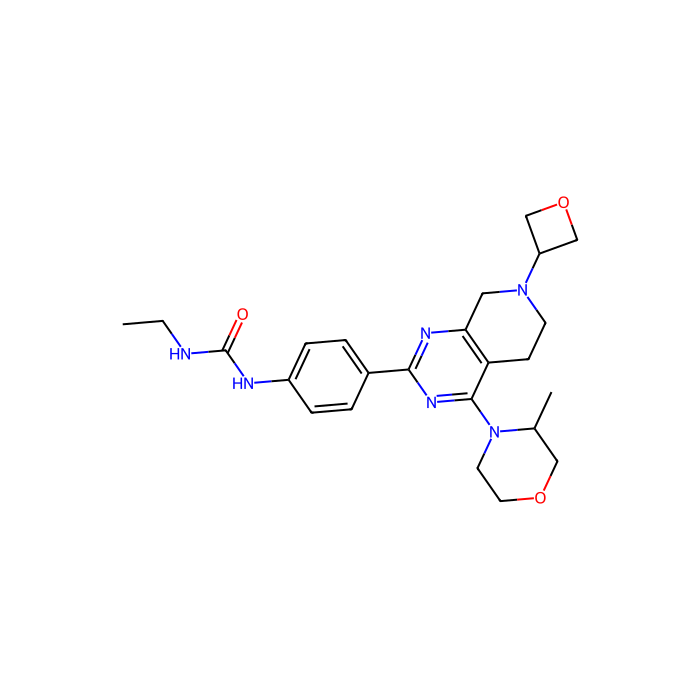
This compound belongs to the class of organic compounds known as pyridopyrimidines. These are compounds containing a pyridopyrimidine, which consists of a pyridine fused to a pyrimidine. Pyridine is 6-membered ring consisting of five carbon atoms and a nitrogen atom. Pyrimidine is a 6-membered ring consisting of four carbon atoms and two nitrogen centers at the 1- and 3- ring positions.
External Descriptors
Not available
1. Djoumbou Feunang Y, Eisner R, Knox C, Chepelev L, Hastings J, Owen G, Fahy E, Steinbeck C, Subramanian S, Bolton E, Greiner R, and Wishart DS. ClassyFire: Automated Chemical Classification With A Comprehensive, Computable Taxonomy. Journal of Cheminformatics, 2016, 8:61.
Determine the necessary mass, volume, or concentration for preparing a solution.
Dilution Calculator
Determine the dilution needed to prepare a stock solution.
Reconstitution Calculator
Reviews
Customer Reviews
Application Protocols
Validated application types and dilutions are not provided for this item.
General guidance for small-molecule screening compounds (not item-specific)
Stock preparation: Dissolve in anhydrous DMSO to 10–50 mM. Vortex and, if needed, sonicate briefly. Filter through 0.22 µm PTFE for light-scattering-sensitive readouts.
Plate handling: Dispense using acoustic or positive-displacement systems to ensure accuracy at low volumes. Maintain constant DMSO across wells.
Concentration–response: Prepare 8–12 point serial dilutions (1:2–1:3) to define potency curves; include vehicle controls.
Stability checks: Reassess concentration after plate staging (evaporation control) by including edge-well controls and/or LC–MS spot checks.
For assay-specific protocols (WB, IF, IHC, enzymatic assays), consult your internal SOPs and the primary literature relevant to the intended biological target.
Biological Roles
Item-specific biological targets or mechanisms of action are not provided in the Product Data for GDC-0349. The following guidance is general for small-molecule research compounds used in discovery biology.
Use context: Such compounds are commonly evaluated as chemical probes or leads in biochemical and cell-based assays to interrogate pathways of interest. Define your experimental hypothesis and readouts before use.
Assay development:
Establish concentration–response curves across several logs of concentration (e.g., 10-point, 1:3 serial dilutions) to estimate potency metrics appropriate to your assay (IC50/EC50; general practice).
Include vehicle controls matched for DMSO percentage and time-exposed controls.
Assess time dependence and reversibility by washout or preincubation protocols as relevant.
Counterscreens:
Rule out assay interference by testing in orthogonal readouts and in the presence of detergents or serum proteins if aggregation or nonspecific binding is a concern.
Evaluate cytotoxicity separately (e.g., CellTiter-Glo) to decouple target engagement from general viability effects.
Stability and adsorption:
Test for instability in culture media (serum esterase activity, pH effects) and adsorption to plastics; precondition plates/tips or use low-bind plastics.
For definitive target information, consult primary literature or the SDS/CoA associated with this exact compound identity and lot.
Buffer Applications
While this compound is not a buffering agent, practical buffer-related guidance is relevant for assay preparation.
General practices for dosing from DMSO stocks (not item-specific)
Vehicle control: Keep final DMSO constant across all conditions (commonly 0.1–0.5% v/v; do not exceed your assay’s validated tolerance).
Dilution sequence: Add the DMSO stock to buffer last with rapid mixing to avoid local supersaturation. Pre-warm buffer (25–37°C) to aid dissolution if permitted by assay design.
Typical assay buffers: PBS, HBSS, or HEPES-buffered saline for phenotypic assays; custom kinetic buffers for biochemical assays (pH 6.5–7.5). Protein-containing media can improve apparent solubility via binding but may alter free concentration.
Surfactants: A low level of non-ionic surfactant (e.g., 0.01–0.05% Tween-20/80 or 0.01% Pluronic F-127) can reduce aggregation and surface adsorption; validate to avoid target interference.
Filtration/clarity: If precipitation is observed after dilution, briefly sonicate and/or filter (0.22 µm) and re-verify concentration by UV/LC where applicable.
Plate-based work
Prepare intermediate aqueous dilutions to minimize DMSO spikes.
Use low-bind tips and plates to mitigate loss from nonspecific adsorption.
Buffer recipes and pH ranges are determined by the biological assay requirements; this item provides no intrinsic buffering capacity.
Green Alternatives
Because this item is a discrete small-molecule screening compound rather than a process solvent or reagent, “green alternative” considerations are generally not applicable.
If your workflow involves preparing solutions, you can improve the environmental footprint by:
Favoring ethanol or water-cosolvent systems over dipolar aprotic solvents when solubility and assay compatibility allow (general guidance).
Minimizing DMSO concentration and total organic solvent volume in screening plates.
Using miniaturized assay formats (low µL scale) to reduce solvent consumption.
No greener chemical substitute is relevant here because the compound identity itself is the object of study. Optimize handling conditions and solvent choices to align with green chemistry principles without altering the test article.
Pharmaceutical Uses
No medical or therapeutic claims are made for this product. It is supplied strictly for research use.
Formulation and developability studies (general guidance; not item-specific)
Solid-state characterization: If larger quantities are available, investigate polymorph/salt form by PXRD and DSC; the Product Data do not specify salt form for this item.
Stability: Conduct forced-degradation studies (acid/base, oxidative, thermal, photolytic) to map degradation pathways and to support analytical method robustness.
Compatibility: Assess adsorption to tubing, filters, and stoppers; silicone and certain elastomers can absorb lipophilic compounds.
Regulatory: There is no stated pharmacopeial grade; this material is for non-GMP research only.
Excipient compatibility (general)
For parenteral model systems, consider solubilizers like captisol/cyclodextrins or mixed cosolvent systems at experimentally safe osmolality and pH.
For oral model systems, evaluate lipid-based formulations (self-emulsifying systems) if aqueous solubility is limiting.
Always confirm the exact salt form, purity, and residual solvent profile from the CoA before any preformulation or ADME/PK study.
Physical Properties
Item-specific physicochemical constants are not provided in the Product Data. Do not use the following as specifications.
Appearance: Not specified for this item; refer to CoA/Spec Sheet.
Melting point: Not specified for this item; refer to CoA/Spec Sheet.
Boiling point: Not applicable/unknown for a non-volatile small molecule; Not specified for this item; refer to CoA/Spec Sheet.
Density: Not specified for this item; refer to CoA/Spec Sheet.
Solubility: Not specified for this item; refer to CoA/Spec Sheet.
LogP, pKa, refractive index: Not specified for this item; refer to CoA/Spec Sheet.
General laboratory guidance (literature/practice; not item-specific)
Stock solutions for drug-like screening compounds are commonly prepared in anhydrous DMSO at 10–50 mM, then diluted into aqueous assay buffers, keeping final DMSO ≤0.1–1% v/v to minimize biological interference.
If aqueous solubility is limited, consider co-solvents (DMF, ethanol) or inclusion of non-ionic surfactants (e.g., 0.01–0.05% Tween-80) in bioassays; verify compatibility with your assay.
Pre-screen solubility by incremental addition of solvent with visual inspection and/or nephelometry; filter through 0.22 µm prior to light-scattering-sensitive assays.
Analytical characterization (general best practices)
Confirm identity/purity by LC–MS and 1H NMR where possible. Establish an HPLC method (C18, gradient water/ACN + 0.1% formic acid) and confirm single major peak and expected mass adducts.
Hygroscopicity/polymorphism are unknown for this lot; assess mass change upon open-air handling if your method is moisture-sensitive.
Quality & Grades
Grade/Purity: Not specified for this item; refer to CoA/Spec Sheet.
Context and expectations
Screening-library compounds are typically provided at high chemical purity suitable for discovery research (e.g., LC–UV/HPLC purity reporting). However, exact assay suitability (cell-based, biochemical) depends on your internal acceptance criteria and must be verified lot-by-lot.
Chromatographic purity vs. assay purity: Single-peak HPLC does not preclude trace residual solvents, counter-ions, or stereoisomeric content. If your application is sensitive, request full analytical documentation (HPLC trace, LC–MS, residual solvent GC, water content, and if applicable, chiral purity).
Stabilizers/salt form: Not specified for this item; refer to CoA/Spec Sheet. Salt form and counter-ions can significantly affect solubility and mass calculations; verify prior to solution prep.
Recommended incoming QC (general guidance)
Identity confirmation: LC–MS (accurate mass), 1H NMR in DMSO-d6 or CDCl3 as appropriate.
Purity check: Analytical RP-HPLC (C18) with UV at multiple wavelengths; assess for late/early coeluters.
Water/residual solvents: Karl Fischer and GC headspace if relevant to your workflows.
Documentation
Use the SKU (G128080) and CAS (1207360-89-1) when requesting CoA/SDS. The CoA contains the authoritative specifications for this exact item/lot.
Reaction & Applications
This product is supplied as a research small molecule for screening and discovery workflows rather than as a synthetic reagent.
Synthetic reaction applications (e.g., as a catalyst, coupling partner, or reagent): Not typically applicable.
Practical uses (general for screening compounds):
Preparation of DMSO stocks for high-throughput screening (HTS) or targeted panel assays.
Reference standard in LC–MS method development for bioanalytical or ADME studies when appropriate to your project.
Positive/negative control in phenotypic assays, contingent on your lab’s established knowledge of the compound’s activity (not provided here; consult primary literature/CoA).
Methodological notes (general)
Maintain consistent vehicle concentration across assay wells/tubes.
Verify compound stability in your assay media over the experimental timeframe (e.g., 4–24 h) using LC–MS.
Avoid freeze–thaw cycling of DMSO stocks; prepare aliquots.
For applications requiring chemical transformation or derivatization, procure appropriately functionalized analogs; this catalog item is not presented with functional handles or reactivity data.
Reaction Conditions
Not applicable. This product is not offered as a chemical reagent for use in synthetic transformations, and no item-specific reactivity or catalytic behavior is provided.
General laboratory handling conditions for solution preparation (not a specification)
Dissolution: Prepare concentrated stock solutions in anhydrous DMSO under ambient conditions; gentle warming (≤40°C) and vortexing/sonication may aid dissolution.
Light/moisture sensitivity: Unknown for this item; protect from excessive light and moisture until confirmed stable.
Compatibility: Avoid strong oxidants/bases/acids during handling unless stability has been verified.
For synthetic reaction planning, consult literature specific to the scaffold; do not infer reactivity from this listing.
Safety & Handling
Safety summary for laboratory research use only.
GHS classification: Not specified for this item; refer to SDS.
Signal word / H-statements / pictograms: Not specified for this item; refer to SDS.
Primary hazards (general for drug-like organics): May cause skin/eye irritation, respiratory irritation, and harmful effects if ingested or inhaled. Handle as a potentially bioactive small molecule.
Best practices (general guidance; defer to SDS)
Engineering controls: Work in a fume hood or ventilated enclosure when weighing and preparing solutions. Avoid aerosolization and dust formation.
PPE: Lab coat, safety glasses, and disposable nitrile gloves. Change gloves frequently when handling DMSO solutions due to skin permeability.
Weighing/transfer: Use antistatic measures; minimize open handling. For potent compounds, consider containment (balance enclosure) and low-retention tips.
Storage incompatibilities: Keep away from strong oxidizers and acids/bases until compatibility is known (general precaution). Store as supplied at the temperature indicated below.
First aid (overview): In case of contact, rinse affected area with water for ≥15 min. If inhaled, move to fresh air. If ingested or in case of exposure concerns, seek medical attention. Provide SDS to responders.
Spill/cleanup: Avoid dust; dampen and collect with inert absorbent. Dispose as hazardous organic waste in accordance with local regulations.
Thermal decomposition: Unknown for this item; avoid overheating and ignition sources.
Always consult the product SDS for authoritative hazard, toxicological, and disposal information.
Solvent Selection
Solvent considerations for preparing research stocks and working solutions of a drug-like small molecule when item-specific solubility data are not provided.
Primary solvent for stocks: Anhydrous DMSO is typically preferred due to broad solvating power for heteroaromatic and polycyclic organics and compatibility with most bioassays at low final %.
Alternative organic vehicles: DMF and NMP offer similar solvation but higher assay interference risk; ethanol or isopropanol can be used for more lipophilic yet alcohol-soluble compounds.
Aqueous handling: To achieve aqueous working solutions, prepare a concentrated DMSO stock and dilute into buffer with vigorous mixing; maintain final DMSO ≤0.1–1% v/v. Use surfactants (e.g., 0.01–0.05% Tween-80) only if validated for your assay.
pH adjustments: For ionizable compounds (unknown here), modest pH shifts (±1 unit) can improve solubility. Confirm compound stability vs. hydrolysis at altered pH before use.
Filtration: 0.22 µm PVDF or PTFE syringe filters are generally compatible with DMSO- or alcohol-based solutions; avoid nylon if strong hydrogen bonding or adsorption is suspected.
Comparison (general)
DMSO: highest solvency, low volatility; biological tolerance limited to ≤1%.
Ethanol: more volatile, broader biological tolerance up to a few percent; lower solvency for apolar heterocycles.
DMF/NMP: strong solvency; potential cell toxicity and regulatory concerns; reserve for biochemical assays only.
Tip: Perform a small-scale solubility screen (DMSO, ethanol, DMF) with visual inspection and LC–UV confirmation to ensure homogeneous dosing.
Storage & Reconstitution
Storage
Storage conditions (Product Data): Store at -20°C.
Shipping (Product Data): Shipped in ice chest with ice pads.
Container: Keep tightly sealed in original container. Protect from moisture and light until stability is established.
Reconstitution (general guidance; not a specification)
Solvent: Prepare concentrated stock solutions in anhydrous DMSO (typical 10–50 mM for screening use). Adjust concentration to your assay needs and solubility limits.
Technique: Allow vial to reach room temperature in a desiccator before opening to prevent moisture condensation. Weigh quickly. Add solvent in small increments with vortexing/sonication until fully dissolved.
Filtration: If particulate persists, filter through 0.22 µm PTFE or PVDF.
Aliquoting: Dispense into single-use, low-bind microtubes to avoid repeated freeze–thaw.
Stability (general)
Frozen DMSO stocks are commonly stored at −20°C to −80°C. Avoid frost-free freezers that cycle temperatures.
Minimize freeze–thaw: Thaw on ice or at room temperature, use immediately, and refreeze unopened aliquots only.
Aqueous working solutions are typically prepared fresh and used the same day; verify stability by LC–MS if longer storage is required.
Always defer to the item’s CoA/SDS for any item-specific stability or storage constraints.
Structure & Identity
Brief identity overview for a small‑molecule research compound supplied as part of a screening library entry.
Product name: GDC-0349 (screening compound; small molecule)
CAS: 1207360-89-1 (Product Data)
PubChem CID: 59239165 (Product Data)
InChIKey: 315714 (as provided in Product Data)
SMILES: Not specified for this item; refer to CoA/Spec Sheet.
Molecular formula: Not specified for this item; refer to CoA/Spec Sheet.
Molecular weight: Not specified for this item; refer to CoA/Spec Sheet.
Structural features
Item-specific structural motifs (rings, heteroatoms, stereocenters): Not specified for this item; refer to CoA/Spec Sheet.
Notes
This listing is part of a “small molecules and compound libraries” category. Detailed stereochemistry and substructure annotations are typically provided on the item CoA/SDS; consult those documents for definitive identifiers.
If you plan to develop analytical methods (HPLC/LC–MS), request structural identifiers (SMILES/InChI) from the CoA to set up exact mass and fragment transitions.
Synthetic Utility
This catalog entry is a discrete research compound intended for screening and biological studies rather than a synthetic reagent or building block.
Functional group-based reactivity or named-reaction participation: Not applicable; no item-specific structure is provided to assess derivatization potential.
If analog synthesis or SAR exploration is desired, consult the primary literature for synthetic routes to the scaffold attributed to “GDC-0349” and obtain appropriately functionalized precursors. Do not attempt transformations on this material without established structural information and purity controls.
For medicinal chemistry campaigns, procure starting materials and intermediates with known handles (e.g., halides, boronates, amines, acids) rather than modifying a finished screening compound.
Target Specificity
Target, pathway, and binding data are not provided in the Product Data for this item.
Item-specific details such as biochemical target(s), binding constants, and selectivity profiles: Not specified for this item; refer to CoA/Spec Sheet and primary literature.
Researchers should rely on their internal references or published sources for target validation and selectivity matrices when designing experiments.
Frequently Asked Questions
What is the purity of this product?
This product is supplied at ≥99% purity (chemical assay). Lot-specific values are stated on the Certificate of Analysis.
How should this product be stored?
Store at ?20 °C. Freezer storage is required to maintain the specified shelf life.
How is this product shipped?
This product ships in an insulated container with ice pads. Unpack on arrival and transfer it to the storage condition stated above.
What are the CAS number, molecular formula and molecular weight?
The CAS Number is 1207360-89-1, the molecular formula is C24H32N6O3, and the molecular weight is 452.55 g/mol. InChIKey RGJOJUGRHPQXGF-INIZCTEOSA-N.
What documentation is provided?
Available product documentation, including Certificates of Analysis (COA), Safety Data Sheets (SDS), and specification sheets, is shown in the product document area. Document availability and access follow the current site policy.
We use cookies to ensure the website functions properly and, where permitted, to improve your experience. You can manage your preferences at any time in Settings. Learn more in our Cookie Policy.
Shall we send you a message when we have discounts available?
Remind me later
Thank you! Please check your email inbox to confirm.
Products are supplied to verified businesses, institutions, and qualified professionals for research and development use only. Not for use in humans, animals, diagnosis, or therapy.

 H2328646