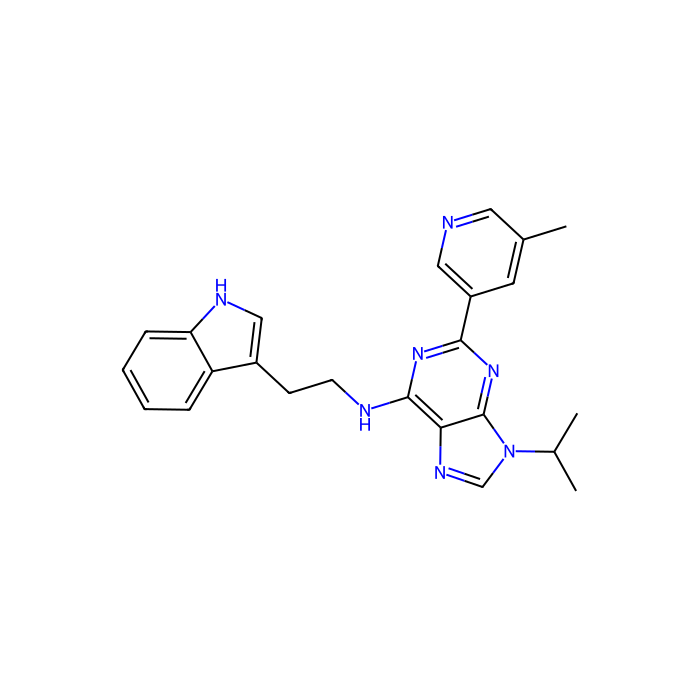
GNF351 GNF351 is a potent antagonist of aryl hydrocarbon receptor (AHR) . GNF351 interacts directly with the AHR ligand binding pocket and competes with a well-characterized photoaffinity AHR ligand for binding to the AHR with IC50 of 62 nM.
GNF351 is a potent antagonist of aryl hydrocarbon receptor (AHR). GNF351 interacts directly with the AHR ligand binding pocket and competes with a well-characterized photoaffinity AHR ligand for binding to the AHR with IC50 of 62 nM.
Storage
Store at -20°C
Shipped In
Ice chest + Ice pads
This product requires cold chain shipping. Ground and other economy services are not available.
This compound belongs to the class of organic compounds known as pyridinylpyrimidines. These are compounds containing a pyridinylpyrimidine skeleton, which consists of a pyridine linked (not fused) to a pyrimidine by a bond.
External Descriptors
Not available
1. Djoumbou Feunang Y, Eisner R, Knox C, Chepelev L, Hastings J, Owen G, Fahy E, Steinbeck C, Subramanian S, Bolton E, Greiner R, and Wishart DS. ClassyFire: Automated Chemical Classification With A Comprehensive, Computable Taxonomy. Journal of Cheminformatics, 2016, 8:61.
Determine the necessary mass, volume, or concentration for preparing a solution.
Dilution Calculator
Determine the dilution needed to prepare a stock solution.
Reconstitution Calculator
Reviews
Customer Reviews
Application Protocols
No manufacturer-tested applications or protocols are provided in the Product Data for this item.
Recommended dilutions/controls/positive controls: Not specified for this item; refer to primary literature and develop pilot protocols appropriate to your assay system.
For authoritative handling and safety, always consult the product SDS and your institutional guidance.
Biological Roles
Context for researchers: GNF351 is widely referenced in the literature as a potent, selective antagonist of the aryl hydrocarbon receptor (AhR). The following is general, literature-based information intended to frame experimental design. It is not product-specific and should not be construed as clinical guidance.
Biochemical role: AhR is a ligand-activated transcription factor that, upon activation, translocates to the nucleus, dimerizes with ARNT, and regulates xenobiotic-response genes (e.g., CYP1A1/1B1). Antagonists like GNF351 are used to probe AhR-dependent signaling by blocking agonist-induced transcriptional programs.
Use cases in research:
Dissecting AhR pathway involvement in xenobiotic metabolism, immune modulation, and barrier tissue biology.
Counter-screening in systems exposed to environmental ligands (e.g., dioxin-like compounds, indoles, tryptophan metabolites) to separate AhR-specific from off-target effects.
Validating target engagement via readouts such as CYP1A1 mRNA/protein induction, XRE-luciferase reporter assays, or chromatin immunoprecipitation of AhR target promoters.
Selectivity considerations: Literature reports describe GNF351 as selective for AhR antagonism with low intrinsic agonist activity under typical assay conditions; however, selectivity and potency can be cell-type and context dependent. Confirm with internal controls and orthogonal assays.
Note: Actual potency (IC50/Ki), permeability, and metabolic stability values are assay- and system-dependent. Verify with primary literature and your own pilot studies.
Buffer Applications
Not typically applicable. GNF351 is not a buffering agent and does not define a pH range in aqueous systems.
Practical note:
If used in aqueous buffers for assays, the compound is generally delivered from an organic stock (e.g., DMSO) into the buffer. Validate solubility and avoid precipitation by adding the solution slowly with vigorous mixing, keeping the final cosolvent percentage within assay tolerances.
Green Alternatives
Not typically applicable. GNF351 is a research-grade bioactive tool compound rather than a process solvent or bulk reagent where green substitution frameworks (e.g., solvent selection guides) are most relevant.
Sustainability considerations (general):
Prefer minimal-scale use consistent with experimental need.
Use high-boiling polar aprotic solvents (DMSO/DMF) judiciously; recover or minimize where possible.
Dispose of solutions and residues according to institutional hazardous waste protocols.
For greener choices in solvent-intensive workflows, consider established solvent substitution guides (e.g., replacing DMF with safer alternatives where feasible).
Pharmaceutical Uses
No pharmacopeial or excipient role is specified for this item. GNF351 is supplied strictly for research use only and is not intended for human or veterinary use.
Formulation context for in vitro research (general):
Stock solutions are commonly prepared in DMSO for distribution to microtiter plates in screening campaigns.
For in vivo or preclinical formulation development, consult institutional approval processes and do not apply this catalog item without appropriate qualifications and source documentation.
Physical Properties
Item-specific physicochemical properties are not provided in the Product Data for this listing.
Appearance: Not specified for this item; refer to CoA/Spec Sheet.
Melting point: Not specified for this item; refer to CoA/Spec Sheet.
Boiling point: Not applicable/unknown for a non-volatile screening solid; item-specific value not provided.
Density: Not specified for this item; refer to CoA/Spec Sheet.
LogP, pKa, refractive index: Not specified for this item; refer to CoA/Spec Sheet.
Aqueous/organic solubility: Not specified for this item; refer to CoA/Spec Sheet.
Practical lab guidance (general, non-spec):
Bioactive screening compounds of this class are commonly formulated as concentrated DMSO stocks (e.g., 10–50 mM), then diluted into assay buffer or media, keeping final DMSO ≤0.1–0.5% v/v as assay tolerance allows. Verify solubility and stability empirically.
If crystallinity or poor wetting is observed, brief sonication or gentle warming (≤37 °C) of sealed vials can aid dissolution. Avoid prolonged heating or light exposure until stability is confirmed for your lot.
Important: Treat any literature property values as approximations only. For specification-critical work (chromatography, formulation, QC), use the lot-specific CoA/SDS.
Quality & Grades
Grade/Purity: Not specified for this item; refer to CoA/Spec Sheet for assay purity, residual solvents, and related substances.
Context and expectations (general for screening compounds):
Research-grade small-molecule tools are typically supplied at high assay purity (e.g., ≥95% by HPLC/LC–MS) to support biological screening. Exact analytical methods (HPLC conditions, detectors, and reference standards) are lot-specific; consult the CoA.
If UV/fluorescence detection or LC–MS quantification is planned, review the CoA for the chromatographic purity, UV spectrum, and mass spectrum. These are critical for setting detection wavelengths and MRM transitions.
Stabilizers/inhibitors: Not specified for this item. If present, the CoA/SDS will note them and they should be considered in biological assays to avoid confounding effects.
Practical QC tips:
Verify identity/purity upon receipt with orthogonal methods where possible (e.g., HPLC-UV + HRMS, or 1H NMR).
For sensitive biological assays, consider a quick solubility check and stability spot test (e.g., LC–MS after 24–48 h in assay buffer at working temperature) before committing resources.
Reaction & Applications
This item is a bioactive small molecule intended for research screening and mechanistic biology, not a general synthetic reagent.
Synthetic reactions: No manufacturer-specified use as a reagent, catalyst, or ligand. If employed in chemistry workflows, it would typically be as an analyte/standard rather than a transformation promoter.
Analytical applications (general): Can serve as a positive/negative control compound in target-based assays after identity/purity confirmation.
If you require a reagent for transformations (e.g., coupling, oxidation, reduction), please consult appropriate sections of the Aladdin catalog (e.g., catalysts, ligands, protecting-group reagents) that are designed and specified for synthetic use.
Reaction Conditions
Not applicable in the usual synthetic sense. No manufacturer guidance is provided for using GNF351 as a reagent or catalyst.
Analytical handling (general guidance):
Stock preparation: Dissolve in anhydrous DMSO to desired concentration (e.g., 10–50 mM), vortex and, if necessary, sonicate briefly. Filter through 0.2 µm PTFE if particulate persists.
Assay dilution: Add DMSO stock to buffer/media under vigorous mixing to avoid local supersaturation. Typical final DMSO tolerances are 0.1–0.5% v/v for many biochemical/cell assays (verify locally).
Stability checks: Confirm short-term stability in the intended assay matrix by LC–MS or HPLC-UV over the assay timeframe.
Safety & Handling
Safety information specific to this item is not provided in the Product Data and may vary by lot/formulation.
GHS Classification / Signal Word / H-Statements / Pictograms: Not specified for this item; refer to SDS.
Primary use: For research use only (non-clinical, non-diagnostic).
General hazards (class-level): Small-molecule bioactives may present risks of skin/eye irritation or organ toxicity upon significant exposure. Handle as a substance of unknown acute toxicity.
Recommended controls (general):
Engineering: Handle powders/solutions in a chemical fume hood. Avoid aerosolization and dust generation.
PPE: Lab coat, safety glasses, and chemically resistant gloves (e.g., nitrile). Consider double-gloving for DMSO solutions.
Hygiene: Avoid ingestion, inhalation, and skin contact. Wash thoroughly after handling. Do not pipette by mouth.
Storage and incompatibilities:
Storage (item-specific): Store at −20 °C (per Product Data). Protect from moisture and light until stability is confirmed.
Incompatibilities (general): Strong oxidizers and strong acids/bases may cause degradation for many aromatic/heteroatom-rich bioactives; verify per SDS.
First aid (overview; defer to SDS):
Skin/eye contact: Rinse with water for ≥15 minutes. Remove contaminated clothing.
Inhalation: Move to fresh air; seek medical attention if symptoms persist.
Ingestion: Rinse mouth; seek medical attention. Provide SDS to healthcare personnel.
Solvent Selection
This product is a small-molecule research tool rather than a process solvent.
Item-specific solubility data are not provided. For many bioactive heteroaromatic compounds:
Good solvents (general): DMSO, DMF, NMP; sometimes ethanol/acetonitrile depending on structure.
Limited solubility: Water and non-polar hydrocarbons.
Strategy for use in assays:
Prepare a concentrated stock in anhydrous DMSO (e.g., 10–50 mM), filter if needed (PTFE, 0.2 µm), and store aliquots at −20 °C to minimize freeze–thaw.
Dilute into pre-warmed media/buffer with vigorous mixing to avoid precipitation; keep final DMSO within assay-tolerated limits.
Comparison (general guidance):
DMSO: Highest solvating power for diverse bioactives; may affect cells at >0.5–1% v/v.
Ethanol/Acetonitrile: Lower solvating power but often more benign to some systems; volatility can complicate dosing accuracy.
Always verify solvent compatibility with your assay system (enzymatic/cellular) and confirm solubility empirically for your lot.
Storage & Reconstitution
Item-specific instructions from Product Data:
Storage: Store at −20 °C.
Shipping: Ice chest + ice pads.
Additional general guidance (non-spec; verify locally):
Protection: Keep tightly sealed under dry, inert atmosphere if possible; protect from light until stability is established.
Aliquoting: Upon first opening, prepare single-use DMSO stock aliquots (e.g., 100–500 µL) to minimize freeze–thaw cycles and headspace moisture.
Freeze–thaw: Avoid repeated cycles; thaw on ice or at room temperature, mix gently, and promptly return unused aliquots to −20 °C.
Aqueous use: If diluting into buffer/media, add the DMSO stock slowly with mixing to prevent precipitation. Use freshly prepared working solutions.
For firm, lot-specific stability (e.g., shelf life, solution stability at 4 °C/RT, light sensitivity), consult the CoA/SDS or perform a small-scale stability check by LC–MS/HPLC-UV.
Structure & Identity
Brief overview: GNF351 is a cataloged small-molecule research compound (often cited in literature as an aryl hydrocarbon receptor antagonist). Item-specific identifiers from this listing are limited.
Product Name: GNF351 (catalog/trade name)
SKU: G413679
CAS: 1227634-69-6
PubChem CID (literature): 46216378
InChIKey (as supplied in Product Data): 1417 (note: this appears incomplete for a standard InChIKey format; consult CoA/SDS for the definitive identifier)
SMILES: Not specified for this item; refer to CoA/Spec Sheet.
Molecular Formula: Not specified for this item; refer to CoA/Spec Sheet.
Molecular Weight: Not specified for this item; refer to CoA/Spec Sheet.
Structural features (general, literature-based, non-item-specific):
Reported in the literature as a synthetic, non-natural small molecule designed to antagonize the aryl hydrocarbon receptor (AhR). Detailed ring/heteroatom features should be verified against the CoA or authoritative databases before method development.
2D structural description (general guidance):
Without an item-specific SMILES or structure diagram, only high-level description is appropriate. Users should obtain the structure drawing from the CoA/SDS or a trusted database (matching the exact CAS and lot) for computational work, spectral assignment, or method validation.
Synthetic Utility
Not a typical building block or reagent. GNF351 is a target-engagement tool compound and is generally not employed to effect chemical transformations.
Potential uses in chemistry labs (general):
Reference standard: May be used to develop/validate analytical methods (LC–MS/MS, HPLC-UV) for quantifying AhR antagonists in matrices.
Degradation studies: Forced-degradation profiling (acid/base/oxidative/light) can elucidate stability-indicating methods and potential liabilities (for internal QC), though conditions and outcomes are compound-specific and should be developed cautiously at small scale.
Target Specificity
Item-specific target details (antigen/epitope/clone/isotype) are not applicable; this is a small-molecule compound, not an antibody or protein reagent.
Manufacturer-provided target specificity data: Not specified for this item.
Frequently Asked Questions
What is the purity of this product?
This product is supplied at ≥98% purity (chemical assay). Lot-specific values are stated on the Certificate of Analysis.
How should this product be stored?
Store at ?20 °C. Freezer storage is required to maintain the specified shelf life.
How is this product shipped?
This product ships in an insulated container with ice pads. Unpack on arrival and transfer it to the storage condition stated above.
What are the CAS number, molecular formula and molecular weight?
The CAS Number is 1227634-69-6, the molecular formula is C24H25N7, and the molecular weight is 411.5 g/mol. InChIKey ABXIUYMKZDZUDC-UHFFFAOYSA-N.
What documentation is provided?
Available product documentation, including Certificates of Analysis (COA), Safety Data Sheets (SDS), and specification sheets, is shown in the product document area. Document availability and access follow the current site policy.
We use cookies to ensure the website functions properly and, where permitted, to improve your experience. You can manage your preferences at any time in Settings. Learn more in our Cookie Policy.
Shall we send you a message when we have discounts available?
Remind me later
Thank you! Please check your email inbox to confirm.
Products are supplied to verified businesses, institutions, and qualified professionals for research and development use only. Not for use in humans, animals, diagnosis, or therapy.

 I2623178