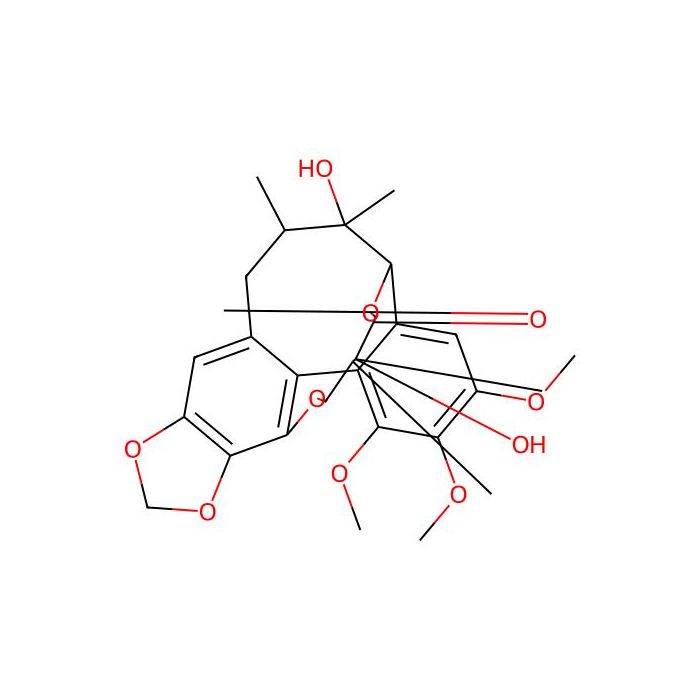
Gomisin D - Moligand™,≥98% , CAS No.60546-10-3

CAS: 60546-10-3 Cat. No.: G664354 Molecular Weight: 530.56
AVAILABLE TO ORDER
GRADE & PURITY Moligand™ ? Moligand™ — Aladdin's line of ligands and bioactive small molecules. Use for receptor, pathway, and binding studies needing defined small-molecule tools. ≥98%
Synonyms
(11R,12R,15S,24S,25S)-12,25-dihydroxy-18,19,20-trimethoxy-11,12,24,25-tetramethyl-4,6,9,14-tetraoxapentacyclo[13.7.3.03,7.08,22.016,21]pentacosa-1,3(7),8(22),16,18,20-hexaen-13-one
Storage
Protected from light,Store at -20°C,Argon charged
Shipped In
Ice chest + Ice pads
 ·  off list, applied to all prices below.
Size
Status
Price
Qty
1mg
G664354-1mg
8-12 wks(?) Production requires sourcing of materials. We appreciate your patience and understanding.
$55.90
5mg
G664354-5mg
8-12 wks(?) Production requires sourcing of materials. We appreciate your patience and understanding.
$129.90
25mg
G664354-25mg
8-12 wks(?) Production requires sourcing of materials. We appreciate your patience and understanding.
$329.90
Enter a quantity for the sizes you want to add.
🧪

Why this grade

Moligand™,≥98% Moligand™ for sensitive chromatographic and analytical workflows requiring minimal baseline interference.

🌡

Storage & shipping

Protected from light,Store at -20°C,Argon charged Ships Ice chest + Ice pads Check lot-specific COA for exact specifications.

📋

Quality documents

SDS, COA, datasheet, and spec sheet available for download. Lot-specific COA accessible via lot number lookup.

📚

Literature proof

Cited in 0 peer-reviewed publications across chromatography, organic synthesis, and cross-coupling reactions.

Overview

Gomisin D is a lignan that binds to PDGFRβ with a Kd of 10 μM. By targeting PDGFRβ to regulate signaling pathways, Gomisin D inhibits the activation and proliferation of hepatic stellate cells and promotes their apoptosis, thereby ameliorating hepatic fibrosis. Gomisin D exhibits multiple activities such as photoprotection, antimelanogenesis, antioxidant effects, and hypoglycemic activity. Gomisin D can be used in studies related to diabetes, Alzheimer's disease, and hepatic fibrosis.

Specifications

Synonyms
(11R, 12R, 15S, 24S, 25S)-12, 25-dihydroxy-18, 19, 20-trimethoxy-11, 12, 24, 25-tetramethyl-4, 6, 9, 14-tetraoxapentacyclo[13.7.3.03, 7.08, 22.016, 21]pentacosa-1, 3(7), 8(22), 16, 18, 20-hexaen-13-one
Specifications & Purity
Moligand™, ≥98%
Storage
Protected from light, Store at -20°C, Argon charged
Shipped In
Ice chest + Ice pads
This product requires cold chain shipping. Ground and other economy services are not available.
Grade
Moligand™
Action Type
INHIBITOR
Purity
≥98%
Names and Identifiers
Canonical SmilesCC1CC2=CC3=C(C4=C2C5=C(C(=C(C=C5C(C1(C)O)OC(=O)C(C(CO4)C)(C)O)OC)OC)OC)OCO3
IUPAC Name12,25-dihydroxy-18,19,20-trimethoxy-11,12,24,25-tetramethyl-4,6,9,14-tetraoxapentacyclo[13.7.3.03,7.08,22.016,21]pentacosa-1,3(7),8(22),16,18,20-hexaen-13-one
InChIKeyVLLFEMVDMFTBHG-UHFFFAOYSA-N
INCHI1S/C28H34O10/c1-13-8-15-9-18-22(37-12-36-18)24-19(15)20-16(10-17(32-5)21(33-6)23(20)34-7)25(27(13,3)30)38-26(29)28(4,31)14(2)11-35-24/h9-10,13-14,25,30-31H,8,11-12H2,1-7H3
Isomeric SMILES CC1CC2=CC3=C(C4=C2C5=C(C(=C(C=C5C(C1(C)O)OC(=O)C(C(CO4)C)(C)O)OC)OC)OC)OCO3
MeSH Entry Terms gomisin D
Molecular Weight 530.56

Documentation

📋 Safety Data Sheet (SDS)

Comprehensive hazard, handling, storage, and regulatory compliance document.

Download SDS →

✅ Certificate of Analysis (COA)

Lot-specific quality data. Enter your lot number to retrieve the exact COA.

Look up COA →

📊 Datasheet

Quick-reference summary of product specifications and applications.

View datasheet →

🔬 Specification Sheet

Full quality attributes and acceptance criteria for this grade.

View spec sheet →

Advanced Data

Taxonomic Classification

Taxonomy Tree

KingdomOrganic compounds
SuperclassPhenylpropanoids and polyketides
ClassTannins
SubclassHydrolyzable tannins
Intermediate Tree Nodes Not available
Direct ParentHydrolyzable tannins
Alternative Parents Lignan lactones  Dibenzocyclooctadiene lignans  Benzodioxoles  Anisoles  Alkyl aryl ethers  Tertiary alcohols  Lactones  Carboxylic acid esters  Oxacyclic compounds  Monocarboxylic acids and derivatives  Acetals  Organic oxides  Hydrocarbon derivatives  Carbonyl compounds  
Molecular FrameworkAromatic heteropolycyclic compounds
Substituents Hydrolyzable tannin - Dibenzocyclooctane lignan - Lignan lactone - Benzodioxole - Anisole - Alkyl aryl ether - Benzenoid - Tertiary alcohol - Lactone - Carboxylic acid ester - Organoheterocyclic compound - Oxacycle - Monocarboxylic acid or derivatives - Ether - Acetal - Carboxylic acid derivative - Organooxygen compound - Carbonyl group - Organic oxygen compound - Organic oxide - Hydrocarbon derivative - Alcohol - Aromatic heteropolycyclic compound
DescriptionThis compound belongs to the class of organic compounds known as hydrolyzable tannins. These are tannins with a structure characterized by either of the following models. In model 1, the structure contains galloyl units (in some cases, shikimic acid units) that are linked to diverse polyol carbohydrate-, catechin-, or triterpenoid units. In model 2, contains at least two galloyl units C-C coupled to each other, and do not contain a glycosidically linked catechin unit.
External Descriptors Not available
3D Structure
Interactive Chemical Structure Model


Certificates(CoA,COO,BSE/TSE and Analysis Chart)
C of A & Other Certificates(BSE/TSE, COO):
Analytical Chart:
Chemical and Physical Properties
Sensitivitylight sensitive;Moisture sensitive
Molecular Weight530.600 g/mol
XLogP33.500
Hydrogen Bond Donor Count2
Hydrogen Bond Acceptor Count10
Rotatable Bond Count3
Exact Mass530.215 Da
Monoisotopic Mass530.215 Da
Topological Polar Surface Area122.000 Ų
Heavy Atom Count38
Formal Charge0
Complexity871.000
Isotope Atom Count0
Defined Atom Stereocenter Count0
Undefined Atom Stereocenter Count5
Defined Bond Stereocenter Count0
Undefined Bond Stereocenter Count0
The total count of all stereochemical bonds0
Covalently-Bonded Unit Count1
Solution Calculators
Reviews

Customer Reviews

Need help choosing the grade?

Our grade selection guide covers purity, stabilizer status, and application suitability for all variants in our catalog.

View Moligand™ grade guide →

Shall we send you a message when we have discounts available?

Remind me later

Thank you! Please check your email inbox to confirm.

Oops! Notifications are disabled.