
Determine the necessary mass, volume, or concentration for preparing a solution.
| Activity Type | Relation | Activity value | Units | Action Type | Journal | PubMed Id | doi | Assay Aladdin ID |
|---|
Information
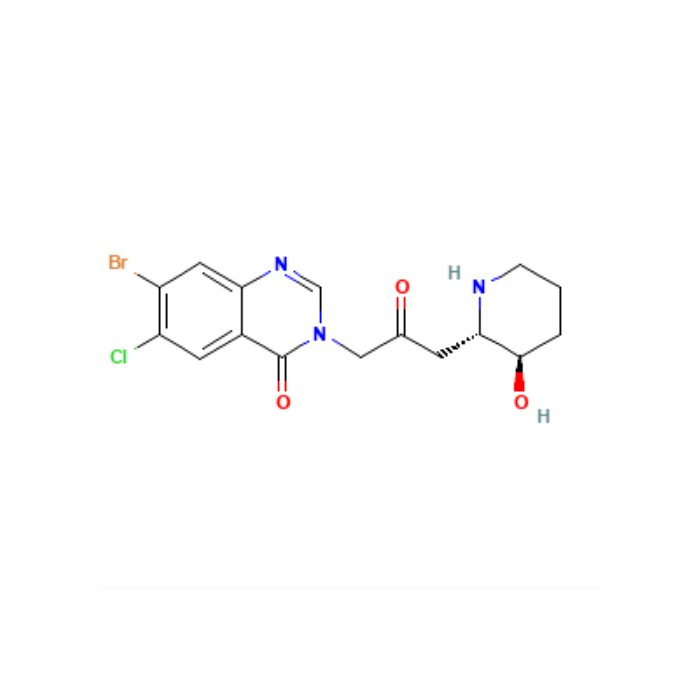
Halofuginone Halofuginone (RU-19110) is the competitively inhibitor of prolyl-tRNA synthetase with Ki of 18.3 nM.It could also down-regulate Smad3 and blocked TGF-β signaling at 10 ng/ml in mammal.
Targets
Smad3 ; prolyl-tRNA synthetase (Cell-free assay) ; 18.3nM(Ki)
In vitro
In mammals, halofuginone at 10 ng/ml down-regulates Smad3, blocking TGF-β signaling and preventing both the differentiation of fibroblasts to myofibroblasts and the transitioning of epithelial cells to mesenchymal cells.
In vivo
Halofuginone clearly extends the survival times of the parasite-infected mice. Oral treatment with halofuginone at doses of 0.2 and 1 mg/kg has an apparent curative effect for the infected mice.The subcutaneous administration of 0.2 mg of halofuginone per kg likewise extends the survival times of the infected mice, but none of the mice is cured. The mice in the 5-mg/kg dose groups die before the completion of treatment with the drug either orally or subcutaneously. Subcutaneous treatment with halofuginone appears to be more toxic to mice than oral treatment.
Cell Research(from reference)
Cell lines:primary murine CD4+ CD25− T cells/MEFs
Concentrations:5-20nM
Incubation Time:4 or 24hrs
Taxonomy Tree
| Kingdom | Organic compounds |
|---|---|
| Superclass | Organoheterocyclic compounds |
| Class | Diazanaphthalenes |
| Subclass | Benzodiazines |
| Intermediate Tree Nodes | Not available |
| Direct Parent | Quinazolines |
| Alternative Parents | Pyrimidones Piperidines Aryl bromides Aryl chlorides Benzenoids Beta-amino ketones Heteroaromatic compounds Secondary alcohols 1,2-aminoalcohols Lactams Azacyclic compounds Dialkylamines Hydrocarbon derivatives Organic oxides Organobromides Organochlorides Organopnictogen compounds |
| Molecular Framework | Aromatic heteropolycyclic compounds |
| Substituents | Quinazoline - Pyrimidone - Aryl bromide - Aryl chloride - Aryl halide - Beta-aminoketone - Benzenoid - Pyrimidine - Piperidine - Heteroaromatic compound - 1,2-aminoalcohol - Ketone - Lactam - Secondary alcohol - Secondary aliphatic amine - Azacycle - Secondary amine - Organobromide - Organohalogen compound - Amine - Alcohol - Organic nitrogen compound - Carbonyl group - Hydrocarbon derivative - Organic oxide - Organopnictogen compound - Organic oxygen compound - Organochloride - Organonitrogen compound - Organooxygen compound - Aromatic heteropolycyclic compound |
| Description | This compound belongs to the class of organic compounds known as quinazolines. These are compounds containing a quinazoline moiety, which is made up of two fused six-member aromatic rings, a benzene ring and a pyrimidine ring. |
| External Descriptors | Not available |
| Activity Type | Relation | Activity value | Units | Action Type | Journal | PubMed Id | doi | Assay Aladdin ID |
|---|
| Activity Type | Relation | Activity value | Units | Action Type | Journal | PubMed Id | doi | Assay Aladdin ID |
|---|
Find and download the COA for your product by matching the lot number on the packaging.
| Lot Number | Certificate Type | Date | Item |
|---|---|---|---|
 J2331063 | Certificate of Analysis | Aug 04, 2026 | H413919 |
| H2513666 | Certificate of Analysis | Jul 26, 2025 | H413919 |
| H2513667 | Certificate of Analysis | Jul 26, 2025 | H413919 |
| H2513668 | Certificate of Analysis | Jul 26, 2025 | H413919 |
| H2513669 | Certificate of Analysis | Jul 26, 2025 | H413919 |
| G2215614 | Certificate of Analysis | Apr 03, 2025 | H413919 |
| G2215615 | Certificate of Analysis | Apr 03, 2025 | H413919 |
| F2428465 | Certificate of Analysis | Apr 26, 2024 | H413919 |
| F2428466 | Certificate of Analysis | Apr 26, 2024 | H413919 |
| F2428467 | Certificate of Analysis | Apr 26, 2024 | H413919 |
| F2428468 | Certificate of Analysis | Apr 26, 2024 | H413919 |
| F2528074 | Certificate of Analysis | Apr 26, 2024 | H413919 |
| G2412322 | Certificate of Analysis | Apr 26, 2024 | H413919 |
| C2426061 | Certificate of Analysis | Jun 05, 2022 | H413919 |
| Solubility | Solubility (25°C) In vitro DMSO: 8 mg/mL (19.29 mM); Water: Insoluble; Ethanol: Insoluble; |
|---|---|
| Sensitivity | air sensitive |
| DMSO(mg / mL) Max Solubility | 20 |
| DMSO(mM) Max Solubility | 48.22996045 |
| Water(mg / mL) Max Solubility | <1 |
| Molecular Weight | 414.7 |
| XLogP3 | 1.400 |
| Hydrogen Bond Donor Count | 2 |
| Hydrogen Bond Acceptor Count | 5 |
| Rotatable Bond Count | 4 |
| Exact Mass | 413.014 Da |
| Monoisotopic Mass | 413.014 Da |
| Topological Polar Surface Area | 82.000 Ų |
| Heavy Atom Count | 24 |
| Formal Charge | 0 |
| Complexity | 533.000 |
| Isotope Atom Count | 0 |
| Defined Atom Stereocenter Count | 2 |
| Undefined Atom Stereocenter Count | 0 |
| Defined Bond Stereocenter Count | 0 |
| Undefined Bond Stereocenter Count | 0 |
| The total count of all stereochemical bonds | 0 |
| Covalently-Bonded Unit Count | 1 |
Not specified for this item; refer to CoA/Spec Sheet.
General, non-binding guidance for small-molecule probes (for planning only):
For validated, product-specific protocols (e.g., recommended assay concentrations, positive controls), consult the CoA/Spec Sheet or contact Aladdin Technical Support.
Context-only literature summary; not a claim about this specific lot/formulation. This product is for research use only.
Origin and class
Mechanistic themes (literature)
Research utilities
Practical considerations
All biological information above reflects general literature and should be confirmed experimentally for your specific application.
This product is a bioactive small molecule, not a buffering agent. It is not used to set or maintain solution pH.
For classical buffer recipes (HEPES, PBS, Tris, etc.), refer to dedicated buffering agents rather than this compound.
Because halofuginone is a specific bioactive probe rather than a commodity solvent or reagent, the concept of “green alternative” primarily concerns the choice of vehicle solvents and handling practices rather than replacing the active itself.
Greener vehicle considerations for stock solutions
Comparison of common vehicles (general)
Operational greening tips
Note: There is no direct “green substitute” for halofuginone’s biological activity. If your study only requires a mechanistic class effect (e.g., probing aminoacyl-tRNA synthetase pathways), survey alternative probes with safer/greener profiles in the literature and validate equivalency experimentally.
This product is supplied strictly for research use and is not an excipient or API grade material. No clinical or therapeutic claims are made.
Formulation context (general information only)
Pharmacopeial/compendial status
Manufacturing suitability
Documentation
Any exploration of formulation properties should remain within laboratory research constraints and institutional safety protocols.
Item-specific values provided in Product Data: none. Do not treat the following as specifications.
General/literature guidance (context only; not product specifications):
Practical notes (general):
For certified physical property values applicable to this exact catalog item, always rely on the CoA/Spec Sheet for the shipped lot.
Item-specific grade: Moligand™
What this means in practice
Suitability
Documentation
This product is supplied as a bioactive small molecule (chemical probe) rather than as a general-purpose synthetic reagent.
Applicability to synthetic chemistry
Research applications (general, non-clinical)
Practical notes for bioassays (general)
If your goal is preparative synthesis or reaction method development, consider dedicated reagents more suited to those roles; see the Synthetic Utility and Reaction Conditions tabs for rationale on limited applicability.
Not typically applicable. This product is a bioactive probe rather than a reagent used to promote or mediate chemical reactions.
If you are pursuing derivatization (advanced/med-chem context; literature guidance only):
Yields and conditions are highly substrate-specific and must be optimized experimentally. Stability studies under the chosen conditions are essential to ensure scaffold integrity.
For routine reaction-method development, consider more conventional substrates rather than this complex bioactive molecule.
Provided hazard metadata for this item are not specified. Treat halofuginone as a bioactive research chemical with appropriate caution.
GHS information (item-specific):
General precautions (good laboratory practice):
First-aid overview (general; defer to SDS):
Spill and disposal (general):
Always consult the product-specific SDS for authoritative hazard, toxicological, and regulatory information before use.
Halofuginone is typically handled as a solid that is reconstituted into assay-appropriate organic solvents.
Practical solvent choices (general/literature guidance)
Polarity/miscibility (context)
Selection guidance
Note: Actual solubility and stability depend on salt form and lot. For the catalog item H413919, specific solubility values are not specified; consult the CoA/Spec Sheet and perform a small-scale solubility check.
Storage (item-specific from Product Data)
Stability
Reconstitution (general guidance; not a specification)
Handling tips
For binding, lot-specific instructions (e.g., exact solubility, stability in solution), always follow the CoA/Spec Sheet packaged with SKU H413919.
Brief overview: Halofuginone (also known as RU-19110) is a febrifugine-derived small molecule commonly used as a chemical probe in pathway studies.
Item-specific identifiers (from Product Data)
Structural features (general/literature description; for context only)
2D structure (verbal description; literature)
Notes: Exact stereochemistry and salt form can vary by supplier/lot. For the definitive structural representation used for SKU H413919, consult the CoA/Spec Sheet provided with the product.
Halofuginone is not commonly used as a synthetic reagent or building block due to its complex, heteroaromatic, bioactive scaffold.
Reactivity considerations (general/literature)
When derivatization is attempted (research context)
Recommendation
In short, view halofuginone as a finished probe rather than a standard reagent, unless your objective is SAR around this scaffold.
Not specified for this item; refer to CoA/Spec Sheet.
Note: While literature frequently discusses molecular targets associated with halofuginone, Aladdin provides target information for specific catalog items only when supported by product-level data. Please consult the product documentation or contact Technical Support with your assay context.
Our grade selection guide covers purity, stabilizer status, and application suitability for all variants in our catalog.
View Moligand™ grade guide →