GRADE & PURITYAnalytical standard?Analytical standard — certified-purity material for quantitative calibration. Use to prepare calibration standards and validate analytical methods.
This compound belongs to the class of organic compounds known as bromobenzenes. These are organic compounds containing a bromine atom attached to a benzene ring.
External Descriptors
Not available
1. Djoumbou Feunang Y, Eisner R, Knox C, Chepelev L, Hastings J, Owen G, Fahy E, Steinbeck C, Subramanian S, Bolton E, Greiner R, and Wishart DS. ClassyFire: Automated Chemical Classification With A Comprehensive, Computable Taxonomy. Journal of Cheminformatics, 2016, 8:61.
Determine the necessary mass, volume, or concentration for preparing a solution.
Dilution Calculator
Determine the dilution needed to prepare a stock solution.
Reconstitution Calculator
Reviews
Customer Reviews
Application Protocols
No antibody/biological application protocols apply to this chemical standard. For analytical use:
GC‑ECD/GC‑MS calibration (general guidance)
Prepare serial dilutions of a weighed stock solution (e.g., in chlorobenzene or DMF) to cover the method’s calibration range.
Use clean glassware and PTFE‑lined caps to minimize adsorption.
Verify instrument response linearity and retention time stability; include a solvent blank and at least one mid‑level check standard.
Cross-coupling reaction setup (general guidance)
Dry glassware; charge catalyst/ligand, base, solvent, then add hexabromobenzene and coupling partner under inert atmosphere.
Heat to target temperature with efficient stirring; monitor by GC‑MS or LC‑MS.
These are general literature practices; consult your method SOPs and the SDS.
Biological Roles
Item-specific biological data: Not specified for this item; refer to literature.
General context (literature)
Hexabromobenzene has no known natural biological role; it is a synthetic, highly brominated aromatic compound.
Due to its hydrophobicity and chemical stability, related polybrominated aromatics can exhibit environmental persistence; any biological interactions are generally nonspecific, driven by hydrophobic partitioning rather than defined biochemical function.
In biochemical research, such compounds may be used as model xenobiotics for studying debromination pathways, sorption, or distribution in environmental matrices, but they are not biochemical reagents or metabolites.
Laboratory implications
Avoid biological system use unless the study specifically concerns fate/transport or analytical determination; for routine biochemistry, this compound is not typically relevant.
Handle to prevent environmental release; follow institutional policies for halogenated organics.
Buffer Applications
This compound is a hydrophobic, neutral, solid aromatic and is not used to prepare aqueous buffers or biological buffer systems. For laboratory work, focus instead on its roles as an analytical standard or as an aryl bromide substrate in organic synthesis. If an aqueous system must be used (e.g., biphasic catalysis), employ organic co‑solvents or surfactants and validate partitioning.
Green Alternatives
Considerations
Hexabromobenzene is a fully brominated aromatic with persistence and halogenated waste implications. Where feasible, evaluate less halogenated substrates or greener solvents.
Alternative strategies (literature/general)
Substrate alternatives: Use mono‑ or poly(bromo)benzene of lower halogen content when synthetic design permits, reducing halogenated waste and improving atom economy.
Solvent changes: Replace chlorinated aromatics with 2‑MeTHF, anisole, or CPME where solubility/reactivity allow. For challenging couplings, propylene carbonate can sometimes substitute polar aprotics.
Catalysis optimization: Employ highly active catalysts/ligands to lower temperature, shorten reaction time, and allow greener media (e.g., Pd‑NHC in anisole or 2‑MeTHF).
Comparison (general, qualitative)
o‑Dichlorobenzene vs 2‑MeTHF: o‑DCB offers high solubility and high bp for stubborn couplings but generates chlorinated waste; 2‑MeTHF is biorenewable, lower toxicity, but may not dissolve hexabromobenzene sufficiently and limits temperature.
DMF/NMP vs propylene carbonate: DMF/NMP provide excellent solvation and base compatibility but have regulatory concerns; propylene carbonate is greener yet more viscous and may solubilize substrates less effectively.
Analytical perspective
If used solely as a calibration standard, minimize solution volumes, select less hazardous solvents compatible with instrumentation (e.g., isopropanol/toluene mixtures if solubility suffices), and employ micro-scale standards to reduce waste.
Pharmaceutical Uses
Item-specific: No pharmacopeial listing or excipient role is provided for this item; Not specified for this item—refer to CoA/Spec Sheet.
General context (non-clinical)
In pharmaceutical analytical laboratories, hexabromobenzene may serve as an external or internal standard in the development/validation of GC‑ECD or GC‑MS methods, particularly for brominated aromatic impurities or degradation products.
It is not used as an active ingredient or typical excipient. Any usage would be confined to laboratory reference purposes under research/quality-control conditions only.
Practical notes
Prepare standards in suitable solvents (e.g., chlorobenzene, DMF) with documented purity corrections from the CoA.
Validate solution stability at storage temperatures; perbrominated aromatics are generally stable, but adsorption to glassware and low solubility can bias low‑level quantitation.
Physical Properties
Item-specific specifications
Appearance: Not specified for this item; refer to CoA/Spec Sheet.
Physical state: White to off‑white crystalline solid (literature)
Melting point: ~322–325 °C (literature; reported decomposition on strong heating)
Boiling point: Not well-defined; perbrominated benzenes typically decompose before boiling at 1 atm (literature)
Density: High relative density expected for polybrominated aromatics (literature; specific value not stated here)
Solubility: Practically insoluble in water; soluble in chlorinated aromatics (e.g., chlorobenzene, o‑dichlorobenzene), nitrobenzene, and polar aprotics such as DMF/DMSO at elevated temperature (literature)
Vapor pressure: Very low at ambient conditions (literature)
LogP: High (strong hydrophobicity) due to six bromine substituents (literature)
Refractive index: Not applicable to solid; solution nD depends on solvent (literature)
Practical notes for users (general)
Dissolution often benefits from warming and use of high‑boiling, moderately polar aromatic solvents (chlorobenzene, o‑DCB) or dipolar aprotics (DMF, NMP).
Material is thermally robust in the solid state but avoid prolonged exposure to temperatures near/deabove its melting point to mitigate decomposition.
Hygroscopicity is negligible; however, keep dry to prevent adventitious hydrolysis of sensitive reagents used alongside it.
Quality & Grades
Item-specific grade (from Product Data)
Analytical standard: Intended for use as a reference/calibration material in analytical methods. Batch-to-batch consistency, identity confirmation, and high purity suitable for quantitative work are prioritized.
What “Analytical standard” typically entails (general guidance; not a specification)
Purity characterization by orthogonal methods (e.g., GC/GC‑MS, NMR) to support use as a calibrant or system suitability standard.
Low and well-characterized impurity profile; documentation (CoA) provides exact assay, residual solvent(s), and trace impurities where relevant.
Traceability: Where applicable, link to primary standards or certified reference materials. Check CoA for uncertainty budgets and use-by dates.
Practical implications for this item
Use for calibration of GC‑ECD/GC‑MS methods quantifying brominated aromatics, flame retardants, or for mass-balance checks in halogen content determinations.
For photometric or LC applications, verify solubility and UV background in your chosen solvent; perbrominated aromatics have limited UV chromophores but can show baseline effects at short wavelengths.
For regulated methods, retain the item’s CoA and ensure solution preparation records include mass, purity correction factors, and stability intervals.
Stabilizers/antioxidants: Not specified for this item; refer to CoA/Spec Sheet.
Reaction & Applications
Analytical uses (aligned with Analytical standard grade)
Reference material for calibration/response‑factor determination in GC‑ECD and GC‑MS for brominated aromatics and related flame‑retardant studies.
Internal/external standard for mass-balance studies in debromination or coupling reactions.
Synthetic applications (literature/general)
Multisite cross-coupling: As a hexa‑aryl bromide, it can undergo Pd‑catalyzed Suzuki–Miyaura, Stille, or Negishi couplings to afford hexa‑substituted benzenes. Steric/electronic deactivation necessitates robust catalysts, elevated temperature, and high‑boiling solvents.
Stepwise diversification: Partial coupling enables access to lower brominated intermediates and mixed substitution patterns; careful control of equivalents/catalyst loading is required to avoid overreaction.
Reductive debromination: Metals (e.g., Zn, Fe) or catalytic hydrogenolysis can give penta‑ to mono‑bromobenzenes, useful as positional isomer standards.
Surface‑assisted or on‑surface coupling: Employed as a precursor for extended aromatic frameworks on metal surfaces (literature reports) after C–Br activation.
Practical tips
Catalyst systems: Pd(PPh3)4 or Pd2(dba)3 with bulky electron‑rich phosphines/NHCs increase reactivity toward aryl bromides; Ni catalysts may be viable under stronger conditions.
Bases: K2CO3, Cs2CO3, or t‑BuONa (depending on coupling type). Phase transfer or aqueous base can be helpful in Suzuki reactions.
Solvents: o‑Dichlorobenzene, chlorobenzene, DMF, NMP; temperatures often 100–160 °C. Degas thoroughly and maintain inert atmosphere.
Order of addition and high dilution can help manage multi‑coupling selectivity to avoid gelation/polymerization.
Reaction Conditions
The following are literature/general conditions intended as guidance for method scouting; optimize per substrate and scale.
Suzuki–Miyaura coupling (multi‑arylation)
Substrate: Hexabromobenzene; Partner: arylboronic acids/esters (6.0–6.6 equiv total for full substitution)
Catalyst: Pd(PPh3)4 (3–10 mol% per C–Br to be transformed) or Pd2(dba)3 (1–5 mol%) with bulky electron‑rich ligands (e.g., SPhos, XPhos, P(t‑Bu)3) or NHCs
Base: K2CO3 or Cs2CO3 (3–6 equiv), optionally aqueous
Solvent: o‑dichlorobenzene, chlorobenzene, DMF, NMP; biphasic toluene/H2O sometimes used with PTC
Temperature/time: 100–160 °C, 6–24 h per coupling stage; higher temps for late-stage couplings
Notes: Degas solvents; incremental addition of catalyst/ligand can improve conversion; monitor by GC‑MS/LC‑MS.
Stille/Negishi
Catalyst: Pd(PPh3)4 or Pd(dba)2 with phosphines; 2–10 mol%
Partners: Aryl stannanes (Stille) or organozinc reagents (Negishi)
Reagents: Zn/Cu in polar aprotic solvent, or catalytic hydrogenolysis (Pd/C) under H2
Conditions: DMF/THF/EtOH mixtures; ambient to 80 °C; monitor to avoid over‑reduction
Analytical standard preparation
Stock solutions: 0.1–1.0 mg/mL in chlorobenzene, o‑DCB, or DMF; sonication and gentle heat may be required
Stability: Store sealed amber vials; verify concentration periodically (evaporation/adsorption losses).
All values above are literature guidance, not item specifications.
Safety & Handling
Product Data
GHS signal word/pictograms/H‑statements: Not specified for this item; refer to SDS.
Storage conditions: Room temperature.
Shipping: Normal (ambient).
General safety guidance for polybrominated aromatics (literature/good practice; defer to SDS for authoritative data)
Likely hazards: Dust may cause mechanical irritation; combustion may generate HBr and brominated fumes. Many highly brominated organics are persistent; prevent environmental release.
PPE: Wear safety glasses, lab coat, and appropriate chemically resistant gloves. Use a dust mask/respirator if handling powders in a manner that can generate airborne particulates (consult SDS/industrial hygiene).
Engineering controls: Handle solids in a fume hood or ventilated enclosure. Use antistatic measures when weighing fine powders.
Incompatibilities: Strong bases/nucleophiles can promote debromination under forcing conditions; avoid strong reducing agents and reactive metals unless intended. Avoid strong oxidizers during waste handling.
Thermal decomposition: Heating to decomposition can produce hydrogen bromide and brominated organics—use heat-resistant glassware, local exhaust, and scrubbers if scaling high‑temperature chemistry.
First aid (overview; consult SDS): If inhaled—move to fresh air; if on skin—wash with soap and water; if in eyes—rinse cautiously with water; if ingested—rinse mouth and seek medical attention. Provide SDS to responders.
Waste: Collect halogenated organic waste in designated containers; do not dispose down the drain. Follow local regulations.
Solvent Selection
Hexabromobenzene is a highly halogenated, nonpolar-to-weakly polar aromatic solid with very low water solubility. Solvent choice depends on use (analytical standard vs. coupling substrate).
Good solvents: Chlorinated aromatics (chlorobenzene, o‑dichlorobenzene), nitrobenzene, bromobenzene; polar aprotics at elevated T (DMF, NMP, DMSO); hot toluene sometimes adequate.
Poor solvents: Alkanes/ethers at ambient; solubility often too low for preparative work.
Selection guidance by application
Analytical standards: Prepare stock solutions in chlorobenzene or o‑dichlorobenzene for GC‑ECD/GC‑MS; for LC/MS‑agnostic stability, DMF or DMSO can be used with dilution into injection solvent.
Cross-coupling substrate: Use high‑boiling aromatic or dipolar aprotic media to reach concentrations enabling catalysis (e.g., o‑DCB, DMF, NMP); these tolerate 100–180 °C.
Small comparison (general)
Chlorobenzene/o‑DCB: High solubility, high bp, compatible with Pd‑catalyzed couplings; chlorinated waste stream.
DMF/NMP: Good solvating power, polar; facilitate base solubility; require careful workup and are reprotoxic (NMP) concerns.
Toluene: Greener profile but often insufficient solubility unless heated; may require co‑solvent.
Practical tips
Warm gently and sonicate to accelerate dissolution; filter to remove particulates before quantitative analysis.
For moisture‑sensitive transformations, dry solvents (molecular sieves or distillation) and maintain inert atmosphere.
Storage & Reconstitution
From Product Data
Storage conditions: Room temperature.
Shipped: Normal (ambient).
Research use only: Yes.
General storage guidance (good practice)
Keep tightly closed in a dry place, at ambient temperature away from direct light and heat sources. Store in chemically compatible containers with PTFE‑lined closures to limit sorption.
Avoid storing near strong oxidizers or reducers. Segregate halogenated organics per institutional policy.
Reconstitution and solution preparation (general)
Solvents: Chlorobenzene or o‑dichlorobenzene often provide good solubility; DMF or DMSO are alternatives for stock solutions. Water is unsuitable.
Technique: Warm gently (40–80 °C) and sonicate to aid dissolution; filter (PTFE syringe filter) for analytical standards.
Concentrations: For calibration stocks, 0.1–1.0 mg/mL are common; adjust to instrument sensitivity. Record purity and apply correction factors from the CoA.
Stability: Solutions are typically stable for weeks to months at room temperature in sealed amber vials; verify periodically by GC‑MS/GC‑FID. Solid is long‑term stable under ambient storage.
Freeze–thaw: Not applicable; store solutions at consistent ambient or refrigerated temperature per your method validation.
For any item‑specific limits (e.g., assay, residual solvents, trace metals), Not specified for this item; refer to CoA/Spec Sheet.
Structure & Identity
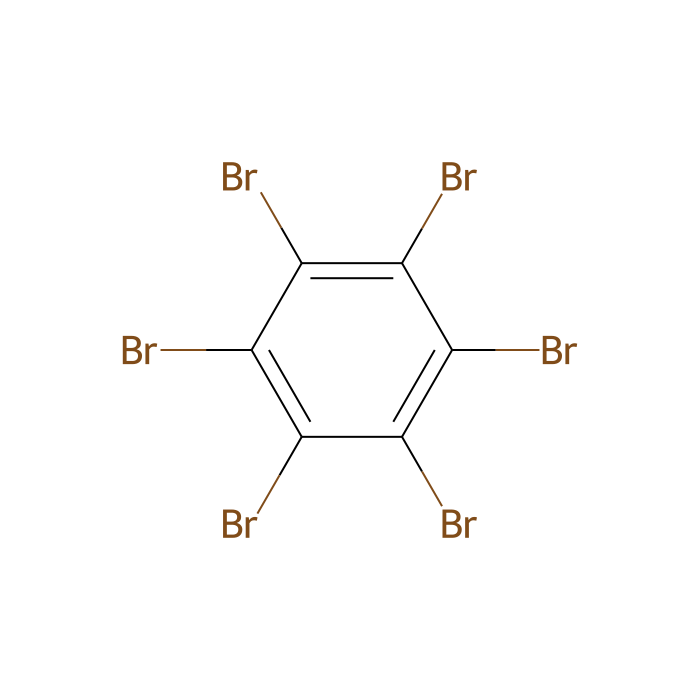
Hexabromobenzene is a perhalogenated aromatic building block and analytical reference standard consisting of a benzene ring fully substituted by six bromine atoms.
Item-specific identifiers (from Product Data)
CAS: 87-82-1
SKU: H114689
Grade: Analytical standard
Storage: Room temperature (shipped at ambient)
InChIKey: Not specified for this item; refer to CoA/Spec Sheet.
SMILES: Not specified for this item; refer to CoA/Spec Sheet.
Literature/computed identity details (for reference; not item specifications)
InChI (Key): Not provided here; consult databases or CoA (literature)
Structural features (general chemistry description)
Core: One planar benzene ring (sp2 carbons) in a D6h-symmetric, perbrominated framework.
Functional groups: Six aryl–bromide (C–Br) bonds; no heteroatoms other than bromine, no stereocenters.
2D description: A hexagonal phenyl ring with a bromine atom at every vertex (positions 1–6). The ring is fully deactivated electronically by strong –I/–M effects of bromine, yet each C–Br bond is a potential site for cross-coupling under Pd/Ni catalysis.
Typical roles: Electrophilic aryl halide substrate in multiple C–C bond-forming reactions; stable, high-bromine-content standard for analytical calibration.
Synthetic Utility
Electrophilic sites: Six aryl–Br bonds offer up to six independent C–C bond‑forming events via Pd/Ni catalysis.
Named transformations (literature)
Suzuki–Miyaura couplings with aryl/alkenyl boron partners to generate hexa‑substituted benzenes (star-shaped architectures, dendrimer cores).
Stille and Negishi couplings from the corresponding stannanes/zinc reagents where higher reactivity is required.
Kumada couplings (with Grignards) under activated conditions; less common due to competitive reduction.
Reductive debromination and radical chemistry to access controlled lower bromination levels for isomer libraries.
Retrosynthetic value
Serves as a convergent hub for assembling C6‑symmetric or densely substituted benzenes by parallel coupling to each C–Br bond.
Provides a platform for constructing extended π‑systems (hexa‑arylated benzenes, precursors to 2D carbon nanostructures) where symmetry and substitution density are critical.
Practical considerations
Reactivity is diminished by the cumulative –I/–M effects; employ strong catalysts/ligands, high temperature, and high‑boiling solvents.
Staged coupling (limiting equivalents and catalyst) can provide partially substituted intermediates; chromatographic separation may be challenging due to similar polarity—plan protecting/orthogonal handles when possible.
Target Specificity
Not applicable. This product is a small‑molecule chemical standard, not a biological targeting reagent (no antigen/epitope/clone/isotype). No target specificity data are provided for this item.
We use cookies to ensure the website functions properly and, where permitted, to improve your experience. You can manage your preferences at any time in Settings. Learn more in our Cookie Policy.
Shall we send you a message when we have discounts available?
Remind me later
Thank you! Please check your email inbox to confirm.
Products are supplied to verified businesses, institutions, and qualified professionals for research and development use only. Not for use in humans, animals, diagnosis, or therapy.