GRADE & PURITYMoligand™?Moligand™ — Aladdin's line of ligands and bioactive small molecules. Use for receptor, pathway, and binding studies needing defined small-molecule tools.≥98%
Moligand™,≥98% Moligand™ for sensitive chromatographic and analytical workflows requiring minimal baseline interference.
🌡
Storage & shipping
Protected from light,Store at -20°C,Argon charged Ships Ice chest + Ice pads Check lot-specific COA for exact specifications.
📋
Quality documents
SDS, COA, datasheet, and spec sheet available for download. Lot-specific COA accessible via lot number lookup.
📚
Literature proof
Cited in 0 peer-reviewed publications across chromatography, organic synthesis, and cross-coupling reactions.
Overview
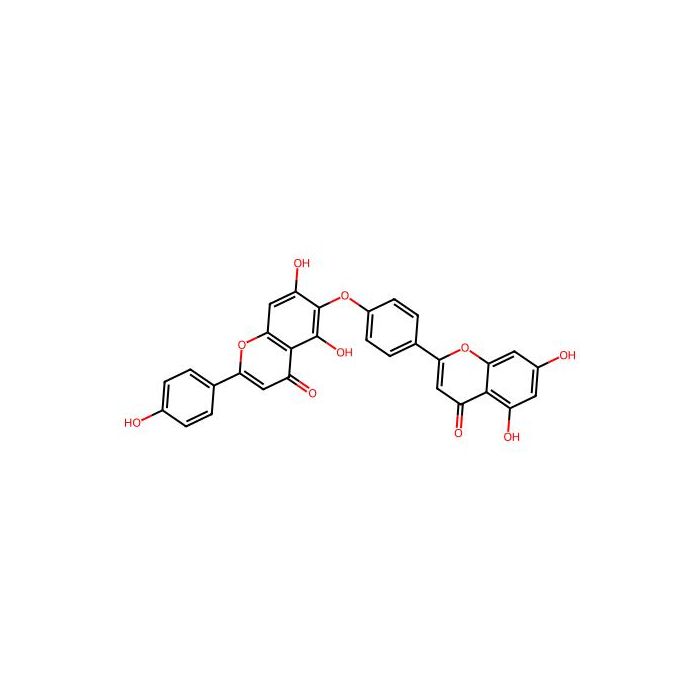
Hinokiflavone is a novel modulator of pre-mRNA splicing activity in vitro and in cellulo. Hinokiflavone blocks splicing of pre-mRNA substrates by inhibiting spliceosome assembly, specifically preventing B complex formation. Hinokiflavone is a SUMO protease inhibitor, inhibiting sentrin-specific protease 1 (SENP1) activity.
Hinokiflavone is a novel modulator of pre-mRNA splicing activity in vitro and in cellulo. Hinokiflavone blocks splicing of pre-mRNA substrates by inhibiting spliceosome assembly, specifically preventing B complex formation. Hinokiflavone is a SUMO proteas
Storage
Protected from light, Store at -20°C, Argon charged
Shipped In
Ice chest + Ice pads
This product requires cold chain shipping. Ground and other economy services are not available.
This compound belongs to the class of organic compounds known as flavones. These are flavonoids with a structure based on the backbone of 2-phenylchromen-4-one (2-phenyl-1-benzopyran-4-one).
External Descriptors
Biflavonoids and polyflavonoids
1. Djoumbou Feunang Y, Eisner R, Knox C, Chepelev L, Hastings J, Owen G, Fahy E, Steinbeck C, Subramanian S, Bolton E, Greiner R, and Wishart DS. ClassyFire: Automated Chemical Classification With A Comprehensive, Computable Taxonomy. Journal of Cheminformatics, 2016, 8:61.
We use cookies to ensure the website functions properly and, where permitted, to improve your experience. You can manage your preferences at any time in Settings. Learn more in our Cookie Policy.
Shall we send you a message when we have discounts available?
Remind me later
Thank you! Please check your email inbox to confirm.
Products are supplied to verified businesses, institutions, and qualified professionals for research and development use only. Not for use in humans, animals, diagnosis, or therapy.