≥98% for sensitive chromatographic and analytical workflows requiring minimal baseline interference.
🌡
Storage & shipping
Store at -20°C Ships Ice chest + Ice pads Check lot-specific COA for exact specifications.
📋
Quality documents
SDS, COA, datasheet, and spec sheet available for download. Lot-specific COA accessible via lot number lookup.
📚
Literature proof
Cited in 1 peer-reviewed publications across chromatography, organic synthesis, and cross-coupling reactions.
Overview
Information
HO-3867, an analog of curcumin, is a selectiveSTAT3inhibitor that inhibits its phosphorylation, transcription, and DNA binding without affecting the expression of other active STATs. HO-3867 inducesapoptosis.
Targets
STAT3
In vitro
HO-3867 produces significant cytotoxicity in A2780 and other tested ovarian cancer cell lines, with less toxic to noncancerous ovarian surface epithelial cells. HO-3867 induces G(2)-M cell cycle arrest in A2780 cells and promotes apoptosis by caspase-8 and caspase-3 activation. HO-3867 blocks the JAK/STAT3 pathway in human ovarian cancer cell lines.
In vivo
HO-3867 (100 ppm p.o.) inhibits the growth of ovarian cancer xenograft tumor in mice without any apparent signs of toxicity, and also results in inhibition of pSTAT3 as well as downregulation of the STAT3-targeting proteins. HO-3867 sensitizes cisplatin-resistant ovarian carcinoma through STAT3 inhibition. HO-3867 (100 ppm p.o.) also attenuates left-heart-failure-induced pulmonary hypertension by decreasing oxidative stress and increasing PTEN expression in the lung of rats.
Cell Research(from reference)
Cell lines:A2780 (A2780R), PA-1, SKOV3, OV4, and OVCAR3 cells; human ovarian surface epithelial cell
HO-3867, an analog of curcumin, is a selective STAT3 inhibitor that inhibits its phosphorylation, transcription, and DNA binding without affecting the expression of other active STATs. HO-3867 induces apoptosis.
Storage
Store at -20°C
Shipped In
Ice chest + Ice pads
This product requires cold chain shipping. Ground and other economy services are not available.
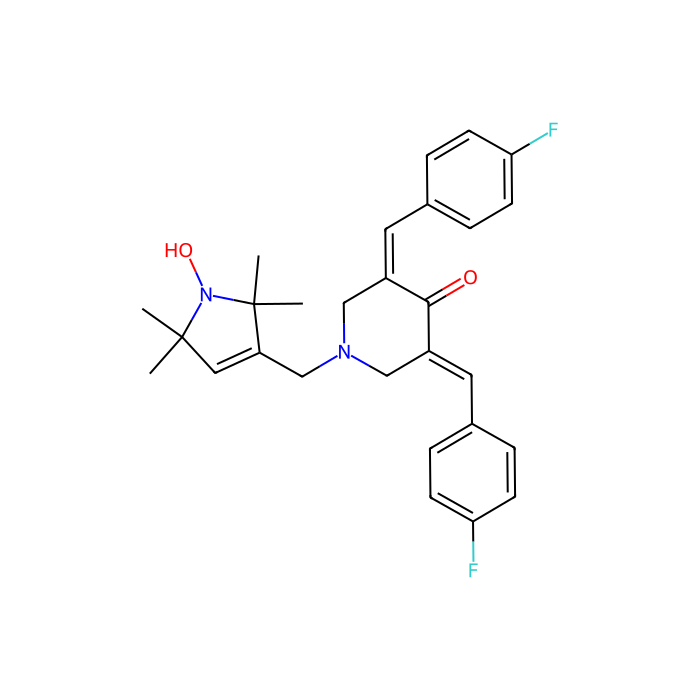
This compound belongs to the class of organic compounds known as piperidinones. These are compounds containing a piperidine ring which bears a ketone.
External Descriptors
Not available
1. Djoumbou Feunang Y, Eisner R, Knox C, Chepelev L, Hastings J, Owen G, Fahy E, Steinbeck C, Subramanian S, Bolton E, Greiner R, and Wishart DS. ClassyFire: Automated Chemical Classification With A Comprehensive, Computable Taxonomy. Journal of Cheminformatics, 2016, 8:61.
Determine the necessary mass, volume, or concentration for preparing a solution.
Dilution Calculator
Determine the dilution needed to prepare a stock solution.
Reconstitution Calculator
Reviews
Customer Reviews
Application Protocols
No tested applications or vendor-validated protocols are provided for this item.
Recommended dilutions, positive controls, and assay formats: Not specified for this item; refer to CoA/Spec Sheet and develop laboratory-specific SOPs.
General planning notes (not protocols, for consideration only):
Establish solvent controls and concentration–response curves.
Confirm stability and adsorption to plastics/glass under your assay conditions.
For detailed protocols, consult the primary literature relevant to your experimental system and validate in-house.
Biological Roles
No biological function data are provided in this listing. The following notes summarize general literature descriptions for the HO-3867 scaffold; they are not item-specific and should not be construed as medical or clinical claims.
Literature commonly classifies HO-3867 among diarylidenyl–piperidone (DAP) curcumin analogs featuring a redox-active nitroxide precursor motif. Such scaffolds have been used as chemical probes in cell-based studies of signaling, redox biology, and stress-response pathways.
Typical study contexts include modulation of transcriptional and enzymatic pathways and evaluation of structure–activity trends. Exact molecular targets, potency ranges, and selectivity profiles vary by study and conditions and are not specified here.
Due to extended conjugation, these compounds often exhibit characteristic UV–Vis absorption enabling concentration tracking and photostability monitoring during experiments (verify for your lot).
Usage reminders:
For all biological experiments, confirm identity/purity for the specific lot, and perform appropriate controls for solvent, time-dependence, and non-specific reactivity.
Ensure compliance with institutional approvals for research chemicals. This product is for research use only and is not intended for diagnostic, therapeutic, or clinical use.
Buffer Applications
This product is not a buffering agent and is not typically used to prepare classical biochemical buffers.
No buffer system parameters (pKa, buffering range, ionic strength contributions) are provided for this item.
Practical note: When dosing into buffered media (e.g., PBS, HEPES-buffered saline, cell culture medium), first dissolve the compound in an appropriate organic solvent (commonly DMSO), then add to the buffer under vigorous mixing to avoid precipitation. Keep final organic solvent levels low (often ≤0.1–0.5% v/v) and include solvent-only controls.
For labs seeking buffer materials, consult our dedicated buffer components and solution concentrates, which include validated recipes and pH ranges.
Green Alternatives
For this item, greener considerations focus on solvent and handling choices rather than replacing the molecule itself.
Greener solvent strategy (general guidance for hydrophobic probes):
Prefer minimal DMSO percentages in assay media (≤0.1–0.5% v/v) to reduce solvent burden.
Explore co-solvent blends that balance performance with safety, e.g., ethanol/water with HP-β-cyclodextrin, or PEG-400/water systems for in vitro studies (validate assay compatibility).
Comparison snapshot (general, not item-specific):
DMSO: high solvency; low volatility; acceptable EHS profile but can transport solutes dermally—use strict PPE.
PEG-400: low volatility and good solvency for many aromatics; viscosity may complicate pipetting and LC compatibility.
HP-β-cyclodextrin (aqueous): can enhance apparent solubility without organic co-solvent; may interact with hydrophobic binding pockets—control experiments required.
Operational green tips:
Prepare concentrated stocks to minimize solvent volume and waste.
Use amber, reusable glass vials where compatible to reduce plastic waste.
Plan aliquots to avoid repeated freeze–thaw and discard of partially degraded solutions.
Note: No item-specific environmental metrics (E-factor, LCA, biodegradability) are available for this listing.
Pharmaceutical Uses
No pharmacopeial status, excipient designation, or formulation role is provided for this item.
This product is sold strictly for research use. It is not intended for human or veterinary use, diagnostic applications, or as an active pharmaceutical ingredient (API) or excipient.
If used in pre-formulation or delivery research, treat it as an investigational research chemical. Validate solubility/stability in model vehicles (e.g., DMSO, ethanol, PEG-400, or cyclodextrin-containing systems) and document all conditions.
No compendial monographs (USP/EP/JP) or cGMP manufacturing statements are provided in this listing.
For formulation science training or platform development, we recommend employing well-characterized model compounds with established compendial references; then translate methods to this research molecule with appropriate re-validation.
Physical Properties
Item-specific physico-chemical specifications are not provided in this listing.
Appearance: Not specified for this item; refer to CoA/Spec Sheet.
Melting point: Not specified for this item; refer to CoA/Spec Sheet.
Boiling point: Not applicable for most solid DAP analogs; specific value not specified for this item; refer to CoA/Spec Sheet.
Density: Not specified for this item; refer to CoA/Spec Sheet.
Refractive index: Not applicable to solids; not specified for this item; refer to CoA/Spec Sheet.
Solubility: Not specified for this item; refer to CoA/Spec Sheet.
General literature guidance (non-item-specific):
Many diarylidenyl-piperidone/curcumin-analog probes exhibit low aqueous solubility and are typically prepared as concentrated DMSO stock solutions (e.g., 10–50 mM) for dilution into assay media. Co-solvents like ethanol or acetonitrile are also used at low final percentages.
Such conjugated enone systems often show strong visible absorption (yellow/orange) with modest fluorescence; exact λmax/ε are structure-dependent (not determined for this item).
Stability in aqueous buffers may be limited by Michael addition or hydrolysis under strongly nucleophilic/basic conditions; protect from prolonged exposure to high pH and from strong nucleophiles (general literature caution for enone-bearing scaffolds).
Important: Use only item-specific data from the CoA/Spec Sheet for method validation, quantitative work, or QC specifications.
Quality & Grades
Grade/Purity: Not specified for this item; refer to CoA/Spec Sheet for assay, purity method (e.g., HPLC/UPLC), and impurity profile.
Interpretation and impact of grade (general guidance):
When purity is reported by HPLC/UPLC, it typically reflects area% at a specified detection wavelength; confirm the method (column, gradient, detection λ) on the CoA.
For small-molecule probes like HO-3867, low non-volatile residue and consistent chromatographic profiles are important for reproducible biological assays. Verify batch-specific residual solvent levels and water content on the CoA when available.
If stabilizers or form-specific details (free base vs. salt, solvate, polymorph) apply, these can influence solubility and potency; none are specified here for this item.
What is specific to this listing:
Storage requirement is explicitly stated (−20°C) and cold shipment is used, consistent with a stability-conscious handling of conjugated, potentially light/air-sensitive scaffolds.
No UV cutoff, metal limits, peroxide limits, or specific trace analyses are provided in the listing. Where such data are critical, request the lot-specific CoA/Spec Sheet.
Recommendation:
For analytical and screening workflows, confirm identity (e.g., 1H/13C NMR, HRMS) and purity for your lot prior to use in QSAR, IC50, or mechanistic studies, especially if inter-lab comparability is required.
Reaction & Applications
This product is typically employed as a reference small molecule/probe in research rather than as a general synthetic reagent. No manufacturer application notes are provided in this listing.
General research applications (literature, non-item-specific):
Used in cell-free and cell-based assay development as a redox-active, conjugated diarylidenyl–piperidone scaffold to interrogate signaling and stress-response pathways.
Employed as a comparator/benchmark compound in structure–activity relationship (SAR) studies of curcumin-analog libraries.
Analytical/assay handling tips (general):
Prepare DMSO stock solutions and verify concentration by UV–Vis or quantitative NMR when precise dosing is required. Use amber vials to limit photodegradation risk typical of extended conjugation systems.
During serial dilutions into aqueous buffers or media, add stock slowly with rapid mixing to avoid local supersaturation and precipitation.
For biochemical assays containing nucleophiles (e.g., glutathione, cysteine-rich proteins), consider potential Michael-addition reactivity characteristic of conjugated enones when interpreting time-dependent activity (literature caution; not item-specific data).
Not typically applicable:
As a stoichiometric reagent or catalyst in classical organic synthesis, this compound is not commonly used; for such needs, see our dedicated reagents and building blocks.
Reaction Conditions
No reaction conditions are specified by the manufacturer for this product, and it is not typically employed as a reagent or catalyst.
General guidance for handling in experimental workflows (non-item-specific):
Stock solution preparation: dissolve in dry DMSO to a convenient concentration (commonly 10–50 mM), vortex or sonicate to clarity, and protect from light. Verify concentration by UV–Vis or qNMR if dosing accuracy is critical.
Aqueous dilution: add organic stock slowly into rapidly stirred buffer or media to minimize precipitation. Maintain final DMSO at ≤0.1–0.5% v/v in biological assays unless otherwise validated.
Stability monitoring: check for time-dependent changes by HPLC/UPLC. Extended-conjugation probes may degrade with light, elevated temperature, or high pH.
If employing this molecule in chemical reactions (research exploration only):
Consider that conjugated enones may undergo nucleophilic additions and conjugate reductions; exact conditions, catalysts, and yields are highly structure-dependent and are not provided here. Develop conditions empirically with analytical tracking.
Always defer to the SDS for safe operating limits and to the CoA/Spec Sheet for item-specific constraints.
Safety & Handling
Authoritative safety information must be taken from the SDS. The following reflects the information provided in this listing and general laboratory practice.
GHS classification: Not specified for this item; refer to SDS.
Signal word / H-statements / Pictograms: Not specified for this item; refer to SDS.
Research use: For research use only (not for human or veterinary use).
General laboratory handling (good practice):
Work in a chemical fume hood; avoid inhalation of dusts/aerosols and contact with skin or eyes.
Wear appropriate PPE: lab coat, safety glasses or face shield, and chemically resistant gloves (e.g., nitrile). Change gloves regularly when handling organic solutions.
Avoid formation of dust; handle solids gently. Use amber glassware or foil-wrap if the compound is light-sensitive (common for conjugated aryl–enone systems; verify on SDS/CoA).
Incompatibilities (general): Strong oxidizers/reductants, strong bases or nucleophiles may react with conjugated enones; segregate from reactive metals and sources of ignition.
First aid (overview; consult SDS for details): rinse skin with water/soap upon contact; flush eyes with water for 15 minutes; remove to fresh air if inhaled; seek medical attention if symptoms persist.
Spill response: Avoid dust generation; collect with inert absorbent; dispose according to institutional and local regulations.
Storage per item listing: Store at −20°C. Shipments are made cold (ice chest + ice pads). Minimize freeze–thaw cycles.
Solvent Selection
Because small, hydrophobic aromatic probes often have limited water solubility, solvent choice is critical for stock-solution preparation and assay delivery.
Item-specific solubility is not listed; use the following as general, literature-based guidance for diarylidenyl-piperidone–type compounds:
Primary stock solvent: DMSO is commonly used due to strong solvating power and compatibility with biological assays at ≤0.1–0.5% v/v final.
Secondary options: Ethanol or acetonitrile can be used for analytical methods or as minor co-solvents. PEG-400 or aqueous HP-β-cyclodextrin solutions may enhance apparent solubility for in vitro work (optimize to avoid assay interference).
Aqueous media: Direct dissolution in water or PBS is usually poor; dissolve first in anhydrous organic solvent, then dilute with vigorous mixing to avoid precipitation.
Comparison (general):
DMSO: highest solvency; potential cell effects at >0.5–1% v/v.
Ethanol: good solvency; higher volatility and potential protein denaturation at elevated percentages.
ACN: analytical compatibility; limited in biological systems.
Practical tips:
Prepare concentrated amber-protected stocks (e.g., 10–50 mM in dry DMSO), aliquot, and store at −20°C to minimize freeze–thaw.
Pre-warm and vortex/sonicate for complete dissolution. Filter through 0.2 μm PTFE for analytical work if needed.
Note: Confirm actual solubility and stability for your lot from the CoA/Spec Sheet before finalizing methods.
Storage & Reconstitution
Item-specific storage and shipping:
Storage Conditions: Store at −20°C (as provided in the listing).
Shipped In: Ice chest + ice pads (as provided).
Reconstitution:
Reconstitution/solubility details: Not specified for this item; refer to CoA/Spec Sheet.
General handling guidance (non-item-specific):
Allow the container to equilibrate to room temperature in a desiccated environment before opening to minimize moisture condensation.
For stock solutions, dry, anhydrous DMSO is commonly used for hydrophobic small molecules; prepare concentrated stocks (e.g., 10–50 mM), aliquot into amber vials, and store at −20°C. Avoid repeated freeze–thaw cycles; thaw only what is needed for immediate use.
Protect from light where feasible, as extended-conjugation systems can be photosensitive. Dispose of expired or degraded solutions (monitor by HPLC/UPLC or UV–Vis as appropriate).
Note: Where appearance, exact solubility, and stability windows are critical, obtain the lot-specific CoA/Spec Sheet prior to initiating experiments.
Structure & Identity
Brief overview: HO-3867 (SKU H413764) is supplied as a research-use small molecule in our small-molecule/compound library category. Item-specific identifiers are limited in the current listing.
CAS: 1172133-28-6 (as provided)
PubChem CID: 46871899 (as provided)
InChIKey: 289159 (as provided; note this is not in the standard 27-character format—refer to CoA/Spec Sheet for confirmation)
Molecular Formula: Not specified for this item; refer to CoA/Spec Sheet.
Molecular Weight: Not specified for this item; refer to CoA/Spec Sheet.
SMILES: Not specified for this item; refer to CoA/Spec Sheet.
Structural features (general literature description):
Literature sources commonly describe HO-3867 as a diarylidenyl-piperidone (DAP)–type curcumin analog bearing a redox-active N-oxyl/N-hydroxypyrroline functionality. Such scaffolds typically present a conjugated enone (Michael acceptor) embedded in an extended aryl–enone–piperidone–aryl framework.
2D structure (literature, descriptive): central six-membered lactam (piperidone) ring with two exocyclic enone linkages conjugated to para-/meta-substituted phenyl rings; one aryl substituent often incorporates a nitroxide precursor (N-hydroxypyrroline) tether. Exact substitution pattern and stereochemistry for this catalog item should be confirmed from the CoA.
Notes:
Because structure fields for this specific lot/item are not fully listed here, please verify the definitive identifiers (InChI, SMILES, MF, MW) on the product CoA/Spec Sheet prior to method development or regulatory documentation.
Synthetic Utility
As supplied, HO-3867 is generally used as a research probe rather than as a building block. No manufacturer guidance is provided for its use in chemical synthesis.
General structural/reactivity considerations (literature, not item-specific):
Diarylidenyl–piperidone scaffolds incorporate a conjugated enone that can participate in Michael-type additions with nucleophiles (e.g., thiols, amines) under suitable conditions. This intrinsic reactivity is often central to their biochemical behavior and can also complicate handling in nucleophile-rich matrices.
The framework may allow late-stage diversification (e.g., aryl substitution, enone modification) for SAR campaigns, but such transformations are beyond the scope of this catalog listing.
Practical implications:
Avoid storing working solutions in strongly basic or nucleophilic environments to limit undesired reactions that could alter composition.
If derivatization is pursued in a research setting, establish reaction conditions de novo using analytical monitoring (HPLC/UPLC, LC–MS) since no synthetic protocols are provided for this item.
Conclusion: Treat HO-3867 primarily as a reference compound for screening/assay purposes; for synthetic elaboration, consult the primary literature and perform independent method development.
Target Specificity
No target, epitope, or specificity data are provided for this item.
Target name/pathway: Not specified for this item; refer to primary literature if needed.
Species reactivity/assay context: Not specified for this item.
Note: Any functional/target annotations in publications should be independently verified under your experimental conditions; parameters may vary with cell type, assay format, and exposure time.
We use cookies to ensure the website functions properly and, where permitted, to improve your experience. You can manage your preferences at any time in Settings. Learn more in our Cookie Policy.
Shall we send you a message when we have discounts available?
Remind me later
Thank you! Please check your email inbox to confirm.
Products are supplied to verified businesses, institutions, and qualified professionals for research and development use only. Not for use in humans, animals, diagnosis, or therapy.

 F2303352