This product requires cold chain shipping. Ground and other economy services are not available.
Note
Wherever possible, you should prepare and use solutions on the same day. However, if you need to make up stock solutions in advance, we recommend that you store the solution as aliquots in tightly sealed vials at -20°C. Generally, these will be useable for up to one month. Before use, and prior to opening the vial we recommend that you allow your product to equilibrate to room temperature for at least 1 hour. Toxic, refer to SDS for further information. Need more advice on solubility, usage and handling? Please visit our frequently asked questions (FAQ) page for more details.
This compound belongs to the class of organic compounds known as macrolactams. These are cyclic amides of amino carboxylic acids, having a 1-azacycloalkan-2-one structure, or analogues having unsaturation or heteroatoms replacing one or more carbon atoms of the ring. They are nitrogen analogues (the a nitrogen atom replacing the o atom of the cyclic carboxylic acid group ) of the naturally occurring macrolides.
External Descriptors
Not available
1. Djoumbou Feunang Y, Eisner R, Knox C, Chepelev L, Hastings J, Owen G, Fahy E, Steinbeck C, Subramanian S, Bolton E, Greiner R, and Wishart DS. ClassyFire: Automated Chemical Classification With A Comprehensive, Computable Taxonomy. Journal of Cheminformatics, 2016, 8:61.
Determine the necessary mass, volume, or concentration for preparing a solution.
Dilution Calculator
Determine the dilution needed to prepare a stock solution.
Reconstitution Calculator
Reviews
Customer Reviews
Application Protocols
The following are literature-style, general protocols for using ikarugamycin as a tool compound. They are not item-specific validated methods; optimize for your system.
A. Transferrin uptake assay (CME inhibition)
Prepare a 10 mM DMSO stock; aliquot and store at −20°C, protected from light.
Seed cells on coverslips; the day of assay, pre-equilibrate in serum-free medium for 30 min.
Treat with ikarugamycin (e.g., 2.5–10 μM final, 15–30 min) at 37°C.
Incubate with fluorescent transferrin (e.g., 25–50 μg/mL) for 5–10 min.
Wash with cold acidic buffer (brief) then PBS to remove surface-bound ligand.
Fix and image; quantify internalization vs. vehicle control.
B. Washout/reversibility test
After treatment, wash cells 3× with warm medium; incubate in fresh medium 30–60 min.
Re-challenge with transferrin; compare uptake to pre-treatment baseline.
Controls and notes
Include vehicle-only control and an orthogonal CME perturbation.
Verify cell viability in parallel (e.g., resazurin or ATP assay) to decouple cytotoxicity from trafficking effects.
Maintain final DMSO ≤0.1–0.5% v/v if possible to minimize solvent effects.
Biological Roles
Scope (research context; no clinical claims)
Ikarugamycin is widely used as a small-molecule tool to perturb clathrin-mediated endocytosis (CME) in eukaryotic cells (literature). It acutely reduces formation/maturation of clathrin-coated pits, thereby decreasing uptake of canonical CME cargo such as transferrin.
Mechanistic insights (literature/general)
Acts as an endocytosis pathway inhibitor, enabling dissection of cargo trafficking, receptor internalization dynamics, and compensatory uptake routes.
Has been employed to probe the dependence of viral entry, receptor downregulation, and nutrient transporter cycling on CME.
As a lipophilic, conjugated natural product, it partitions into membranes; observed effects can include changes in plasma membrane trafficking and endosomal processing (context-dependent, literature).
Experimental considerations
Potency and cytotoxicity are cell-type and time-dependent; short exposures at micromolar concentrations are commonly used to balance pathway inhibition with cell health.
Effects may not be strictly specific to CME under all conditions. Employ orthogonal assays (e.g., clathrin knockdown, dominant-negative constructs) to validate mechanistic conclusions.
Note
Biological behavior can vary with formulation (solvent, serum content) and lot-specific purity. Validate dose–response and time courses for each experimental system.
Buffer Applications
This item is not a buffering reagent and is not typically used to prepare or stabilize buffer systems.
Practical guidance
For cell-based assays, dilute ikarugamycin DMSO stocks into pre-warmed physiological buffers or culture media (e.g., HBSS, PBS, or complete growth medium). Maintain low final DMSO content and verify solubility to avoid precipitation.
If adsorption losses are observed, pre-rinse plasticware with buffer containing the same co-solvent percentage or consider low-binding labware.
Green Alternatives
Context
This product is a bioactive natural product used as a mechanistic tool in biology, not a bulk solvent or commodity reagent. “Green alternative” considerations therefore focus on solvent systems and handling rather than replacing the active compound itself.
Greener handling strategies (general)
Prefer aqueous-compatible assay formats using minimal DMSO (≤0.1–0.5% v/v final) to reduce organic solvent burden.
Employ miniaturized assay volumes (96–384 well plates) to lower total solvent use.
Choose lower-toxicity co-solvents when feasible (e.g., ethanol over DMF) while maintaining solubility and assay performance.
Use amber micro-aliquots to extend stock life and reduce waste from degraded material.
Illustrative comparison (literature/general)
DMSO vs ethanol for stock solutions:
DMSO: highest solvency and stability; requires careful control of final % to avoid cellular effects.
Ethanol: greener toxicological profile but lower solubility; may require higher final % in assays, which can be limiting.
Waste and EHS
Collect all solutions and rinses containing ikarugamycin as hazardous chemical waste.
Source reduction (aliquoting, right-first-time experiments) is often the largest lever for sustainability with scarce natural products.
Pharmaceutical Uses
No excipient or formulation-grade use is indicated for this product.
Intended use: research use only (per Product Data). Not for human or veterinary applications, diagnostics, or as an API/excipient.
While natural products like ikarugamycin can inform medicinal chemistry, this catalog item is provided solely as a laboratory research standard or tool compound. Any GMP/Ph. Eur./USP status, residual solvent controls, and elemental impurity compliance are not specified for this item; refer to CoA/Spec Sheet if such information is required for nonclinical development studies.
Physical Properties
Item-specific specifications
Appearance: Not specified for this item; refer to CoA/Spec Sheet.
Molecular formula: Not specified for this item; refer to CoA/Spec Sheet.
Molecular weight: Not specified for this item; refer to CoA/Spec Sheet.
Literature/general values and handling-relevant traits (for context only)
State: typically isolated as an amorphous or microcrystalline solid (literature).
Solubility profile: sparingly soluble in water; soluble in polar aprotic/organic solvents such as DMSO and methanol; limited solubility in purely aqueous buffers without co-solvent (literature).
Partitioning: behaves as a lipophilic, membrane-active natural product; expect high organic/water partitioning (literature, qualitative).
Spectroscopy: UV-visible absorption consistent with a conjugated polyene chromophore; strong absorbance in near-UV/visible range (literature, qualitative).
Important reminders
Do not treat literature values as item specifications. For exact numerical properties (mp/bp, density, solubility limits, UV cutoff, water content, residual solvents), consult the lot-specific CoA/Specification Sheet.
Quality & Grades
Item-specific details
Grade/Purity: Not specified for this item; refer to CoA/Spec Sheet.
Interpretation and guidance
Natural product standards such as ikarugamycin are typically offered as research-grade materials intended for biochemical, cell biology, and mechanistic studies. In the absence of a declared analytical/HPLC grade, assume standard research-grade quality, verified by identity (e.g., NMR/HRMS) and purity by chromatographic methods.
Purity: HPLC/UPLC area percentage and reporting wavelength; orthogonal purity metrics if available.
Residual solvents and water: Karl Fischer and GC residual solvents, if reported.
Counter-ions/additives: confirm if the product is a free base/neutral form; stabilizers are uncommon for this class but verify.
Stabilizers and UV purity
No stabilizer is stated for this item. If low-UV applications (e.g., photophysical assays) are planned, request UV spectra and impurity profiles, as conjugated polyenes can show background absorbance.
Regulatory/use note
Research use only (per Product Data). Not for human or veterinary use, clinical diagnostics, or consumption.
Reaction & Applications
Use domain
Ikarugamycin is not typically used as a synthetic reagent or coupling partner. Its primary laboratory use is as a bioactive small molecule standard and tool compound in cell and chemical biology.
Research applications (literature/general)
Acute inhibition of clathrin-mediated endocytosis (CME) to interrogate trafficking pathways (e.g., transferrin uptake assays).
Probe for endocytic dependency of receptor internalization, viral entry models, and nutrient uptake pathways.
Positive control compound in imaging-based CME inhibition screens.
Assay integration tips
Pre-validate cytotoxicity and vehicle tolerance for the specific cell line; titrate across a log scale to identify minimally perturbative concentrations that still yield robust CME inhibition.
Incorporate temporal controls: brief, pre-treatment incubations commonly used to establish steady-state inhibition before ligand addition (e.g., transferrin-AF488), followed by washout studies to gauge reversibility.
Parallel controls: include vehicle (DMSO) and an orthogonal CME inhibitor (e.g., pitstop analogs) to deconvolute off-target effects.
Note
For chemical synthesis or scale transformations, ikarugamycin’s complex scaffold and sensitivity make it unsuitable as a routine reagent; see Synthetic Utility for guidance on how it is typically handled analytically rather than as a building block.
Reaction Conditions
This product is not commonly employed as a reagent in synthetic reactions; therefore, standard reaction condition guidance (solvents, catalysts, temperatures, and yields) does not apply.
For biological assays (literature/general guidance)
Stock solutions: often prepared in anhydrous DMSO (e.g., 5–20 mM), aliquoted, and stored at −20°C protected from light.
Working concentrations: micromolar ranges are typically explored; exact values depend on cell type and assay readout. Begin with a broad titration (e.g., 0.3–20 μM) to establish potency and tolerability.
Exposure times: acute treatments from 10–60 minutes are common to interrogate endocytic steps, with longer incubations increasing risk of cytotoxicity.
Temperatures: standard cell culture conditions (37°C, 5% CO2) unless otherwise specified by the assay protocol.
Note: Reported conditions are general literature practices for tool-compound use and are not item-specific specifications.
Safety & Handling
Authoritative data
GHS classification, signal word, pictograms, and H-statements: Not specified for this item; refer to the Aladdin SDS for SKU I275950.
General laboratory safety guidance (non-exhaustive; defer to SDS)
Likely hazards (literature/general for lipophilic natural products): may be harmful if swallowed, inhaled, or in contact with skin; may cause irritation. Handle as a bioactive small molecule with potential cytotoxicity.
Personal protective equipment: lab coat, safety glasses, and appropriate chemically resistant gloves; handle powders/stock solutions in a fume hood or biosafety cabinet as appropriate.
Storage incompatibilities: avoid strong acids/bases and strong oxidizers that may degrade the polyene/tetramic acid core (general chemical caution). Protect from moisture.
Special risks: as a conjugated natural product, it may be light sensitive; minimize light exposure during handling and storage (literature caution). Avoid aerosolization of dry powder.
First aid (overview; follow institutional procedures):
Inhalation: move to fresh air; seek medical attention if symptoms persist.
Skin/eye contact: rinse with water for several minutes; remove contaminated clothing; obtain medical advice.
Ingestion: rinse mouth; do not induce vomiting; seek medical attention.
Shipping & storage from Product Data
Shipped in: ice chest + ice pads.
Storage conditions: Store at -20°C, desiccated.
Always consult the official SDS for definitive hazard and response information.
Solvent Selection
Overview
Compound class: hydrophobic, polycyclic polyketide with limited aqueous solubility (literature/general).
Recommended solvents (research practice)
Primary stock preparation: anhydrous DMSO is commonly used to prepare concentrated stocks (e.g., 5–20 mM) due to high solvency for lipophilic natural products (literature/general).
Alternative solvents: methanol or ethanol for lower-concentration working solutions; DMF where DMSO is incompatible. For aqueous applications, dilute DMSO stocks into buffered media to a low final DMSO percentage (typically ≤0.1–0.5% v/v, as tolerated by the assay system).
Miscibility and polarity considerations
Water: poor direct solubility. Use co-solvent or cosolvent + carrier proteins/vehicles if required for biological assays.
Nonpolar solvents (hexanes, toluene): generally inadequate for stable solutions; adsorption and poor handling may occur.
Practical tips
Filter-sterilize working solutions (0.2 μm PTFE) if sterility is required; avoid cellulose-based filters with high organic content.
Add compound solution last to pre-equilibrated media to minimize local precipitation; gently invert to mix.
Minimize freeze–thaw by aliquoting DMSO stocks; use amber containers to limit light exposure (literature caution).
Comparison (general)
DMSO vs methanol: DMSO affords higher achievable concentration and better long-term stability; methanol is more volatile and can perturb cells at lower percentages—choose based on assay tolerance and required stock strength.
Storage & Reconstitution
Item-specific storage
Storage conditions (from Product Data): Store at −20°C, desiccated.
Shipped in: Ice chest + ice pads.
General reconstitution guidance (literature/practice)
Solvent: reconstitute in anhydrous DMSO to prepare concentrated stocks (commonly 5–20 mM). Mix gently to fully dissolve. If needed, brief sonication can assist dissolution.
Aliquoting: dispense single-use aliquots into amber vials or low-bind microtubes to minimize freeze–thaw and light exposure.
Working solutions: dilute DMSO stocks into pre-warmed buffer or culture medium with thorough mixing to avoid precipitation. Aim for minimal final DMSO (≤0.1–0.5% v/v) as tolerated by your system.
Stability and handling
Protect from light during storage and handling (literature caution for conjugated natural products).
Avoid repeated freeze–thaw cycles; discard aliquots showing precipitation, discoloration, or loss of activity.
Specifications note
Appearance, concentration limits, water content, and exact solubility are not specified for this item; refer to the lot-specific CoA/Spec Sheet for definitive guidance.
Use restriction
For research use only (per Product Data). Not for human or veterinary use.
Structure & Identity
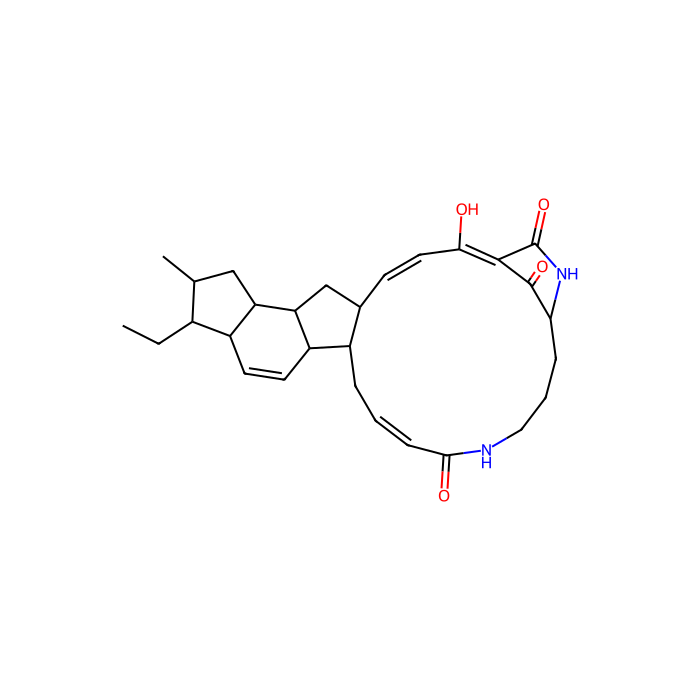
Ikarugamycin is a polycyclic polyketide natural product commonly classified among polycyclic tetramate/tetramic acid macrolactams (PTMs).
Item-specific (from Product Data)
SKU: I275950
Product name: Ikarugamycin
CAS: 36531-78-9
PubChem CID: 54680304
InChIKey: 102542 (as provided)
SMILES: Not specified for this item; refer to CoA/Spec Sheet.
Literature identity (general chemistry knowledge)
Structural class: polycyclic polyketide featuring a tetramic acid (pyrrolidine-2,4-dione) motif fused to a highly conjugated, macrocyclic framework with multiple double bonds and a single nitrogen (macrolactam character).
Functional groups: tetramic acid (enolizable 1,3-dicarbonyl adjacent to an amide N), conjugated polyene segments, amide, and multiple stereogenic centers embedded in a rigid, fused-ring architecture.
2D description in words: a compact, conformationally restricted, multi-ring scaffold bearing a tetramic acid headgroup, an internal lactam linkage within a macrocycle, and an extended, partially hydrogenated polyene chain integrated into the ring system.
Notes
Exact atom connectivity, stereochemistry, and string identifiers (full InChI/SMILES) are not specified for this item; consult the CoA or authoritative databases for definitive strings. The brief InChIKey string above is reproduced exactly from Product Data, although typical InChIKeys are 27-character hashes.
Synthetic Utility
Role in synthesis
Ikarugamycin is a complex, highly functionalized natural product and is not generally used as a building block or reagent.
Analytical and reference utility (literature/general)
Serves as a reference standard for method development and validation in natural product analytics (e.g., LC–MS characterization of PTM biosynthetic outputs).
Benchmark compound for SAR studies within the polycyclic tetramate/tetramic acid macrolactam family.
The tetramic acid moiety is enolizable and can engage in tautomerization; extreme pH may promote degradation or isomerization.
Conjugated double bonds can undergo photo-oxidation; protect from light and oxidants.
Amide/macrocycle may be sensitive to strong nucleophiles or bases leading to ring opening under forcing conditions.
Retrosynthetic perspective (literature)
Total syntheses target construction of the tetramic acid core and macrocyclic polyene with control of multiple stereocenters, highlighting the molecule’s complexity; however, these strategies are not typically leveraged in routine lab transformations.
Target Specificity
Not an antibody or affinity reagent; no clone/isotype/species reactivity apply.
Research context (literature/general)
Functional specificity: used as a small-molecule inhibitor of clathrin-mediated endocytosis (CME). Effects on CME components and coated-pit dynamics are well-documented, but on-target molecular binding partners are not universally agreed upon; thus, employ orthogonal validation to establish pathway specificity in your system.
We use cookies to ensure the website functions properly and, where permitted, to improve your experience. You can manage your preferences at any time in Settings. Learn more in our Cookie Policy.
Shall we send you a message when we have discounts available?
Remind me later
Thank you! Please check your email inbox to confirm.
Products are supplied to verified businesses, institutions, and qualified professionals for research and development use only. Not for use in humans, animals, diagnosis, or therapy.