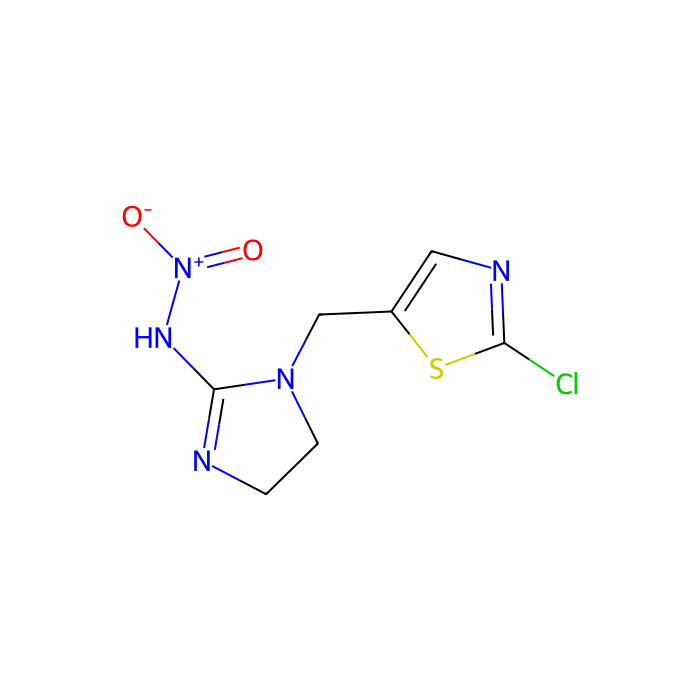
Imidaclothiz is an action body of nicotinic acid acetylcholinesterase enzyme acceptor. It can be used as a pesticide. After pests contact the product, the normal conduction of their central nerves is inhibited and pests are numbed to death.
Specifications
Synonyms
(EZ)-1-(2-Chloro-1,3-thiazol-5-ylmethyl)-N-nitroimidazolidin-2-ylideneamine | 1H-Imidazol-2-amine, 1-[(2-chloro-5-thiazolyl)methyl]-4,5-dihydro-N-nitro- | 1-[(2-chloro-5-thiazolyl)methyl]-4,5-dihydro-N-nitro-1H-imidazol-2-amine | 1H-Imidazol-2-amine, 1-[(2-chloro-5-thiazolyl)methyl]-4,5-dihydro-N-nitro-; Imidaclothiz | N-[1-[(2-chloro-1,3 Show more
Specifications & Purity
≥98%
Storage
Protected from light,Store at -20°C
Shipped In
Ice chest + Ice pads
This product requires cold chain shipping. Ground and other economy services are not available.
This compound belongs to the class of organic compounds known as 2,5-disubstituted thiazoles. These are compounds containing a thiazole ring substituted at positions 2 and 5 only.
External Descriptors
Not available
1. Djoumbou Feunang Y, Eisner R, Knox C, Chepelev L, Hastings J, Owen G, Fahy E, Steinbeck C, Subramanian S, Bolton E, Greiner R, and Wishart DS. ClassyFire: Automated Chemical Classification With A Comprehensive, Computable Taxonomy. Journal of Cheminformatics, 2016, 8:61.
Determine the necessary mass, volume, or concentration for preparing a solution.
Dilution Calculator
Determine the dilution needed to prepare a stock solution.
Reconstitution Calculator
Reviews
Customer Reviews
Application Protocols
No antibody- or kit-type validated application protocols are associated with this small-molecule analyte. For laboratory use, the following general protocols are commonly employed for neonicotinoid standards (general guidance; not item specifications):
Preparation of stock solutions:
Dissolve accurately weighed material in acetonitrile or DMSO to 1–10 mg/mL. Vortex and, if needed, sonicate briefly. Store aliquots at −20 °C in amber vials.
LC–MS/MS calibration:
Prepare serial dilutions in acetonitrile:water (1:1) with 0.1% formic acid or buffer. Include an isotopically labeled internal standard when available.
Construct multi-level calibration curves; verify linearity and residuals. Use matrix-matched standards to mitigate ion suppression/enhancement.
Stability checks:
Assess short-term (bench-top), autosampler, freeze–thaw, and long-term stability under your method conditions.
Adjust solvent choice and concentrations to your instrument and regulatory/QA requirements. Refer to the product’s CoA and SDS before use.
Biological Roles
Note: The following is general biological context for the neonicotinoid class and is not a medical or clinical claim.
Mode of action (general/literature):
Neonicotinoids are selective agonists at insect nicotinic acetylcholine receptors (nAChRs). Their nitroimino/guanidine moieties facilitate high-affinity binding to insect-specific receptor subtypes, leading to persistent activation and subsequent receptor desensitization.
Selectivity considerations:
Structural features (heteroaryl ring, nitroimino/guanidine electronics) bias binding toward insect nAChRs versus many mammalian subtypes, though cross-reactivity and off-target effects can occur depending on species and exposure.
Metabolic and environmental fate (literature):
Common pathways include nitro reduction, N-dealkylation, oxidative transformations, and conjugation. Photolysis and hydrolysis contribute to degradation; rates depend on pH, light intensity, and matrix composition.
Laboratory relevance:
Used as a reference compound in receptor-binding assays, electrophysiology on insect nAChRs, and in silico modeling (docking/MD) to elucidate SAR.
Employed in ecotoxicology research to assess exposure–response relationships in non-target organisms without implying any field or clinical outcomes.
For precise kinetic constants (Kd, EC50) and species-specific data, consult primary literature; values vary by receptor subtype, assay conditions, and organism.
Buffer Applications
This item is not a buffering agent and is not typically used to formulate buffer systems. For experimental work involving Imidaclothiz:
Choose buffers to suit the analytical technique rather than the compound itself.
LC–MS: volatile buffers such as ammonium formate or ammonium acetate (e.g., 2–10 mM) with formic acid can improve ionization and peak shape.
Stability testing: phosphate or borate buffers may be used to control pH during hydrolysis studies, but verify compound stability and avoid prolonged exposure to strong base.
No item-specific buffer recipes are provided; select conditions empirically for your assay.
Green Alternatives
Context: Imidaclothiz is a research analyte; greener considerations apply to solvents, sample prep, and waste minimization rather than replacing the analyte itself.
Greener solvent choices (general):
Prefer acetonitrile or ethanol over chlorinated solvents for extractions and chromatography when method performance allows.
Explore aqueous normal-phase or HILIC with high-water content to reduce organic solvent use in LC.
Sample preparation:
QuEChERS workflows reduce solvent volumes and streamline extraction/cleanup for residue analysis.
Solid-phase extraction (SPE) with water-wettable sorbents can reduce solvent consumption and improve selectivity, minimizing repeats.
Energy and stability:
Store at −20 °C in amber vials to extend solution life, reducing frequency of fresh preparations and waste.
Batch analytical runs to improve instrument utilization and cut standby energy.
Comparative overview (general; not a solvent):
Replacement of this analyte is not applicable; instead, optimize the analytical ecosystem—use greener eluents, miniaturized LC (UHPLC/microLC), and validated waste segregation to mitigate environmental impact.
Tradeoffs: Higher-water mobile phases may reduce MS sensitivity; acetonitrile often outperforms methanol for peak shape in HILIC. Validate any change to ensure method suitability.
Pharmaceutical Uses
Imidaclothiz is an agrochemical research analyte and is not formulated as a pharmaceutical excipient or API in the biomedical context.
Appropriate lab uses:
Reference standard for residue analysis, environmental monitoring, and mechanistic studies related to insect nAChRs.
Not applicable:
No compendial (USP/EP/JP) pharmaceutical monograph usage is relevant.
No clinical or therapeutic applications should be inferred.
All uses are for research only, as stated in the Product Data.
Physical Properties
Item-specific values from Product Data:
Appearance: Not specified for this item; refer to CoA/Spec Sheet.
Molecular weight: Not specified for this item; refer to CoA/Spec Sheet.
Storage/Shipping (item-specific):
Store at −20 °C, protected from light.
Shipped in ice chest with ice pads.
Typical physical properties (literature/general for neonicotinoids; not item specifications):
Physical state: usually crystalline solids with moderate polarity.
Solubility: commonly soluble in polar aprotic organic solvents (acetonitrile, DMF, DMSO) and moderately in methanol/ethanol; very low volatility.
Partitioning: logP/logD generally in the low-to-moderate range (reflecting balance of polar nitro/guanidine with heteroaryl group), facilitating LC–MS/MS analysis.
Thermal behavior: decompose before boiling; melting points often observed in the ~150–200 °C region for analogous structures, but exact values vary by compound and form.
UV absorbance: neonicotinoids often show strong absorption in the 200–270 nm region due to the nitroimino/heteroaryl chromophore, enabling HPLC-UV detection.
Practical notes (general):
For quantitative work, prepare stock solutions freshly or store aliquots at −20 °C in amber vials to minimize photolysis and oxidative changes.
Avoid prolonged exposure to strong base or strong light during sample preparation; both can promote degradation.
For definitive numerical specifications (mp, purity, residual solvents, water content, UV cutoff, density), refer to the product’s CoA/Spec Sheet.
Grade/Purity: Not specified for this item; refer to CoA/Spec Sheet.
How to interpret common grades (general guidance):
Analytical/Reference standard: emphasizes identity confirmation (NMR/LC–MS), tight purity, and low unknown impurities—useful for method development and quantitation.
Research grade: fit for general laboratory research, including synthesis and mechanistic or degradation studies, but may not meet metrological traceability requirements of certified reference materials (CRMs).
Documentation to expect:
CoA typically includes assay purity, residual solvents, and chromatographic identity data (e.g., HPLC/UPLC area %), as well as lot-specific storage guidance.
Spectral package may include 1H/13C NMR, MS, and HPLC traces (availability varies).
Stabilization and packaging (this item):
Stored at −20 °C and protected from light per Product Data, indicating light-sensitivity risk typical of neonicotinoids.
Shipped cold to preserve integrity during transit.
For exact acceptance criteria (e.g., assay %, single-impurity limits, water content, UV cutoff), consult the item’s CoA/Spec Sheet. Avoid inventing or inferring specifications beyond the provided documentation.
Reaction & Applications
Research applications (item-relevant, non-clinical):
Analytical standard for method development and quantitation of neonicotinoids in environmental, food, and residue studies (e.g., LC–MS/MS SRM transitions optimized per instrument).
Photolysis, hydrolysis, and oxidative degradation studies to map environmental fate and byproduct formation.
Binding and SAR investigations with insect nicotinic acetylcholine receptor (nAChR) models (biophysical assays, docking/MD) without in vivo claims.
Synthetic and preparative context (general):
Neonicotinoids commonly arise from coupling of a heteroaryl-methyl electrophile with a nitroimino/guanidine synthon. Researchers may use the compound as a reference in cross-coupling or nucleophilic substitution benchmarking studies.
Derivatization for analytical enhancement (e.g., forming isotope-labeled analogs, or tagging for immunoassays) uses standard amide/urea/guanidine or nitro-group manipulations.
Practical tips:
For quantitative studies, prepare fresh working solutions daily. Verify stability by bracketed QC injections and monitor for known degradants.
Control light exposure during reactions and sample prep. Employ amber glassware, foil-wrapped syringes, and minimized residence times on autosamplers.
Use formic acid or ammonium formate buffers (LC–MS) to balance response and chromatographic resolution; optimize source conditions to reduce in-source fragmentation typical of nitroimino groups.
Notable transformations (literature):
Base-induced hydrolysis, photodegradation under UV/visible light, and oxidative pathways (e.g., N-oxidation) are commonly reported for this class.
Reaction Conditions
Because this product is typically used as an analytical reference and not as a reagent, “reaction conditions” most often pertain to stability and degradation studies rather than synthetic transformations.
Degradation/stability studies (literature/general for neonicotinoids):
Hydrolysis: evaluate in buffered water at pH ~4, 7, and 9 across 20–40 °C. Basic conditions accelerate hydrolysis; acid stability is typically higher.
Photolysis: expose aqueous or solvent solutions to controlled UV/visible irradiation (e.g., xenon lamp) in quartzware; monitor by LC–MS/MS for primary photoproducts.
Oxidation: test with mild oxidants (e.g., H2O2 traces) or in advanced oxidation processes to map transformation pathways.
Analytical method conditions (general guidance):
LC–MS/MS: reversed-phase C18 or HILIC; mobile phases of water/acetonitrile with 0.1% formic acid or 2–5 mM ammonium formate. Optimize ESI (positive) with source temperature 250–400 °C and monitor characteristic MRM transitions (compound-specific; verify empirically).
HPLC-UV: detect typically at 254–270 nm; confirm peak identity with MS or diode-array spectra.
Workup and handling:
Use amber vials and minimize air/light exposure. Filter samples through 0.2 µm PTFE or PVDF to remove particulates.
These conditions are general literature practices for the class; adjust based on your validated method and confirm compound-specific parameters experimentally.
Safety & Handling
Item-specific hazard/GHS (from Product Data):
Signal word: Not specified for this item; refer to SDS.
H-Statements: Not specified for this item; refer to SDS.
GHS classification/pictograms: Not specified for this item; refer to SDS.
General safety guidance (for neonicotinoid research chemicals; consult SDS for authoritative instructions):
PPE: laboratory coat, safety glasses, and appropriate chemical-resistant gloves (e.g., nitrile). Handle in a fume hood to avoid inhalation of dust or solvent vapors from solutions.
Avoid ingestion, inhalation, and skin contact. Prevent environmental release; collect waste in clearly labeled, sealed containers.
First aid overview: If inhaled—move to fresh air and seek medical attention if symptoms persist. Skin—wash with soap and water; remove contaminated clothing. Eyes—rinse cautiously with water for several minutes; remove contact lenses if present and easy to do. Ingestion—rinse mouth; seek medical attention.
Incompatibilities (general): strong bases and strong acids can induce hydrolysis; strong oxidants may cause unwanted reactions. Protect from light to minimize photodegradation.
Fire response: Use CO2, dry chemical, or foam for surrounding solvent fires. Combustion may produce NOx, SOx, HCl/HX (depending on heteroatoms in the scaffold).
Hygiene: Do not eat, drink, or smoke when using this product. Wash hands thoroughly after handling.
Always consult the product’s SDS for definitive classification, exposure limits, spill cleanup, and disposal guidance.
Solvent Selection
This product is a solid analyte/building block rather than a solvent. Solvent selection pertains to dissolving, processing, or analyzing the compound.
General solubility behavior (literature/general for neonicotinoids):
Good solubility in polar aprotic solvents (acetonitrile, DMF, DMSO). Moderate in methanol and ethanol. Limited solubility in nonpolar hydrocarbons (hexanes, toluene).
For LC–MS workflows, acetonitrile:water (with 0.1% formic acid or ammonium formate, as method-appropriate) is commonly used.
Practical tips:
Prepare concentrated stocks in acetonitrile or DMSO (e.g., 10–50 mg/mL) and dilute into aqueous mobile phases shortly before use to limit precipitation.
Use amber vials to minimize photolysis; keep solutions chilled or frozen for long-term storage.
When extracting from environmental matrices, mixed solvents (acetonitrile with small water content, QuEChERS-type systems) often provide robust recoveries for neonicotinoids.
When to choose alternatives:
If matrix effects in LC–MS are high, consider methanol-based mobile phases or buffered systems to modulate ionization.
For NMR, DMSO‑d6 or CD3CN typically affords sharp resonances; CD3OD may engage in H-bonding and shift labile signals.
Note: No item-specific solubility numbers are provided; consult the CoA/Spec Sheet or determine empirically.
Storage & Reconstitution
Item-specific storage (from Product Data):
Store at −20 °C.
Protect from light.
Shipped in an ice chest with ice pads to maintain cold chain.
Reconstitution (general guidance for neonicotinoid standards; not item-specific):
Solvents: acetonitrile, methanol, or DMSO are typical for primary stock solutions. Use high-purity LC–MS grade.
Concentration: prepare 1–10 mg/mL stocks; filter through 0.2 µm PTFE if particulate is observed.
Aliquoting: dispense into amber vials to minimize headspace and light exposure; avoid repeated freeze–thaw by using single-use aliquots.
Solution stability (general):
At −20 °C, many neonicotinoids are stable in tightly sealed, light-protected stocks for weeks to months; verify with periodic QC injections.
In aqueous mobile phases, prepare fresh daily or validate autosampler stability over the intended run time.
Handling notes:
Allow frozen aliquots to equilibrate to room temperature before opening to prevent moisture ingress.
Reseal promptly and return to −20 °C storage after use.
For lot-specific stability and any special precautions, consult the CoA/Spec Sheet and SDS. Research use only.
Structure & Identity
Brief description: Imidaclothiz is a neonicotinoid-type small molecule used in agrochemical research, often studied as an analytical standard and for environmental fate/toxicity investigations.
Item-specific identifiers (from Product Data):
CAS: 105843-36-5
SKU: I330628
InChIKey: Not specified for this item; refer to CoA/Spec Sheet.
SMILES: Not specified for this item; refer to CoA/Spec Sheet.
Molecular formula: Not specified for this item; refer to CoA/Spec Sheet.
Molecular weight: Not specified for this item; refer to CoA/Spec Sheet.
Structural features (general/literature context):
Belongs to the neonicotinoid family; molecules in this class typically feature a nitro- or cyano-imine/guanidine pharmacophore linked to a heteroaromatic ring (commonly thiazolyl or related motifs).
Functional groups often include: nitroimino/guanidine segment (strongly electron-withdrawing) and a heteroaryl substituent (e.g., thiazole) that modulates binding to insect nicotinic acetylcholine receptors (nAChRs).
2D architecture (general): an electron-poor N–C(=N–NO2) fragment conjugated to a heteroaryl-CH2/bridge, generating a polarized, moderately polar scaffold with multiple H-bond acceptors and few donors; typically no stereocenters.
Registry cross-references (literature):
PubChem CID: 184601 (literature)
Note: Exact atom connectivity (canonical SMILES, InChI, formula, and precise MW) should be confirmed on the item’s CoA/Spec Sheet for this specific catalog lot.
Synthetic Utility
While primarily used as a research analyte/reference, the structural motifs typical of Imidaclothiz (neonicotinoid class) suggest several synthetic touchpoints in methodological studies:
Functional group landscape (general):
Nitroimino/guanidine segment: can engage in hydrogen bonding and electron-withdrawing activation; subject to reduction, N-alkylation (under controlled conditions), and protective group strategies.
Heteroaryl substituent (e.g., thiazolyl in related compounds): offers handles for cross-coupling (if halogenated), lithiation/electrophile trapping, or nucleophilic substitution on activated positions.
Applications in synthesis research:
Model substrate for studying SN2/SNAr reactivity at benzylic/heterobenzylic positions.
Benchmarking photocatalytic or oxidative degradation methodologies relevant to environmental remediation.
Isotopic labeling (13C/15N/2H) for internal standards in quantitative LC–MS/MS.
Retrosynthetic considerations (general):
Disconnection between heteroaryl-CH2 (or analogous linker) and nitroimino/guanidine core, assembled via alkylation of a guanidine/nitroimino precursor or via coupling to an activated heteroaryl electrophile.
Note: Specific transformation conditions depend on the exact connectivity and substituent pattern; consult primary literature for Imidaclothiz-specific syntheses.
Target Specificity
Target specificity details such as antigen/epitope, clone, isotype, and species reactivity apply to biological antibodies/proteins and are not applicable to this small-molecule analyte.
General biological context (literature): neonicotinoids act as agonists at insect nicotinic acetylcholine receptors (nAChRs), with subtype selectivity influenced by the heteroaryl and nitroimino/guanidine moieties. No item-specific receptor constants are provided here; consult primary literature for quantified binding/activation data.
Frequently Asked Questions
What is the purity of this product?
This product is supplied at ≥98% purity (chemical assay). Lot-specific values are stated on the Certificate of Analysis.
How should this product be stored?
Store at ?20 °C, protected from light. The material is light-sensitive — keep it in its original opaque or amber container.
How is this product shipped?
This product ships in an insulated container with ice pads. Unpack on arrival and transfer it to the storage condition stated above.
What are the CAS number, molecular formula and molecular weight?
The CAS Number is 105843-36-5, the molecular formula is C7H8ClN5O2S, and the molecular weight is 261.69 g/mol. InChIKey OWRSHPAYDYCHSJ-UHFFFAOYSA-N.
What documentation is provided?
Available product documentation, including Certificates of Analysis (COA), Safety Data Sheets (SDS), and specification sheets, is shown in the product document area. Document availability and access follow the current site policy.
We use cookies to ensure the website functions properly and, where permitted, to improve your experience. You can manage your preferences at any time in Settings. Learn more in our Cookie Policy.
Shall we send you a message when we have discounts available?
Remind me later
Thank you! Please check your email inbox to confirm.
Products are supplied to verified businesses, institutions, and qualified professionals for research and development use only. Not for use in humans, animals, diagnosis, or therapy.

 E2416191