This product requires cold chain shipping. Ground and other economy services are not available.
Note
Wherever possible, you should prepare and use solutions on the same day. However, if you need to make up stock solutions in advance, we recommend that you store the solution as aliquots in tightly sealed vials at -20°C. Generally, these will be useable for up to one month. Before use, and prior to opening the vial we recommend that you allow your product to equilibrate to room temperature for at least 1 hour. Need more advice on solubility, usage and handling? Please visit our frequently asked questions (FAQ) page for more details.
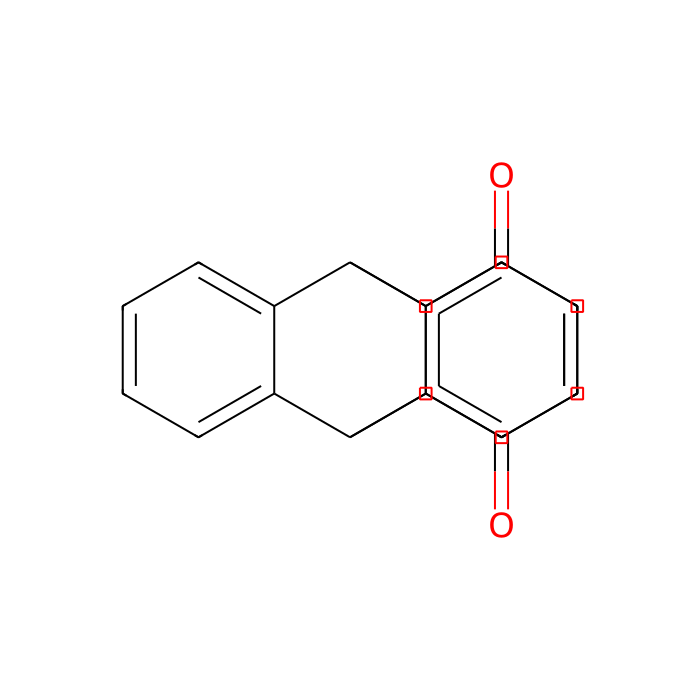
This compound belongs to the class of organic compounds known as anthraquinones. These are organic compounds containing either anthracene-9,10-quinone, 1,4-anthraquinone, or 1,2-anthraquinone.
External Descriptors
Not available
1. Djoumbou Feunang Y, Eisner R, Knox C, Chepelev L, Hastings J, Owen G, Fahy E, Steinbeck C, Subramanian S, Bolton E, Greiner R, and Wishart DS. ClassyFire: Automated Chemical Classification With A Comprehensive, Computable Taxonomy. Journal of Cheminformatics, 2016, 8:61.
Determine the necessary mass, volume, or concentration for preparing a solution.
Dilution Calculator
Determine the dilution needed to prepare a stock solution.
Reconstitution Calculator
Reviews
Customer Reviews
Application Protocols
Item-specific tested applications and conditions: Not specified for this item; refer to CoA/Spec Sheet.
General small-molecule handling protocol (for screening use)
Stock preparation: Allow vial to equilibrate to room temperature in a desiccated environment. Weigh quickly. Prepare a 10–20 mM stock in anhydrous DMSO (or another validated solvent). Mix to clarity (vortex/sonicate as needed). Filter through 0.2 µm PTFE if particulate persists.
Aliquoting: Dispense into low-bind tubes/plates in single-use aliquots to minimize freeze–thaw. Record exact concentration and date.
Storage of stocks: Store at −20°C or below, protected from moisture and light. Avoid repeated freeze–thaw. Inspect periodically by LC–MS/HPLC for degradation.
Assay dilution: Dilute stock into assay buffer to achieve desired final concentration with matched vehicle controls (constant final DMSO, typically ≤0.5–1% v/v, as assay permits). Confirm absence of precipitation or turbidity.
Documentation: Capture lot number, storage history, and analytical check results in ELN/LIMS to support reproducibility.
Biological Roles
Item-specific target/role information
Not specified for this item; refer to CoA/Spec Sheet and primary literature associated with the exact structure.
General context for small-molecule research tools
Small molecules in discovery research serve as chemical probes to modulate protein function, signaling pathways, or cellular phenotypes. Properly characterized probes can help assign function to targets, validate mechanisms in vitro, and provide starting points for structure–activity relationship (SAR) studies.
Key best practices: Establish potency and selectivity profiles in orthogonal assays; quantify solubility and permeability; and assess aggregation or redox activity that may confound readouts. Use suitable negative controls and dose–response designs.
ADME/stability (general): Early exploratory measurements (stability in buffer and microsomes, plasma protein binding, permeability) can guide assay conditions and interpretation of cellular results. These parameters are Not specified for this item and should be determined experimentally if relevant.
Caveat
Because the precise structure and biochemical target for this catalog entry are not specified here, avoid assigning biological roles or mechanisms until you confirm identity from the Spec Sheet and, if needed, independent spectral data.
Buffer Applications
Not typically applicable. INCA-6 is a discrete small-molecule library compound rather than a buffering agent or buffer component.
Practical notes (general)
If the compound must be used in aqueous systems, prepare a concentrated stock in a water-miscible organic solvent (commonly DMSO) and dilute into the final buffer with vigorous mixing to avoid precipitation. Maintain consistent final cosolvent across controls and test wells.
Buffer composition can strongly influence apparent activity for hydrophobic or ionizable compounds via solubility and protein binding. Optimize salt, pH, and additive (e.g., serum, BSA, Tween-20) conditions empirically once the compound’s properties are known. Properties are Not specified for this item; refer to CoA/Spec Sheet.
Green Alternatives
This section is more applicable when the product is used as a solvent or reagent present in bulk. INCA-6 is a small-molecule library compound used in minute quantities; green chemistry considerations primarily concern the choice of solvents and workup during handling and any custom synthesis.
Greener handling considerations (general)
Choose greener diluents: Where compatible with your assays/analytics, prefer ethanol or water-based systems over high-toxicity aprotic solvents. If DMSO is required, minimize volumes and waste.
Microscale operations: Conduct weighing/reconstitution on a microscale to limit solvent usage and waste generation. Use calibrated low-dead-volume vials and septa to reduce losses.
Waste minimization: Consolidate dilute organic wastes and segregate halogenated streams. Employ solvent recycling when facility infrastructure permits.
If custom synthesis is planned, consult solvent replacement guides (e.g., ACS GCI or CHEM21) to substitute hazardous solvents (DMF, NMP, dichloromethane) with preferred options (2-MeTHF, CPME, EtOAc, MeCN) when compatible with the molecule’s functional groups and stability.
Item-specific eco/tox profile, biodegradability, and lifecycle data are Not specified for this item; refer to SDS and CoA for any available environmental information.
Pharmaceutical Uses
No clinical or therapeutic claims. For research use only.
Formulation/processing context (general for small molecules used in research)
Preformulation: If the compound advances to in vivo research (preclinical), determine salt/solid form, polymorphism, and stability to guide vehicle selection. None of these data are specified for this item; refer to CoA/Spec Sheet.
Vehicles (preclinical research only): Common vehicles include PEG400/saline, Captisol, or aqueous surfactant systems, but compatibility must be established experimentally and under institutional oversight. Avoid extrapolating without stability/compatibility data for this specific compound.
Quality considerations: For any regulated or translational work, lot-specific identity, purity, residual solvent levels, and elemental impurities must be documented. Current product listing provides no pharmacopeial grade information.
Conclusion
This item is provided for laboratory research use. Any exploration of formulation or dosing must be preceded by confirmation of structure and purity and guided by institutionally approved protocols and the SDS.
Physical Properties
Item-specific facts (from Product Data)
Appearance: Not specified for this item; refer to CoA/Spec Sheet.
Melting point (MP): Not specified for this item; refer to CoA/Spec Sheet.
Boiling point (BP): Not specified for this item; refer to CoA/Spec Sheet.
Density: Not specified for this item; refer to CoA/Spec Sheet.
Refractive index: Not applicable/unknown; refer to CoA/Spec Sheet.
Solubility: Not specified for this item; refer to CoA/Spec Sheet.
logP/logD, pKa: Not specified for this item; refer to CoA/Spec Sheet.
Practical guidance (general)
If the compound is provided as a solid, typical reconstitution vehicles for small molecules include anhydrous DMSO or DMF, followed by dilution into aqueous buffers containing cosolvent (e.g., 0.1–1% DMSO) as assay-compatible. Confirm actual solubility and stability from the Spec Sheet.
Hygroscopic or hydrolytically sensitive materials should be handled under dry nitrogen/argon and weighed rapidly in a desiccated environment. Given the specified storage “-20°C, desiccated,” assume moisture sensitivity until data indicate otherwise.
Establish an analytical ID method (LC–MS/HRMS, 1H NMR) upon first receipt to confirm identity and assess purity appropriate to your application.
Quality & Grades
Item-specific facts (from Product Data)
Grade/Purity: Not specified for this item; refer to CoA/Spec Sheet.
How to interpret grade/purity for small-molecule research reagents (general)
Research-grade small molecules are typically offered with an assay purity by HPLC/UPLC (area%) and identity confirmation by NMR and/or MS. If optical activity is relevant, a chiral assay may be provided. In the absence of a stated grade, assume “research use only; not for human or veterinary use.”
For screening libraries or chemical biology use, an HPLC purity ≥95% (area%) is commonly targeted. For mechanistic enzymology or quantitative biophysics, higher stringency (≥98%) and verified residual solvent/inorganic content may be appropriate.
Stabilizers/salt forms: If the product is supplied as a salt, solvate, or with stabilizers, this will impact MW for dosing and can influence solubility and stability. This information is Not specified for this item; refer to CoA/Spec Sheet.
Recommendations
Request the lot-specific CoA prior to critical experiments. Confirm: analytical method(s), purity basis (area% vs. weight%), residual solvents, water content, and counterion content (if salt form). Adjust dosing by exact formula weight where applicable.
Establish internal QC on receipt (LC–MS retention time match, purity check) to ensure suitability for your application.
Reaction & Applications
Manufacturer applications (from Product Data)
Not specified for this item.
Research-use context (general for small-molecule library members)
Probe development: Compounds like INCA-6 are commonly employed as candidates in chemical biology to modulate or interrogate cellular pathways in phenotypic or target-based assays. Define assay windows and cytotoxicity thresholds early.
Screening: Suitable for inclusion in enzyme or cell-based screening cascades. Validate identity and purity by LC–MS before hit triage. Track plate maps, freeze–thaw cycles, and stock history to mitigate false negatives/positives.
Mechanistic follow-up: Upon observing activity, deploy orthogonal assays (biochemical vs. cellular), counterscreens, and control analogs to confirm on-target effects.
Analytical characterization: Build a fit-for-purpose analytical panel (LC–MS, 1H/13C NMR, HRMS) to verify compound integrity after storage and assay exposure (e.g., light, oxygen, aqueous buffers).
Synthetic chemistry note
If derivatization or SAR expansion is intended, obtain or derive the unambiguous structure and functional group map (Not specified for this item; refer to CoA/Spec Sheet) before planning protective group strategies or cross-couplings. Without structural data, avoid speculative transformations.
Reaction Conditions
Typical reaction conditions are not applicable without a defined structure or functional group set.
Guidance for exploratory work (general)
If custom modifications are planned, run microscale scouting experiments under mild, chemoselective conditions first (e.g., neutral coupling reagents, buffered media) and track progress by LC–MS.
Sensitivity screening: Test stability to acid/base, peroxide, and light on milligram scale to establish permissible ranges before committing to multistep sequences.
Workup/purification: Small, lipophilic molecules often purify well by reverse-phase preparative HPLC; polar/ionic species may require ion-exchange or normal-phase methods. Choose based on observed retention factors once the structure is confirmed.
Item-specific optimal solvents, temperatures, catalysts, and yields are Not specified for this item; refer to CoA/Spec Sheet and any primary literature tied to the confirmed structure.
Safety & Handling
GHS and hazard statements (from Product Data)
Signal word: Not specified for this item; refer to SDS.
H-statements: Not specified for this item; refer to SDS.
GHS classification and pictograms: Not specified for this item; refer to SDS.
General laboratory safety guidance (always defer to the official SDS for this product/lot)
PPE: Wear lab coat, safety glasses, and appropriate chemically resistant gloves. Use in a fume hood to avoid inhalation of dusts or vapors.
Avoid: Contact with skin/eyes, inhalation, and ingestion. Prevent moisture exposure if the material is desiccation-sensitive (per storage guidance).
Incompatibilities: Unknown for this specific item; as general practice, keep away from strong oxidizers, strong acids/bases, and sources of ignition until compatibility is confirmed.
First aid (general): If on skin/eyes, rinse with water for at least 15 minutes and remove contaminated clothing. If inhaled, move to fresh air. If ingested or symptoms persist, seek medical attention and present the SDS.
Spill/accident: Avoid raising dust; absorb solids with inert material, collect in a sealable container for disposal. Decontaminate surfaces with suitable solvent/detergent per SDS guidance.
Waste: Dispose of as organic laboratory waste in accordance with institutional and local regulations.
Transport/receipt: Shipped in an ice chest with ice pads as specified; inspect upon receipt and return to recommended storage promptly to maintain integrity.
Solvent Selection
This section is generally more applicable to solvents or reagents used as media. INCA-6 is supplied as a small molecule/compound-library member, not as a solvent.
Practical guidance (general for small molecules)
Primary stock solutions: DMSO is often the first-line solvent for hydrophobic screening compounds. Begin with 10–20 mM trial stocks and evaluate clarity and stability. Water miscibility can be tested after dilution of the DMSO stock into buffer.
Alternative vehicles: If DMSO solubility is limited, consider DMF, acetonitrile, ethanol, or inclusion of solubilizing excipients (e.g., 0.5–2% cyclodextrin) depending on assay constraints. Always confirm compatibility with your biological or analytical system.
pH effects: If ionizable groups are present (Not specified for this item; refer to CoA/Spec Sheet), solubility may improve upon pH adjustment. Prepare buffers outside the degradation-prone pH ranges once the compound’s stability profile is known.
Adsorption: Some lipophilic compounds adsorb to plastics. Use low-bind tubes and pre-equilibrate tips if recovery issues are observed.
Data needs for selection
Solubility, logP/logD, and pKa are Not specified for this item; refer to CoA/Spec Sheet. Optimize solvent choice empirically on a small scale and document conditions for reproducibility.
Storage & Reconstitution
Item-specific facts (from Product Data)
Storage conditions: Store at −20°C, desiccated.
Shipping: Ice chest with ice pads.
Appearance: Not specified for this item; refer to CoA/Spec Sheet.
Reconstitution guidance (general for small molecules)
Solvent selection: Begin with anhydrous DMSO for initial stocks unless the Spec Sheet indicates otherwise. Target 10–20 mM; adjust concentration to maintain a clear solution. If insoluble, trial DMF, acetonitrile, or ethanol. Water solubility is unknown.
Technique: Allow vial to warm to room temperature before opening to prevent moisture condensation. Weigh rapidly in a dry box or with desiccant nearby. Cap promptly after withdrawing material.
Aliquoting and storage: Prepare single-use aliquots of stock solutions. Store at −20°C or below, protected from light and moisture. Minimize freeze–thaw cycles.
Stability checks: Verify integrity after reconstitution via LC–MS/HPLC at initial time and periodically thereafter. Record any changes in retention time, purity, or presence of degradants.
Notes
Exact solubility, pH stability, and long-term solution stability are Not specified for this item; refer to CoA/Spec Sheet and SDS. Adjust handling based on any lot-specific notes provided by Aladdin Scientific.
Structure & Identity
Item-specific facts (from Product Data)
Product name: INCA-6 (SKU: I275153)
CAS: 3519-82-2
PubChem CID: 230748
InChIKey: 98286 (as provided)
SMILES: Not specified for this item; refer to CoA/Spec Sheet.
Molecular formula: Not specified for this item; refer to CoA/Spec Sheet.
Molecular weight: Not specified for this item; refer to CoA/Spec Sheet.
Notes on structural features
Structural class and functional groups: Not specified for this item; refer to CoA/Spec Sheet.
Stereochemistry: Not specified for this item; refer to CoA/Spec Sheet.
General guidance
When structural identifiers (SMILES/InChI) are required for LIMS registration or cheminformatics, please verify against the Certificate of Analysis (CoA) or an authentic spectral package. If discrepancies arise between third‑party databases and the CoA, prioritize the CoA/Aladdin Spec Sheet for this specific lot.
For procurement or screening library curation, use the CAS and CID as coarse identifiers, but confirm exact structure and salt/solvate state from the Spec Sheet prior to assay design or analytical method development.
Synthetic Utility
This section is typically applicable to building blocks and reagents with defined functional handles. The exact functional groups and reactivity of INCA-6 are Not specified for this item; refer to CoA/Spec Sheet.
General guidance
If INCA-6 is to be derivatized for SAR or tagged for affinity/fluorescence studies, first confirm the precise structure (including salt/solvate state and any stereochemistry). Map sites tolerant to substitution and assess stability toward common transformations (oxidation/reduction, coupling conditions) on an analytical scale.
Establish orthogonal protection strategies only after confirming the presence and reactivity of nucleophilic/electrophilic sites. Without structural data, avoid planning named reactions or conditions that could compromise integrity.
For linker installation (e.g., biotinylation or click handles), select chemistries matched to known functional groups (azide/alkyne, amine, carboxyl, halide). Their presence is not confirmed here.
Target Specificity
Item-specific data
Target/biomolecule specificity: Not specified for this item; refer to CoA/Spec Sheet.
Species reactivity, clone/isotype (if biologic): Not applicable to this small-molecule product.
Guidance (general)
Upon establishing activity in a biological assay, evaluate specificity using orthogonal assays and a diverse counterscreen panel to detect off-target effects. Chemoproteomics, CETSA, or thermal shift assays can help define target engagement when feasible.
Report concentration–response with Hill slopes and include assay interference controls (e.g., redox, fluorescence, aggregation) to reduce false associations.
We use cookies to ensure the website functions properly and, where permitted, to improve your experience. You can manage your preferences at any time in Settings. Learn more in our Cookie Policy.
Shall we send you a message when we have discounts available?
Remind me later
Thank you! Please check your email inbox to confirm.
Products are supplied to verified businesses, institutions, and qualified professionals for research and development use only. Not for use in humans, animals, diagnosis, or therapy.