
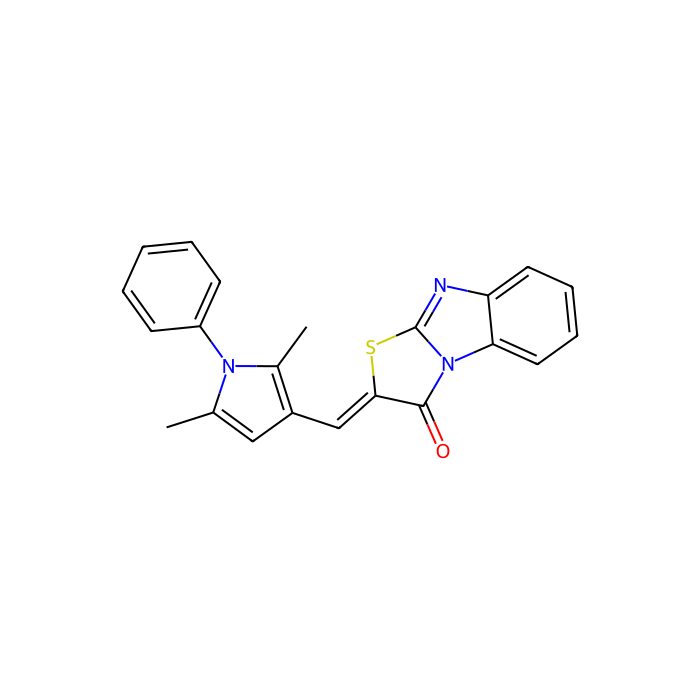
Determine the necessary mass, volume, or concentration for preparing a solution.
| Activity Type | Relation | Activity value | Units | Action Type | Journal | PubMed Id | doi | Assay Aladdin ID |
|---|
Taxonomy Tree
| Kingdom | Organic compounds |
|---|---|
| Superclass | Organoheterocyclic compounds |
| Class | Pyrroles |
| Subclass | Substituted pyrroles |
| Intermediate Tree Nodes | Not available |
| Direct Parent | Phenylpyrroles |
| Alternative Parents | Benzimidazoles N-substituted imidazoles Benzene and substituted derivatives Thiazoles Heteroaromatic compounds Lactams Azacyclic compounds Organopnictogen compounds Organooxygen compounds Organonitrogen compounds Organic oxides Hydrocarbon derivatives |
| Molecular Framework | Aromatic heteropolycyclic compounds |
| Substituents | 1-phenylpyrrole - Benzimidazole - Monocyclic benzene moiety - N-substituted imidazole - Benzenoid - Azole - Imidazole - Thiazole - Heteroaromatic compound - Lactam - Azacycle - Organic oxide - Organooxygen compound - Organonitrogen compound - Organopnictogen compound - Organic nitrogen compound - Hydrocarbon derivative - Organic oxygen compound - Aromatic heteropolycyclic compound |
| Description | This compound belongs to the class of organic compounds known as phenylpyrroles. These are polycyclic aromatic compounds containing a benzene ring linked to a pyrrole ring through a CC or CN bond. |
| External Descriptors | Not available |
| Activity Type | Relation | Activity value | Units | Action Type | Journal | PubMed Id | doi | Assay Aladdin ID |
|---|
| Activity Type | Relation | Activity value | Units | Action Type | Journal | PubMed Id | doi | Assay Aladdin ID |
|---|
Find and download the COA for your product by matching the lot number on the packaging.
| Lot Number | Certificate Type | Date | Item |
|---|---|---|---|
 C23231267 | Certificate of Analysis | Jan 19, 2026 | I286819 |
| C2324045 | Certificate of Analysis | Jan 19, 2026 | I286819 |
| C2324047 | Certificate of Analysis | Jan 19, 2026 | I286819 |
| C2324068 | Certificate of Analysis | Jan 19, 2026 | I286819 |
| C2324069 | Certificate of Analysis | Jan 19, 2026 | I286819 |
| C2324070 | Certificate of Analysis | Jan 19, 2026 | I286819 |
| C2324071 | Certificate of Analysis | Jan 19, 2026 | I286819 |
| C2324073 | Certificate of Analysis | Jan 19, 2026 | I286819 |
| C2324076 | Certificate of Analysis | Jan 19, 2026 | I286819 |
| C2324078 | Certificate of Analysis | Jan 19, 2026 | I286819 |
| C2513053 | Certificate of Analysis | Dec 30, 2022 | I286819 |
| Solubility | Solvent:DMSO, Max Conc. mg/mL: 1.86, Max Conc. mM: 5 |
|---|---|
| Molecular Weight | 371.500 g/mol |
| XLogP3 | 5.300 |
| Hydrogen Bond Donor Count | 0 |
| Hydrogen Bond Acceptor Count | 3 |
| Rotatable Bond Count | 2 |
| Exact Mass | 371.109 Da |
| Monoisotopic Mass | 371.109 Da |
| Topological Polar Surface Area | 65.099 Ų |
| Heavy Atom Count | 27 |
| Formal Charge | 0 |
| Complexity | 617.000 |
| Isotope Atom Count | 0 |
| Defined Atom Stereocenter Count | 0 |
| Undefined Atom Stereocenter Count | 0 |
| Defined Bond Stereocenter Count | 1 |
| Undefined Bond Stereocenter Count | 0 |
| The total count of all stereochemical bonds | 1 |
| Covalently-Bonded Unit Count | 1 |
The following are general, literature-informed practices for small-molecule probes in cell-based or biochemical assays. They are not item-specific validated protocols.
Preparing stocks and working solutions:
Cell-based assays (general):
Biochemical assays (general):
Data quality:
These guidelines support reproducible handling; adapt to your specific biology and readout.
Context for research use (literature):
Use considerations:
Caveats:
Note: The above describes general, literature-based biological context for ITX3-like probes and is not item-specific specification or advice for clinical use.
This product is not a buffering agent and is not used to prepare pH buffer systems. For experimental work, it is typically dissolved in DMSO and then diluted into existing biological buffers or culture media.
Practical notes:
This item is a bioactive probe used at micromolar concentrations rather than a bulk reagent or solvent; therefore, conventional “green replacement” analysis is not typically applicable.
Sustainability-conscious practices (general suggestions):
If your workflow involves synthetic modification of ITX3, consider greener solvent substitutions (e.g., 2-MeTHF vs THF; CPME vs Et2O) and catalytic methods, but such considerations are outside the normal use case for this catalog item.
This product is supplied strictly for research use and is not an excipient or active pharmaceutical ingredient in approved products.
If you require a related scaffold for preclinical development, consult the primary literature and engage appropriate CMC characterization (polymorph, salt form, residual solvents, stability) under qualified QA systems.
Item-specific physical constants were not provided with this listing. Do not use the following fields as specifications for QA release; consult the CoA/SDS for authoritative values.
Note: If you require quantitative solubility or partition data for method development (HPLC, LC–MS), request the CoA/Spec Sheet for the exact lot.
Guidance on grade meaning and implications (general):
What is specific to this listing:
This product is supplied as a finished small-molecule probe; it is not primarily used as a synthetic reagent. Accordingly, classical organic “reaction applications” (e.g., as a solvent, base, or catalyst) are not typical.
Research applications (literature, chemical biology):
Practical notes for assay use (general):
If you intend to derivatize or immobilize ITX3 for chemoproteomics, request structural data (SMILES, functional handles) from the CoA/literature to assess feasibility.
Conventional reaction-condition guidance is not applicable since ITX 3 is not used as a reagent or catalyst.
Assay preparation conditions (practical, general):
These are general laboratory practices for small-molecule probes; optimize for your specific assay and confirm compound integrity by analytical methods where results are sensitive to concentration and stability.
Safety information specific to this item was not provided. The guidance below is conservative, general lab practice for small organic research compounds; always defer to the product’s SDS.
Authoritative information, exposure limits, and transport details are in the SDS (request from Aladdin Scientific with SKU I286819).
Practical dissolution strategy for ITX 3 (general guidance for small-molecule probes):
Polarity/miscibility context (general):
Tips:
For best reproducibility, document lot number, preparation date, solvent, concentration, and storage conditions for each stock.
Brief overview: ITX 3 is a cataloged small-molecule research compound supplied for chemical biology and screening workflows.
Structural features (general, literature):
2D structure description (general):
ITX 3 is offered as a finished bioactive small molecule rather than a synthetic building block. As such, it is not commonly used as a reagent or intermediate in multistep synthesis.
Recommendation: For any planned conjugation or prodrug design, request structural documentation (CoA/Spec Sheet) and evaluate compatibility of the intended chemistry (e.g., carbamate/amide formation, cross-couplings) with the scaffold’s heteroaromatic core and potential liability motifs (oxidation, hydrolysis) identified from literature.
No target specificity details are provided for this catalog item.
Note: This section is typically applicable to biologics (antibodies) or well-annotated inhibitors. For small molecules, users should consult peer-reviewed studies and perform in-house profiling where selectivity is critical to interpretation.