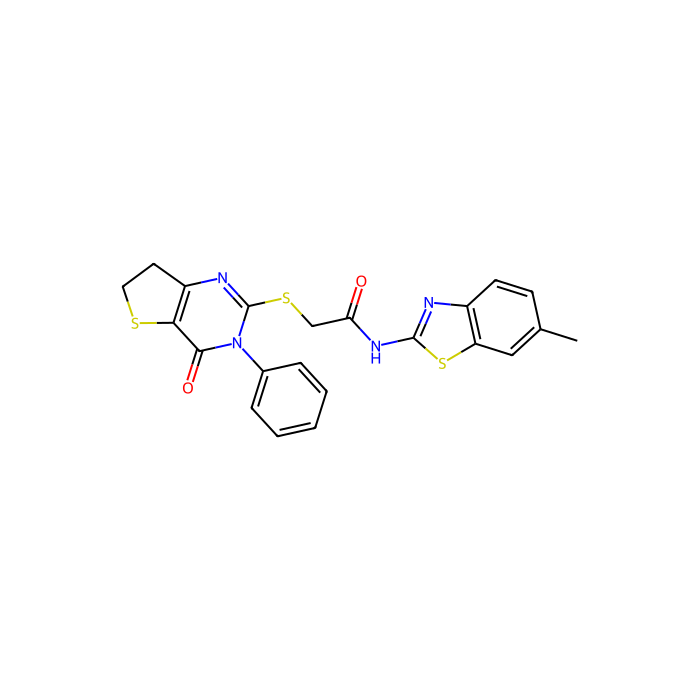
IWP-2 - ≥98% , CAS No.686770-61-6

CAS: 686770-61-6 Cat. No.: I126927 Formula: C22H18N4O2S3 Molecular Weight: 466.6
AVAILABLE TO ORDER
GRADE & PURITY ≥98%
Synonyms
N -(6-Methyl-2-benzothiazolyl)-2-[(3,4,6,7-tetrahydro-4-oxo-3-phenylthieno[3,2- d ]pyrimidin-2-yl)thio]-acetamide|N-(6-Methylbenzo[d]thiazol-2-yl)-2-(4-oxo-3-phenyl-3,4,6,7-tetrahydrothieno[3,2-d]pyrimidin-2-ylthio)acetamide|N-(6-methylbenzo[d]thiazol-2-yl)-2-((4-oxo-3-phenyl-3,4,6,7-tetrahydrothieno[3,2-d]pyrimidin-2-yl)thio)acetamide|N-(6-Methyl-2-benzothiazolyl)-2-[(3,4,6,7-tetrahydro-4-oxo-3-phenylthieno[3,2-d]pyrimidin-2-yl)thio]-acetamide|Wnt Inhibitor IWP-2|IWP-2 (GMP)|inhibitor of Wnt Production-2|N-(6-Methyl-2-benzothiazolyl)-2-[(3 ,4,6,7-tetrahydro-4-oxo-3-phenylthieno[3,2-d]pyrimidin-2-yl)thio]-acetamide|IWP2|IWP-2|IWP 2|N-(6-methyl-1,3-benzothiazol-2-yl)-2-[(4-oxo-3-phenyl-6,7-dihydrothieno[3,2-d]pyrimidin-2-yl)sulfanyl]acetamide|N-(6-methyl-1,3-benzothiazol-2-yl)-2-[(4-oxo-3-phenyl-6,7-dihydrothieno[3,2-d]pyrimidin-2-yl)thio]acetamide
Storage
Store at -20°C
Shipped In
Ice chest + Ice pads
★
Size
USA
Germany (EU)*
Price
Qty
5mg
I126927-5mg
3 In stock
—

$40.90

$61.90
Save $21.00 (33.93%)
10mg
I126927-10mg
3 In stock
—

$65.90

$98.90
Save $33.00 (33.37%)
25mg
I126927-25mg
2 In stock
—

$144.90

$217.90
Save $73.00 (33.50%)
50mg
I126927-50mg
2 In stock
—

$214.90

$322.90
Save $108.00 (33.45%)
100mg
I126927-100mg
Made to order · 8–12 wks

$386.90

$580.90
Save $194.00 (33.40%)
Enter a quantity for the sizes you want to add.

Overview

IWP-2 is an inhibitor of Wnt processing and secretion with IC50 of 27 nM in a cell-free assay, selective blockage of Porcn-mediated Wnt palmitoylation, does not affect Wnt/β-catenin in general and displays no effect against Wnt-stimulated cellular responses.
An inhibitor of Wnt production


Application

IWP-2 has been used to treat the cell lines L-Wnt-3a and L-Wnt-5a, to demonstrate the inhibitory effect of IWP-2. It has also been used as a Wnt signaling inhibitor to treat WT and Gja1Jrt/+ stromal cells to confirm that, theWnt/β-catenin signaling pathway pathway was not involved in the increased marker expression by Gja1Jrt/+ osteoblasts.

Specifications

Synonyms
N -(6-Methyl-2-benzothiazolyl)-2-[(3,4,6,7-tetrahydro-4-oxo-3-phenylthieno[3,2- d ]pyrimidin-2-yl)thio]-acetamide | N-(6-Methylbenzo[d]thiazol-2-yl)-2-(4-oxo-3-phenyl-3,4,6,7-tetrahydrothieno[3,2-d]pyrimidin-2-ylthio)acetamide | N-(6-methylbenzo[d]thiazol-2-yl)-2-((4-oxo-3-phenyl-3,4,6,7-tetrahydrothieno[3,2-d]pyrimidin-2-yl)thio)acetamid Show more
Specifications & Purity
≥98%
Biochemical and Physiological Mechanisms
Inhibitor of Wnt processing and secretion. Inactivates PORCN, a membrane-bound O-acyltransferase (MBOAT), and selectively inhibits palmitoylation of Wnt. Blocks Wnt-dependent phosphorylation of Lrp6 receptor and Dvl2, andβ-catenin accumulation. Suppresses self-renewal in R1 embryonic stem cells and promotes cardiomyocyte differentiation from hPSCs. IWP-2 is an inactivator of Porcn function; inhibitor of Wnt production. Wnt/b-catenin (‘canonical′) pathway maintains transcriptional programs that enable stem cells to remain multipotent. Hyperactivation of the Wnt/b-catenin pathway leads to disease stage. IWP-2 inhibits Wnt production. It appears that IWP inactivates Porcn function either by directly inhibiting the Porcn active site or by modulating the function of a Porcn regulator. Porcn is a member of the membrane-bound O-acyltransferase (MBOAT) family, which adds a palmitoyl group to Wnt proteins that is essential to their signaling ability and is required for Wnt secretion. IWP-2 is useful in both regenerative medicine and anticancer efforts.
Storage
Store at -20°C
Shipped In
Ice chest + Ice pads
This product requires cold chain shipping. Ground and other economy services are not available.
Purity
≥98%
Names and Identifiers
Pubchem Sid
Pubchem Sid Url
https://pubchem.ncbi.nlm.nih.gov/substance/504760703
SMILES
CC1=CC2=C(C=C1)N=C(S2)NC(=O)CSC3=NC4=C(C(=O)N3C5=CC=CC=C5)SCC4
IUPAC Name
N-(6-methyl-1,3-benzothiazol-2-yl)-2-[(4-oxo-3-phenyl-6,7-dihydrothieno[3,2-d]pyrimidin-2-yl)sulfanyl]acetamide
InChIKey
WRKPZSMRWPJJDH-UHFFFAOYSA-N
InChI
1S/C22H18N4O2S3/c1-13-7-8-15-17(11-13)31-21(23-15)25-18(27)12-30-22-24-16-9-10-29-19(16)20(28)26(22)14-5-3-2-4-6-14/h2-8,11H,9-10,12H2,1H3,(H,23,25,27)
Isomeric SMILES
CC1=CC2=C(C=C1)N=C(S2)NC(=O)CSC3=NC4=C(C(=O)N3C5=CC=CC=C5)SCC4
WGK Germany
2
Molecular Weight
466.6
Reaxy-Rn
19908773
Reaxys-RN_link_address
https://www.reaxys.com/reaxys/secured/hopinto.do?context=S&query=IDE.XRN=19908773&ln=

Advanced Data

Taxonomic Classification

Taxonomy Tree

KingdomOrganic compounds
SuperclassOrganoheterocyclic compounds
ClassThienopyrimidines
SubclassNot available
Intermediate Tree Nodes Not available
Direct ParentThienopyrimidines
Alternative Parents Benzothiazoles  N-arylamides  Pyrimidones  Alkylarylthioethers  Benzene and substituted derivatives  Thiazoles  Heteroaromatic compounds  Secondary carboxylic acid amides  Lactams  Sulfenyl compounds  Azacyclic compounds  Organopnictogen compounds  Organic oxides  Hydrocarbon derivatives  Carbonyl compounds  
Molecular FrameworkAromatic heteropolycyclic compounds
Substituents 1,3-benzothiazole - Thienopyrimidine - Aryl thioether - N-arylamide - Pyrimidone - Alkylarylthioether - Monocyclic benzene moiety - Pyrimidine - Benzenoid - Azole - Heteroaromatic compound - Thiazole - Carboxamide group - Lactam - Secondary carboxylic acid amide - Carboxylic acid derivative - Azacycle - Sulfenyl compound - Thioether - Organic oxygen compound - Hydrocarbon derivative - Organic oxide - Organosulfur compound - Organooxygen compound - Organonitrogen compound - Organic nitrogen compound - Carbonyl group - Organopnictogen compound - Aromatic heteropolycyclic compound
DescriptionThis compound belongs to the class of organic compounds known as thienopyrimidines. These are heterocyclic compounds containing a thiophene ring fused to a pyrimidine ring. Thiophene is 5-membered ring consisting of four carbon atoms and one sulfur atom. Pyrimidine is a 6-membered ring consisting of four carbon atoms and two nitrogen centers at the 1- and 3- ring positions.
External Descriptors Not available
3D Structure
Interactive Chemical Structure Model


Associated Targets(Human)
PORCN Tchem Protein-serine O-palmitoleoyltransferase porcupine (1 Activities)
Activity TypeActivity Value -log(M)Mechanism of ActionActivity ReferencePublications (PubMed IDs)
CSNK1D Tchem Casein kinase I delta (4546 Activities)
Activity TypeRelationActivity valueUnitsAction TypeJournalPubMed IddoiAssay Aladdin ID
CSNK1E Tclin Casein kinase I epsilon (1412 Activities)
Activity TypeRelationActivity valueUnitsAction TypeJournalPubMed IddoiAssay Aladdin ID
ZAP70 Tchem Tyrosine-protein kinase ZAP-70 (2189 Activities)
Activity TypeRelationActivity valueUnitsAction TypeJournalPubMed IddoiAssay Aladdin ID
CAPAN-1 (772 Activities)
Activity TypeRelationActivity valueUnitsAction TypeJournalPubMed IddoiAssay Aladdin ID
HT-29 (80576 Activities)
Activity TypeRelationActivity valueUnitsAction TypeJournalPubMed IddoiAssay Aladdin ID
PANC-1 (6144 Activities)
Activity TypeRelationActivity valueUnitsAction TypeJournalPubMed IddoiAssay Aladdin ID
MIA PaCa-2 (5949 Activities)
Activity TypeRelationActivity valueUnitsAction TypeJournalPubMed IddoiAssay Aladdin ID
HEK293 (82097 Activities)
Activity TypeRelationActivity valueUnitsAction TypeJournalPubMed IddoiAssay Aladdin ID
SW-620 (52400 Activities)
Activity TypeRelationActivity valueUnitsAction TypeJournalPubMed IddoiAssay Aladdin ID
TLK2 Tchem Serine/threonine-protein kinase tousled-like 2 (710 Activities)
Activity TypeRelationActivity valueUnitsAction TypeJournalPubMed IddoiAssay Aladdin ID
PORCN Tchem Probable protein-cysteine N-palmitoyltransferase porcupine (135 Activities)
Activity TypeRelationActivity valueUnitsAction TypeJournalPubMed IddoiAssay Aladdin ID
Associated Targets(non-human)
Soat1 Acyl coenzyme A:cholesterol acyltransferase 1 (295 Activities)
Activity TypeRelationActivity valueUnitsAction TypeJournalPubMed IddoiAssay Aladdin ID
Jun Transcription factor AP-1 (36 Activities)
Activity TypeRelationActivity valueUnitsAction TypeJournalPubMed IddoiAssay Aladdin ID
Wnt3a Protein Wnt-3a (429 Activities)
Activity TypeRelationActivity valueUnitsAction TypeJournalPubMed IddoiAssay Aladdin ID
Danio rerio (3092 Activities)
Activity TypeRelationActivity valueUnitsAction TypeJournalPubMed IddoiAssay Aladdin ID
Mboat4 Ghrelin O-acyltransferase (37 Activities)
Activity TypeRelationActivity valueUnitsAction TypeJournalPubMed IddoiAssay Aladdin ID
Mboat1 Lysophospholipid acyltransferase 1 (1 Activities)
Activity TypeRelationActivity valueUnitsAction TypeJournalPubMed IddoiAssay Aladdin ID
Hhat Protein-cysteine N-palmitoyltransferase HHAT (1 Activities)
Activity TypeRelationActivity valueUnitsAction TypeJournalPubMed IddoiAssay Aladdin ID
Mboat2 Lysophospholipid acyltransferase 2 (1 Activities)
Activity TypeRelationActivity valueUnitsAction TypeJournalPubMed IddoiAssay Aladdin ID
Lpcat3 Lysophospholipid acyltransferase 5 (1 Activities)
Activity TypeRelationActivity valueUnitsAction TypeJournalPubMed IddoiAssay Aladdin ID
Mechanisms of Action
Certificates (CoA,COO,BSE/TSE and Analysis Chart)
C of A & Other Certificates(BSE/TSE, COO):
Analytical Chart:

Find and download the COA for your product by matching the lot number on the packaging.

6 results found

Lot NumberCertificate TypeDateItem
D2610050D2610050Certificate of AnalysisApr 18, 2026 I126927
A2211790A2211790Certificate of AnalysisJul 15, 2025 I126927
A2211804A2211804Certificate of AnalysisJul 15, 2025 I126927
A2211836A2211836Certificate of AnalysisJul 15, 2025 I126927
A2211853A2211853Certificate of AnalysisJul 15, 2025 I126927
A2211868A2211868Certificate of AnalysisJul 15, 2025 I126927
Chemical and Physical Properties
SolubilitySolvent:DMSO, Max Conc. mg/mL: 2.33, Max Conc. mM: 5 with gentle warming
Sensitivityheat sensitive
Boil Point(°C)723.12° C
Melt Point(°C)316.82°C
Molecular Weight466.600 g/mol
XLogP34.800
Hydrogen Bond Donor Count1
Hydrogen Bond Acceptor Count7
Rotatable Bond Count5
Exact Mass466.059 Da
Monoisotopic Mass466.059 Da
Topological Polar Surface Area154.000 Ų
Heavy Atom Count31
Formal Charge0
Complexity796.000
Isotope Atom Count0
Defined Atom Stereocenter Count0
Undefined Atom Stereocenter Count0
Defined Bond Stereocenter Count0
Undefined Bond Stereocenter Count0
The total count of all stereochemical bonds0
Covalently-Bonded Unit Count1
Documents & Articles
Solution Calculators
Reviews

Customer Reviews

Application Protocols

Validated application protocols (e.g., assay formats, recommended working concentrations, or positive controls) are not provided in the Product Data for this item.

  • Tested applications: Not specified for this item.
  • Recommended dilutions/concentrations: Not specified for this item.
  • Positive/negative controls: Not specified for this item.

General guidance (informational only; verify in your system):

  • Prepare fresh DMSO stocks and include matched vehicle controls.
  • For cell-based assays, begin with a broad titration (e.g., 8–10 points, half-log spacing) and quantify pathway readouts with appropriate reporters or qPCR markers.
  • Confirm reversibility/washout behavior if temporal control is important.

Please refer to the CoA/Spec Sheet or contact Aladdin Scientific Technical Support for any available lot-specific application notes.

Biological Roles

IWP-2 is broadly recognized in the literature as a chemical probe used to modulate Wnt signaling in cell and developmental biology research. Item-specific biochemical parameters (e.g., IC50, target binding constants) are not provided in this listing.

General context (literature):

  • Wnt pathway: Wnt ligands require post-translational lipidation for secretion and activity. Chemical inhibition of Wnt ligand maturation enables researchers to downregulate canonical and non-canonical Wnt signaling upstream of receptor engagement.
  • Research utility: Such probes support studies of stem cell self-renewal/differentiation, tissue patterning, and signaling crosstalk in model systems. They are often used with reporter assays (e.g., TCF/LEF luciferase) to quantify pathway activity.
  • Experimental design: Distinguish effects on ligand production versus downstream signaling by comparing with exogenous Wnt ligands or downstream pathway activators.

Important notes:

  • No medical or diagnostic claims are made for this product; it is for research use only.
  • Potency, selectivity, metabolite profiles, and off-target information are assay- and context-dependent and are Not specified for this item; consult primary literature and validate in your system.
Buffer Applications

This product is a bioactive small molecule rather than a buffering reagent; standard buffer formulation guidance (e.g., pH capacity, ionic strength) is not applicable.

Practical notes for assay buffers (general):

  • Vehicle addition: Prepare concentrated DMSO stock and add to the assay buffer or culture medium under mixing to avoid localized supersaturation and precipitation. Keep final DMSO low (often ≤0.1–0.2% v/v; literature) to minimize vehicle effects.
  • Protein binding: Serum proteins and albumin can alter free compound concentrations; maintain consistent serum content across controls and treatments.
  • Adsorption: Hydrophobic probes can adsorb to plastics; pre-equilibrate or use low-binding tips/plates if assay sensitivity demands.

Item-specific buffer compatibility, pKa, and solubility are Not specified for this item; refer to CoA/Spec Sheet and validate empirically.

Green Alternatives

As a bioactive probe, IWP-2 itself is not replaceable by a “green solvent,” but its handling and formulation can adopt greener practices.

Greener handling strategies (general):

  • Solvent minimization: Prepare higher-concentration DMSO stocks to reduce solvent volumes introduced into assays while keeping final DMSO ≤0.1–0.2% v/v when possible.
  • Alternative vehicles: Where compatible with assay biology, consider aqueous formulations with minimal organic co-solvent using cyclodextrins (e.g., HP-β-CD) or micellar systems to reduce DMSO.
  • Waste reduction: Consolidate assays to minimize partial vials and expired stocks. Quench and segregate organic waste (DMSO/DMF/EtOH) per institutional guidelines.
  • Energy conservation: Store aliquots at −20°C (as specified) rather than in ultra-low freezers when stability permits; batch-thaw to limit door openings.

Comparison of common vehicles (general):

  • DMSO: High solvency, completely miscible with water; higher environmental persistence. Widely accepted in bioassays at ≤0.1–0.5% v/v.
  • Ethanol: Lower toxicity profile in waste streams, faster evaporation; reduced solvency for many heteroaromatics.
  • PEG 400 or aqueous HP-β-CD: Enables lower organic solvent percentages; may influence cell membranes or binding equilibria—requires control experiments.

Note: Item-specific solubility and excipient compatibility are Not specified for this item; validate greener alternatives empirically for your assay.

Pharmaceutical Uses

IWP-2 is provided strictly for research use and is not an approved pharmaceutical, API, or excipient.

  • Pharmacopeial status: Not compendial; no USP/EP/JP monograph (to the best of public literature knowledge). Not specified for this item; confirm as needed.
  • Formulation role: In preclinical research, compounds of this class may be formulated for in vitro studies as DMSO stocks and, if used in animal studies by qualified researchers, in vehicles such as aqueous PEG/surfactant systems. Such uses are outside the scope of this listing and require institutional approvals.
  • Manufacturing use: Not intended for GMP manufacturing or clinical applications.

Note: No therapeutic claims are made. Any in vivo use, dose, or route is not specified for this item and must be determined by the investigator under applicable regulations and ethical approvals.

Physical Properties

Item-specific physicochemical specifications are not provided in this listing.

  • Appearance: Not specified for this item; refer to CoA/Spec Sheet.
  • Molecular weight: Not specified for this item; refer to CoA/Spec Sheet.
  • Molecular formula: Not specified for this item; refer to CoA/Spec Sheet.
  • Melting point (MP): Not specified for this item; refer to CoA/Spec Sheet.
  • Boiling point (BP): Not applicable for most solid bioactive probes; Not specified for this item.
  • Density: Not specified for this item; refer to CoA/Spec Sheet.
  • Refractive index: Not applicable to solids; Not specified for this item.
  • LogP/logD: Not specified for this item; refer to CoA/Spec Sheet.
  • Aqueous solubility: Not specified for this item; refer to CoA/Spec Sheet.

General guidance (literature/typical for Wnt-pathway probes):

  • Solubility profile: Such probes are commonly dissolved in anhydrous DMSO to prepare concentrated stocks (e.g., 10–50 mM), then diluted into assay buffers/medium. Actual solubility and stability are compound- and lot-dependent; verify by small-scale test and CoA.
  • Stability: Many heteroaromatic inhibitors are light- and moisture-sensitive to varying degrees; minimize exposure to ambient light and repeated freeze–thaw.

Note: All values above labeled as “Not specified” should be confirmed against the Certificate of Analysis (CoA) for this SKU/lot.

Quality & Grades

Item-specific grade/purity are not listed in the Product Data.

  • Grade/Purity: Not specified for this item; refer to CoA/Spec Sheet.

Interpretation and context for researchers:

  • Research-grade small-molecule probes are typically provided at high chemical purity (often ≥95% by HPLC), with identity confirmed by NMR/MS/HRMS. However, exact acceptance criteria are lot-specific—please consult the CoA.
  • Chromatographic profile: For bioactive screening, low levels of UV-absorbing impurities are important; HPLC chromatograms in the CoA (if provided) should be reviewed, especially for secondary peaks within ±1 min of the main peak (co-elution risk).
  • Residual solvents, water, and stabilizers: Not specified for this item; refer to CoA/Spec Sheet. If present, stabilizers/antioxidants will be declared on the CoA and may influence bioassay readouts.
  • Batch traceability: Use the lot number on the label to retrieve the matching CoA. For reproducibility, maintain records of lot, concentration, and storage history of stock solutions.

Recommendations:

  • For quantitative biology, verify purity by in-house LC–MS where feasible.
  • If using in cell assays, perform a brief cytotoxicity baseline titration to confirm the working window for your system, as trace impurities or vehicle effects can shift apparent potency.
Reaction & Applications

This product is supplied and used as a bioactive small-molecule probe rather than a synthetic reagent; it is not typically chosen as a solvent or building block for organic synthesis.

Research applications (general, literature):

  • Pathway modulation: IWP-2 is widely cited as a chemical tool to suppress Wnt ligand maturation in cellular systems for target validation, pathway mapping, and phenotypic screening. Use includes temporal control of Wnt signaling during differentiation protocols or reporter assays.
  • Mechanistic studies: Enables interrogation of upstream Wnt biogenesis versus downstream receptor signaling by comparing responses to Wnt-conditioned media, Wnt ligands, or pathway agonists/antagonists.
  • Combination studies: Employed alongside β-catenin/TCF reporters, GSK3 inhibitors, or PORCN genetic perturbations to triangulate pathway nodes.

Practical guidance:

  • Prepare fresh DMSO stock solutions and store aliquots at −20°C to limit freeze–thaw cycles. Protect from light.
  • Validate working concentrations in your cell model; typical effective ranges for pathway probes can span nanomolar to low micromolar (literature), but are assay- and cell-type–dependent.
  • Include vehicle controls and, where applicable, orthogonal probes to confirm on-target effects.

Note: Any numerical potency metrics (IC50, KD) and specific target annotations are Not specified for this item and should be sourced from primary literature or the CoA if provided.

Reaction Conditions

This product is supplied for use as a bioactive probe in biological assays, not as a substrate or reagent for chemical reactions. Therefore, standard synthetic reaction conditions (solvent/catalyst/temperature/yield) are not applicable.

Assay handling conditions (general guidance, literature):

  • Stock preparation: Dissolve in anhydrous DMSO to prepare a concentrated stock (e.g., 10–50 mM); vortex and, if necessary, briefly sonicate. Verify clarity and absence of particulates.
  • Working solutions: Dilute into pre-warmed media or assay buffer under mixing to the desired final concentration. Maintain consistent final DMSO across controls and treatments.
  • Temperature/light: Handle at ambient temperature during solution prep; protect from strong light to mitigate potential photodegradation found in many heteroaromatic probes.
  • Stability checks: If solutions will be used over multiple days, assess stability by LC–MS or activity in a pilot assay; store aliquots at −20°C between uses to minimize degradation.

Item-specific kinetic stability, hydrolysis sensitivity, or photostability are Not specified for this item; consult CoA and SDS for additional guidance.

Safety & Handling

Hazard classification for this specific item is not provided in the listing; always consult the SDS supplied with the shipment for authoritative safety information.

Item-specific safety data:

  • GHS classification: Not specified for this item; refer to SDS.
  • Pictograms, Signal Word, H-statements: Not specified for this item; refer to SDS.
  • Research use: For research use only (not for human or veterinary use).
  • Storage: Store at −20°C (per Product Data). Shipments are provided in an ice chest with ice pads to maintain the cold chain.

General laboratory precautions (good practice):

  • PPE: Wear laboratory coat, appropriate gloves (e.g., nitrile), and safety glasses. Handle powders in a fume hood to avoid dust inhalation; handle DMSO solutions with care due to skin permeability.
  • Incompatibilities: Avoid strong oxidizers and strong acids/bases unless process-validated. Keep away from light and moisture if stability is uncertain.
  • First aid (overview; defer to SDS): In case of skin/eye contact, rinse with water for ≥15 minutes and remove contaminated clothing. If inhaled, move to fresh air. If ingested, rinse mouth and seek medical attention. Provide SDS to responders.
  • Spill/cleanup: Avoid dust generation; absorb solutions with inert material. Dispose as organic laboratory waste in accordance with institutional and local regulations.
  • Special risks: Bioactive small molecules can have potent cellular effects at low concentrations; prevent exposure and environmental release.
Solvent Selection

IWP-2 is a hydrophobic small-molecule probe; item-specific solubility data are not provided. Researchers typically prepare concentrated DMSO stocks for bioassays.

  • Primary stock solvent (practice, literature): Anhydrous DMSO is commonly used to 10–50 mM, then diluted into buffer or culture medium. Confirm actual solubility with a small-scale test and the CoA.
  • Aqueous use: Introduce DMSO stocks into aqueous media under vigorous mixing; keep final DMSO typically ≤0.1–0.2% v/v for sensitive cells (literature guidance). Filter sterilize through 0.22 µm if required.
  • Alternative vehicles (general): Ethanol or DMF can be used for difficult solubilization, followed by dilution into media containing serum or solubilizing excipients (e.g., 0.5–1% Tween 80 or 1–5% PEG 400). Validate vehicle effects on your assay.
  • Polarity/miscibility: DMSO is fully miscible with water and most polar organic solvents; it minimizes precipitation during dilution compared to less miscible solvents.

Comparison (general considerations):

  • DMSO vs ethanol: DMSO offers higher solvating power for heteroaromatics but can have stronger cellular effects; ethanol evaporates faster and may change osmolarity less at equal volumes.
  • DMSO vs DMF: DMF has comparable solvency but is less preferred in bioassays due to toxicity and handling constraints.

Note: Specific solubility limits, extinction coefficients, and pKa/logP are Not specified for this item; refer to CoA/Spec Sheet.

Storage & Reconstitution

Item-specific storage conditions are provided; reconstitution guidance is general best practice for small-molecule bioactive probes.

  • Storage (solid): Store at −20°C (per Product Data). Protect from light and moisture. Keep container tightly closed. Shipped in an ice chest with ice pads to maintain temperature.
  • Stability: Not specified for this item; refer to CoA/Spec Sheet for shelf life and retest date.

General reconstitution guidance (informational):

  • Solvent: Use anhydrous DMSO to prepare a concentrated stock. Item-specific solubility is Not specified; test a small amount to confirm.
  • Concentration: Common research stocks are 10–50 mM (literature); adjust based on solubility and intended final assay concentrations.
  • Filtration: If sterility is required, pass the DMSO stock or the diluted working solution through a 0.22 µm PTFE or PVDF filter.
  • Aliquoting: Dispense single-use aliquots in amber vials or low-bind tubes to minimize freeze–thaw and adsorption losses.
  • Storage (solutions): Store DMSO stocks at −20°C in tightly sealed, inert (e.g., PTFE-lined) containers. Avoid repeated freeze–thaw; thaw on ice and mix before use.

Note: Exact solvent compatibility, solution stability, and precipitation limits are Not specified for this item and should be validated empirically. Always defer to the CoA and SDS accompanying your lot.

Structure & Identity

IWP-2 is a research small molecule commonly used as a chemical probe in Wnt pathway studies. Public registry identifiers are provided; detailed structural descriptors are not specified in this item listing.

  • Product name: IWP-2 (SKU: I126927)
  • CAS: 686770-61-6 (public registry identifier)
  • PubChem CID: 2155128 (public registry identifier)
  • InChIKey: 406162 (provided; note: appears non-standard length for an InChIKey)
  • Molecular formula: Not specified for this item; refer to CoA/Spec Sheet.
  • Molecular weight: Not specified for this item; refer to CoA/Spec Sheet.
  • SMILES: Not specified for this item; refer to CoA/Spec Sheet.

Structural features (general, literature):

  • IWP-2 is reported in the literature as a synthetic, heteroaromatic small molecule designed to inhibit Wnt ligand maturation. Specific ring systems and functional groups vary by supplier record; consult primary literature or the CoA for definitive structural representation for this lot.

2D structure (verbal description):

  • Not specified for this item. For visualization, consult the CAS/CID record or request the CoA/SDS from Aladdin Scientific for the definitive structure associated with this SKU.
Synthetic Utility

As a finished bioactive probe, IWP-2 is not commonly employed as a synthetic building block or reagent. Consequently, classic synthetic utility topics (e.g., functional group interconversions, coupling handles) are not typically applicable for routine laboratory synthesis workflows.

General considerations (chemistry perspective):

  • Structural complexity: Literature depictions of this probe class indicate multi-ring heteroaromatic frameworks designed for target engagement rather than modular derivatization.
  • Derivatization: If analog development is of interest, refer to medicinal chemistry literature on structure–activity relationships (SAR) for related Wnt-pathway probe series; this listing does not provide functional handles or protection strategies for derivatization.

For synthetic chemists seeking reagents or intermediates: Consider browsing Aladdin Scientific’s catalogs of heteroaromatic building blocks, coupling partners, and protecting groups to support custom synthesis of Wnt-modulator analogs.

Item-specific reactive functional groups, protecting groups, and stability toward reagents are Not specified for this item; consult the CoA and primary literature.

Target Specificity

Target, isoform selectivity, and off-target profiles are not provided in the Product Data for this item.

  • Target/epitope/clone/isotype (if applicable): Not specified for this item; refer to CoA/Spec Sheet.

Note: If you require target specificity data (biochemical IC50, cellular EC50, kinome/selectivity panels), please consult primary literature for IWP-2 and request the lot-specific CoA from Aladdin Scientific.

Frequently Asked Questions

What is the purity of this product?
This product is supplied at ≥98% purity (chemical assay). Lot-specific values are stated on the Certificate of Analysis.
How should this product be stored?
Store at ?20 °C. Freezer storage is required to maintain the specified shelf life.
How is this product shipped?
This product ships in an insulated container with ice pads. Unpack on arrival and transfer it to the storage condition stated above.
What are the CAS number, molecular formula and molecular weight?
The CAS Number is 686770-61-6, the molecular formula is C22H18N4O2S3, and the molecular weight is 466.6 g/mol. InChIKey WRKPZSMRWPJJDH-UHFFFAOYSA-N.
What documentation is provided?
Available product documentation, including Certificates of Analysis (COA), Safety Data Sheets (SDS), and specification sheets, is shown in the product document area. Document availability and access follow the current site policy.

Shall we send you a message when we have discounts available?

Remind me later

Thank you! Please check your email inbox to confirm.

Oops! Notifications are disabled.