This compound belongs to the class of organic compounds known as alpha amino acid esters. These are ester derivatives of alpha amino acids.
External Descriptors
Not available
1. Djoumbou Feunang Y, Eisner R, Knox C, Chepelev L, Hastings J, Owen G, Fahy E, Steinbeck C, Subramanian S, Bolton E, Greiner R, and Wishart DS. ClassyFire: Automated Chemical Classification With A Comprehensive, Computable Taxonomy. Journal of Cheminformatics, 2016, 8:61.
Determine the necessary mass, volume, or concentration for preparing a solution.
Dilution Calculator
Determine the dilution needed to prepare a stock solution.
Reconstitution Calculator
Reviews
Customer Reviews
Application Protocols
No assay or application protocols are specified for this item in the Product Data. For synthetic use:
General workflow suggestions (literature/practice):
Preparation for reaction: dry under vacuum, backfill with argon (aligns with product’s argon-charged storage), and weigh quickly to minimize moisture uptake.
Reaction setup: use anhydrous solvents and non-nucleophilic bases when preserving the methyl ester; add acid chlorides/anhydrides at 0 °C to control exotherms for N‑acylations.
Workup: quench into cold, buffered aqueous media; avoid strong base washes; extract with EtOAc or MTBE; dry over Na2SO4/MgSO4.
Purification: silica gel chromatography with EtOAc/hexanes or DCM/MeOH gradients; monitor lactam/ester bands by TLC (UV + ninhydrin weakly responsive; use KMnO4 or phosphomolybdic acid stains).
Analytical control: 1H/13C NMR, LC–MS, and chiral HPLC to verify identity and enantiopurity after key steps.
Biological Roles
Item-specific biological claims are not provided and this product is for research use only.
General biochemical context (literature):
Pyroglutamic acid (5‑oxoproline) is a naturally occurring derivative of L‑glutamic acid found in peptides/proteins via N‑terminal cyclization and in the γ‑glutamyl cycle related to glutathione metabolism.
The methyl ester itself is not a natural metabolite; it is a synthetic derivative used to facilitate organic-solvent solubility, membrane permeability (in model studies), and protecting-group strategies.
In enzymology, esterified derivatives can serve as pro‑substrates for esterases/lipases in biocatalytic transformations but do not generally mirror the biological activity of the parent acid.
Practical note:
If using in biochemical assays, verify that the methyl ester is stable in your buffer and consider rapid hydrolysis by esterases in crude biological matrices. Confirm identity and integrity by LC–MS before and after incubations.
No clinical or therapeutic claims are made; consult primary literature if linking to mechanistic studies of the γ‑glutamyl cycle or protein N‑terminal cyclization.
Buffer Applications
Not typically applicable. L‑Pyroglutamic Acid Methyl Ester is not a buffering reagent and does not provide a defined acid/base pair in aqueous media.
Practical guidance:
If used in aqueous assays, select an appropriate buffer (e.g., phosphate, HEPES, MOPS) based on your pH range and compatibility with amide/ester functionalities.
Avoid highly basic buffers if preservation of the methyl ester is required; consider pH 5.5–7.5 neutral buffers to minimize hydrolysis during short incubations.
Green Alternatives
While this product is a solid/liquid intermediate rather than a solvent, greener choices relate to solvent/media selection and protecting-group strategy.
Greener solvent swaps (general guidance):
Replace DCM with EtOAc or 2‑MeTHF where solubility and selectivity allow.
Prefer MeCN or acetone over DMF/NMP when feasible to reduce reproductive-toxicity concerns.
Use ethanol/i‑propanol as alcohol solvents when transesterification is intended, to align with bio-based feedstocks.
Comparison snapshot (general literature):
DCM vs EtOAc: EtOAc is biodegradable, lower toxicity, and often adequate for extractions and many acylations; DCM offers superior volatility and solvency but has higher environmental impact.
THF vs 2‑MeTHF/CPME: 2‑MeTHF and CPME provide similar polarity with improved safety (peroxide risk remains; monitor) and bio-based sourcing (2‑MeTHF).
Process intensification and waste minimization:
Employ catalytic coupling systems (e.g., DIC/DMAP minimized, or EDCI/water-compatible systems) to reduce urea waste.
Use in situ solvent recycling and antisolvent crystallizations to avoid silica-based purifications.
Consider enzymatic hydrolysis of the methyl ester (lipases) in aqueous/green media to access the acid with high ee and fewer hazardous reagents.
Note: Selections must be validated for your specific transformation; small-scale solubility and selectivity screens are recommended.
Pharmaceutical Uses
No excipient or therapeutic use is claimed for this catalog item; for research use only.
General formulation/manufacturing context (literature):
Chiral intermediate: employed as a starting material or intermediate in the synthesis of constrained amino acid derivatives and peptidomimetics that may be advanced to APIs.
Pro-moiety in discovery: the methyl ester may act as a transient protecting group to modulate lipophilicity and processability during lead optimization campaigns (removed during later steps).
Salt and polymorph considerations are typically irrelevant for this neutral ester/lactam; however, downstream products derived from it may require solid-form screening.
Regulatory note:
Not a compendial excipient to our knowledge; any use in GMP settings requires full qualification of supplier, CoA verification, impurity profiling, and stability data per ICH guidelines.
Physical Properties
Item-specific specifications (this lot):
Appearance: Not specified for this item; refer to CoA/Spec Sheet.
Grade/Purity: Not specified for this item; refer to CoA/Spec Sheet.
Literature/general values (non-binding, for reference only):
Molecular formula: C6H9NO3 (literature)
Molecular weight: 143.14 g/mol (literature)
Physical state: typically a low‑melting solid or viscous oil depending on purity and stereochemical integrity (literature observations)
Solubility: expected to be miscible or highly soluble in polar organic solvents (MeOH, EtOH, AcOEt, MeCN, DCM); limited solubility in nonpolar hydrocarbons; moderate in water due to amide/ester polarity (literature/structure-based rationale)
LogP/logD: estimated low to moderate hydrophobicity owing to dual carbonyls (literature expectation)
pKa: amide N is non-basic; no titratable group in ester; lactam weakly basic only under strong conditions (general chemistry)
Optical rotation: depends on solvent/concentration; not provided here (refer to CoA/Spec Sheet)
Notes for practitioners:
The methyl ester reduces acidity relative to the parent acid and increases organic solubility—useful for nonaqueous transformations.
Hygroscopic behavior can vary with manufacturing history; minimize exposure to ambient moisture to avoid slow hydrolysis of the methyl ester (general caution).
Quality & Grades
Item-specific quality information:
Grade/Purity: Not specified for this item; refer to CoA/Spec Sheet.
Interpretation and implications (general guidance):
For chiral building blocks such as L‑pyroglutamic acid methyl ester, two independent quality dimensions matter:
Chemical purity (organic impurities, residual solvents, water content)
Stereochemical integrity (enantiomeric excess [ee] and epimerization risk)
If an “analytical” or “synthetic” grade is provided on the CoA, expect defined purity thresholds (e.g., GC/HPLC area% ≥ 95–98%) but verify ee via chiral HPLC when chirality is critical.
UV/Vis transparency is rarely critical for this class unless used in photochemical or analytical workflows.
Stabilizers: None are typical for this substrate; inert atmosphere packaging (argon charged, as specified) minimizes hydrolysis and racemization during storage.
What to request/verify for regulated or critical applications:
Full CoA with: assay method, impurity profile, water content (Karl Fischer), residual solvents, and chiral purity.
Batch traceability and retest/expiry dating.
If applicable, documentation for absence of animal-derived materials (for bioprocess compatibility), though not typically relevant for this commodity intermediate.
Reaction & Applications
Scope and common uses (literature/practice):
Chiral building block: serves as an L‑configured synthon for glutamic acid derivatives, proline analogs, and constrained peptidomimetics.
Protecting-group strategy: the lactam ring functions as an internal N‑protecting group; the methyl ester masks the carboxylate, enabling selective N‑acylation/alkylation.
Ring opening: nucleophilic ring opening of the lactam (e.g., with alcohols or amines under acid catalysis) furnishes L‑glutamate derivatives with retention of configuration when conditions are controlled.
Peptide and peptidomimetic chemistry: conversion to N‑Boc or N‑Cbz derivatives, followed by downstream ester manipulations, enables incorporation into sequences or scaffolds.
Organocatalysis precursor: L‑pyroglutamate frameworks underpin several bifunctional organocatalysts; the methyl ester is a convenient handle for further elaboration.
Practical tips:
Maintain anhydrous, neutral to mildly acidic conditions to minimize epimerization at C2; avoid strong bases that can generate enolates adjacent to the lactam carbonyl.
For selective transformations at the ester, use nucleophiles under Steglich or Mukaiyama conditions; for N‑acylation, preform the acid chloride/anhydride and use non-nucleophilic bases (DIPEA, 2,6‑lutidine).
Hydrolysis to the free acid (L‑pyroglutamic acid) is typically achieved under mild basic or enzymatic conditions; acidic methanolysis can equilibrate—monitor by chiral HPLC.
For asymmetric inductions, leverage substrate-controlled approaches via the chiral center at C2; many additions proceed with predictable facial bias (literature precedents).
Reaction Conditions
General conditions from literature (illustrative, non-item-specific):
N‑Acylation of the lactam nitrogen:
Reagents: acyl chlorides or anhydrides; base: DIPEA or 2,6‑lutidine; solvent: DCM or acetonitrile.
Temperature: 0–25 °C; Time: 0.5–6 h. Monitor to avoid overacylation.
Ester hydrolysis to L‑pyroglutamic acid:
Conditions: aq. Na2CO3/MeOH–H2O (pH 9–10) at 0–25 °C; or enzymatic hydrolysis (lipases) in phosphate buffer.
Notes: keep basicity mild to limit epimerization; neutralize carefully and isolate quickly.
Lactam ring opening (alcoholysis or aminolysis):
Acid-catalyzed alcoholysis: ROH (MeOH/EtOH/i‑PrOH) with catalytic H2SO4 or p‑TsOH; 0–40 °C; hours to overnight.
Aminolysis: amine (RNH2) with Lewis acid activation (e.g., BF3·OEt2) in DCM/THF; 0–25 °C.
Carbamate (Boc) installation at N:
Reagents: Boc2O, base (NaHCO3, DIPEA), solvent: THF, DCM, or dioxane–water; 0–25 °C; 1–3 h.
Coupling at the ester position (transesterification):
Catalysts: acid (HCl, H2SO4) or base (NaOMe) in corresponding alcohol; 0–25 °C; monitor to avoid lactam opening.
Typical outcomes:
High chemoselectivity achievable under mild conditions; expected isolated yields often 60–90% depending on step (literature ranges). Always confirm stereointegrity post-reaction.
Safety & Handling
GHS and hazard information for this specific item:
Signal word: Not specified for this item; refer to SDS.
Hazard statements (H-codes): Not specified for this item; refer to SDS.
GHS classification/pictograms: Not specified for this item; refer to SDS.
General laboratory safety guidance (literature/practice; not a substitute for the SDS):
Likely low volatility; handle in a fume hood to avoid inhalation of aerosols or dusts.
Avoid contact with strong acids/bases and nucleophiles that can catalyze ester hydrolysis or lactam ring opening.
Storage incompatibilities: store away from moisture, strong bases (aminolysis/saponification risk), strong acids (acidic methanolysis), and strong oxidizers.
First aid overview: rinse skin/eyes with water upon contact; move to fresh air if inhaled; seek medical attention as needed. Consult the SDS for detailed measures.
Special risks and stability:
Esters may slowly hydrolyze under humid conditions; argon blanket (as specified for this product) helps preserve integrity.
No known peroxide formation tendency; not a flammable solvent, but treat as combustible organic solid/liquid depending on form.
Always defer to the product’s SDS and your institutional EHS policies for authoritative guidance.
Solvent Selection
Fit-to-purpose solvent choices for L‑pyroglutamic acid methyl ester (general guidance):
Polarity/functional profile: polar, moderately hydrogen-bonding solute (lactam + ester). Good solubility in polar aprotic and protic organic media.
Preferred solvents by task:
Coupling/derivatization (amide/urethane formation): DMF, DMAc, NMP, DCM, THF, or toluene with catalytic bases; MeCN for polar reactions.
Protection/deprotection work: MeOH/EtOH for alcoholysis; DCM or EtOAc for acid chloride/anhydride-mediated steps.
Crystallization/trituration: EtOAc/hexanes or MTBE/hexanes screens can be effective; MeCN/water mixtures may induce oiling-out—pilot small scale first.
Comparisons (literature/practice):
DMF vs MeCN: DMF often dissolves higher loads and supports coupling chemistry; MeCN is easier to remove and greener (lower bp toxicity profile).
DCM vs EtOAc: DCM offers superior solvency and low basicity; EtOAc is greener and often sufficient for workups and extractions.
Alcohols (MeOH/EtOH): promote transesterification/hydrolysis under acid/base catalysis—avoid if ester retention is required.
Drying and handling:
Use anhydrous solvents when ester integrity is critical; molecular sieves (3Å/4Å) or distillation recommended.
Avoid strong basic aqueous washes; prefer buffered or mildly acidic aqueous phases during workup when preserving the ester.
Practical storage guidance (general best practices):
Keep tightly sealed under inert gas (argon or nitrogen) in a dry environment to minimize ester hydrolysis and maintain stereochemical integrity.
Protect from prolonged exposure to atmospheric moisture and strong light/heat; store in amber glass if long-term storage is anticipated.
If material is viscous or semi-solid, gentle warming (25–35 °C) may aid handling; avoid overheating.
Reconstitution/handling:
Not applicable as a lyophilizate; dissolve directly in anhydrous organic solvent appropriate to the intended use (e.g., DCM, MeCN, THF, EtOAc).
Prepare stock solutions fresh; for short-term storage, keep solutions under inert gas at 2–8 °C and use within a few days to limit hydrolysis.
Shelf-life and QC:
If retest/expiry is not listed on the label, verify suitability by NMR/LC–MS prior to critical use.
Any missing item-specific parameters (water content, assay, optical rotation) are Not specified for this item; refer to CoA/Spec Sheet.
Research Use Notice: For research use only.
Structure & Identity
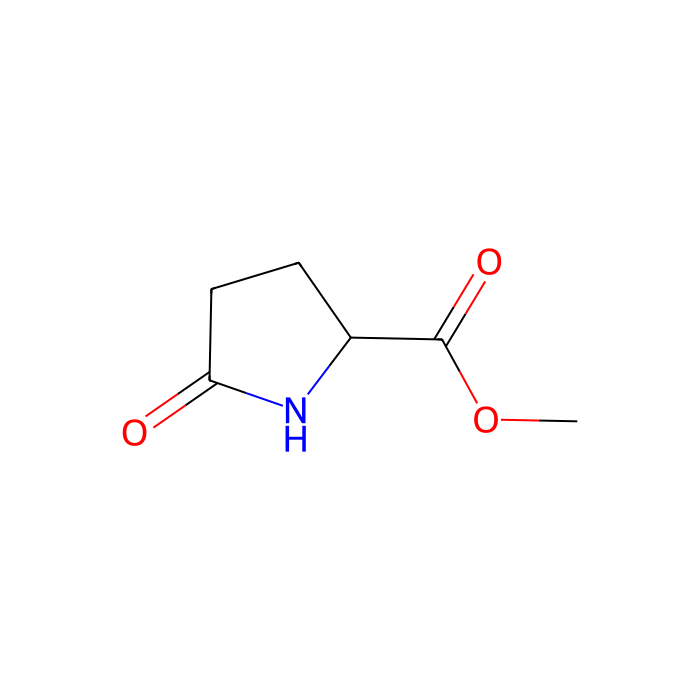
Brief description: L‑Pyroglutamic Acid Methyl Ester is the L‑configured methyl ester of 5‑oxoproline (pyroglutamic acid), featuring a five‑membered lactam ring (pyrrolidinone) bearing a chiral C2 carboxylate methyl ester.
Item-specific identifiers (from Product Data):
CAS: 4931-66-2
SKU: M138905
InChIKey: Not specified for this item; refer to CoA/Spec Sheet.
SMILES: Not specified for this item; refer to CoA/Spec Sheet.
Literature/computed identity (general reference only; not item-specific specifications):
Common synonyms: L-5-Oxoproline methyl ester; (S)-5-oxopyrrolidine-2-carboxylic acid methyl ester
Molecular formula (literature): C6H9NO3
Molecular weight (literature): 143.14 g/mol
Idealized SMILES (literature): COC(=O)[C@@H]1CC(=O)NC1 (represents L/S configuration at C2)
Structural features (general chemistry):
Ring system: five‑membered lactam (2-pyrrolidinone)
Functional groups: secondary amide (lactam), methyl ester; one stereogenic center at C2 with L (S) configuration
2D description: a cyclic amide ring where C2 bears a carboxylate methyl ester substituent; the ring contains a carbonyl at C5 and an NH between C4–C5.
Chirality/absolute configuration (literature): L (S) at the α-carbon (C2) relative to the lactam nitrogen.
Synthetic Utility
Strategic roles (literature/practice):
Chiral pool synthon: provides a preinstalled stereocenter for constructing L‑glutamate/proline analogs; substrate-controlled inductions are common.
Orthogonal reactivity: ester handles acyl substitutions and selective hydrolysis; lactam nitrogen participates in acylation/alkylation under activation without overreactions typical of free amines.
Ring-opening tactics: acid-catalyzed alcoholysis/aminolysis of the lactam opens to linear L‑glutamate derivatives. Lewis acids (e.g., BF3·OEt2) or strong Brønsted acids can accelerate formation of N‑acyliminium-like intermediates.
Protect–modify–deprotect sequences: N‑protection (Boc, Cbz, Fmoc) on the lactam, followed by transformations at C2 side chain, then ester/lactam unmasking to reveal amino acid targets.
Access to bicyclic scaffolds: intramolecular additions onto the lactam carbonyl from tethered nucleophiles produce constrained peptidomimetic cores.
Retrosynthetic utility:
Backward from glutamate derivatives: close the lactam to secure stereochemistry, convert acid to methyl ester, then forward elaborate and reopen as needed.
Operational notes:
Keep bases mild and non-nucleophilic; minimize epimerization near C2 by low temperatures and short exposure.
Monitor by chiral HPLC/UPC2 and 1H/13C NMR (look for characteristic lactam carbonyl ~175–178 ppm; ester carbonyl ~170–173 ppm) to confirm integrity.
Target Specificity
Not applicable. This product is a small-molecule synthetic intermediate and is not an antibody, probe, or biologic with defined target specificity. No target/epitope information is provided in the Product Data.
Frequently Asked Questions
What is the purity of this product, and how is it determined?
This product is supplied at ≥97% purity, determined by gas chromatography (GC). Lot-specific values are stated on the Certificate of Analysis.
How should this product be stored?
Store at room temperature under argon. It is supplied under an argon blanket; reseal under inert gas after each use.
How is this product shipped?
This product ships under standard ambient conditions. No temperature-controlled packaging is required.
What are the CAS number, molecular formula and molecular weight?
The CAS Number is 4931-66-2, the molecular formula is C6H9NO3, and the molecular weight is 143.14 g/mol. InChIKey HQGPKMSGXAUKHT-BYPYZUCNSA-N.
What documentation is provided?
Available product documentation, including Certificates of Analysis (COA), Safety Data Sheets (SDS), and specification sheets, is shown in the product document area. Document availability and access follow the current site policy.
We use cookies to ensure the website functions properly and, where permitted, to improve your experience. You can manage your preferences at any time in Settings. Learn more in our Cookie Policy.
Shall we send you a message when we have discounts available?
Remind me later
Thank you! Please check your email inbox to confirm.
Products are supplied to verified businesses, institutions, and qualified professionals for research and development use only. Not for use in humans, animals, diagnosis, or therapy.

 E1731071