Determine the necessary mass, volume, or concentration for preparing a solution.
Taxonomy Tree
| Kingdom | Organic compounds |
|---|---|
| Superclass | Lipids and lipid-like molecules |
| Class | Fatty Acyls |
| Subclass | Fatty acids and conjugates |
| Intermediate Tree Nodes | Not available |
| Direct Parent | Long-chain fatty acids |
| Alternative Parents | Straight chain fatty acids Carboxylic acid salts Monocarboxylic acids and derivatives Carboxylic acids Organic oxides Organic lead salts Hydrocarbon derivatives Carbonyl compounds |
| Molecular Framework | Not available |
| Substituents | Long-chain fatty acid - Straight chain fatty acid - Carboxylic acid salt - Monocarboxylic acid or derivatives - Carboxylic acid - Carboxylic acid derivative - Organic oxygen compound - Organic oxide - Hydrocarbon derivative - Organic lead salt - Organic salt - Organooxygen compound - Carbonyl group - Aliphatic acyclic compound |
| Description | This compound belongs to the class of organic compounds known as long-chain fatty acids. These are fatty acids with an aliphatic tail that contains between 13 and 21 carbon atoms. |
| External Descriptors | Not available |
Find and download the COA for your product by matching the lot number on the packaging.
| Lot Number | Certificate Type | Date | Item |
|---|---|---|---|
| Certificate of Analysis | May 18, 2026 | L112991 | |
| Certificate of Analysis | May 18, 2026 | L112991 | |
| Certificate of Analysis | May 18, 2026 | L112991 | |
| Certificate of Analysis | May 18, 2026 | L112991 | |
| Certificate of Analysis | Oct 29, 2025 | L112991 | |
| Certificate of Analysis | Aug 13, 2025 | L112991 | |
| Certificate of Analysis | Jun 16, 2025 | L112991 | |
| Certificate of Analysis | Sep 16, 2022 | L112991 | |
| Certificate of Analysis | Jun 07, 2022 | L112991 |
| Melt Point | 104-109°C |
|---|---|
| Molecular Weight | 774 |
| XLogP3 | |
| Hydrogen Bond Donor Count | 0 |
| Hydrogen Bond Acceptor Count | 4 |
| Rotatable Bond Count | 30 |
| Exact Mass | 774.504 Da |
| Monoisotopic Mass | 774.504 Da |
| Topological Polar Surface Area | 80.300 Ų |
| Heavy Atom Count | 41 |
| Formal Charge | 0 |
| Complexity | 196.000 |
| Isotope Atom Count | 0 |
| Defined Atom Stereocenter Count | 0 |
| Undefined Atom Stereocenter Count | 0 |
| Defined Bond Stereocenter Count | 0 |
| Undefined Bond Stereocenter Count | 0 |
| The total count of all stereochemical bonds | 0 |
| Covalently-Bonded Unit Count | 3 |
H301:Toxic if swallowed
H302:Harmful if swallowed
H311:Toxic in contact with skin
H315:Causes skin irritation
H319:Causes serious eye irritation
H332:Harmful if inhaled
H335:May cause respiratory irritation
H360:May damage fertility or the unborn child
H373:May causes damage to organs through prolonged or repeated exposure
H400:Very toxic to aquatic life
H410:Very toxic to aquatic life with long lasting effects
H301+H311:Toxic if swallowed or in contact with skin
P260:Do not breathe dust/fume/gas/mist/vapors/spray.
P261:Avoid breathing dust/fume/gas/mist/vapors/spray.
P264:Wash hands [and …] thoroughly after handling.
P270:Do not eat, drink or smoke when using this product.
P271:Use only outdoors or in a well-ventilated area.
P273:Avoid release to the environment.
P280:Wear protective gloves/protective clothing/eye protection/face protection.
P321:Specific treatment (see ... on this label).
P330:Rinse mouth.
P391:Collect spillage.
P302+P352:IF ON SKIN: wash with plenty of water.
P304+P340:IF INHALED: Remove person to fresh air and keep comfortable for breathing.
P305+P351+P338:IF IN EYES: Rinse cautiously with water for several minutes. Remove contact lenses if present and easy to do - continue rinsing.
P361+P364:Take off immediately all contaminated clothing and wash it before reuse.
P362+P364:Take off contaminated clothing and wash it before reuse.
P405:Store locked up.
P403+P233:Store in a well-ventilated place. Keep container tightly closed.
P501:Dispose of contents/container to an approved waste disposal plant.
P203:Obtain, read and follow all safety instructions before use.
P264+P265:Wash hands [and …] thoroughly after handling. Do not touch eyes.
P301+P316:IF SWALLOWED: Get emergency medical help immediately.
P301+P317:IF SWALLOWED: Get medical help.
P318:if exposed or concerned, get medical advice.
P317:Get emergency medical help.
P337+P317:If eye irritation persists: Get medical help.
P332+P317:If skin irritation occurs: Get medical help.
P316:Get emergency medical help immediately.
P319:Get medical help if you feel unwell.
No vendor-tested biological application protocols (e.g., WB, IHC, IF, FC) apply to this chemical reagent.
These are illustrative, literature-informed workflows and not product-specific recommendations. Adjust parameters to your system and consult primary sources.
This product is intended for research use only. Lead stearate itself has no beneficial biological role.
General biochemical context (literature):
Relevance to laboratory work:
Item-specific biological data: Not specified for this item; refer to CoA/Spec Sheet if any bioburden/endotoxin data are provided (typically not applicable to this chemical class).
Lead stearate is a hydrophobic, water-insoluble metal soap and is not used to prepare aqueous buffers. It has no conventional role in pH buffering, electrophoresis buffers, or cell culture media preparation.
Given the inherent toxicity and persistence of lead compounds, substituting lead stearate is a priority where feasible. Options depend on the application.
Alternative stabilizers/lubricants for polymers (literature/general):
Alternative nanocrystal strategies (literature/general):
Comparative notes (general):
Process improvements regardless of choice:
No pharmaceutical or excipient use is indicated or appropriate for lead stearate due to the toxicity of lead compounds.
Regulatory and formulation context (general):
Item-specific pharmacopeial status: Not specified for this item; refer to CoA/Spec Sheet. This product is designated "For research use only" in the Product Data and is not intended for human or veterinary use.
Item-specific: Appearance, exact numerical specifications (mp, density, etc.): Not specified for this item; refer to CoA/Spec Sheet.
Literature/typical values (for guidance; not product specs):
Practical notes (general):
Item-specific grade:
What AR grade typically implies (general):
Stabilizers/additives:
Practical qualification guidance:
Materials synthesis (literature/general):
Polymer processing (literature/general):
Catalysis/condensation (literature/general):
Practical tips (general):
Item-specific manufacturer applications: Not specified beyond “For research use only” in the Product Data.
The following are general, literature-based conditions where lead stearate is commonly employed. They are intended as starting points and not product specifications.
Lead chalcogenide nanocrystal synthesis:
Polymer compounding (research scale):
Film/oxide generation:
Analytics and monitoring:
Item-specific hazard fields in Product Data: Signal word, H-statements, GHS classification, pictograms: Not specified for this item; refer to SDS.
Critical safety context (literature/general for lead compounds; consult SDS for authoritative guidance):
Handling & PPE:
Incompatibilities and reactivity (general):
First aid (overview; consult SDS):
Storage: See Storage & Reconstitution tab (item-specific: Room temperature, desiccated).
This item is a hydrophobic solid additive/reagent rather than a solvent. Solvent selection pertains to dispersing, dissolving, or processing lead stearate.
Polarity and miscibility (literature/general):
Selection guidance by application:
Small comparison (general):
Practical tips:
Item-specific storage and logistics (from Product Data):
Container and stability (general guidance):
Reconstitution/dispersion (general):
Freeze–thaw: Not applicable; store at ambient as specified.
Safety note:
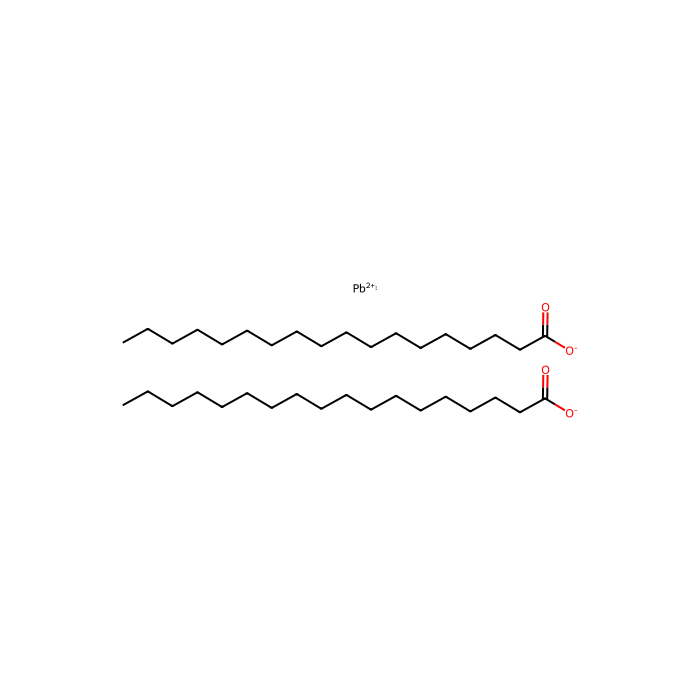
Lead stearate is a lipophilic metal soap of divalent lead and stearic acid.
Item-specific (from Product Data):
Literature/typical identity details (for context; not item specification):
Notes on identifiers:
Lipophilic Pb2+ source (literature/general):
Ligand and salt exchange:
Polymer/additive science:
Surface science/coatings:
Practical tips:
Not applicable. This product is a chemical reagent (lead stearate), not a biological targeting reagent. No antigen, epitope, clone, isotype, or species reactivity applies.
Our grade selection guide covers purity, stabilizer status, and application suitability for all variants in our catalog.
View AR grade guide →