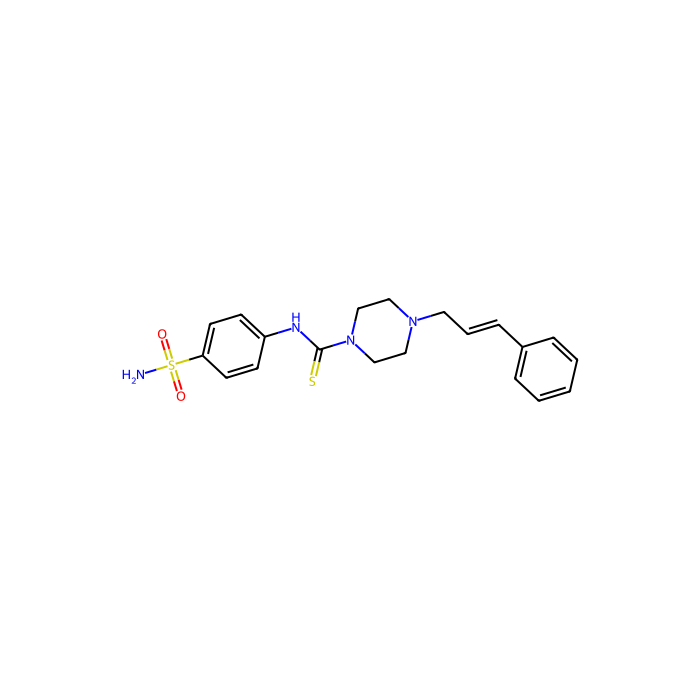
LF3 LF3 is a specific inhibitor of canonical Wnt signaling by disrupting the interaction between β-catenin and TCF4 with an IC50 less than 2 μM.
Targets
β-catenin/Tcf4 (Cell-free assay) 1.65 μM
In vitro
LF3 does not cause cell death or interfere with cadherin-mediated cell-cell adhesion. The self-renewal capacity of cancer stem cells is blocked by LF3 in concentration-dependent manners, as examined by sphere formation of colon and head and neck cancer stem cells under nonadherent conditions. LF3 inhibits Wnt/β-catenin signaling, but does not interfere with E-cadherin/β-catenin-mediated cell-cell adhesion. LF3 blocks the expression of a series of Wnt target genes in Wnt-addicted colon cancer cells. It inhibits proliferation of Wnt-addicted colon cancer cells through induction of cell-cycle arrest and also inhibits self-renewal capacity of CSCs.
In vivo
LF3 reduces tumor growth and induces differentiation in a mouse xenograft model of colon cancer while exhibiting no significant toxicity for mice and does not disturb the normal histology of the gut of mice.
This compound belongs to the class of organic compounds known as benzenesulfonamides. These are organic compounds containing a sulfonamide group that is S-linked to a benzene ring.
External Descriptors
Not available
1. Djoumbou Feunang Y, Eisner R, Knox C, Chepelev L, Hastings J, Owen G, Fahy E, Steinbeck C, Subramanian S, Bolton E, Greiner R, and Wishart DS. ClassyFire: Automated Chemical Classification With A Comprehensive, Computable Taxonomy. Journal of Cheminformatics, 2016, 8:61.
Determine the necessary mass, volume, or concentration for preparing a solution.
Dilution Calculator
Determine the dilution needed to prepare a stock solution.
Reconstitution Calculator
Reviews
Customer Reviews
Application Protocols
No item-specific, validated application protocols were supplied for LF3.
General protocols for small-molecule library members (not item-specific)
Stock preparation: Dissolve in anhydrous DMSO to 10–50 mM. Vortex/sonicate to ensure homogeneity. Prepare single-use aliquots (e.g., 10–100 µL) in low-bind tubes; store at -20°C.
Working solutions: Dilute stocks into assay buffer or media immediately prior to use. Maintain final DMSO ≤0.5–1% v/v unless your system tolerates more. Include vehicle controls and, where possible, positive controls.
Analytical QC: Verify concentration by UV–vis (if chromophore present) or quantitative NMR. Confirm purity by LC–MS/UPLC prior to critical experiments.
Plate-based screening: Dispense using calibrated acoustic or pin tools. Seal plates to minimize evaporation; equilibrate to assay temperature to reduce edge effects.
Stability check: For long assays, include time-zero and end-point samples for LC–MS to monitor degradation or adsorption losses.
For any specialized uses (e.g., photochemistry, electrochemistry), consult structural data first to tailor light sources, potentials, or catalysts.
Biological Roles
Item-specific biological function, targets, or pathways for LF3 are not provided.
General considerations for small-molecule library members (not item-specific)
Endogenous role: Most screening compounds lack endogenous biological roles; they are synthetic entities used as chemical tools.
Mechanistic evaluation: Potential interactions (e.g., with enzymes, receptors, or protein–protein interfaces) must be determined experimentally. Without structural and assay data, no biological role can be inferred.
ADME properties: Absorption, distribution, metabolism, and excretion profiles are structure-dependent and should not be generalized. If ADME is relevant to your study, conduct in vitro stability (microsomes, plasma), permeability (PAMPA/Caco-2), and solubility assays under standardized protocols.
Important note
No medical or clinical claims are made. This product is supplied strictly for laboratory research use. For any biological testing, adhere to institutional biosafety approvals and perform appropriate controls (vehicle, positive/negative standards) to contextualize observations.
Buffer Applications
This product is a small organic library member rather than a buffering reagent. It is not typically used to prepare defined pH buffer systems.
Buffer capacity, pKa sets, and formulation recipes: Not applicable without defined acid/base functionalities and pKa values.
Guidance
If LF3 must be used in buffered media (e.g., biological assays), select the buffer based on your assay pH and compatibility (e.g., PBS, HEPES, MOPS). Confirm compound stability in the chosen buffer and any required co-solvent (e.g., ≤1% DMSO).
Green Alternatives
Because LF3 is a small-molecule library member (not a bulk solvent or reagent), “green alternatives” mainly concern the choice of handling and work-up solvents rather than substitution of the compound itself.
Greener solvent choices (general guidance)
Dissolution/assay stocks: Consider bio-based solvents where feasible (e.g., Cyrene, 2-methyltetrahydrofuran, propylene carbonate) recognizing their different polarity profiles compared to DMSO/DMF. Pilot solubility tests are essential.
Chromatography: Replace acetonitrile with ethanol or isopropanol blends when compatible with resolution and pressure constraints. For normal-phase work, heptane/green ethers can substitute for hexane/halogenated solvents.
Work-up/extraction: Favor ethyl acetate over dichloromethane/chloroform; employ aqueous biphasic systems or solid-phase extraction to minimize solvent volumes.
Illustrative comparison (general, not item-specific)
Greener options: Cyrene/2-MeTHF/PC (renewable or lower toxicity profiles), ethanol (bio-derived), water-rich mobile phases (when analyte polarity permits).
Trade-offs
Solubility and stability of unknown structures may limit substitution. Viscosity, UV cutoffs, and chromatographic backpressure can change with greener solvents. Validate on small scale before adoption.
Pharmaceutical Uses
No pharmacopeial status, excipient role, or GMP-related information is provided for LF3.
Regulatory/compendial status: Not specified for this item; refer to CoA/Spec Sheet.
Formulation/excipient use: Not specified for this item; refer to CoA/Spec Sheet.
General guidance (not item-specific)
Research-use-only small molecules are not intended for human or veterinary applications. They should not be used in API manufacturing, clinical formulations, or diagnostic procedures.
If pre-formulation research is contemplated (e.g., for mechanistic studies), perform comprehensive characterization (purity profile, polymorphism if solid, solvent residuals) and stress testing to establish stability-indicating methods. Any translation beyond research use would require new sourcing under appropriate quality systems.
Physical Properties
Item-specific physicochemical data were not supplied.
Melting point (MP): Not specified for this item; refer to CoA/Spec Sheet.
Boiling point (BP): Not specified for this item; refer to CoA/Spec Sheet.
Density: Not specified for this item; refer to CoA/Spec Sheet.
Refractive index: Not specified for this item; refer to CoA/Spec Sheet.
LogP/logD: Not specified for this item; refer to CoA/Spec Sheet.
Aqueous solubility: Not specified for this item; refer to CoA/Spec Sheet.
Organic solvent solubility: Not specified for this item; refer to CoA/Spec Sheet.
pKa: Not specified for this item; refer to CoA/Spec Sheet.
General laboratory guidance (literature/practice, not product-specific)
Many screening compounds are supplied or handled as DMSO stock solutions (e.g., 10–50 mM) due to broad solvating ability. If aqueous work is needed, co-solvents (≤1–2% DMSO or ethanol) and surfactants (e.g., 0.01–0.1% Tween 80) are sometimes used to aid dispersion.
If the compound contains labile functionalities (e.g., esters, anhydrides), avoid prolonged exposure to moisture or basic/acidic conditions.
Determine UV–vis absorbance profile experimentally before analytical use (e.g., HPLC with UV detection) to select appropriate wavelengths.
Recommendation
For precise handling parameters (e.g., solubility limits, partitioning, stability in diluents), consult the current CoA/Spec Sheet for LF3 (SKU L414020) or verify experimentally on a small scale.
Quality & Grades
Item-specific grade and purity are not provided for SKU L414020 (LF3).
Grade/Purity: Not specified for this item; refer to CoA/Spec Sheet.
Interpretation and guidance (general, not item-specific)
Research grade compounds are suitable for discovery chemistry, screening, and method development. They are not intended for human or veterinary use.
Purity reporting: Screening compounds are typically supplied with HPLC/UPLC purity (e.g., area %), sometimes accompanied by MS (ESI) and 1H NMR. Verify the analytical method (detector wavelength, gradient, diluent) used for purity determination.
Stabilizers/additives: If present, they will be listed on the CoA. Absence/presence of stabilizers can influence storage life and assay background. For bioassays, prefer additive-free materials when possible.
Batch-to-batch documentation: Request the latest CoA for the specific lot you receive, including chromatograms and spectra where available. This ensures traceability of analytical criteria used for acceptance.
Practical tips
If your application is UV-sensitive (e.g., photochemistry or fluorescence assays), inquire about residual UV-active impurities and baseline behavior.
For quantitative work, establish an in-house reference standard curve with the supplied lot to capture any matrix- or solvatochromic effects.
Reaction & Applications
No item-specific application notes were provided for LF3. The product is categorized under small molecules/compound libraries and is intended for research use only.
General research applications for library compounds (not item-specific)
Assay development and screening: Use as a reference or tool compound in biochemical or cell-based assays to validate workflows, detection windows, and controls.
SAR and analog profiling: If LF3 is a member of a chemotype series, it can serve as a benchmark for structure–activity studies once structural details are confirmed.
Analytical method development: Establish retention behavior (HPLC/UPLC), ionization efficiency (LC–MS), and detector response (UV/fluorescence) to qualify methods for related analogs.
Stability studies: Evaluate stability in assay media, buffers, and storage solvents to set handling limits (e.g., light, temperature, pH sensitivity), once the structure is known.
Practical tips (general)
Prepare frozen aliquots (e.g., 10–100 µL) of DMSO stock at -20°C to mitigate freeze–thaw cycles.
If unknown reactivity is a concern, avoid strong bases, nucleophiles, or oxidants during handling. Use amber vials to minimize photolysis risk until photostability is established.
For NMR, begin with CD3OD, DMSO-d6, or CDCl3 trials to identify a suitable deuterated solvent.
Reaction Conditions
Item-specific reaction conditions cannot be recommended without structural information for LF3.
General laboratory conditions for small-molecule handling (not item-specific)
Solution preparation: Begin with anhydrous DMSO to 10–50 mM; sonicate or gentle warming (≤40°C) if needed. Filter through 0.2 µm PTFE for particulate removal prior to analytical injections.
Analytical methods: Start with reversed-phase UPLC (C18); gradient 5–95% acetonitrile or methanol in water with 0.1% formic acid over 5–10 min at 30–40°C. Confirm mass by ESI± LC–MS.
Stability checks: Incubate in intended assay buffer (with vehicle) at target temperature and sample over time to monitor degradation by LC–MS. Compare light-protected vs ambient to assess photosensitivity.
If derivatization is planned: Select conditions (e.g., amide coupling, Suzuki) only after confirming relevant functional groups. Run micro-scale screens to define base, catalyst, and temperature windows while monitoring by TLC/LC–MS.
Expected yields, temperatures, catalysts
Not applicable without known structure; consult literature once functional groups are identified.
Safety & Handling
Safety specifics were not provided for this item. Always review the official SDS before use.
GHS and hazard information (item-specific)
Signal word: Not specified for this item; refer to SDS.
Hazard statements: Not specified for this item; refer to SDS.
GHS classification/pictograms: Not specified for this item; refer to SDS.
General laboratory precautions (good practice; not product-specific)
Wear appropriate PPE: lab coat, safety glasses or goggles, and suitable chemically resistant gloves (e.g., nitrile). Use in a fume hood to avoid inhalation of vapors, dusts, or aerosols.
Avoid skin and eye contact. Prevent inhalation of dust or mists. Do not ingest.
Incompatibilities depend on structure; until known, avoid strong oxidizers and reactive bases/acids. Do not heat to decomposition.
First aid (general): In case of skin/eye contact, rinse cautiously with water for several minutes; remove contaminated clothing. If inhaled, move to fresh air. If ingested, rinse mouth; seek medical advice. Always follow SDS instructions.
Spill response: Absorb with inert material (e.g., vermiculite), place in chemical waste container. Prevent release to drains.
Waste: Dispose in accordance with institutional, local, and national regulations.
Storage and shipping
Storage: Store at -20°C (as provided). Keep container tightly closed, desiccated, and protected from light if the compound is photosensitive (verify via SDS/CoA).
Shipping: Ice chest + ice pads (as provided).
Solvent Selection
Item-specific solubility and polarity parameters are not provided; choose solvents empirically and confirm with small-scale tests.
General guidance for small-molecule library members (not item-specific)
Primary stock solvent: Anhydrous DMSO is commonly used for 10–50 mM stocks due to broad solvency and assay compatibility at ≤0.5–1% v/v in most biological systems.
Secondary solvents: DMF, ethanol, methanol, acetonitrile, or isopropanol may be suitable. For water-insoluble analytes, co-solvent systems (e.g., 5–20% ACN or EtOH in buffer) can aid dissolution.
Aqueous work: For low-solubility compounds, consider cyclodextrin inclusion, surfactants (e.g., 0.01–0.1% Tween 80 or Pluronic F-127), or pH adjustment if ionizable groups are known (verify structure first).
Analytical compatibility: For LC–MS, MeOH/ACN with 0.1% formic acid or 5–10 mM ammonium formate/acetate are typical; avoid non-volatile buffers.
Small comparison (general)
DMSO: broad solvency; high boiling point; suitable for -20°C storage of aliquots.
DMF: similar solvency but more hygroscopic; handle with care.
EtOH/MeOH: volatile, easier removal; may not dissolve highly lipophilic compounds.
Recommendation
Start with DMSO dissolution tests at 10 mM; if insoluble, escalate to DMF or mixed organic solvents. Always verify stability in the chosen solvent over the intended assay/storage duration.
Storage & Reconstitution
Storage
Store at -20°C (as provided). Keep tightly sealed in original container. Protect from moisture; consider a desiccant. If the compound is light-sensitive (unknown), use amber vials or secondary light protection.
Shipped in an ice chest with ice pads (as provided). Upon receipt, transfer to -20°C promptly.
Reconstitution (general guidance; not item-specific)
Solvent: Start with anhydrous DMSO to prepare a concentrated stock (e.g., 10–50 mM). Alternative solvents (DMF, ethanol, methanol, acetonitrile) may be evaluated empirically.
Technique: Warm gently to room temperature before opening to avoid condensation. Vortex/sonicate to dissolve fully. If particulates persist, filter through a 0.2 µm PTFE syringe filter.
Aliquoting: Prepare single-use aliquots to avoid repeated freeze–thaw. Label aliquots with concentration, solvent, and date.
Working solutions: Prepare immediately before use. Avoid long-term storage of dilute aqueous solutions unless stability has been established.
Stability/shelf life
Not specified for this item; refer to CoA/Spec Sheet and SDS. Perform small-scale stability checks (freeze–thaw cycles, light exposure, and time-in-solution) to set in-lab handling limits.
Research use only
For research use only. Not for human or veterinary use.
Structure & Identity
Overview: This product is listed as a small-molecule library member (“LF3”). Item-specific structural identifiers are incomplete in the provided data.
CAS: 664969-54-4 (as provided)
PubChem CID: 1213452 (as provided)
InChIKey: 466939 (as provided; note: atypically short for a full InChIKey)
SMILES: Not specified for this item; refer to CoA/Spec Sheet.
Molecular formula: Not specified for this item; refer to CoA/Spec Sheet.
Molecular weight: Not specified for this item; refer to CoA/Spec Sheet.
Structural features
Functional groups, ring systems, stereochemistry: Not specified for this item; refer to CoA/Spec Sheet.
2D structural description
A descriptive 2D structure (connectivity, heteroatoms, substituents) cannot be provided without SMILES/InChI or an image. Please consult the product’s Certificate of Analysis (CoA) or technical dossier for definitive structural information.
Notes for identity confirmation (general guidance)
For small-molecule library members, identity is commonly confirmed by 1H/13C NMR, HRMS, and HPLC/UPLC purity. If you require structural verification, request the latest CoA, spectral package, and chromatogram for SKU L414020 (LF3).
Synthetic Utility
Synthetic transformations and reactivity depend on the compound’s functional groups, which are not provided for LF3.
Key functional groups and reactivity: Not specified for this item; refer to CoA/Spec Sheet.
General commentary (not item-specific)
If LF3 is used as a synthetic intermediate, define its handles (e.g., aryl halide for cross-coupling, carbonyl for condensations, amine/alcohol for derivatization) via structural elucidation (NMR, MS, IR).
Protecting-group strategy, chemoselectivity, and scalability should be established experimentally. For route scouting, map potential disconnections (retrosynthesis) and evaluate robustness under standard coupling/activation conditions before committing to scale.
Purification best practices: Utilize orthogonal methods (normal/reverse-phase chromatography, trituration, crystallization) depending on polarity and stability. Track impurities by LC–MS to avoid co-elution artifacts.
Target Specificity
Target or pathway specificity for LF3 is not provided in the product data.
Target name/class: Not specified for this item; refer to CoA/Spec Sheet or application notes.
Species selectivity: Not specified for this item; refer to CoA/Spec Sheet or application notes.
Assay context: Not specified for this item; refer to CoA/Spec Sheet or application notes.
Note
If LF3 is intended as a tool compound, its target engagement and selectivity profile must be established experimentally (e.g., enzyme kinetics, thermal shift assays, CETSA, SPR, ITC) and corroborated with orthogonal methods.
Frequently Asked Questions
What is the purity of this product?
This product is supplied at ≥98% purity (chemical assay). Lot-specific values are stated on the Certificate of Analysis.
How should this product be stored?
Store at ?20 °C. Freezer storage is required to maintain the specified shelf life.
How is this product shipped?
This product ships in an insulated container with ice pads. Unpack on arrival and transfer it to the storage condition stated above.
What are the CAS number, molecular formula and molecular weight?
The CAS Number is 664969-54-4, the molecular formula is C20H24N4O2S2, and the molecular weight is 416.56 g/mol. InChIKey ZUQIFHLBPBLRRM-QPJJXVBHSA-N.
What documentation is provided?
Available product documentation, including Certificates of Analysis (COA), Safety Data Sheets (SDS), and specification sheets, is shown in the product document area. Document availability and access follow the current site policy.
We use cookies to ensure the website functions properly and, where permitted, to improve your experience. You can manage your preferences at any time in Settings. Learn more in our Cookie Policy.
Shall we send you a message when we have discounts available?
Remind me later
Thank you! Please check your email inbox to confirm.
Products are supplied to verified businesses, institutions, and qualified professionals for research and development use only. Not for use in humans, animals, diagnosis, or therapy.

 E2628017