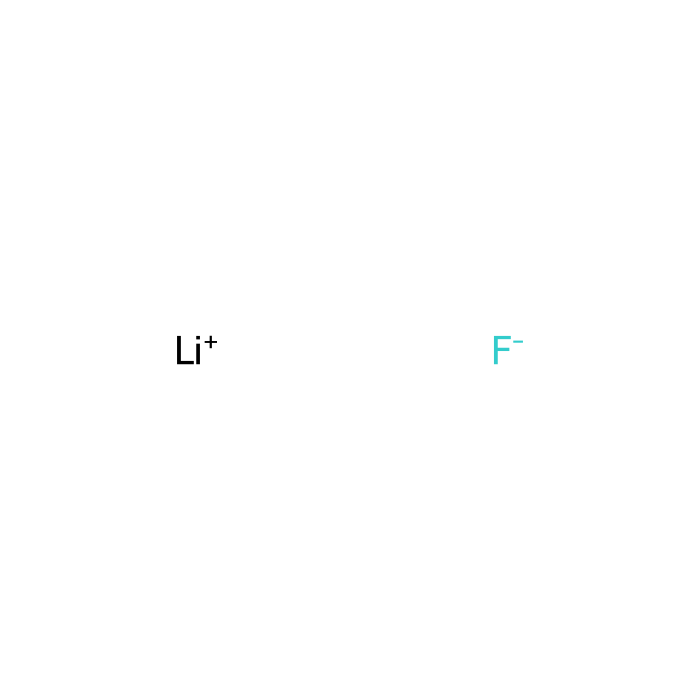
Lithium fluoride - ≥99.98% metals basis, powder,<100μm , CAS No.7789-24-4

CAS: 7789-24-4 Cat. No.: L434126 Formula: LiF Molecular Weight: 25.94 EC Number: 232-152-0
AVAILABLE TO ORDER
GRADE & PURITY ≥99.98% metals basis powder,<100μm
Synonyms
Lithium fluoride, Optical Grade|lithium;fluoride|Lithium fluoride (Li(HF2))|TLD 100|Lithium fluoride (6LiF)|Hydrofluoric acid, ion(1-), with lithanylium (1:1)|Lithium fluorure (FRENCH)|LITHIUM FLUORIDE [INCI]|Lithium monofluoride|Lithium fluoride, ultra dry|NTL 50|TLD 700|Lithium Fluoratum|Lithium fluoride (7LiF)|Lithium fluorure [French]|(6L)Lithium fluoride|TETRAMETHYL-P-PHENYLENEDIAMINE, 2,3,5,6-|Lithium bifluoride|Fluorolithium|Lithium fluoride (LiF)|LiF|Lithium fluorure [French]|LITHIUM FLUORIDE [HSDB]|(7L)Lithium fluoride|Lithium fluorure|LITHIUM FLUORIDE [MI]|1,3,5-TRIMETHYL-2,6-BENZENEDIAMINE|Trilithium trifluoride|LITHIUM FLUORIDE
Storage
Room temperature
Shipped In
FedEx DG Service
★
Size
USA
Germany (EU)*
Price
Qty
5g
L434126-5g
2 In stock
—

$125.90

$146.90
Save $21.00 (14.30%)
25g
L434126-25g
2 In stock
—

$385.90

$450.90
Save $65.00 (14.42%)
Enter a quantity for the sizes you want to add.

Overview

Application:
Lithium fluoride can be used:
As an additive to fabricate SiO@C/graphite composite anode materials for Li-ion batteries. LiF stabilizes solid electrolyte interphase (SEI) and enhances initial coulombic efficiency.
As a critical component in SEI for stabilizing the SEI layer and improving the cycling efficiency of Li metal batteries.
To fabricate electron contacts for high-efficiency n-type crystalline silicon solar cells.
To prepare solid-state light sources for radiation imaging detectors.
To synthesize highly crystalline MXene for asymmetric supercapacitor applications. And also, lightweight, flexible, and hydrophobic MXene foam with reasonable strength, high electrical conductivity, and an outstanding EMI-shielding performance.
As an electron-injection layer to fabricate ITO/PEDOT:PSS/perovskite/B3PYMPM/ LiF/Al OLED device with a quantum efficiency of 20%.

Specifications

Synonyms
Lithium fluoride, Optical Grade | lithium;fluoride | Lithium fluoride (Li(HF2)) | TLD 100 | Lithium fluoride (6LiF) | Hydrofluoric acid, ion(1-), with lithanylium (1:1) | Lithium fluorure (FRENCH) | LITHIUM FLUORIDE [INCI] | Lithium monofluoride | Lithium fluoride, ultra dry | NTL 50 | TLD 700 | Lithium Fluoratum | Lithium fluoride (7LiF) Show more
Specifications & Purity
≥99.98% metals basis, powder,<100μm
Storage
Room temperature
Shipped In
FedEx DG Service
Purity
≥99.98% metals basis
Names and Identifiers
Pubchem Sid
SMILES
[Li+].[F-]
IUPAC Name
lithium;fluoride
InChIKey
PQXKHYXIUOZZFA-UHFFFAOYSA-M
InChI
1S/FH.Li/h1H;/q;+1/p-1
Isomeric SMILES
[Li+].[F-]
WGK Germany
3
UN Number
3288
Packing Group
III
Molecular Weight
25.94

Advanced Data

Taxonomic Classification

Taxonomy Tree

KingdomInorganic compounds
SuperclassMixed metal/non-metal compounds
ClassAlkali metal salts
SubclassAlkali metal fluorides
Intermediate Tree Nodes Not available
Direct ParentAlkali metal fluorides
Alternative Parents Inorganic lithium salts  
Molecular FrameworkNot available
Substituents Alkali metal fluoride - Inorganic lithium salt - Inorganic salt
DescriptionThis compound belongs to the class of inorganic compounds known as alkali metal fluorides. These are inorganic compounds in which the largest halogen atom is fluorine, and the heaviest metal atom is an alkali metal.
External Descriptors Not available
3D Structure
Interactive Chemical Structure Model


Certificates (CoA,COO,BSE/TSE and Analysis Chart)
C of A & Other Certificates(BSE/TSE, COO):
Analytical Chart:

Find and download the COA for your product by matching the lot number on the packaging.

3 results found

Lot NumberCertificate TypeDateItem
K2321307K2321307Certificate of AnalysisSep 04, 2026 L434126
K2321326K2321326Certificate of AnalysisSep 04, 2026 L434126
F2527116F2527116Certificate of AnalysisNov 08, 2023 L434126
Chemical and Physical Properties
Solubilityaqueous acid: slightly soluble(lit.)
Sensitivitymositure sensitive
Boil Point1680°C
Melt Point848°C
Molecular Weight26
XLogP3
Hydrogen Bond Donor Count0
Hydrogen Bond Acceptor Count1
Rotatable Bond Count0
Exact Mass26.0144 Da
Monoisotopic Mass26.0144 Da
Topological Polar Surface Area0.000 Ų
Heavy Atom Count2
Formal Charge0
Complexity2.000
Isotope Atom Count0
Defined Atom Stereocenter Count0
Undefined Atom Stereocenter Count0
Defined Bond Stereocenter Count0
Undefined Bond Stereocenter Count0
The total count of all stereochemical bonds0
Covalently-Bonded Unit Count2
Safety and Hazards(GHS)
Pictogram(s)
Signal
Danger
Hazard Statements

H301:Toxic if swallowed

H319:Causes serious eye irritation

Precautionary Statements

P264:Wash hands [and …] thoroughly after handling.

P270:Do not eat, drink or smoke when using this product.

P280:Wear protective gloves/protective clothing/eye protection/face protection.

P305+P351+P338:IF IN EYES: Rinse cautiously with water for several minutes. Remove contact lenses if present and easy to do - continue rinsing.

P337+P313:IF eye irritation persists: Get medical advice/attention.

P405:Store locked up.

P501:Dispose of contents/container to an approved waste disposal plant.

P301+P310+P330:IF SWALLOWED: Rinse mouth.Immediately call a POISON CENTER/doctor/.

WGK Germany
3
Class
6.1
Documents & Articles
High-Refractive-Index vs Low-Refractive-Index Coating Materials: From AR/Waveguide Principles to a Formulation & Material-Selection Map (Including Product Category Tables A/B/C)
Light-Emitting Polymers (LEPs): A Practical Panorama - A Core PL/EL Mechanistic Framework, Material Family Map, and Structural “Design Knobs” (including Product Tables 1–4 and a selection guide)
Selection of Common Research Salts: A Task Map for Alkali Metal Salts & Alkaline Earth Metal Salts (with Product Tables 1–6)
Perovskite PV/PeLED Precursor Guide: Selecting Metal Halide Salts, Key Conditions, and Reproducible Performance (including Product Tables 1–4 and a Selection Navigation Guide)
Unstabilized Azomethine Ylide Chemistry from a Single Precursor: Acceptor-Controlled Divergence and Patterns of Scaffold Outcomes
From ICMA to ICBA/ICTA: Structural Modulation and Device Performance of Indene-C60 Adduct Acceptors
Citations of This Product
Solution Calculators
Reviews

Customer Reviews

Shall we send you a message when we have discounts available?

Remind me later

Thank you! Please check your email inbox to confirm.

Oops! Notifications are disabled.