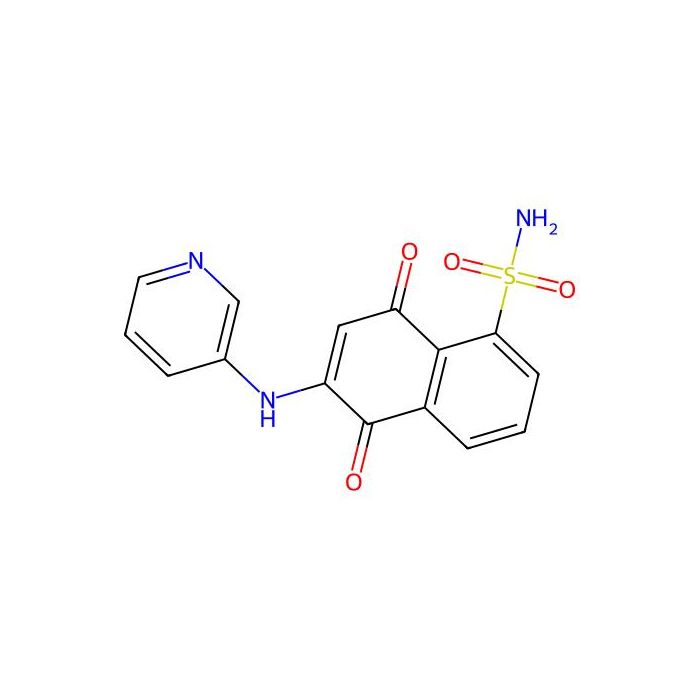
LY5 is a STAT3 inhibitor with an IC 50 value of 0.5 μM. LY5 induces apoptosis and inhibits STAT3 phosphorylation. LY5 shows antitumor activity in vivo, it can be used for the research of cancer
In Vitro
LY5 shows inhibition effects to U2OS, RH30 and RD2 cancer cells with IC 50 values of 0.52, 0.55 and 1.39 μM, respectively. LY5 (0.25-1 μM; 16 h) induces apoptosis and inhibits STAT3 phosphorylation in human sarcoma cancer cells. LY5 (0.25-1 μM; 5 h) inhibits STAT3 phosphorylation induced by IL-6. MCE has not independently confirmed the accuracy of these methods. They are for reference only. Western Blot AnalysisCell Line: RH30 and EW8 cell lines Concentration: 0.25-1 μM Incubation Time: 16 hours Result: Completely inhibited Tyr705 phosphorylation at 0.5 μM and dose-dependently decreased in formation of P-STAT3.
In Vivo
LY5 (5 mg/kg; i.p. once daily for 21 days) inhibits breast tumor growth in vivo . MCE has not independently confirmed the accuracy of these methods. They are for reference only. Animal Model: Nude mice with MDA-MB-231 cancer cells injection Dosage: 5 mg/kg Administration: Intraperitoneal injection; 5 mg/kg; once daily; for 21 days Result: Suppressed tumor growth and significantly reduced the tumor sizes.
IC50& Target:IC50: 0.5 μM (STAT3)
Specifications
Biochemical and Physiological Mechanisms
LY5 is a STAT3 inhibitor with an IC 50 value of 0.5 μM. LY5 induces apoptosis and inhibits STAT3 phosphorylation. LY5 shows antitumor activity in vivo, it can be used for the research of cancer.
Storage
Store at -20°C
Shipped In
Ice chest + Ice pads
This product requires cold chain shipping. Ground and other economy services are not available.
This compound belongs to the class of organic compounds known as naphthoquinones. These are compounds containing a naphthohydroquinone moiety, which consists of a benzene ring linearly fused to a bezene-1,4-dione (quinone).
External Descriptors
Not available
1. Djoumbou Feunang Y, Eisner R, Knox C, Chepelev L, Hastings J, Owen G, Fahy E, Steinbeck C, Subramanian S, Bolton E, Greiner R, and Wishart DS. ClassyFire: Automated Chemical Classification With A Comprehensive, Computable Taxonomy. Journal of Cheminformatics, 2016, 8:61.
Determine the necessary mass, volume, or concentration for preparing a solution.
Dilution Calculator
Determine the dilution needed to prepare a stock solution.
Reconstitution Calculator
Reviews
Customer Reviews
Application Protocols
No item-specific, validated application protocols are provided in the Product Data for LY5.
General starting points for bioactive small molecules (to be optimized by the user):
Stock preparation: Prepare a sterile-filtered DMSO stock (e.g., 10 mM). Store aliquots at −20°C. Protect from light if chromophoric groups are present. Verify concentration by UV or quantitative NMR where possible.
Enzyme inhibition assays: Generate 8–12 point dose–response curves (half-log dilutions). Include appropriate positive/negative controls and vehicle controls. Maintain consistent final DMSO across wells.
Cell-based assays: Start with 0.03–30 µM testing windows, adjusting based on observed potency and cytotoxicity. Monitor precipitation and adjust solvent percentage as needed.
Data quality: Use triplicates or quadruplicates; include at least three independent biological replicates. Apply appropriate curve-fitting (four-parameter logistic) and report Hill slopes and confidence intervals.
Note: These are general research practices and not validated for this specific SKU. Refer to the CoA/SDS and primary literature for LY5 before establishing definitive protocols.
Biological Roles
Item-specific biological target data are not provided in this listing; consult the CoA and primary literature for LY5 before designing experiments.
Literature context (for orientation only; verify against your use case):
LY5 has been described in the literature as a small-molecule probe developed to modulate intracellular signaling pathways (e.g., STAT family signaling) by interacting with protein domains involved in transcriptional regulation. Such tool compounds support studies of pathway dependency, feedback control, and context-specific responses in cells.
How to deploy a bioactive tool compound rigorously:
Establish biochemical potency against the intended target with purified protein or validated cellular readouts (e.g., phosphorylation status or reporter assays). Include off-target panels when possible.
Use concentration ranges that bracket reported IC50/KD values and perform time-course analyses to capture on-target kinetics and downstream effects.
Incorporate orthogonal validation: genetic knockdown/knockout, rescue experiments, or structurally distinct inhibitors to rule out scaffold-specific artifacts.
Monitor general cytotoxicity and stress responses to avoid misattribution of phenotypes due to solvent or compound aggregation.
Notes and limitations:
No medical or clinical uses are implied. This product is for research use only. Any disease-relevant findings should be interpreted within preclinical research frameworks and validated independently.
Buffer Applications
Not typically applicable as a buffer component. LY5 is a bioactive small molecule used as a probe/inhibitor rather than as a buffering agent.
Practical notes for assay buffers (general guidance):
Prepare LY5 stock in DMSO, then dilute into your assay buffer (e.g., PBS, HEPES, or Tris-based) with continuous mixing to avoid precipitation.
Maintain consistent vehicle control (same final DMSO % across all wells/conditions).
Filter sterilize working solutions through 0.22 µm PTFE or PVDF if required for cell-based assays and if the compound is stable to filtration; avoid nylon with strongly hydrophobic analytes to limit adsorption.
Optimize pH and ionic strength of buffers for target activity; verify that the chosen buffer does not chelate essential cofactors or inactivate your protein target.
Green Alternatives
As a small-molecule bioactive, LY5 is not itself a process solvent; sustainability considerations primarily concern solvent selection for dissolution, purification, and any derivative synthesis.
Greener handling options (general guidance):
Prefer DMSO or ethanol for routine stock preparations when compatible with the assay, instead of higher-hazard polar aprotics (DMF, NMP).
For chromatographic purification (if further derivatization or analog synthesis is performed), use ethyl acetate/ethyl lactate/MTBE/2-MeTHF in place of dichloromethane or chloroform when separation efficiency allows.
Minimize DMSO volumes in biological assays; consolidate runs to reduce waste. Implement microplate formats and automated liquid handling to limit solvent use.
Illustrative comparison (general):
DMSO vs DMF: DMSO has a better overall toxicological profile and lower volatility; DMF is a reproductive toxin and should be avoided when not essential.
2-MeTHF vs THF: 2-MeTHF is bio-based with lower peroxide risk and higher boiling point, aiding recyclability in synthetic campaigns.
Waste and lifecycle:
Segregate halogenated vs non-halogenated organic waste; recover and recycle solvents where infrastructure exists. Consider life-cycle impacts when selecting solvents for scale-up synthesis of analogs.
Pharmaceutical Uses
No pharmacopeial status or excipient role is provided for this item. LY5 is supplied for laboratory research use only and is not manufactured under GMP.
Formulation considerations for research studies (general guidance):
For in vitro work: DMSO stock solutions are commonly diluted into aqueous media. Confirm compatibility with serum proteins and plasticware to minimize adsorption or precipitation.
For preclinical exploratory studies (non-clinical, research only): Investigators sometimes evaluate solubilization vehicles such as PEG400, captisol, or lipid-based carriers; however, any in vivo or translational use is outside Aladdin’s intended scope for this product and must follow institutional approvals and regulations.
Stability-indicating analytics (HPLC/UPLC, LC–MS) are recommended to confirm solution stability over the tested timeframes and storage conditions.
Regulatory note:
Not for human or veterinary use. Not an API or excipient. No claims of safety, efficacy, or clinical utility are made or implied.
Physical Properties
Item-specific specifications are not provided in the current listing and should be confirmed on the CoA/Spec Sheet.
Appearance: Not specified for this item; refer to CoA/Spec Sheet.
Purity/Grade: Not specified for this item; refer to CoA/Spec Sheet.
Melting point (MP): Not specified for this item; refer to CoA/Spec Sheet.
Boiling point (BP): Not applicable for most non-volatile screening solids; specific value not specified for this item; refer to CoA/Spec Sheet.
Density: Not specified for this item; refer to CoA/Spec Sheet.
logP/logD: Not specified for this item; refer to CoA/Spec Sheet.
pKa: Not specified for this item; refer to CoA/Spec Sheet.
Refractive index: Not applicable for solids; not specified.
Solubility: Not specified for this item; refer to CoA/Spec Sheet.
General/literature guidance for small-molecule screening compounds like LY-series:
Often supplied as crystalline or amorphous solids with good solubility in polar aprotic solvents (e.g., DMSO) and limited aqueous solubility unless buffered with co-solvent or adjusted pH.
Stock solutions for biological assays are commonly prepared in anhydrous DMSO at 10–50 mM (literature practice), then diluted into assay media, maintaining final DMSO ≤0.1–0.5% v/v to minimize solvent effects. Verify compound-specific solubility and stability prior to assay setup.
Quality & Grades
Item-specific grade/purity: Not specified for this item; refer to CoA/Spec Sheet.
How we typically qualify small-molecule screening compounds:
Identity confirmation by high-resolution MS and/or 1H NMR. Where applicable, 13C NMR and elemental analysis may be used to further confirm composition.
Purity assessment by HPLC/UPLC with UV or MS detection across multiple wavelengths; impurity thresholds appropriate for medicinal chemistry and screening workflows.
Water or residual solvent content may be evaluated by Karl Fischer titration and GC, respectively (values, if available for this SKU, will be listed on the CoA).
What the grade implies (general guidance):
“Screening” or “bioactive” grade compounds are intended for biochemical/cellular assays and SAR programs. They prioritize high chemical purity and identity but are not produced under GMP and are not intended for clinical, diagnostic, or in vivo therapeutic use.
Stabilizers/ additives:
None stated. If stabilizers or salt forms are present, they will be declared on the product label and CoA. Always consult the lot-specific CoA for exact counterion, solvate, or polymorph information.
Reaction & Applications
Item-specific synthetic or catalytic applications are not provided. LY5 is supplied primarily as a bioactive screening compound for chemical biology and target validation.
Research applications (general/literature context for LY-series bioactives):
Tool compound in pathway dissection studies (e.g., JAK/STAT signaling, growth factor response, or stress-response pathways) where selective inhibition enables target engagement and phenotypic readouts. Always verify target and potency from primary literature for LY5 and confirm with orthogonal assays.
Use in biochemical assays such as enzyme activity inhibition, protein–protein interaction disruption, or binding assays (SPR, MST, ITC) after establishing solubility and stability in assay buffers.
Cellular applications: dose–response viability/proliferation assays, reporter gene assays, or phospho-protein measurements. Include vehicle (DMSO) controls and counter-screens for off-target effects.
Practical considerations:
Prepare fresh DMSO stock solutions under dry, inert conditions if sensitivity to hydrolysis or oxidation is suspected (check SDS/CoA). Store aliquots at −20°C to minimize freeze–thaw cycles.
Confirm lot identity/purity by LC–MS before critical studies; track batch numbers across experiments to ensure reproducibility.
If target engagement is claimed in your study, complement biochemical IC50/ KD with cellular target occupancy or pathway biomarker modulation to strengthen conclusions.
Reaction Conditions
Not directly applicable: LY5 is supplied as a finished research compound rather than a reagent or catalyst.
General conditions relevant to typical assembly of LY-like scaffolds (literature guidance):
Cross-coupling: Suzuki–Miyaura (Pd(dppf)Cl2, 1–3 mol%; K3PO4 or Cs2CO3; dioxane/H2O or 2-MeTHF; 60–90°C; 2–12 h). Buchwald–Hartwig for C–N formation (Pd2(dba)3/XPhos or BrettPhos; NaOtBu; toluene or dioxane; 80–110°C).
Amide/urea formation: HATU or T3P in DMF/DCM/EtOAc; DIPEA or lutidine; 0–25°C for activation, then 25–60°C; or CDI for ureas (THF/DMF, 0–50°C).
SNAr on electron-poor heteroaryl chlorides: K2CO3/DIPEA in DMF/DMSO; 25–80°C.
Analytical and workup tips:
Use LC–MS to track conversions. Quench palladium with scavengers and apply silica/fluorous or SPE cleanup before final HPLC purification if necessary.
Note:
These are generic literature conditions for assembling heteroaryl/amide frameworks and are not item-specific. Always tailor to the actual structure of LY5 as documented in the CoA or verified literature.
Safety & Handling
GHS classification, pictograms, signal word, and H-statements: Not specified for this item; refer to SDS for authoritative safety information.
Research use: For research use only (per Product Data). Not for human or veterinary use.
General laboratory precautions for small-molecule bioactives:
Wear appropriate PPE: lab coat, safety glasses, and disposable nitrile gloves. Handle powders in a fume hood to avoid inhalation of dust.
Avoid skin/eye contact and ingestion. Many bioactive small molecules can have potent cellular effects at low concentrations.
Solvent considerations: If preparing DMSO or DMF stocks, prevent skin exposure (these solvents can enhance dermal absorption of solutes). Clean spills promptly with suitable absorbents; dispose of as organic hazardous waste.
Incompatibilities: Avoid strong oxidizers and strong acids/bases unless reaction conditions specifically require them (consult the SDS and any method-specific guidance).
First aid (overview; defer to SDS):
Inhalation: Move to fresh air; seek medical attention if symptoms occur.
Skin contact: Wash with soap and water; remove contaminated clothing.
Eye contact: Rinse cautiously with water for several minutes; seek medical attention if irritation persists.
Ingestion: Rinse mouth; do not induce vomiting; seek medical attention.
Fire safety: Many organics are combustible. Use CO2, dry chemical, or foam extinguishers. Thermal decomposition may form hazardous fumes.
Waste: Collect in halogenated/non-halogenated organic waste streams per local regulations.
Solvent Selection
This product is a small-molecule solid; solvent choice concerns dissolution for assay stocks and synthetic manipulations rather than its use as a bulk solvent.
General dissolution strategy (literature/practice):
Primary: Anhydrous DMSO for concentrated stocks (e.g., 10–50 mM). Pros: broad solvency for heteroaromatics; miscible with aqueous media upon dilution. Cons: hygroscopic; can carry compounds into skin—use caution.
Secondary: DMF or NMP for difficult cases. Pros: strong solvation; Cons: higher toxicity, removal challenges, and assay interference risks.
Volatile cosolvents for intermediate dilutions: Acetonitrile or ethanol (balance volatility, assay compatibility, and solubility).
Aqueous buffers: Often require small percentages of DMSO/EtOH to maintain solubility; pre-warm and vortex/sonicate. Filter sterilize if using in cell-based assays.
Selection tips:
Start with DMSO; if precipitation occurs upon aqueous dilution, reduce stock concentration, add slowly with mixing, and keep final DMSO ≤0.1–0.5% v/v in biological assays.
For analytical prep (HPLC), choose solvents compatible with your detection (ACN/H2O or MeOH/H2O with 0.1% FA/AmAc as needed). Validate compound UV profile before setting wavelengths.
Environmental and safety note:
Prefer DMSO/EtOH over DMF/NMP when feasible due to hazard profiles. Document solvent history when comparing biological data across experiments.
Storage & Reconstitution
Storage (item-specific): Store at −20°C (per Product Data). Shipments are sent in an ice chest with ice pads to maintain a low temperature during transit.
Best practices (general guidance for small-molecule bioactives):
Upon receipt, allow the sealed container to equilibrate to room temperature inside a desiccator before opening to avoid moisture condensation.
If preparing solutions: Use anhydrous DMSO to make a concentrated stock (e.g., 10–50 mM, as solubility permits). Vortex and, if necessary, gently warm to 25–37°C or sonicate briefly. Do not overheat.
Sterile handling: For cell-based work, pass solutions through a 0.22 µm PTFE/PVDF filter if compatible. Avoid nylon if adsorption is suspected.
Aliquoting: Divide stock into single-use aliquots to minimize freeze–thaw cycles. Store aliquots at −20°C in tightly sealed, inert-atmosphere vials if feasible. Protect from light if the compound is photosensitive (verify from CoA/SDS).
Stability: Solution and solid-state stability are compound-dependent and are not specified for this item; refer to CoA/Spec Sheet. Re-check concentration and purity periodically by HPLC/LC–MS for long-term studies.
Disposal: Follow institutional guidelines for disposal of organic chemical waste and DMSO-containing solutions.
Structure & Identity
Small-molecule bioactive compound offered for research screening and chemical biology.
Item-specific identifiers (from Product Data):
Product Name: LY5
CAS: 1436382-03-4
PubChem CID: 71680713
InChIKey (as provided): 110190
SMILES: Not specified for this item; refer to CoA/Spec Sheet.
Molecular Formula: Not specified for this item; refer to CoA/Spec Sheet.
Molecular Weight: Not specified for this item; refer to CoA/Spec Sheet.
Structural features (general/literature context):
LY-series compounds reported in the literature are typically heteroaromatic, amide-/urea-/biaryl-containing scaffolds designed to engage protein pockets (e.g., SH2 or kinase domains). Exact functional groups for this catalog item are not specified here; consult the CoA/SDS for definitive structure.
2D structure description (general):
Without an explicit SMILES or structure drawing in the item record, a definitive 2D atom-by-atom description cannot be provided. For cheminformatics workflows (substructure searches, docking), please use the structure block or SMILES from the CoA/Spec Sheet or import the PubChem CID (71680713) record as a literature reference and verify against Aladdin’s CoA.
Synthetic Utility
This product is offered as a finished bioactive small molecule rather than a synthetic building block, and item-specific functional group reactivity is not listed.
General medicinal-chemistry context for LY-series scaffolds (literature perspective):
Many LY-class tool compounds incorporate heteroaromatic cores (e.g., pyridines, quinazolines, indazoles) connected via amide/urea/biaryl linkages to engage protein binding pockets. Such motifs are typically assembled by cross-coupling (Suzuki–Miyaura/Buchwald–Hartwig), nucleophilic aromatic substitution, and amide/urea formations.
Late-stage diversification often employs palladium-catalyzed couplings, selective N-alkylations, and heterocycle annulations, followed by salt formation to modulate solubility.
If derivatization of LY5 is desired for SAR or probe development:
Map modifiable positions (solvent-exposed vs buried) using docking or published SAR, then plan parallel syntheses with robust coupling chemistry.
Build analytical gates (LC–MS purity >95%, single HRMS mass, 1H NMR confirmation) prior to biological testing.
Caveat:
Without the explicit structure for this SKU, specific transformations cannot be recommended. Consult the literature/CID entry and confirm with Aladdin’s CoA to design reliable synthetic routes.
Target Specificity
Item-specific target, epitope, or selectivity profile is not provided in the Product Data for LY5.
Target name/class: Not specified for this item; refer to CoA/Spec Sheet and primary literature.
Potency metrics (IC50/KD): Not specified for this item; refer to CoA/Spec Sheet.
Off-targets/counterscreens: Not specified for this item; refer to CoA/Spec Sheet.
Guidance:
For rigorous studies, confirm LY5’s target engagement using orthogonal biochemical and cellular assays, and consult peer-reviewed sources for selectivity panels if available.
Frequently Asked Questions
How should this product be stored?
Store at ?20 °C. Freezer storage is required to maintain the specified shelf life.
How is this product shipped?
This product ships in an insulated container with ice pads. Unpack on arrival and transfer it to the storage condition stated above.
What are the CAS number, molecular formula and molecular weight?
The CAS Number is 1436382-03-4, the molecular formula is C15H11N3O4S, and the molecular weight is 329.33 g/mol. InChIKey GSGMKINCHGAOPK-UHFFFAOYSA-N.
What documentation is provided?
Available product documentation, including Certificates of Analysis (COA), Safety Data Sheets (SDS), and specification sheets, is shown in the product document area. Document availability and access follow the current site policy.
We use cookies to ensure the website functions properly and, where permitted, to improve your experience. You can manage your preferences at any time in Settings. Learn more in our Cookie Policy.
Shall we send you a message when we have discounts available?
Remind me later
Thank you! Please check your email inbox to confirm.
Products are supplied to verified businesses, institutions, and qualified professionals for research and development use only. Not for use in humans, animals, diagnosis, or therapy.