GRADE & PURITYMoligand™?Moligand™ — Aladdin's line of ligands and bioactive small molecules. Use for receptor, pathway, and binding studies needing defined small-molecule tools.10 mM in DMSO
Moligand™, 10 mM in DMSO Moligand™ for sensitive chromatographic and analytical workflows requiring minimal baseline interference.
🌡
Storage & shipping
Store at -80°C Ships Dry ice packs + Cold packs Check lot-specific COA for exact specifications.
📋
Quality documents
SDS, COA, datasheet, and spec sheet available for download. Lot-specific COA accessible via lot number lookup.
📚
Literature proof
Cited in 0 peer-reviewed publications across chromatography, organic synthesis, and cross-coupling reactions.
Overview
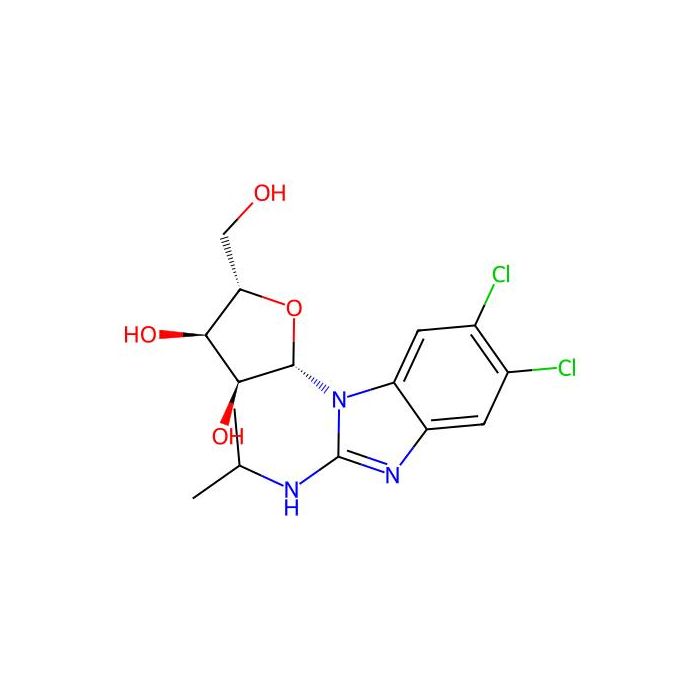
Maribavir is a potent inhibitor of histone phosphorylation catalyzed by wild-type pUL97 in vitro, with an IC 50 of 3 nM. Maribavir has potent antiviral activity against HCMV and Epstein-Barr virus ( EBV ).
Specifications
Specifications & Purity
Moligand™, 10 mM in DMSO
Storage
Store at -80°C
Shipped In
Dry ice packs + Cold packs
This product requires cold chain shipping. Ground and other economy services are not available.
Determine the necessary mass, volume, or concentration for preparing a solution.
Dilution Calculator
Determine the dilution needed to prepare a stock solution.
Reconstitution Calculator
Reviews
Customer Reviews
Application Protocols
Only tested applications and conditions supplied in the Product Data can be reported here.
Tested applications, recommended concentrations, and positive controls: Not specified for this item; refer to CoA/Spec Sheet.
General research guidance (non-spec):
Typical usage involves preparing a DMSO stock and conducting concentration–response experiments in relevant biochemical or cellular assays, including appropriate vehicle controls and orthogonal readouts.
For plate-based screening, pre-dispense compound into assay plates using acoustic or pin tools to minimize DMSO carryover and evaporation.
Biological Roles
General literature context (no medical/clinical claims):
Maribavir is widely characterized as a selective modulator of kinase-mediated processes in human cytomegalovirus (HCMV) research, with primary attention to the viral protein kinase UL97. Inhibition of UL97 affects phosphorylation-dependent steps implicated in viral DNA processing and nuclear egress pathways in cell-based models.
Due to this mechanism focus, maribavir is used to dissect kinase-substrate relationships, to map resistance-associated mutations in UL97, and to study crosstalk between viral and host kinases during infection cycles in vitro.
In broader chemical biology, it serves as a tool compound to explore structure–activity relationships (SAR) around benzimidazole-based kinase modulators and to benchmark selectivity across related kinase panels.
Assay implications:
Researchers often employ maribavir as a positive control in biochemical UL97 assays and as a reference inhibitor in cellular phospho-readouts, ensuring matched DMSO controls.
Results should be orthogonally validated (e.g., genetic knockdown/knockout of UL97 or use of resistant variants) to confirm on-target effects.
Item-specific biological specifications (target binding constants, selectivity panels, etc.): Not specified for this item; refer to CoA/Spec Sheet or primary literature for quantitative parameters under defined assay conditions.
Buffer Applications
This product is a hydrophobic small molecule used as a research probe, not a buffering agent. Therefore it does not define pH or provide buffering capacity.
Practical notes for assay buffers (general guidance):
Prepare compound stocks in DMSO and dilute into the assay buffer of choice (e.g., HEPES, PBS, or Tris-based systems) maintaining a low final DMSO fraction (commonly ≤0.5–1% v/v) to minimize effects on enzyme activity or cell viability.
Include vehicle controls to account for solvent effects. Consider adding low levels of non-ionic surfactant if precipitation is observed, consistent with assay constraints.
Item-specific buffer recipes or pH ranges: Not applicable.
Green Alternatives
As a bioactive small molecule used chiefly as a probe/standard, conventional “green reagent” substitution frameworks are not directly applicable. The main opportunity for greener practice lies in solvent and process choices during handling and assay preparation.
Greener practice recommendations (general guidance):
Prefer aqueous-compatible stocks at the lowest effective DMSO content consistent with solubility and stability.
Minimize DMF use due to reproductive toxicity concerns; if high-boiling polar aprotics are required, NMP alternatives such as Cyrene or propylene carbonate may be explored for certain operations, recognizing compatibility limits with biological assays.
Use microscale preparation of stocks to reduce waste; adopt 96/384-well miniaturization to decrease solvent consumption.
Implement closed-vial thaw-and-dispense workflows to limit volatilization and exposure.
Small comparison (general):
DMSO vs ethanol as stock solvent: DMSO typically offers higher solubility for heteroaromatics but has higher viscosity and can affect some enzyme assays; ethanol is less polar, often lower solubility, but may be preferable for certain biological systems at very low percentages.
Item-specific greener alternatives to this molecule are not relevant, as it functions as a specific research probe rather than a generic solvent or reagent.
Pharmaceutical Uses
This listing is provided strictly for research use only and is not offered for clinical or therapeutic applications.
As a well-studied bioactive small molecule, maribavir can be used as a reference standard in analytical method development and validation (e.g., LC/UV, LC–MS) for pharmaceutical research laboratories.
It can serve as a positive control in in vitro ADME assessments (e.g., microsomal stability, plasma protein binding, permeability) to benchmark workflows, with all testing conducted under non-clinical research environments.
Formulation screening for in vitro use may explore solubilization systems such as DMSO concentrates, co-solvent mixtures, or cyclodextrin complexes, provided the intent is non-clinical and research-only.
Item-specific pharmacopeial status, excipient functions, and regulatory details: Not specified for this item; refer to CoA/Spec Sheet and applicable regulations. No medical or clinical claims are made or implied.
Physical Properties
Item-specific physicochemical properties have not been provided for this catalog entry.
Appearance: Not specified for this item; refer to CoA/Spec Sheet.
Molecular weight: Not specified for this item; refer to CoA/Spec Sheet.
Molecular formula: Not specified for this item; refer to CoA/Spec Sheet.
Melting point: Not specified for this item; refer to CoA/Spec Sheet.
Boiling point: Not specified for this item; refer to CoA/Spec Sheet.
Density: Not specified for this item; refer to CoA/Spec Sheet.
Refractive index: Not applicable to solids; if solution data are needed, refer to CoA/Spec Sheet.
Solubility: Not specified for this item; refer to CoA/Spec Sheet.
logP/logD: Not specified for this item; refer to CoA/Spec Sheet.
pKa: Not specified for this item; refer to CoA/Spec Sheet.
General literature guidance (non-spec):
Research-grade small-molecule inhibitors such as benzimidazole derivatives are commonly formulated in anhydrous DMSO to prepare stock solutions (e.g., 10–50 mM) and then diluted into aqueous assay buffers containing co-solvent (0.1–1% DMSO) to maintain solubility. Actual solubility limits should be verified empirically for each lot and vehicle.
Stability can be compound- and lot-dependent; verify with small-scale pilot solutions and monitor by LC/HPLC for any degradation under your exact storage/assay conditions.
Quality & Grades
Grade/Purity provided: Moligand™.
What Moligand™ typically indicates (general description):
A research-grade small-molecule suitable for screening, target validation, and medicinal chemistry exploration.
Emphasis on identity confirmation and suitability for library use; exact purity specification, residual solvents, and elemental limits are not stated here and should be confirmed on the CoA.
Implications for experimental design:
Analytical confirmation recommended prior to critical studies: LC/HPLC purity profiling, HRMS, and optional NMR to confirm identity and assess impurity profile aligned with your application.
For bioassays, prepare fresh DMSO stocks, pass through 0.2 µm filters if appropriate, and confirm concentration by UV or quantitative NMR if needed.
Item-specific notes:
UV cutoff, water content, residual metals, stabilizers: Not specified for this item; refer to CoA/Spec Sheet.
Appearance and form factor (powder vs. film vs. DMSO solution): Not specified for this item; refer to CoA/Spec Sheet.
Use scope:
For research use only; not intended for human or veterinary use, clinical diagnostics, or consumption.
Reaction & Applications
This compound is primarily a bioactive research tool and is not typically employed as a stoichiometric reagent or catalyst in synthetic transformations.
Research applications (general literature context):
Used as a selective chemical probe in virology research to interrogate protein kinases associated with herpesviruses. It has been widely studied for its ability to modulate viral protein phosphorylation cascades in cell-based models.
Serves as a reference control in target-engagement assays (e.g., biochemical kinase assays, cellular phosphorylation readouts) and in resistance-mutation mapping studies.
Assay setup considerations (general guidance):
Prepare concentrated DMSO stocks and dilute into assay medium with attention to final DMSO content and potential compound aggregation.
Validate activity windows by running concentration-response curves and including orthogonal readouts (e.g., biochemical vs. cellular) to decouple target engagement from cytotoxic or off-target effects.
Track lot-specific performance using internal reference standards and QC check compounds.
Synthetic reaction use:
Not commonly used as a reagent in named organic reactions. If derivatization is desired for SAR, employ standard heteroaromatic functionalization strategies (halogen–metal exchange, cross-coupling) on appropriate intermediates rather than on the final bioactive scaffold.
Item-specific application claims: None provided in Product Data; users should design experiments according to their research goals.
Reaction Conditions
This product is not intended for use as a reagent in chemical reactions, and no item-specific reaction condition data are provided.
General laboratory handling for solution preparation (non-spec):
Stock solutions: commonly prepared at 10–50 mM in anhydrous DMSO; vortex gently and sonicate briefly if needed. Filter through 0.2 µm PTFE if particulate persists and filtration is compatible with your application.
Light/temperature: prepare and handle at room temperature unless your assay dictates otherwise; protect from excessive light if chromophoric. Avoid prolonged exposure to elevated temperatures.
Assay dilution: add stock to pre-warmed buffer with vigorous mixing to avoid local supersaturation; confirm clarity visually and by a quick test run.
If derivatization or analog synthesis is pursued (medicinal chemistry context), conditions will depend on the chosen route for benzimidazole functionalization and are outside the scope of this product listing.
Safety & Handling
Follow your institutional EHS practices and consult the product SDS before use.
GHS information (from Product Data):
Signal Word: Not specified for this item; refer to SDS.
Hazard Statements: Not specified for this item; refer to SDS.
GHS Classification: Not specified for this item; refer to SDS.
Pictograms: Not specified for this item; refer to SDS.
General laboratory precautions (general guidance):
Handle in a chemical fume hood; avoid inhalation and skin/eye contact.
Recommended PPE: lab coat, safety glasses or goggles, and appropriate chemical-resistant gloves (e.g., nitrile); change gloves regularly.
Avoid generating dust/aerosols; use microbalance practices for solids.
Prevent environmental release; dispose according to local regulations.
Incompatibilities and stability (general guidance):
Avoid strong acids/bases and strong oxidizers unless compatibility is verified.
Protect solutions from light if the compound is chromophoric; use amber vials when feasible.
First-aid overview (general guidance; defer to SDS for details):
Skin/eye contact: Rinse with water for at least 15 minutes; remove contaminated clothing; seek medical evaluation.
Inhalation: Move to fresh air; monitor breathing; seek medical attention if symptoms persist.
Ingestion: Rinse mouth; do not induce vomiting; seek medical attention.
Solvent Selection
This product is a hydrophobic small-molecule inhibitor-class compound; item-specific solubility values are not provided.
Practical solvent guidance (general, non-spec):
Primary stock solvent: anhydrous DMSO is commonly used for benzimidazole-derived inhibitors.
Alternative solvents: DMF or ethanol can be explored if DMSO is unsuitable; final assay dilutions should keep organic co-solvent typically ≤1% v/v unless your assay tolerates more.
Aqueous vehicles: If aqueous delivery is required, use co-solvent systems (DMSO/H2O or ethanol/H2O) and consider surfactants (e.g., 0.01–0.1% Tween 80) as permitted by the assay.
DMSO and DMF are fully miscible with water and accommodate many heteroaromatic inhibitors at millimolar levels.
Ethanol is water-miscible to 100%, but compound solubility can be lower than in DMSO.
Selection tips:
Begin with a 10 or 20 mM DMSO stock; verify clarity at room temperature and after a freeze–thaw.
For sensitive biological assays, pre-equilibrate compound solutions in assay buffer to minimize precipitation, and confirm by light scattering or a quick microfiltration.
Item-specific solubility data: Not specified for this item; refer to CoA/Spec Sheet.
Storage & Reconstitution
Storage conditions (from Product Data): Store at -80°C.
Upon receipt, keep the container sealed and continue storage at -80°C. If frequent access is expected, consider preparing single-use aliquots to minimize freeze–thaw cycles.
Allow vials to equilibrate to room temperature in a desiccated environment before opening to prevent moisture condensation.
Reconstitution: Prepare concentrated stock solutions in anhydrous DMSO under dry conditions; record exact concentration and date. For aqueous assays, dilute into buffered media with thorough mixing and verify solution clarity.
Stability tracking: For long-term studies, periodically assess stock integrity by LC/UV or LC–MS and replace stocks at the first sign of degradation or precipitation.
Item-specific shelf life, solution stability, and solubility limits: Not specified for this item; refer to CoA/Spec Sheet and SDS for authoritative guidance.
Structure & Identity
Maribavir is a bioactive small molecule widely used as a research tool compound in virology and kinase-signaling studies.
Molecular Formula: Not specified for this item; refer to CoA/Spec Sheet.
Molecular Weight: Not specified for this item; refer to CoA/Spec Sheet.
SMILES: Not specified for this item; refer to CoA/Spec Sheet.
InChIKey: Not specified for this item; refer to CoA/Spec Sheet.
Structural description (general literature context, not item-specific specs):
Maribavir is a substituted benzimidazole derivative bearing aryl/haloaryl substituents that confer kinase-binding selectivity in virology research.
Functional group features include a benzimidazole heteroaromatic core and halogenated aryl substitution; no stereocenters are typically present in the core scaffold.
2D topology: fused imidazole–benzene ring (benzimidazole) substituted with lipophilic aryl groups that enhance membrane permeability and target engagement.
Intended use: For research use only (per Product Data).
Synthetic Utility
Maribavir is an end-use bioactive probe compound rather than a general synthetic building block. Consequently, it is not typically used as a reagent, catalyst, or intermediate in routine organic synthesis.
Context for medicinal chemistry (general literature):
The benzimidazole core common to maribavir-like scaffolds is frequently explored in SAR campaigns via variation of aryl substitution, heteroatom placement, and halogenation patterns to modulate potency and selectivity in kinase-focused programs.
Typical retrosynthetic strategies involve assembling the benzimidazole ring from o-phenylenediamine derivatives and carboxyl equivalents (e.g., formamides, aldehydes, or carboxylic derivatives), followed by selective arylation/halogenation and protection–deprotection sequences.
Analytical utility:
Serves as a chromatographic/LC–MS reference material during development of methods aimed at quantifying related analogs or metabolites in research matrices.
Item-specific reactivity and transformation data: Not specified for this item; refer to CoA/Spec Sheet for any available characterization data.
Target Specificity
Only item-specific target data from the Product Data may be listed here.
Target, pathway, species reactivity, and binding parameters: Not specified for this item; refer to CoA/Spec Sheet.
General literature note (not item-specific):
Maribavir has been extensively studied as a chemical probe for the viral kinase UL97 in HCMV research, but quantitative affinities and selectivity panels are assay- and protocol-dependent and are not provided in this catalog entry.
Frequently Asked Questions
What is Moligand??
Moligand? is one of Aladdin Scientific's premium product lines, formulated for high-purity applications across multiple workflows. Compared to standard grades in the same workflow, Moligand? products typically offer tighter specifications, more rigorous QC, and stronger lot-to-lot consistency.
How should this product be stored?
Store at ?80 °C. Ultra-low temperature storage is required to maintain the specified shelf life.
How is this product shipped?
This product ships frozen with dry ice and cold packs. Unpack on arrival and transfer it to the storage condition stated above; handle dry ice with insulated gloves in a ventilated area.
What are the CAS number, molecular formula and molecular weight?
The CAS Number is 176161-24-3, the molecular formula is C15H19Cl2N3O4, and the molecular weight is 376.24 g/mol.
What documentation is provided?
Available product documentation, including Certificates of Analysis (COA), Safety Data Sheets (SDS), and specification sheets, is shown in the product document area. Document availability and access follow the current site policy.
Need help choosing the grade?
Our grade selection guide covers purity, stabilizer status, and application suitability for all variants in our catalog.
We use cookies to ensure the website functions properly and, where permitted, to improve your experience. You can manage your preferences at any time in Settings. Learn more in our Cookie Policy.
Shall we send you a message when we have discounts available?
Remind me later
Thank you! Please check your email inbox to confirm.
Products are supplied to verified businesses, institutions, and qualified professionals for research and development use only. Not for use in humans, animals, diagnosis, or therapy.