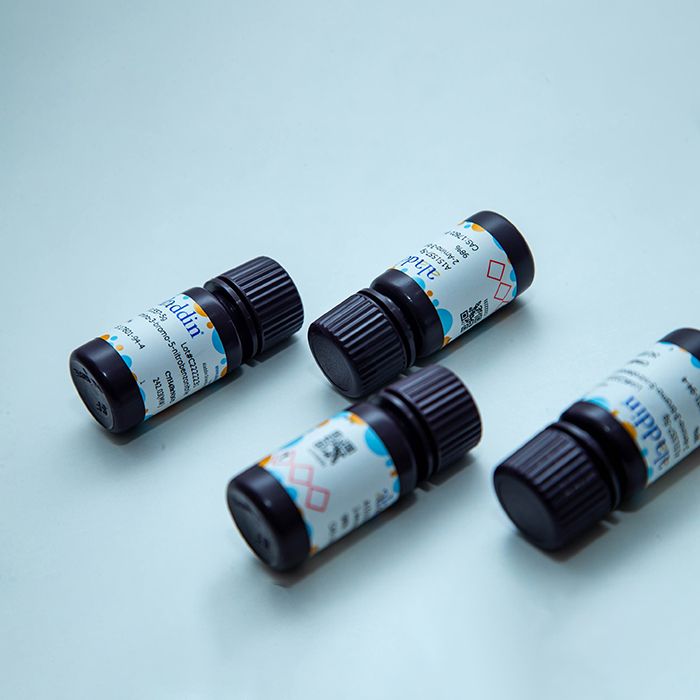
MDP1 acetate, a Melittin-derived peptide, alters the integrity of both Gram-positive and Gram-negative bacterial membranes and kills the bacteria via membrane damages. MDP1 acetate has a high-antibacterial activity against multidrug resistant (MDR) and re
Appearance:Solid
In Vitro:MDP1 acetate exhibits more potent antibacterial activities against S. aureus , E. coli and P. aeruginosa . Geometric means of MICs for MDP1 is recorded at 4.06 μg/mL ( S. aureus ), 1.22 μg/mL ( E. coli ) and 3.75 μg/mL ( P. aeruginosa ), respectively
Biological Activity:MDP1 acetate, a Melittin-derived peptide, alters the integrity of both Gram-positive and Gram-negative bacterial membranes and kills the bacteria via membrane damages. MDP1 acetate has a high-antibacterial activity against multidrug resistant (MDR) and re
Specifications
Specifications & Purity
≥98%
Storage
Protected from light,Argon charged,Desiccated,Store at -80°C
Shipped In
Dry ice packs + Cold packs
This product requires cold chain shipping. Ground and other economy services are not available.
Action Type
INHIBITOR
Purity
≥98%
Names and Identifiers
Molecular Weight
2521.05
Advanced Data
Certificates (CoA,COO,BSE/TSE and Analysis Chart)
C of A & Other Certificates(BSE/TSE, COO):
Analytical Chart:
Chemical and Physical Properties
Solubility
H2O : 10 mg/mL (3.97 mM; Need ultrasonic)
Solution Calculators
Molarity Calculator
Determine the necessary mass, volume, or concentration for preparing a solution.
Dilution Calculator
Determine the dilution needed to prepare a stock solution.
Reconstitution Calculator
Reviews
Customer Reviews
Application Protocols
No validated assay protocols are provided in the Product Data for MDP1 acetate. For general small-molecule screening, the following high-level steps may be adapted after confirming structure and solubility (research use only):
Stock preparation:
Dissolve in dry DMSO to 10–50 mM; sonicate gently if needed; filter (0.2 µm PTFE) if compatible. Record exact concentration (adjust for salt form if necessary).
Aliquoting and storage:
Dispense into low-bind microtubes or assay plates; argon-purge headspace; store at −80 °C protected from light; avoid repeated freeze–thaw cycles.
Dosing into assay:
Dilute into buffer or media to desired working concentration; keep final DMSO ≤0.1–1% v/v as assay permits; verify absence of precipitation.
Quality control:
Pre- and post-assay LC–MS to confirm integrity; include vehicle controls and, where possible, a known positive control.
Refer to your laboratory’s SOPs and the compound’s CoA/SDS for detailed instructions and safety constraints.
Biological Roles
No structure or biological annotation is provided in the Product Data for MDP1 acetate. Therefore, specific biological roles, pathways, or target interactions cannot be assigned for this item.
Research context (general):
As a member of a small-molecule/compound library, this product may be used to interrogate biochemical pathways, protein–ligand interactions, or cellular phenotypes in a research setting, contingent on the end-user’s determination of structure and activity.
Cautions:
Do not infer biological function or mechanism without primary data. Any observed biological effects should be validated with orthogonal assays and appropriate controls to rule out artifacts (e.g., compound aggregation, fluorescence interference, redox activity).
Documentation:
For any reported biological use, record lot number, exact concentration (free base/acid equivalents if applicable), solvent composition, exposure time, and assay conditions to ensure reproducibility.
Research Use Only: This product is designated for laboratory research use only and is not intended for diagnostic, therapeutic, or other clinical applications.
Buffer Applications
This product is a small-molecule library entry and is not a buffer component or pH stabilizer. As such, standard buffer formulation guidance (e.g., phosphate, HEPES, Tris systems) is not typically applicable.
Practical notes (assay handling):
When dosing from DMSO or other organic stock into aqueous buffers, keep the final organic cosolvent fraction low (commonly ≤0.1–1% v/v, assay-dependent) to avoid perturbing buffer capacity or biological systems.
Pre-dissolve in a compatible solvent and add slowly to vigorously mixed buffer to minimize precipitation.
If the acetate form affects pH in sensitive assays, verify the buffer’s capacity and adjust as needed.
For detailed buffer recipes and pH ranges, refer to established buffering systems (e.g., PBS pH 7.4, HEPES 6.8–8.2, MOPS 6.5–7.9) as dictated by your biological assay—not by this compound.
Green Alternatives
Because the structure and function of MDP1 acetate are not provided, specific green-substitution guidance for this molecule is not possible. However, for common laboratory operations associated with small-molecule screening and handling, the following greener practice suggestions may apply.
Stock solution solvent choices (general):
Prefer bio-derived or lower-toxicity solvents when compatible with solubility and assay constraints: ethanol (EtOH), 2-propanol (IPA), ethyl acetate (EtOAc) for workups.
For aprotic polar needs where feasible, consider Cyrene (dihydrolevoglucosenone) or propylene carbonate as emerging greener alternatives to DMF/DMSO in certain contexts, after compatibility tests.
Comparison highlights (literature-general):
DMSO: excellent solvency, high boiling point; environmental impact moderate; widely accepted in assays but manage disposal responsibly.
Ethanol: renewable routes available; excellent EHS profile; limited solubility for some hydrophobic compounds.
2-MeTHF/CPME (for synthesis/workup, if applicable): improved safety vs THF/Et2O; test for solubility and stability.
Process considerations:
Minimize solvent volumes via miniaturized assays (uHTS), adopt sealed-plate handling to reduce VOCs, and segregate halogenated/non-halogenated waste streams.
Validate greener solvent substitutions by checking compound stability, assay signal-to-background, and target engagement metrics.
Pharmaceutical Uses
No pharmacopeial status, excipient role, or formulation data are provided for MDP1 acetate in the Product Data. Accordingly, pharmaceutical-use guidance cannot be provided for this item.
Scope limitation:
This product is sold strictly for research use only and is not intended for clinical, diagnostic, or therapeutic applications.
If exploring pre-formulation (research only):
Determine salt identity (acetate salt vs acetate ester) and measure solubility in pharmaceutically relevant media (FaSSIF/FeSSIF, pH 1–8 buffers) to assess developability in a research context.
Evaluate stability under ICH-like stress (light, heat, oxidative, humidity) on a small research scale only; correlate degradation with pH and excipient compatibility.
Documentation and compliance:
Any use beyond basic research requires comprehensive CMC and regulatory evaluation, which is out of scope for this product and not supported by the current data.
Physical Properties
Item-specific physico-chemical parameters are not provided in the Product Data. The following placeholders indicate where to refer for authoritative values.
Appearance: Not specified for this item; refer to CoA/Spec Sheet.
Purity/Grade: Not specified for this item; refer to CoA/Spec Sheet.
Molecular weight: Not specified for this item; refer to CoA/Spec Sheet.
Molecular formula: Not specified for this item; refer to CoA/Spec Sheet.
Melting point (mp): Not specified for this item; refer to CoA/Spec Sheet.
Boiling point (bp): Not specified for this item; refer to CoA/Spec Sheet.
Density: Not specified for this item; refer to CoA/Spec Sheet.
Refractive index: Not specified for this item; refer to CoA/Spec Sheet.
pKa/logP/logD: Not specified for this item; refer to CoA/Spec Sheet.
Solubility profile (water/buffer/organic): Not specified for this item; refer to CoA/Spec Sheet.
General guidance (literature-general, not item-specific):
For small-molecule acetate salts intended for screening, dimethyl sulfoxide (DMSO) is commonly used for primary stock preparation (e.g., 10–50 mM) due to broad solubilizing capacity.
If the material is moisture- or hydrolysis-sensitive, strictly minimize water content in solvents and use freshly opened anhydrous grades.
Conduct a micro-solubility panel (DMSO, DMF, MeOH, EtOH, acetonitrile, PBS) on a small aliquot to establish working conditions before scale-up.
Quality & Grades
Item-specific grade and purity are not listed in the Product Data and should be confirmed on the CoA/Spec Sheet.
Item-specific:
Grade/Purity: Not specified for this item; refer to CoA/Spec Sheet.
Appearance: Not specified for this item; refer to CoA/Spec Sheet.
Screening library grade: optimized for biological assay compatibility and identity confirmation (NMR/LC–MS); UV trace impurities may be controlled but are not necessarily at HPLC-grade solvent levels.
Assay-ready/HTS-ready: often provided with validated identity and purity (typically ≥90–95% by LC–MS/UPLC), suitable for plate-based screening; confirm exact threshold on CoA.
Salt form (e.g., acetate): improves handling, crystallinity, or solubility; report concentrations in terms of free base/acid equivalents where relevant.
Stabilizers/antioxidants:
Not specified for this item; refer to CoA/Spec Sheet. If none are present, stability must be managed through strict low-temperature, desiccated, inert storage as specified.
Documentation:
Request the latest CoA/Spec Sheet for batch-specific identity (e.g., NMR, HRMS), purity assay method and result, residue on ignition, water content (KF), and residual solvent data if needed for your application.
Reaction & Applications
This product is listed under a small-molecule/compound library category and is primarily intended for research screening and discovery workflows rather than as a general synthetic reagent.
Primary research applications (general, assay-focused):
High-throughput screening (HTS) and fragment/ligand discovery in biochemical, biophysical, or cell-based assays.
Mechanistic probes in target validation studies, chemical genetics, or pathway interrogation (research use only).
Reference compound for SAR exploration once structural identity and purity are confirmed.
Not typically applicable as a reagent:
Without a confirmed structure and functional group specification, it is not appropriate to assign roles in named synthetic reactions (e.g., cross-couplings, condensations). If you intend to use it synthetically, obtain the structural and reactivity profile from the CoA/Spec Sheet and perform a small-scale pilot.
Practical assay tips:
Prepare concentrated DMSO stocks, aliquot, and avoid repeated freeze–thaw.
Verify chemical identity and purity via LC–MS prior to critical screening runs.
Confirm absence of assay-interfering properties (e.g., strong fluorescence, redox cycling, aggregation) using orthogonal counter-screens where feasible.
Reaction Conditions
No reaction-condition guidance can be provided without the compound’s structure and reactivity profile. The following general notes apply only if you intend to explore transformations after confirming identity.
Establish baseline data (general):
Confirm identity and purity (≥95% by LC–MS/UPLC if possible for synthetic work).
Run small-scale stability screens across solvents (MeOH, MeCN, DCM, toluene), pH (2–10), and temperatures (−20 to 80 °C) to identify safe handling windows.
If acetate ester (illustrative, literature-general):
Hydrolysis: acid- or base-catalyzed at 0–60 °C; monitor by TLC/UPLC; quench and neutralize carefully.
Transesterification: catalytic acid or base in alcohol solvents; remove byproducts by azeotrope where compatible.
If acetate salt of an amine (illustrative, literature-general):
Free-basing: adjust to basic pH (e.g., NaHCO3/Na2CO3 or stronger bases as needed), extract into organic solvent; dry thoroughly before downstream steps.
Always pilot on milligram scale, monitor by LC–MS, and validate work-up/quench conditions to preserve integrity.
Safety & Handling
Safety details specific to MDP1 acetate are not provided in the Product Data; consult the SDS for definitive hazard classification and response measures.
GHS/CLP (item-specific):
Signal word: Not specified for this item; refer to SDS.
H-statements: Not specified for this item; refer to SDS.
Pictograms: Not specified for this item; refer to SDS.
GHS classification: Not specified for this item; refer to SDS.
Storage and stability (from Product Data):
Store at −80 °C, protected from light, under argon, and desiccated.
Shipped on dry ice packs + cold packs to maintain low temperature and minimize moisture ingress.
Handling best practices (general laboratory guidance):
Work in a fume hood; avoid inhalation, ingestion, and skin/eye contact.
Wear appropriate PPE: lab coat, nitrile gloves, eye protection; escalate PPE if SDS indicates.
Allow vials to equilibrate to room temperature in a desiccator before opening to prevent condensation.
Open under inert atmosphere (argon or nitrogen) if air/moisture sensitive; promptly re-cap and re-purge headspace.
Prepare small aliquots to minimize freeze–thaw cycles.
Incompatibilities (general):
If acetate salt of a base: may be incompatible with strong oxidizers and strong bases; avoid prolonged exposure to aqueous basic or strongly acidic conditions that may promote hydrolysis (literature-general guidance).
Always defer to the product’s SDS and institutional safety protocols for authoritative instructions.
Solvent Selection
Because item-specific solubility data are not provided, initial solvent selection should follow a rational micro-screen strategy suitable for small-molecule library members.
Secondary: DMF, acetonitrile, methanol, ethanol — evaluate if DMSO needs to be limited in the assay.
Aqueous: PBS or assay buffer — test serial dilution from an organic cosolvent; monitor for precipitation.
Polarity and ionization considerations (general):
If MDP1 acetate is a salt of a basic amine, it may show improved aqueous solubility relative to the free base; however, solubility can drop after basification or upon dilution into high-ionic-strength buffers.
Co-solvent and pH can dramatically affect solubility; consider pH adjustment near predicted pKa (once known from the CoA or your measurements).
Practical tips:
Filter stocks (0.2 µm PTFE) if compatible to remove particulates; avoid adsorption losses by pre-rinsing filters and vials.
For moisture-sensitive materials, use anhydrous solvents and handle under inert gas.
Document final working solvent composition in assays (e.g., ≤0.1–1% DMSO v/v commonly tolerated in many biochemical screens).
Storage & Reconstitution
Storage and shipping conditions are provided in the Product Data and should be followed strictly to preserve material integrity.
Storage (from Product Data):
Store at −80 °C.
Protect from light.
Maintain under argon (inert atmosphere) and in a desiccated environment.
Shipping (from Product Data):
Shipped on dry ice packs + cold packs to maintain low temperature during transit.
Reconstitution (general guidance, not item-specific):
Use anhydrous solvent (commonly DMSO for small molecules) to prepare a concentrated stock (e.g., 10–50 mM) once vial has equilibrated to room temperature in a desiccator.
If hygroscopic or air-sensitive, open vial under inert gas and promptly reseal/purge after aliquoting.
Filter stock if compatible (0.2 µm PTFE) and label with concentration, solvent, date, and lot number.
Stability management:
Prepare single-use aliquots to avoid freeze–thaw; store aliquots at −80 °C in amber or foil-wrapped containers.
Periodically confirm integrity by LC–MS/UPLC prior to critical experiments.
Item-specific specifications (if required by your workflow):
Any details on water content, residual solvents, stabilizers, and exact solubility: Not specified for this item; refer to CoA/Spec Sheet.
Structure & Identity
Brief overview: This listing is for MDP1 acetate (SKU: M659294), supplied as a research-use small molecule entry in Aladdin Scientific's screening compound library. Item-specific structural identifiers are not provided in the Product Data.
Item-specific identifiers (from Product Data):
CAS: Not specified for this item; refer to CoA/Spec Sheet.
InChIKey: Not specified for this item; refer to CoA/Spec Sheet.
SMILES: Not specified for this item; refer to CoA/Spec Sheet.
Molecular formula: Not specified for this item; refer to CoA/Spec Sheet.
Molecular weight: Not specified for this item; refer to CoA/Spec Sheet.
Nomenclature notes (general):
The suffix "acetate" typically denotes an acetate salt or ester form. Without a structure, it is not possible to confirm whether this is a protonated base paired with acetate (salt) or an acetylated/acetoxy functionality (ester). Please consult the CoA/Spec Sheet for definitive identity.
Structural features (descriptive, contingent on structure; not item-specific):
If an acetate salt: expect a cationic parent (e.g., amine) balanced by acetate anion.
If an acetate ester: expect an –O–C(=O)CH3 functionality susceptible to hydrolysis under strong acid/base (literature-general).
2D structure depiction:
Not available in the Product Data. A structural sketch and stereochemical description (if any) should be taken from the provided CoA/Spec Sheet once available.
Synthetic Utility
Synthetic utility cannot be assigned without a defined structure. If MDP1 acetate is intended as a building block or intermediate in your workflow, consult the CoA/Spec Sheet for functional group information and proceed with a small pilot reaction to establish compatibility.
General considerations (contingent on structure; literature-general):
Acetate esters: may participate in transesterification, nucleophilic acyl substitution, or serve as protecting groups for alcohols; susceptible to base- or acid-catalyzed hydrolysis.
Acetate salts of amines: typically used to improve handling; free base can be generated by basification if needed for coupling or nucleophilic reactions.
Practical tips:
Verify water content (e.g., Karl Fischer) if moisture-sensitive steps are planned; dry under vacuum at low temperature if compatible.
If planning cross-coupling, condensations, or amide formations, confirm presence of the requisite handles (halide, boronate, carboxyl, amine) via CoA or independent characterization (NMR, IR, MS).
Target Specificity
Not applicable. This listing is not an antibody, protein, or nucleic acid reagent, and the Product Data do not provide any target-binding specificity. No antigen, epitope, clone, isotype, or species reactivity information is available for this item.
Frequently Asked Questions
What is the purity of this product?
This product is supplied at ≥98% purity (chemical assay). Lot-specific values are stated on the Certificate of Analysis.
How should this product be stored?
Store at ?80 °C, protected from light, desiccated, under argon. It is supplied under an argon blanket; reseal under inert gas after each use.
How is this product shipped?
This product ships frozen with dry ice and cold packs. Unpack on arrival and transfer it to the storage condition stated above; handle dry ice with insulated gloves in a ventilated area.
What are the CAS number, molecular formula and molecular weight?
The CAS Number is M659294, the molecular formula is C113H206N34O30, and the molecular weight is 2521.05 g/mol.
What documentation is provided?
Available product documentation, including Certificates of Analysis (COA), Safety Data Sheets (SDS), and specification sheets, is shown in the product document area. Document availability and access follow the current site policy.
We use cookies to ensure the website functions properly and, where permitted, to improve your experience. You can manage your preferences at any time in Settings. Learn more in our Cookie Policy.
Shall we send you a message when we have discounts available?
Remind me later
Thank you! Please check your email inbox to confirm.
Products are supplied to verified businesses, institutions, and qualified professionals for research and development use only. Not for use in humans, animals, diagnosis, or therapy.