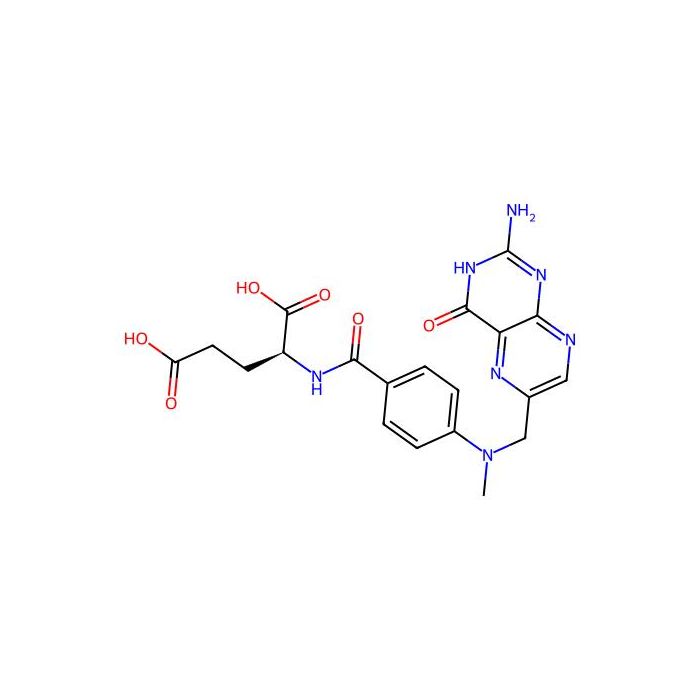
This compound belongs to the class of organic compounds known as folic acids. These are heterocyclic compounds based on the 4-[(pteridin-6-ylmethyl)amino]benzoic acid skeleton conjugated with one or more L-glutamate units.
External Descriptors
Not available
1. Djoumbou Feunang Y, Eisner R, Knox C, Chepelev L, Hastings J, Owen G, Fahy E, Steinbeck C, Subramanian S, Bolton E, Greiner R, and Wishart DS. ClassyFire: Automated Chemical Classification With A Comprehensive, Computable Taxonomy. Journal of Cheminformatics, 2016, 8:61.
Determine the necessary mass, volume, or concentration for preparing a solution.
Dilution Calculator
Determine the dilution needed to prepare a stock solution.
Reconstitution Calculator
Reviews
Customer Reviews
Application Protocols
No validated, item-specific application protocols are provided in the product data.
General research-use suggestions (non-clinical; verify empirically):
Stock preparation: Dissolve in DMSO (e.g., 10–50 mM) or in mildly alkaline water; sterile-filter if required by your assay. Store as aliquots at −20 °C protected from light.
Enzyme assays: Maintain final DMSO ≤1–2% v/v; include appropriate controls (vehicle, inactive analogs) and confirm linearity of readouts.
Cell-based assays: Confirm medium compatibility and precipitation behavior upon dilution; pre-warm media and add slowly with mixing.
Analytical standards: Prepare gravimetrically, correct for purity from CoA, and record solution stability (time, temperature, light exposure).
Always develop assay-specific SOPs and consult the item’s CoA/SDS for constraints and safety notes.
Biological Roles
General biochemical context (literature; not item-specific and not a medical claim):
Methopterin-class compounds are antifolates that interact with the folate cycle, commonly acting as potent inhibitors of dihydrofolate reductase (DHFR). DHFR catalyzes reduction of dihydrofolate to tetrahydrofolate, a cofactor for one-carbon transfer reactions essential to purine and thymidylate biosynthesis.
By diminishing tetrahydrofolate pools, antifolates modulate pathways involving serine/glycine interconversion, formyl-THF–dependent purine formation, and methylene-THF–dependent dTMP synthesis (via thymidylate synthase).
Polyglutamation by folylpolyglutamate synthase (FPGS) can alter cellular retention and potency profiles of antifolates, emphasizing the importance of the glutamate tail in intracellular trafficking and enzyme binding.
Transport across membranes may involve reduced folate carrier (RFC), proton-coupled folate transporter (PCFT), and folate receptors; exact transporter usage is compound-specific.
These roles make antifolates valuable as research tools for dissecting one-carbon metabolism, nucleotide biosynthesis, and folate-mediated methylation pathways in biochemical and cellular systems.
Buffer Applications
This compound is not a buffering agent and is not typically used to prepare buffer systems.
Practical guidance:
For dissolution, mildly alkaline buffers (e.g., sodium bicarbonate/carbonate) can enhance solubility of antifolate-like molecules; subsequently adjust pH to the assay requirement.
Maintain ionic strength and pH suitable for your biological system (e.g., phosphate or HEPES buffers) after initial dissolution, ensuring compound stability is validated at the working pH.
No specific buffer recipes are provided for this item.
Green Alternatives
As a solid bioactive research reagent, the concept of a “green alternative” applies primarily to the choice of dissolution media and work-up conditions rather than to replacing the molecule itself.
Prefer aqueous buffers where compatible with solubility and stability (e.g., bicarbonate-adjusted water) over high-toxicity amide solvents.
If an organic co-solvent is required, minimize volume and consider propylene carbonate or ethylene carbonate mixtures when method-compatible; however, these may be too viscous for routine pipetting.
Use DMSO judiciously: it has favorable EHS characteristics relative to DMF but still requires responsible handling and waste management.
DMSO: lower volatility, good solvency; downstream biological tolerance typically up to 1–2% v/v.
DMF: effective solvent but higher EHS burden; avoid when alternatives suffice.
Operational green tips:
Prepare concentrated stocks to reduce solvent usage, aliquot to minimize waste from freeze–thaw cycles, and use amber, reusable glassware where feasible.
Pharmaceutical Uses
No pharmaceutical grade, compendial status, or excipient role is specified for this catalog item; it is supplied strictly for research use only.
Research and analytical context (non-clinical):
May be used as a reference standard or system suitability compound for analytical method development in research labs (e.g., LC–UV/LC–MS), including stability-indicating methods exploring pH- and light-sensitivity of antifolate scaffolds.
Not supplied with pharmacopeial certification (USP/EP/JP) unless stated on the CoA; none is specified here.
Do not use this material for human or veterinary applications, drug formulation, or diagnostic purposes.
Physical Properties
Item-specific physicochemical specifications are not provided in the product data.
Appearance: Not specified for this item; refer to CoA/Spec Sheet.
Molecular Weight: Not specified for this item; refer to CoA/Spec Sheet.
Molecular Formula: Not specified for this item; refer to CoA/Spec Sheet.
Melting point, boiling point, density, refractive index: Not specified for this item; refer to CoA/Spec Sheet.
Solubility (item-specific): Not specified for this item; refer to CoA/Spec Sheet.
General/literature guidance (for folate/antifolate analogs; not item-specific):
Typically sparingly soluble in water at neutral pH; solubility improves in alkaline aqueous media (e.g., dilute NaOH or carbonate) due to deprotonation of carboxyl groups and basic nitrogens.
Often soluble in polar aprotic solvents such as DMSO and DMF; limited solubility in alcohols; essentially insoluble in nonpolar solvents.
Strong UV chromophores from the pteridine and PABA segments enable quantification by UV/Vis (λmax values are compound-specific; consult CoA/SDS or literature for exact maxima).
Important note: Do not treat any values as specifications unless explicitly provided on the item CoA/Spec Sheet. For method development (e.g., LC-UV), establish extinction coefficients and λmax empirically for your lot.
Quality & Grades
Grade/Purity: Not specified for this item; refer to CoA/Spec Sheet.
Interpretation and guidance:
In the absence of an explicit grade (e.g., analytical standard, bioactive reference material, or research grade), use the CoA to confirm purity, assay basis (e.g., anhydrous vs. hydrate), residual solvents, and impurity profile.
For bioactive small molecules, vendors may control for identity (1H/13C NMR, HRMS), purity (HPLC/UPLC area%), and water content (KF). These parameters are lot-specific—verify on your CoA.
If a stabilizer is present (common for light/oxidation sensitive materials), it will be listed on the label/CoA. None is specified here; therefore, do not assume the presence or absence of stabilizers.
What this means practically:
For quantitative applications (e.g., calibration standards, enzyme kinetics), confirm purity and correct for assay if needed (e.g., 98% purity → correct weighed amount accordingly).
For LC method development, low-UV impurity levels and residual solvent profiles can influence baselines—consult CoA chromatograms where available.
Reaction & Applications
Manufacturer Applications: Not specified in the product data.
Research-use context (general, non-clinical):
Methopterin-class antifolates are widely used as biochemical tools to perturb folate-dependent one-carbon metabolism in cell-free enzymology or cell-based research, particularly targeting dihydrofolate reductase (DHFR) activity. This enables studies of nucleotide biosynthesis, thymidylate and purine pathways, and metabolic flux.
Analytical applications may include use as a reference standard for chromatographic method development (e.g., LC-UV/LC–MS) in research laboratories.
Practical notes (general, not item-specific):
Prepare concentrated stocks in DMSO or mildly alkaline aqueous media; filter through 0.22 µm if particulate is present and solubility permits.
Protect from strong light; consider amber vials and minimized headspace (oxygen) if long-term storage in solution is required.
For enzyme assays, confirm activity readouts are not confounded by solvent content (keep DMSO ≤1–2% v/v in final assay unless validated).
No specific synthetic or manufacturing application is claimed for this catalog item beyond research use only.
Reaction Conditions
No preparative reaction conditions specific to this item are provided. The compound is typically used as-received in biological or analytical experiments rather than in transformations.
Handling conditions for solution preparation (general guidance):
Solvents: DMSO, DMF, or mildly alkaline aqueous solutions are commonly used for initial dissolution. Verify stability in chosen medium.
Temperature: Dissolve at ambient temperature; gentle warming (≤40 °C) may assist dissolution but avoid prolonged heating or strong light.
Atmosphere: Protect from strong light; inert atmosphere is generally not required but can be beneficial for long-term solution stability.
Filtration: 0.22 µm PTFE/nylon filters are typical for organic solutions; PES for aqueous. Confirm adsorption is negligible.
Analytical method development (general):
LC–UV or LC–MS using acidic aqueous mobile phases (e.g., 0.1% formic acid) with acetonitrile or methanol gradients is common; for MS, consider ammonium formate/acetate buffers at low mM levels to maintain ionization efficiency.
These are literature/practice-based suggestions and not product specifications.
Safety & Handling
GHS and hazard classification: Not specified for this item; refer to SDS for authoritative data.
General laboratory safety guidance for antifolate analogs (literature/practice-based; not item-specific):
Handle in a chemical fume hood and avoid inhalation or ingestion. Prevent skin and eye contact.
Recommended PPE: lab coat, nitrile gloves (change frequently), safety glasses or face shield if splash risk.
Avoid contact with strong oxidizers and strong acids/bases unless used intentionally for dissolution under controlled conditions.
Many pteridine/antifolate solids are light-sensitive; minimize exposure to strong light. Use amber containers when possible.
First-aid overview (general):
Skin/eye contact: Rinse with water for at least 15 minutes; remove contaminated clothing; seek medical attention as appropriate.
Inhalation: Move to fresh air; obtain medical attention if symptoms occur.
Ingestion: Rinse mouth; do not induce vomiting; seek medical attention.
Spill/leak & waste:
Avoid dust generation. Sweep with minimal disturbance or use damp disposable towels/HEPA vacuum. Dispose of according to institutional hazardous chemical waste procedures.
Always defer to the current SDS for this product for definitive hazard pictograms, signal word, H-statements, and disposal requirements.
Solvent Selection
Solvent guidance for dissolution and handling (general literature for antifolate-type molecules; not item-specific):
Polarity: Highly polar, polyfunctional; behaves as a multi-acid/multi-base (zwitterion forms possible). Nonpolar solvents are unsuitable.
Preferred solvents for stock solutions:
DMSO: Often affords high-concentration stocks; compatible with many bioassays after dilution.
DMF: Good solvating power; dry, amide-type solvent; consider toxicity and compatibility.
Aqueous base: Dilute NaOH or carbonate/bicarbonate buffers raise solubility by deprotonating carboxylates; adjust to target pH after dissolution.
Secondary options: Mixed co-solvent systems (e.g., DMSO:H2O, DMF:H2O). Alcohols may offer limited solubility; test empirically.
Comparison and selection tips:
Choose DMSO for small, stable frozen aliquots for screening workflows; minimize freeze–thaw.
Choose alkaline aqueous when organic solvents are undesirable; confirm compound stability at elevated pH and then adjust to near-neutral.
Avoid strong acids for dissolution unless stability has been confirmed; pteridine rings may degrade under harsh acidic/oxidative conditions.
Always verify item- and lot-specific solubility and stability empirically; the CoA/Spec Sheet is the authoritative source if provided.
Storage & Reconstitution
Storage conditions (item-specific):
Store at −20 °C (as provided in product data).
Shipped in: Ice chest + ice pads. Upon receipt, place immediately at recommended storage temperature.
General best practices:
Protect from light and moisture. Keep container tightly closed. Use desiccant if available.
For solution stocks, prepare small aliquots in amber vials to avoid repeated freeze–thaw cycles.
Avoid prolonged storage in strongly acidic or basic media unless stability has been verified.
Start with DMSO or mildly alkaline water/bicarbonate buffer to achieve complete dissolution. Typical stock ranges for lab use: 1–50 mM depending on solubility and assay needs.
After dissolution in alkaline media, adjust pH to the target range with appropriate buffers before biological use, monitoring for precipitation.
Shelf life: Not specified for this item; refer to CoA/Spec Sheet. Always label aliquots with concentration, solvent, preparation date, and purity correction factor.
Structure & Identity
Brief description: Methopterin is commonly referenced in the literature as a pteridine-class folate analog (antifolate) bearing a pteridine core conjugated via a para-aminobenzoate (PABA) linker to a glutamate residue, analogous to the folate scaffold. Item-specific identifiers for this catalog entry are limited.
SKU: M1065852
Product Name: Methopterin
CAS: 2410-93-7 (as provided)
PubChem CID: 135434845 (as provided)
InChIKey: Not specified for this item; refer to CoA/Spec Sheet. (Catalog lists "124575", which is not a standard-format InChIKey.)
SMILES: Not specified for this item; refer to CoA/Spec Sheet.
Molecular Formula: Not specified for this item; refer to CoA/Spec Sheet.
Molecular Weight: Not specified for this item; refer to CoA/Spec Sheet.
Structural features (general literature description, not item-specific):
Contains a bicyclic pteridine ring system bearing amino substituents (typical of antifolates).
Conjugated to a para-aminobenzoate unit through a methylene bridge.
Terminal L-glutamate (or polyglutamate) moiety attached via an amide bond to the PABA carboxylate.
Overall, a highly polar, polyfunctional molecule with multiple heteroatoms (N, O) and ionizable groups.
2D structure in words (literature):
A fused diazine–pyrazine (pteridine) core with exocyclic amino groups at C-2/C-4, a benzylic linkage at C-6 to a para-aminobenzoic acid residue, which in turn is amide-coupled to a glutamic acid side chain. No stereocenters in the pteridine/PABA segment; L-configuration resides in the glutamate residue.
Synthetic Utility
As a highly functionalized, bioactive small molecule, this item is generally used as a research tool or analytical standard rather than a building block.
General chemistry perspective (literature; not item-specific):
The pteridine core contains multiple ring nitrogens and exocyclic amines, leading to complex acid–base behavior and potential for hydrogen bonding and coordination.
The PABA–glutamate segment provides carboxylate and amide functions; further derivatization (e.g., esterification of the glutamate carboxyls, amide coupling to form prodrugs or analogs) is synthetically feasible but outside the scope of typical end-user practice with a finished antifolate.
For medicinal chemistry, scaffold modifications at the 4-aminobenzoate and pteridine substituents tune DHFR affinity and selectivity; however, such transformations generally start from earlier intermediates rather than from the fully elaborated antifolate.
Bottom line: treat this compound as a final tool molecule; it is not typically employed as a synthon in routine organic synthesis workflows.
Target Specificity
This section typically applies to antibodies or biological affinity reagents. No antibody/bioreagent target information is provided for this small-molecule product.
General note (literature; not item-specific): Antifolate compounds are often studied for interactions with dihydrofolate reductase (DHFR) and components of folate transport/retention machinery, but no target-binding specifications or activity data are provided for this catalog item.
We use cookies to ensure the website functions properly and, where permitted, to improve your experience. You can manage your preferences at any time in Settings. Learn more in our Cookie Policy.
Shall we send you a message when we have discounts available?
Remind me later
Thank you! Please check your email inbox to confirm.
Products are supplied to verified businesses, institutions, and qualified professionals for research and development use only. Not for use in humans, animals, diagnosis, or therapy.