GRADE & PURITYAnhydrous Grade?Anhydrous grade — water removed and packaged dry for moisture-sensitive chemistry. Use in reactions where even trace water would interfere or quench.≥99.5%
This compound belongs to the class of organic compounds known as methyl esters. These are organic compounds containing a carboxyl group that is esterified with a methyl group. They have the general structure RC(=O)OR', where R=H or organyl group and R'=methyl group.
External Descriptors
a small molecule
1. Djoumbou Feunang Y, Eisner R, Knox C, Chepelev L, Hastings J, Owen G, Fahy E, Steinbeck C, Subramanian S, Bolton E, Greiner R, and Wishart DS. ClassyFire: Automated Chemical Classification With A Comprehensive, Computable Taxonomy. Journal of Cheminformatics, 2016, 8:61.
Add methyl acetate (3–5 volumes) to wet organic phase or solid; distill under atmospheric or slight vacuum to co-remove water or methanol via azeotrope; repeat as necessary.
Extraction helper
For mixtures containing methanol/water, add methyl acetate to improve phase separation; salt out if needed (e.g., brine), verify layers by density.
Always validate conditions on small scale and follow institutional SOPs. This guidance is general and not product-specific.
Biological Roles
This product is intended for research use only. Methyl acetate is not a native metabolite but can be encountered environmentally and in laboratory exposures.
Metabolism: Esterases hydrolyze methyl acetate to methanol and acetic acid. Acetic acid enters central metabolism as acetyl-CoA; methanol undergoes oxidation to formaldehyde and formate in organisms possessing the requisite enzymes.
Toxicology mechanisms: Central nervous system effects are largely attributable to solvent vapors (narcosis) and, upon hydrolysis, to methanol formation; however, methyl acetate is generally considered of lower acute toxicity compared to many chlorinated solvents. Exposure limits and risk assessments should be guided by institutional EHS policies and the SDS.
Biomembrane interactions: As a small, moderately polar aprotic solvent, it can partition into lipid phases and perturb membrane organization at high concentrations—relevant when designing extraction protocols for lipids or membrane proteins (use buffered aqueous systems to limit unintended effects).
Bioprocess considerations: Its volatility and partial water miscibility make it useful for in situ extractive removal of hydrophobic metabolites in two-phase systems, provided organism tolerance is confirmed.
No clinical or therapeutic claims are made; all uses are in vitro, process, or analytical contexts.
Buffer Applications
Methyl acetate is not a buffering agent and does not form conventional aqueous buffer systems. It is an organic solvent used alongside buffer systems in extractions or chromatographic separations.
Practical notes
If used with biological buffers, ensure phase compatibility; its partial miscibility with water can alter buffer ionic strength and pH measurement accuracy.
For pH-sensitive work, maintain a well-defined aqueous buffer phase (e.g., phosphate, HEPES) separate from the organic solvent and confirm phase volumes post-equilibration.
Green Alternatives
Methyl acetate is often regarded as a relatively benign, readily biodegradable solvent with low persistence; however, it is a VOC and highly flammable. Selection should weigh safety, environmental impact, and process performance.
Comparison (literature; general guidance only):
Methyl acetate
Pros: Low toxicity profile, biodegradable, very low boiling point for easy recovery; partial water miscibility useful for workups.
Cons: High vapor pressure (VOC emissions), flammable, partial water miscibility can complicate phase splits.
Ethyl acetate
Pros: Widely accepted as a green solvent, higher bp enables better process windows, good biodegradability, broad utility in chromatography and extraction.
Cons: Slower removal than methyl acetate; similar flammability.
2-Methyltetrahydrofuran (2-MeTHF)
Pros: Bio-based routes available, good hydrophobicity, tunable for Grignard and organolithium chemistry.
Cons: Higher bp (~80 °C) and peroxide formation risk; odor and supply variability.
Propylene carbonate
Pros: Non-volatile (low VOC), high polarity, good replacement for acetone/MeCN in some reactions.
Cons: High bp and viscosity complicate removal; not suitable when low-temperature evaporation is required.
Practical selection tips
For greener extractions or chromatography with easier waste minimization, ethyl acetate is a close, often greener substitute.
Where very fast solvent removal is paramount, methyl acetate may minimize energy use despite VOC concerns—use condensers and solvent recovery to mitigate emissions.
Pharmaceutical Uses
No therapeutic claims are made. The following are literature-based roles as a processing solvent or excipient context; applicability should be verified case-by-case and per regulatory filings.
Processing solvent: Used in coating, granulation, and cleaning steps where a fast-evaporating, moderately polar solvent is advantageous. Its low boiling point enables rapid drying at reduced temperatures.
Extraction and crystallization: Serves as an organic phase for intermediate isolations or polymorph control when lower boiling esters are desired. Partial water miscibility can assist antisolvent crystallizations with controlled phase behavior.
Residual solvent considerations: Typically categorized among Class 3 or similar low-toxicity solvents in some regulatory frameworks; always verify current pharmacopoeial status and permissible daily exposures for a given region and dossier. Residual limits and analytical methods (e.g., GC headspace) must be set per ICH/USP/EP guidance.
Device/ancillary: Occasionally used for cleaning or as a carrier in non-aqueous processing streams where rapid drying is needed.
Always confirm acceptability and specifications with quality, regulatory, and the specific CoA/Spec Sheet for this item.
Physical Properties
Item-specific specifications
Appearance: Not specified for this item; refer to CoA/Spec Sheet.
Computed/literature values (for reference; not item specifications)
Boiling point: ~56–57 °C at 1 atm (literature)
Melting point: ~−98 °C (literature)
Density: ~0.932 g/mL at 20 °C (literature)
Refractive index: nD20 ≈ 1.361 (literature)
Vapor pressure: ~170–175 mmHg at 25 °C (literature)
Dielectric constant: ~6.7 at 20 °C (literature)
LogP (octanol/water): ~0.2 (literature)
Water solubility: Moderately soluble; mutual partial miscibility with water (on the order of 25 wt% at 20 °C). Fully miscible with many organic solvents including alcohols, ketones, and hydrocarbons (literature).
pKa: Not applicable (no Brønsted-acidic/basic sites; ester does not ionize in water under neutral conditions).
General notes for practitioners
Volatile, low-boiling ester solvent; readily removed under reduced pressure.
Forms azeotropes (literature): with methanol and with water, useful for azeotropic removal of residual protic solvents or water during workups and esterifications.
Hygroscopicity: Limited; however, slow hydrolysis occurs in the presence of water and acid/base catalysts—drying and neutral conditions help preserve quality.
Quality & Grades
Item-specific grade
Grade/Purity: Anhydrous Grade
What Anhydrous Grade implies (general guidance)
Prepared and packaged to minimize water content for moisture-sensitive workflows (e.g., moisture-intolerant reactions, Karl Fischer standards preparation, or precise azeotrope behavior).
Actual water specification, residual impurities, stabilizers, or UV cutoffs: Not specified for this item; refer to CoA/Spec Sheet.
Practical notes for users
Verification: For critical water limits, perform Karl Fischer titration upon receipt and after opening if the application is moisture-sensitive.
Handling: Minimize ambient exposure—dispense under dry inert gas when possible. Reseal tightly after use.
Drying/conditioning in-lab (if needed): 3 Å molecular sieves are commonly used for esters; pre-activate sieves at 250–300 °C, cool in a desiccator, and add 5–10% w/v to maintain dryness.
Compatibility: Avoid basic drying agents that may catalyze transesterification or hydrolysis (e.g., strong alkoxides in wet systems).
Use cases for anhydrous methyl acetate
Water-intolerant extractions, azeotropic removal of water or methanol, and as a low-boiling solvent for moisture-sensitive transformations where rapid solvent removal is beneficial.
Reaction & Applications
General laboratory roles (literature)
Solvent for organic synthesis, extractions, and recrystallizations where a low-boiling, moderately polar medium is needed.
Azeotropic agent for removal of residual water or methanol from reaction mixtures and wet solids.
Chemical reactivity considerations (literature)
Ester stability: Stable under neutral conditions; undergoes hydrolysis in acidic or basic aqueous media to methanol and acetic acid.
Transesterification: Can participate as the methyl donor in acid- or base-catalyzed transesterifications with higher alcohols to give higher alkyl acetates; equilibrium can be driven by removal of methanol or by using excess alcohol.
Acyl source: Under strong nucleophilic acyl substitution conditions (e.g., with alkoxides, amines under activation), acts as an acetyl source, though more reactive acylating agents are typically preferred.
Process/industrial context (literature)
Carbonylation route: Methyl acetate is a key intermediate/solvent in Rh/Ir-catalyzed carbonylation processes to acetic anhydride (related to Cativa/older Monsanto technologies).
Practical tips
Drying: Maintain anhydrous conditions with 3 Å sieves for moisture-sensitive reactions to avoid hydrolysis.
Acid/base compatibility: Use non-nucleophilic acids (e.g., p-TsOH) for catalytic transesterification; avoid strong bases in the presence of water which accelerate saponification.
Workup: Due to volatility, concentrate under gentle vacuum at low bath temperatures to minimize loss of light ends or residual reactive species.
Analytical: GC analysis is straightforward due to volatility; monitor for methanol and acetic acid as hydrolysis markers.
Reaction Conditions
The following are literature-based, general conditions where methyl acetate participates or serves as solvent. They are guidance only and not item specifications.
Transesterification (as reagent/solvent)
Catalyst: p-TsOH (1–5 mol%) or H2SO4 (1–3 wt%) for acid route; NaOMe or KOMe (0.5–2 mol%) for base route (anhydrous).
Temperature: 40–80 °C (reflux of methyl acetate is ~56–57 °C; pressure or co-solvents adjust range).
Strategy: Use excess alcohol nucleophile or remove methanol by azeotropic distillation to drive equilibrium; water content must be minimized.
Aminolysis to acetamides (forcing)
Catalyst/activation: Lewis acids or coupling reagents; neat heating often insufficient without activation.
Temperature: Elevated (80–120 °C) or pressure; yields vary widely depending on substrate and activation.
Use in a fume hood due to volatility and potential for vapor accumulation; avoid inhalation of vapors.
Keep away from heat, sparks, open flames, and hot surfaces. Use intrinsically safe equipment and proper grounding/bonding for bulk transfers.
Avoid contact with eyes and prolonged skin exposure. Recommended PPE: safety glasses or chemical splash goggles, lab coat, and nitrile gloves.
Incompatibilities: Strong oxidizers. Under acidic or basic conditions in the presence of water, hydrolyzes to methanol and acetic acid; avoid contact with strong acids/bases if hydrolysis is undesirable.
Spills: Eliminate ignition sources; absorb with inert material and dispose per local regulations.
First aid (overview; consult SDS): Move exposed persons to fresh air; rinse eyes with water for at least 15 minutes; wash skin with soap and water; seek medical attention if symptoms persist.
Fire: Use alcohol-resistant foam, dry chemical, or CO2. Cool containers with water spray from a safe distance.
Miscible with: Alcohols, ketones, ethers, chlorinated solvents, many hydrocarbons.
Water: Partial mutual miscibility; forms an azeotrope that can aid drying steps.
When to choose methyl acetate
Preferred for processes needing rapid evaporation at low temperatures, gentle concentration, or reduced thermal stress on heat-sensitive intermediates.
Useful as an extraction solvent where slightly higher polarity than hydrocarbons is desired but stronger hydrogen-bond basicity (e.g., acetone, acetonitrile) is not.
A greener-leaning alternative to chlorinated solvents in certain workups.
Comparison with common alternatives (literature, general)
Ethyl acetate: Higher bp (~77 °C) and broader use in chromatography; methyl acetate offers faster removal and lower reflux temperatures.
Acetone: Higher polarity and complete water miscibility; methyl acetate is less polar and more selective in extractions.
2-MeTHF: Greener, higher bp (~80 °C), better hydrophobicity; methyl acetate is more volatile and easier to remove.
Chromatography/workup tips
As an eluent modifier, methyl acetate can behave similarly to ethyl acetate but yields slightly different selectivity; test gradients accordingly.
For extractions, salting-out can reduce aqueous miscibility and improve phase separation.
Storage & Reconstitution
Item-specific storage/shipping
Storage conditions: Room temperature (per Product Data). Keep container tightly closed in a well-ventilated place away from ignition sources.
Shipped in: FedEx DG Service (per Product Data). Handle as flammable dangerous goods upon receipt.
General handling and preservation (literature-based best practices)
Moisture control: Although labeled Anhydrous Grade, water content is not specified for this item; refer to CoA/Spec Sheet. After opening, minimize exposure to ambient humidity; consider storing over pre-activated 3 Å molecular sieves for critical applications.
Container: Store in compatible, tightly sealed amber glass or approved metal containers with PTFE-lined caps to reduce permeation and evaporation.
Stability: Stable under neutral, dry conditions. Avoid prolonged contact with acids/bases in the presence of water to prevent hydrolysis to methanol and acetic acid.
Freeze–thaw: Not applicable; liquid at typical storage temperatures.
Reconstitution: Not required—ready-to-use neat solvent. If a specific dryness is required, condition in-lab (sieves) and verify by Karl Fischer.
Inspect regularly for seal integrity and any odor changes suggestive of hydrolysis products; if detected, test acidity or GC profile before critical use.
Structure & Identity
Item-specific identifiers (from Product Data)
SKU: M103359
Product name: Methyl acetate
CAS: 79-20-9
PubChem CID: 6584
InChIKey (as provided): 192216
Computed/literature structural identity (for reference; not the item specification)
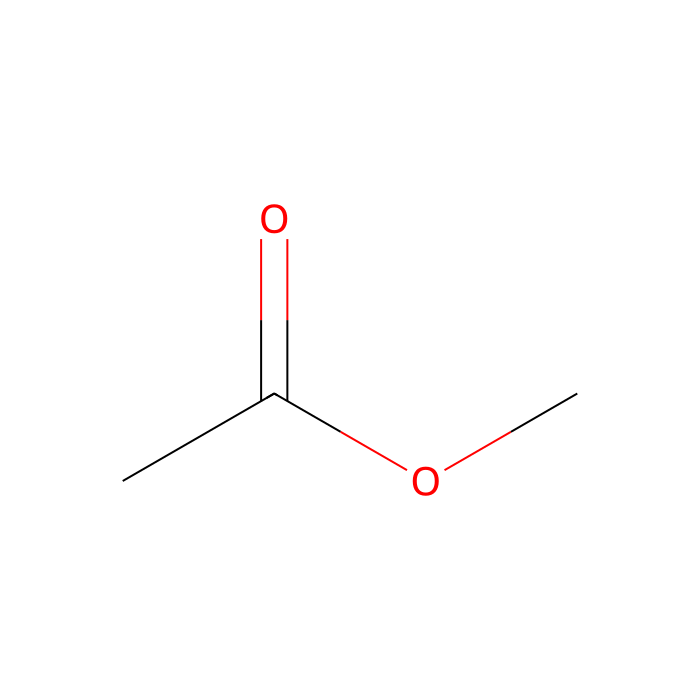
Functional groups: One carboxylic ester (acetate) with a methyl alkoxy substituent.
Skeleton: A simple two-carbon acetyl group [CH3–C(=O)–] esterified with methanol [–O–CH3].
2D description in words: A carbonyl carbon double-bonded to oxygen and single-bonded to a methyl and an alkoxy oxygen; the alkoxy oxygen bears a methyl substituent.
Stereochemistry: None (achiral, no stereocenters, planar carbonyl).
Synthetic Utility
From a retrosynthetic and functional-group perspective (literature):
Ester as a masked acyl fragment: Methyl acetate can serve as an acetyl synthon via nucleophilic acyl substitution, though reactivity is modest; activation or catalysis is typically required (e.g., transesterification, aminolysis under forcing conditions).
Transesterification platform: With acid catalysts (p-TsOH, H2SO4) or base catalysts (alkoxides), methyl acetate exchanges the methoxy group for bulkier alcohols, enabling access to higher alkyl acetates using a low-boiling reagent that’s easy to remove.
Carbonylation chemistry: In the presence of Rh/Ir catalysts, CO, and promoters, methyl acetate participates in carbonylation equilibria relevant to acetic anhydride formation—primarily of process/industrial interest.
Protecting-group logistics: As a solvent, its modest polarity can modulate rates/selectivity in acylation, protection, and rearrangement reactions where more basic solvents (e.g., DMF) are detrimental.
Workup engineering: Its azeotropes with methanol and water enable strategic solvent swaps and removal of light protic impurities, improving downstream isolation and drying.
Practical hints
Choose methyl acetate when the transformation benefits from a low reflux temperature and an ester environment that is less hydrogen-bond basic than acetone/DMF, thereby reducing side coordination to catalysts or electrophiles.
Monitor for hydrolysis products if acids/bases and water are present; neutral and dry conditions preserve integrity.
Target Specificity
Not applicable to this product type. Methyl acetate is a small-molecule solvent and does not possess biological target specificity, antigen reactivity, or clone/isotype attributes.
We use cookies to ensure the website functions properly and, where permitted, to improve your experience. You can manage your preferences at any time in Settings. Learn more in our Cookie Policy.
Shall we send you a message when we have discounts available?
Remind me later
Thank you! Please check your email inbox to confirm.
Products are supplied to verified businesses, institutions, and qualified professionals for research and development use only. Not for use in humans, animals, diagnosis, or therapy.

 G2617614