Background Introduction:
Aladdin Micrococcal Nuclease (MNase), also known as Micrococcal Endonuclease or S7 Nuclease, is derived from Staphylococcus aureus (CAS No. 9013-53-0) with a molecular weight of approximately 18.6 kDa. It is a Ca²⁺-dependent endonuclease that exhibits high enzymatic activity within a pH range of 7.0–10.0. This enzyme degrades various forms of DNA/RNA, including single/double-stranded and linear/circular nucleic acids, producing mono- or oligonucleotides with 3'-phosphorylated ends. It shows higher cleavage efficiency toward single-stranded nucleic acids and AT/AU-rich regions, making it a relatively non-specific nuclease capable of efficiently removing nucleic acid contaminants from cell lysates and reducing sample viscosity.
A key characteristic of MNase is its ability to specifically cleave linker DNA between nucleosomes without digesting nucleosome-protected regions, making it an ideal enzyme for Chromatin Immunoprecipitation (ChIP). It is suitable for both X-ChIP and N-ChIP applications: in X-ChIP, digestion yields 200–1000 bp fragments suitable for studying low-affinity DNA-binding proteins; in N-ChIP, it generates fragments containing 1–5 nucleosomes, making it well-suited for investigating histone modification binding sites.
This product offers stable enzyme activity and excellent batch-to-batch consistency, serving as a reliable tool for molecular biology experiments, gene transcription regulation studies, and epigenetic research.
Instruction for use
1. Dilution of MNase:
If dilution of MNase is required, it is recommended to use 1X Reaction Buffer supplemented with 1X BSA as the diluent for serial dilution. This helps maintain the stability of MNase and reduces its adsorption to container surfaces.For example:Add 5 µL of MNase stock solution (2000 gel units/µL) to 45 µL of the diluent. Mix thoroughly by pipetting up and down. This yields 50 µL of MNase at a concentration of 200 gel units/µL.Then, take 5 µL of this diluted MNase solution (200 gel units/µL) and add it to 45 µL of fresh diluent. Mix thoroughly again. This yields 50 µL of MNase at a concentration of 20 gel units/µL.Subsequent dilutions can be performed by repeating this serial dilution process.
2. MNase is used for the digestion of nucleic acids or cell samples:
a. Add the corresponding reagents and samples according to the table below:
Reagent | Volume(20µl system) | Volume (50µl system) | Final Concentration |
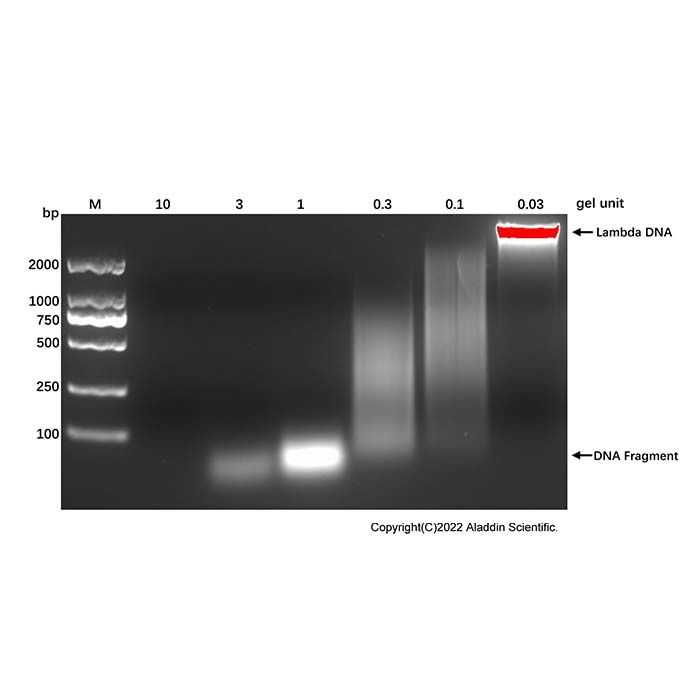
MNase | 1 µL | 2.5 µL | 1~2000 gel units |
Reaction Buffer (10X) | 2 µL | 5 µL | 1X |
BSA (100X) | 0.2 µL | 0.5 µL | 1X |
Sample | x µL | x µL | - |
Water | (17-x) µL | (42-x) µL | - |
Total Volume | 20 µL | 50 µL | - |
Note 1: MNase may be appropriately diluted by referring to Step 1. The specific dilution factor and usage amount require optimization.
Note 2: If the sample does not contain protein, BSA should be added to the reaction buffer at a final concentration of 1X. For cell samples, no BSA addition is required.
b. Mix the reaction system properly and incubate at 37°C for 15–30 minutes, or longer as needed, until the nucleic acids are fully digested or the desired digestion results are achieved.
c. Optional: Add an appropriate amount of 0.5 M EDTA (pH 8.0) to stop the reaction. For example, add 1 µL of 0.5 M EDTA (pH 8.0) to a 20 µL reaction system, or add 2.5 µL to a 50 µL reaction system.
3. MNase for Chromatin Fragmentation in ChIP Experiments.
Matters needing attention
1. This product contains 50% glycerol and will not freeze when stored at -20°C. Storage at -80°C should be avoided, as freeze-thaw cycles may reduce the enzyme activity.
2. The product is relatively viscous. Please ensure accurate pipetting and mix thoroughly by pipetting up and down after addition to avoid bubble formation.
3. Ca²⁺ is a key catalytic cofactor for MNase. The reaction buffer must contain 1–5 mM Ca²⁺ to maintain enzyme activity. Metal ion chelators such as EDTA or EGTA in the reaction solution may inhibit enzyme activity.
4. The salt ion concentration in the reaction solution should be kept below 100 mM, as higher salt concentrations may impair MNase activity.
5. If the sample does not contain protein, BSA should be added to the reaction buffer at a final concentration of 1X.

 ZJ26F0433904