GRADE & PURITYMoligand™?Moligand™ — Aladdin's line of ligands and bioactive small molecules. Use for receptor, pathway, and binding studies needing defined small-molecule tools.≥98%(HPLC)
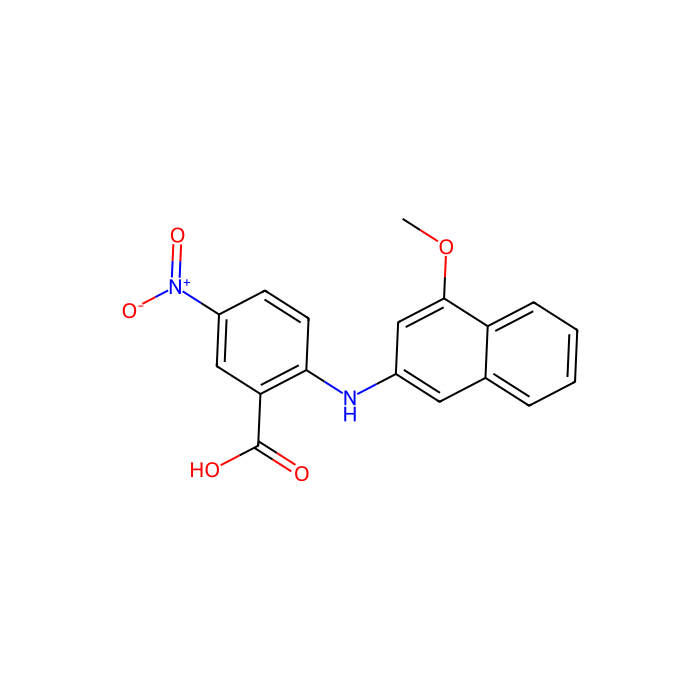
Potent TMEM16A (Anoctamin-1) blocker (IC50= 80 nM). Exhibits >100-fold selectivity for TMEM16A over bestrophin-1, CLC2 and CFTR. Induces vasorelaxation of rodent resistance arteries in presence or absence of chloride ions.
Storage
Store at -20°C
Shipped In
Ice chest + Ice pads
This product requires cold chain shipping. Ground and other economy services are not available.
This compound belongs to the class of organic compounds known as nitrobenzoic acids and derivatives. These are compounds containing a nitrobenzoic acid moiety, which consists of a benzene ring bearing both a carboxylic acid group and a nitro group on two different ring carbon atoms.
External Descriptors
Not available
1. Djoumbou Feunang Y, Eisner R, Knox C, Chepelev L, Hastings J, Owen G, Fahy E, Steinbeck C, Subramanian S, Bolton E, Greiner R, and Wishart DS. ClassyFire: Automated Chemical Classification With A Comprehensive, Computable Taxonomy. Journal of Cheminformatics, 2016, 8:61.
Solvent:DMSO, Max Conc. mg/mL: 33.83, Max Conc. mM: 100
Molecular Weight
338.300 g/mol
XLogP3
4.600
Hydrogen Bond Donor Count
2
Hydrogen Bond Acceptor Count
6
Rotatable Bond Count
4
Exact Mass
338.09 Da
Monoisotopic Mass
338.09 Da
Topological Polar Surface Area
104.000 Ų
Heavy Atom Count
25
Formal Charge
0
Complexity
494.000
Isotope Atom Count
0
Defined Atom Stereocenter Count
0
Undefined Atom Stereocenter Count
0
Defined Bond Stereocenter Count
0
Undefined Bond Stereocenter Count
0
The total count of all stereochemical bonds
0
Covalently-Bonded Unit Count
1
Solution Calculators
Molarity Calculator
Determine the necessary mass, volume, or concentration for preparing a solution.
Dilution Calculator
Determine the dilution needed to prepare a stock solution.
Reconstitution Calculator
Reviews
Customer Reviews
Application Protocols
No tested application protocols are provided for this item. The following is general guidance for handling small-molecule ligands in screening workflows; it is not a specification for this product.
Stock solutions: Prepare a fresh 10–50 mM solution in anhydrous DMSO. Aliquot into low-bind microtubes (single-use) and store at −20 °C. Minimize freeze–thaw cycles.
Serial dilutions: Use DMSO or assay buffer with matched final DMSO concentration across wells. Mix thoroughly; avoid edge effects by equilibrating plates to room temperature before reading.
Controls: Include vehicle controls, positive/negative reference ligands (if available), and counter-screens to detect assay interference (fluorescence quenching, redox cycling, aggregation).
Data quality: Employ replicates and plate QC (Z′ factor). Validate concentrations by independent measurement where practical.
Sterility: For cell-based work, filter final working solutions (0.2 µm) when compatible with the compound and solvent system.
For any protocol requiring compound-specific conditions (e.g., light protection, pH range), consult the CoA/SDS or generate pilot data under your assay conditions.
Biological Roles
Item-specific biological targets or modes of action are not provided in the product data. The following guidance is general for small-molecule research ligands used in discovery biology.
Exogenous research ligands do not have endogenous physiological roles; they are tools for modulating or reporting on biomolecular functions in vitro and in cellular systems.
Typical objectives include probing enzyme active sites, ion channels, transporters, GPCRs, or protein–protein interactions to map signaling pathways or validate phenotypes.
Interrogation strategies: perform concentration–response curves to estimate potency metrics (e.g., IC50/EC50) and conduct selectivity profiling across related targets to deconvolute phenotypic effects. Include cytotoxicity controls to separate on-target from off-target effects.
Mechanism-of-action elucidation: run time-dependence, washout, and competition assays; employ chemoproteomics or CETSA/TPP where applicable to confirm direct binding in cells.
ADME considerations for cellular work: monitor compound stability in culture media (protein binding, adsorption to plastics), and confirm intracellular exposure using LC–MS/MS if available.
Important: Without target-specific information for this item, users should consult primary literature corresponding to the CAS/CID provided or request the current CoA/Spec Sheet for any available mechanism notes. All uses are for research use only.
Buffer Applications
This product is a small-molecule research ligand, not a buffering reagent. Therefore, it is not typically used to establish or maintain pH. No item-specific buffer recipes or pKa values are provided.
Practical guidance (general):
Prepare concentrated stocks in DMSO (or other suitable solvent) and dilute into the assay buffer of choice (e.g., HEPES, PBS, Tris) while vortexing to mitigate precipitation.
Maintain constant final organic co-solvent across controls and treated samples (e.g., 0.1% DMSO in all wells) to avoid solvent-induced artifacts.
If precipitation is observed upon dilution, consider warming gently to room temperature, slowing the addition, or increasing surfactant within assay-permitted limits.
For buffer composition, pH ranges, and compatibility, follow your assay’s standard operating procedures. Item-specific acid/base equilibria are not available for this SKU; consult the CoA/Spec Sheet if such data are needed.
Green Alternatives
Because MONNA (Moligand™) is typically handled as a research ligand rather than a bulk process solvent or reagent, green-chemistry opportunities primarily center on solvent choice and minimizing waste during dissolution and assay preparation.
Practical greener choices (general):
Prefer aqueous buffers with minimal DMSO content consistent with assay tolerance (e.g., ≤0.1–0.5% v/v), reducing polar aprotic solvent use.
If a co-solvent is required for intermediate dilutions, consider ethanol or isopropanol where biocompatible, recognizing lower solvating power vs DMSO.
Use microscale dissolution and serial dilution in 96/384-well formats to minimize waste. Pre-aliquot stocks to extend shelf-life and avoid repeated thawing.
For analytical work, choose ACN over halogenated solvents where feasible, and employ LC–MS-compatible modifiers (formic acid, ammonium formate) to avoid salt waste.
Comparison of common solvents (general, not item-specific):
DMSO: high solvency, ubiquitous in screening; higher energy in manufacture and environmental persistence—use sparingly.
Ethanol: renewable feedstocks available; lower toxicity; may not dissolve very lipophilic scaffolds.
2-MeTHF/CPME: greener ethers for synthesis contexts; rarely needed for assay stocks but suitable for extractions/workups if you perform synthetic modifications.
Documentation and waste:
Track solvent volumes per plate/run; favor aqueous wash protocols and validated micro-quantities. Dispose of organic waste according to local regulations.
Pharmaceutical Uses
No pharmacopeial status or excipient role is provided for this item. MONNA (Moligand™) is supplied strictly for research use and is not intended for human or veterinary use, diagnostic procedures, or as an active pharmaceutical ingredient.
Context for discovery workflows (general, non-clinical):
Early discovery: Employed as a tool compound candidate in target validation and hit-to-lead hypothesis testing. Not manufactured under GMP.
Formulation screening (in vitro/in vivo research only): If solubility is limiting, researchers may explore co-solvents (DMSO, PEG-400), cyclodextrins, or lipid-based vehicles to achieve exposure in model systems. Such approaches must be validated by the user and are outside product specifications.
Analytical characterization: For PK/PD method development in preclinical research, LC–MS/MS assays are typically developed with isotopically labeled internal standards if available. None are specified for this item.
Compliance note:
No claims are made regarding clinical safety, efficacy, or therapeutic equivalence. For any regulated application, obtain an appropriate grade and documentation; this product is for research use only.
Physical Properties
Item-specific physicochemical properties were not provided in the product data. Do not treat any typical values below as specifications for this SKU.
Appearance (this item): Not specified for this item; refer to CoA/Spec Sheet.
Molecular weight (this item): Not specified for this item; refer to CoA/Spec Sheet.
Molecular formula (this item): Not specified for this item; refer to CoA/Spec Sheet.
Melting/boiling point, density, refractive index (this item): Not specified for this item; refer to CoA/Spec Sheet.
Solubility, logP, pKa (this item): Not specified for this item; refer to CoA/Spec Sheet.
General guidance for small-molecule screening ligands (literature/typical, not product specifications):
Many heteroaromatic research ligands are solids with melting points often in the 80–250 °C range and are commonly dissolved first in anhydrous DMSO to prepare concentrated stocks (e.g., 10–50 mM), then diluted into assay buffers or media. Actual solubility and stability can vary widely with structure, counterion, and impurity profile.
Hydrolytic or oxidative sensitivity (if present) depends on functional groups (e.g., esters, aldehydes, anilines). Absent structural data for this item, assume neutral handling and verify with lot-specific CoA/SDS.
Important: For any quantitative method development (HPLC, LC–MS, qNMR), obtain lot-specific purity, water content, and extinction coefficients (if applicable) from the CoA prior to use.
Quality & Grades
Grade: Moligand™ — Aladdin’s Moligand™ designation indicates the compound is supplied for research screening/discovery workflows as a small-molecule ligand candidate. This typically emphasizes suitability for target engagement studies, assay development, and SAR exploration rather than for analytical calibration or GMP use.
What Moligand™ generally implies (general description; not a specification):
Emphasis on identity and assay-ready handling. Lots are intended for use in biochemical/cellular assays after appropriate user validation.
Purity is optimized for research use; quantitative purity thresholds, residual solvents/metals, water content, and UV cutoff are not specified here and should be confirmed on the lot CoA.
Packaging often supports small-scale dissolution (e.g., DMSO stocks) and repeated sub-aliquoting to reduce freeze–thaw.
Item-specific details (this product):
Purity: Not specified for this item; refer to CoA/Spec Sheet.
Stabilizers/inhibitors: Not specified for this item; refer to CoA/Spec Sheet.
Water/peroxide/metal limits, UV cutoff: Not specified for this item; refer to CoA/Spec Sheet.
Recommendations:
If using for quantitative pharmacology (e.g., EC50/IC50 determinations), confirm purity and identity via orthogonal methods (LC–MS, 1H NMR) and use fresh DMSO stocks. Document lot numbers for reproducibility.
Reaction & Applications
This product is supplied as a research ligand (Moligand™) rather than a synthetic reagent. As such, its primary application is as a small-molecule probe candidate in discovery biology and screening assays. No specific biological target or application is provided in the product data for this item.
Research use scenarios (general guidance):
Assay development: Use as a tool compound candidate during optimization of readouts (fluorescence, luminescence, electrophysiology, SPR, DSF, etc.).
Target validation: Evaluate concentration–response behavior in biochemical or cell-based assays to benchmark assay sensitivity and dynamic range.
Mechanistic studies: Time-dependence, reversibility, and competition experiments can elucidate binding modes when a comparator ligand is available.
Orthogonal confirmation: Pair functional assays with biophysical methods (e.g., ITC, MST, TSA) to confirm engagement, where feasible.
Practical tips (general):
Prepare fresh DMSO stocks; minimize freeze–thaw cycles by aliquoting. Confirm concentration by UV–Vis or qNMR if an extinction coefficient or internal standard is available.
Check for aggregation artifacts (use detergent controls and DLS if available) and redox cycling interference in reporter assays.
For LC–MS quantification in ADME workflows, develop a simple ACN/H2O + 0.1% formic acid method and verify single, dominant ion species.
Note: No item-specific reaction chemistry (as a reagent) is claimed here; consult the CoA if synthetic transformations of this molecule are intended.
Reaction Conditions
No item-specific reactivity or transformation data are provided for MONNA under this SKU. The following guidance is generic and intended for users contemplating synthetic modification or analytical method development around small-molecule ligands.
Analytical LC–MS method (general): Start with water/acetonitrile + 0.1% formic acid, 5–95% B over 5–10 min on a C18 column at 0.3–0.6 mL/min, UV 210–254 nm and MS ESI±.
Stock preparation (assay use): Typical DMSO stocks at 10–50 mM; filter through 0.2 µm PTFE/nylon if particulate is observed. Validate concentration by UV–Vis or qNMR where possible.
Stability checks: Incubate at room temperature and 37 °C in assay buffer at intended dilution for 24 h; assess by LC–MS for degradation or adsorption.
If derivatization is planned (general):
Couplings: Use standard peptide/amide coupling agents (EDC/HOBt, HATU) if a carboxylate/amine is present.
Cross-couplings: Pd-catalyzed Suzuki/Buchwald methods if aryl halide/boronate/amine handles exist; inert atmosphere, 60–100 °C, polar aprotic solvent.
Reductive amination: Aldehyde/ketone motifs with amines, NaBH3CN/AcOH or hydrogenation catalysts.
These are literature-style conditions and not specifications for this item. Confirm the actual functional groups and compatibility from the CoA before attempting any reaction.
Safety & Handling
Safety information specific to this item was not provided in the product data and must be confirmed via the SDS.
GHS classification (this item): Not specified for this item; refer to SDS.
Signal word, hazard statements, pictograms (this item): Not specified for this item; refer to SDS.
General laboratory precautions for small organic ligands (good practice; defer to SDS):
PPE: Lab coat, safety glasses, and appropriate chemically resistant gloves (e.g., nitrile). Handle powders in a fume hood to avoid inhalation and dust exposure.
Avoid contact with skin and eyes; prevent aerosolization when weighing. Use closed-cap microtubes or serum vials for solutions.
Incompatibilities: Until structure-specific data are confirmed, avoid strong oxidizers and strong acids/bases. Do not mix with incompatible solvents without prior evaluation.
First aid (overview): In case of skin/eye contact, rinse with water for several minutes and seek medical attention as needed. If inhaled, move to fresh air; if ingested, rinse mouth. Refer to SDS for detailed procedures.
Waste: Dispose according to institutional and local regulations for organic chemical waste. Segregate halogenated vs non-halogenated solvent streams.
Special risks: If the compound contains light- or air-sensitive motifs (unknown here), protect from light, minimize headspace oxygen, and use amber vials. Verify any specific hazards (e.g., reproductive toxicity, sensitization) directly from the SDS.
Solvent Selection
Item-specific solubility data are not provided; the following are general guidelines for small-molecule ligands used in screening.
Primary stock solvent (typical): Anhydrous DMSO is commonly used to prepare 10–50 mM stocks due to broad solvating power and assay compatibility at ≤0.1–0.5% v/v final DMSO.
Secondary solvents: DMF, ethanol, methanol, and acetonitrile can sometimes be used depending on functional groups; verify compatibility with your assay system.
Aqueous work: Prepare a concentrated organic stock first, then dilute into buffered aqueous media while vortexing to minimize precipitation. Include 0.01–0.1% nonionic surfactant only if your assay permits and precipitation persists.
Polarity/miscibility (general): DMSO and DMF are fully miscible with water and most organics, simplifying serial dilutions. ACN offers low viscosity and LC–MS compatibility but may have lower solvating power for highly aromatic or lipophilic scaffolds.
Comparison (general, not specific to this item):
DMSO: strongest solvating power; widely tolerated in biochemical assays; hygroscopic.
DMF: strong solvent; higher toxicity concerns; less preferred in biology-facing assays.
Ethanol/methanol: benign at low percentages; limited solubility for very lipophilic compounds.
PEG-400: can solubilize lipophiles for in vivo method development; high viscosity and assay interference risk.
Always confirm actual solubility and stability for this specific item using small-scale tests and consult the lot CoA.
Storage & Reconstitution
Storage (item-specific conditions provided):
Store at −20 °C (per product data). Shipments are made in an ice chest with ice pads to maintain a cold chain.
Additional handling recommendations (general best practices for small-molecule ligands; not specifications):
Keep container tightly closed in a dry, well-ventilated place. If the compound is hygroscopic or light-sensitive (not specified), store under inert gas and/or protect from light using amber vials.
Upon first opening, consider splitting into single-use aliquots to limit freeze–thaw and headspace moisture ingress.
Reconstitution (general guidance; verify solubility with small trials):
Prepare a concentrated stock in anhydrous DMSO (e.g., 10–50 mM). Vortex and, if necessary, sonicate briefly to aid dissolution. If particulates persist, warm gently to room temperature and filter through a 0.2 µm PTFE syringe filter compatible with DMSO.
For aqueous assays, add the DMSO stock to buffer with vigorous mixing to a final DMSO content typically ≤0.1–0.5% v/v, consistent with assay tolerance.
Record preparation date, concentration, and lot number on each aliquot. Monitor for precipitation or color change over time and discard if degradation is suspected.
Always defer to the lot-specific CoA and SDS for authoritative instructions on storage stability and safe handling.
Structure & Identity
Brief overview: MONNA (SKU M288264) is listed in our small-molecule/compound library collection (Moligand™ grade). Structural identifiers for this specific item are not provided in the product data.
Chemical name: Not specified for this item; refer to CoA/Spec Sheet.
Synonyms: “MONNA” (catalog/trade name); additional synonyms not specified.
CAS: 1572936-83-4 (provided)
PubChem CID: 72165188 (provided)
InChIKey: Not specified for this item; refer to CoA/Spec Sheet. (Product data lists “161576,” which does not conform to InChIKey format.)
SMILES: Not specified for this item; refer to CoA/Spec Sheet.
Molecular formula: Not specified for this item; refer to CoA/Spec Sheet.
Molecular weight: Not specified for this item; refer to CoA/Spec Sheet.
Grade: Moligand™ (see Quality & Grades)
Category: Small molecules and compound libraries (研究/筛选用途)
Structural features (general context):
Item-specific functional groups, ring systems, and stereochemistry are not provided. For precise structure (2D/3D), consult the Certificate of Analysis/SDS or authoritative databases using the CAS or CID above.
2D structure description (general note):
Without an item-specific SMILES or formula, a text description of the scaffold cannot be provided. If you require explicit atom connectivity, please request the current CoA/Spec Sheet for this production lot.
Synthetic Utility
This SKU is offered as a research ligand rather than a general-purpose synthetic building block; no functional group-level specifications are provided. Consequently, any discussion of synthetic transformations is necessarily generic and should not be construed as item-specific capability.
General considerations (not item-specific):
If the structure contains common functional groups (e.g., carboxylic acids, amides, heteroaromatics), typical derivatizations may include esterification/amidation, N-alkylation/acylation, cross-coupling of aryl halides/boronates, or salt formation for improved handling.
For SAR exploration, medicinal chemists often retain the core scaffold while modifying substituents via SNAr, Suzuki–Miyaura, Buchwald–Hartwig, or reductive amination, depending on available handles.
Purification and analysis: Reverse-phase preparative HPLC and LC–MS monitoring are standard for polar, heteroatom-rich ligands. Stability testing against hydrolysis and oxidation helps set storage protocols.
If you intend to use this specific item as a synthetic precursor, please obtain the exact structural data (SMILES/InChI, functional group inventory) from the CoA/Spec Sheet and verify reactivity with small pilot experiments before scale-up.
Target Specificity
Target/epitope information is applicable to biologics (antibodies, proteins). For this small-molecule research ligand, no target specificity data are provided in the product information.
Target name/class: Not specified for this item; refer to CoA/Spec Sheet or primary literature associated with the CAS/CID.
Species selectivity, binding constants, or selectivity panels: Not specified for this item; refer to CoA/Spec Sheet.
If you require target engagement data (e.g., IC50, KD, on/off rates), please contact us with the SKU and lot number so we can advise on any available characterization or literature references.
Frequently Asked Questions
What is the purity of this product, and how is it determined?
This product is supplied at ≥98% purity, determined by HPLC. Lot-specific values are stated on the Certificate of Analysis.
What is Moligand??
Moligand? is one of Aladdin Scientific's premium product lines, formulated for high-purity applications across multiple workflows. Compared to standard grades in the same workflow, Moligand? products typically offer tighter specifications, more rigorous QC, and stronger lot-to-lot consistency.
How should this product be stored?
Store at ?20 °C. Freezer storage is required to maintain the specified shelf life.
How is this product shipped?
This product ships in an insulated container with ice pads. Unpack on arrival and transfer it to the storage condition stated above.
What are the CAS number, molecular formula and molecular weight?
The CAS Number is 1572936-83-4, the molecular formula is C18H14N2O5, and the molecular weight is 338.31 g/mol. InChIKey JIVRLHBAUUZTNC-UHFFFAOYSA-N.
What documentation is provided?
Available product documentation, including Certificates of Analysis (COA), Safety Data Sheets (SDS), and specification sheets, is shown in the product document area. Document availability and access follow the current site policy.
Need help choosing the grade?
Our grade selection guide covers purity, stabilizer status, and application suitability for all variants in our catalog.
We use cookies to ensure the website functions properly and, where permitted, to improve your experience. You can manage your preferences at any time in Settings. Learn more in our Cookie Policy.
Shall we send you a message when we have discounts available?
Remind me later
Thank you! Please check your email inbox to confirm.
Products are supplied to verified businesses, institutions, and qualified professionals for research and development use only. Not for use in humans, animals, diagnosis, or therapy.

 C2625071