
Determine the necessary mass, volume, or concentration for preparing a solution.
| Activity Type | Relation | Activity value | Units | Action Type | Journal | PubMed Id | doi | Assay Aladdin ID |
|---|
Product Describtion:
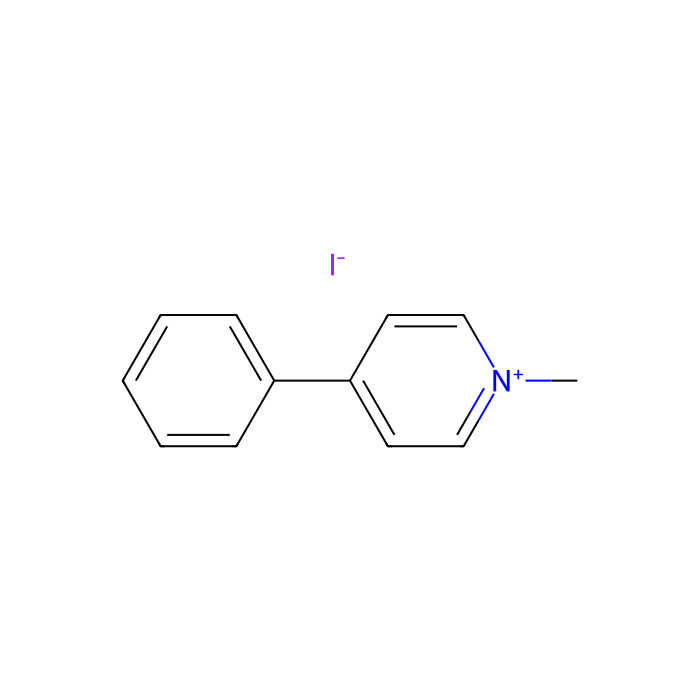
1-Methyl-4-phenylpyridinium (MPP+) induces neurotoxicity by inhibiting mitochondrial redox functions in the striatal synaptosomes. It is a potential neurotoxin and induces Parkinson′s disease in animal models. It mediates apoptosis by the generation of reactive oxygen species in cerebellar granule neurons and neuroblastoma cells. MPP+ modulates the distribution of dopamine. It elicits neurotoxicity by activating neuronal nitric oxide synthase (nNOS), resulting in excess nitric oxide.
Product Application: MPP+ iodide has been used: to induce oxidative stress in zebrafish embryos for the inhibition of glutamate uptake in mitochondria of astrocytes in testing cell viability using MTT (3 (4,5-dimethylthiazol)-2-yl-2,5-diphenyltetrazolium bromide) in microglia (BV2) cells
Taxonomy Tree
| Kingdom | Organic compounds |
|---|---|
| Superclass | Organoheterocyclic compounds |
| Class | Pyridines and derivatives |
| Subclass | Phenylpyridines |
| Intermediate Tree Nodes | Not available |
| Direct Parent | Phenylpyridines |
| Alternative Parents | N-methylpyridinium compounds Pyridinium derivatives Benzene and substituted derivatives Heteroaromatic compounds Azacyclic compounds Organonitrogen compounds Organic iodide salts Hydrocarbon derivatives Organic cations |
| Molecular Framework | Aromatic heteromonocyclic compounds |
| Substituents | 4-phenylpyridine - N-methylpyridinium - Benzenoid - Pyridinium - Monocyclic benzene moiety - Heteroaromatic compound - Azacycle - Organic nitrogen compound - Hydrocarbon derivative - Organic iodide salt - Organic salt - Organonitrogen compound - Organic cation - Aromatic heteromonocyclic compound |
| Description | This compound belongs to the class of organic compounds known as phenylpyridines. These are polycyclic aromatic compounds containing a benzene ring linked to a pyridine ring through a CC or CN bond. |
| External Descriptors | Not available |
| Activity Type | Relation | Activity value | Units | Action Type | Journal | PubMed Id | doi | Assay Aladdin ID |
|---|
| Activity Type | Relation | Activity value | Units | Action Type | Journal | PubMed Id | doi | Assay Aladdin ID |
|---|
Find and download the COA for your product by matching the lot number on the packaging.
| Lot Number | Certificate Type | Date | Item |
|---|---|---|---|
 E2628601 | Certificate of Analysis | Mar 07, 2026 | N137206 |
| E2628602 | Certificate of Analysis | Mar 07, 2026 | N137206 |
| E2628604 | Certificate of Analysis | Mar 07, 2026 | N137206 |
| E2628610 | Certificate of Analysis | Mar 07, 2026 | N137206 |
| C2219011 | Certificate of Analysis | Oct 11, 2025 | N137206 |
| H2525497 | Certificate of Analysis | Aug 04, 2025 | N137206 |
| H2525496 | Certificate of Analysis | Aug 04, 2025 | N137206 |
| H2525495 | Certificate of Analysis | Aug 04, 2025 | N137206 |
| H2525494 | Certificate of Analysis | Aug 04, 2025 | N137206 |
| F2525009 | Certificate of Analysis | Jul 02, 2025 | N137206 |
| L2205276 | Certificate of Analysis | Sep 18, 2024 | N137206 |
| A2506250 | Certificate of Analysis | Sep 18, 2024 | N137206 |
| L2205275 | Certificate of Analysis | Sep 18, 2024 | N137206 |
| L2205271 | Certificate of Analysis | Sep 18, 2024 | N137206 |
| B2512022 | Certificate of Analysis | Sep 18, 2024 | N137206 |
| C2219016 | Certificate of Analysis | Jan 04, 2024 | N137206 |
| F2307383 | Certificate of Analysis | Sep 29, 2022 | N137206 |
| E2431057 | Certificate of Analysis | Sep 29, 2022 | N137206 |
| E2429059 | Certificate of Analysis | Sep 29, 2022 | N137206 |
| I2405050 | Certificate of Analysis | Sep 29, 2022 | N137206 |
| L2205274 | Certificate of Analysis | Sep 29, 2022 | N137206 |
| C2219010 | Certificate of Analysis | Jan 05, 2022 | N137206 |
| C2219005 | Certificate of Analysis | Jan 05, 2022 | N137206 |
| Solubility | H2O: >10 mg/mL, soluble |
|---|---|
| Sensitivity | light & Moisture sensitive |
| Molecular Weight | 297.13 |
| XLogP3 | |
| Hydrogen Bond Donor Count | 0 |
| Hydrogen Bond Acceptor Count | 1 |
| Rotatable Bond Count | 1 |
| Exact Mass | 297.001 Da |
| Monoisotopic Mass | 297.001 Da |
| Topological Polar Surface Area | 3.900 Ų |
| Heavy Atom Count | 14 |
| Formal Charge | 0 |
| Complexity | 141.000 |
| Isotope Atom Count | 0 |
| Defined Atom Stereocenter Count | 0 |
| Undefined Atom Stereocenter Count | 0 |
| Defined Bond Stereocenter Count | 0 |
| Undefined Bond Stereocenter Count | 0 |
| The total count of all stereochemical bonds | 0 |
| Covalently-Bonded Unit Count | 2 |
H301:Toxic if swallowed
H311:Toxic in contact with skin
H315:Causes skin irritation
H319:Causes serious eye irritation
H331:Toxic if inhaled
H335:May cause respiratory irritation
P261:Avoid breathing dust/fume/gas/mist/vapors/spray.
P264:Wash hands [and …] thoroughly after handling.
P270:Do not eat, drink or smoke when using this product.
P271:Use only outdoors or in a well-ventilated area.
P280:Wear protective gloves/protective clothing/eye protection/face protection.
P321:Specific treatment (see ... on this label).
P330:Rinse mouth.
P302+P352:IF ON SKIN: wash with plenty of water.
P304+P340:IF INHALED: Remove person to fresh air and keep comfortable for breathing.
P305+P351+P338:IF IN EYES: Rinse cautiously with water for several minutes. Remove contact lenses if present and easy to do - continue rinsing.
P361+P364:Take off immediately all contaminated clothing and wash it before reuse.
P362+P364:Take off contaminated clothing and wash it before reuse.
P405:Store locked up.
P403+P233:Store in a well-ventilated place. Keep container tightly closed.
P501:Dispose of contents/container to an approved waste disposal plant.
P264+P265:Wash hands [and …] thoroughly after handling. Do not touch eyes.
P301+P316:IF SWALLOWED: Get emergency medical help immediately.
P337+P317:If eye irritation persists: Get medical help.
P332+P317:If skin irritation occurs: Get medical help.
P316:Get emergency medical help immediately.
P319:Get medical help if you feel unwell.
Only item-specific, validated protocols should be reported here. For this product, no application protocols are provided in the Product Data.
General guidance should be developed under your lab’s SOPs, with small-scale pilot experiments to establish dose–response and exposure parameters appropriate to your system.
General biochemical context (literature; non-clinical)
Experimental considerations (general)
Note: The above describes literature roles of MPP+ as a research probe. It does not constitute usage recommendations or specifications for this specific catalog item; consult primary literature and your institutional approvals.
Not a buffering agent. MPP+ iodide does not provide acid–base buffering capacity.
Practical notes (general)
Item-specific buffer guidance is not provided; refer to your assay SOPs and the CoA/SDS for compatibility details.
Context: “Green alternatives” generally address solvent/reagent substitution to reduce environmental or safety impact. MPP+ iodide is a bioactive research compound (salt), not a process solvent or common reagent; direct greener substitutes are not applicable.
If your objective is to study related biochemical mechanisms with improved handling properties, consider:
Operational green practices
Because this product functions as a specific research probe, substitution affects scientific outcomes; prioritize data needs while applying standard green chemistry principles in handling and waste management.
No excipient or manufacturing use is indicated for this product.
If a formulation-like context is needed for in vitro research (e.g., preparing defined solutions), follow laboratory reagent preparation practices and do not infer any pharmaceutical applicability from this listing.
Item-specific specifications
Literature/general reference values (non-binding; for context only)
Practical notes (general)
Item-specific grade: Moligand™ (from Product Data)
Purity reporting
Documentation and QC suggestions
Stabilizers/additives
Chemical reaction utility
Research applications (general; non-clinical)
Analytical/assay notes
If your goal is chemical synthesis, consider that MPP+ iodide is not a practical synthon for cross-coupling or nucleophilic substitutions under standard conditions; alternative pyridinium derivatives (e.g., Katritzky salts engineered as redox-activated esters) are more suitable for transformations.
Not typically used as a reagent or catalyst; therefore, standard “reaction condition” windows are not applicable.
General handling conditions for solution preparation (literature/practice)
For any transformations intentionally involving pyridinium salts, consult reaction-specific literature; do not extrapolate from the biological use of MPP+.
Item-specific hazard information
General laboratory safety guidance (non-binding; follow your institutional SOPs and SDS)
Always defer to the SDS and institutional risk assessments for definitive hazard classifications and emergency procedures.
Applicability: MPP+ iodide is a polar, permanently cationic organic salt; solvent choice centers on dissolution for stock preparation and compatibility with bioassays or analytical workflows.
Polarity/miscibility (literature/general)
Practical selection guidance
Comparison (general considerations)
Note: Solubility limits are batch- and condition-dependent; verify experimentally. No item-specific solubility specifications are provided for this product.
Item-specific storage/shipping
Container and handling
Reconstitution/preparation
Stability considerations (general)
Always consult the SDS for safe handling and the CoA for any lot-specific notes on stability, water content, or special precautions.
Brief description: MPP+ iodide is the quaternary ammonium salt of 1-methyl-4-phenylpyridinium paired with iodide, widely used as a research tool compound.
Item-specific identifiers (from Product Data)
Canonical identifiers (literature/general reference, not item-specific)
Structural features (general chemistry)
Note: Where values are marked as literature, they are provided for reference only and are not specifications for this specific item.
Limited synthetic utility. As a quaternary pyridinium salt, MPP+ iodide is:
Comparative note (general)
Analytical chemistry relevance
If your objective is synthetic manipulation of pyridinium frameworks, consider tailored pyridinium leaving-group reagents instead of MPP+ iodide.
This section applies to bioaffinity reagents (e.g., antibodies, ligands with defined biological targets) with validated specificity metrics. No such item-specific data are provided for this product.
Note: While MPP+ is widely employed to perturb mitochondrial complex I activity in research, no validated “target specificity” dataset is provided for this catalog item.
Our grade selection guide covers purity, stabilizer status, and application suitability for all variants in our catalog.
View Moligand™ grade guide →