GRADE & PURITYMoligand™?Moligand™ — Aladdin's line of ligands and bioactive small molecules. Use for receptor, pathway, and binding studies needing defined small-molecule tools.10 mM in DMSO
Moligand™, 10 mM in DMSO Moligand™ for sensitive chromatographic and analytical workflows requiring minimal baseline interference.
🌡
Storage & shipping
Store at -80°C Ships Dry ice packs + Cold packs Check lot-specific COA for exact specifications.
📋
Quality documents
SDS, COA, datasheet, and spec sheet available for download. Lot-specific COA accessible via lot number lookup.
📚
Literature proof
Cited in 0 peer-reviewed publications across chromatography, organic synthesis, and cross-coupling reactions.
Overview
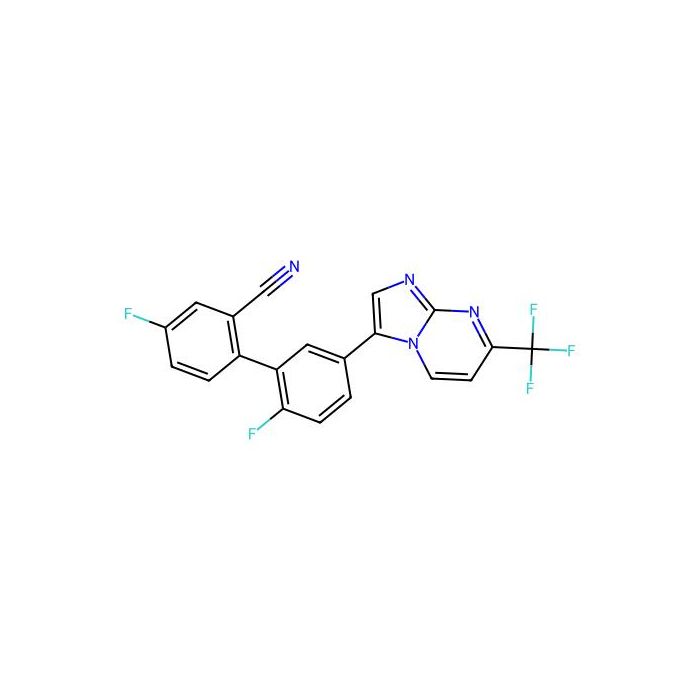
MRK-898 is an orally active GABA(A) receptor modulator. MRK-898 binds to α1, α2, α3 or α5 subunit of GABA(A) receptor with K i values of 1.2 nM, 1.0 nM, 0.73 nM, and 0.50 nM, respectively. However, α1-containing GABA(A) receptors are identified as the "sedative" and α2- and/or α3-containing receptors as the "anxiolytic" subtype(s).
Specifications
Specifications & Purity
Moligand™, 10 mM in DMSO
Storage
Store at -80°C
Shipped In
Dry ice packs + Cold packs
This product requires cold chain shipping. Ground and other economy services are not available.
Grade
Moligand™
Action Type
MODULATOR
Names and Identifiers
Molecular Weight
400.30
Documentation
📋 Safety Data Sheet (SDS)
Comprehensive hazard, handling, storage, and regulatory compliance document.
Determine the necessary mass, volume, or concentration for preparing a solution.
Dilution Calculator
Determine the dilution needed to prepare a stock solution.
Reconstitution Calculator
Reviews
Customer Reviews
Application Protocols
No item-specific, validated protocols are provided for MRK-898. The following are general, non-binding procedures suitable for many small-molecule ligands.
Example A: Preparing a 10 mM DMSO stock
Equilibrate vial to room temperature in a desiccated environment. 2) Accurately weigh compound. 3) Add anhydrous DMSO to achieve 10 mM. 4) Vortex and sonicate briefly if needed; warm gently (≤40–45°C) to aid dissolution. 5) Aliquot into low-bind, amber tubes; store at −80°C.
Example B: Serial dilution for a 10-point half-log curve
Prepare 10 mM stock in DMSO. Make a 1:3 intermediate in DMSO (e.g., 10 to 3.33 mM). Proceed with 1:3 serial dilutions to generate a 10-point series. Transfer 1–2 μL per well to assay plates to achieve final DMSO ≤0.5% v/v after adding buffer/cells.
Example C: Plate handling
Use acoustic or positive-displacement dispensing. Seal plates immediately to limit evaporation. Include vehicle controls matching DMSO content.
Note: Adjust solvent percentages, incubation times, and temperatures to your assay. These generic protocols are not item-specific specifications.
Biological Roles
Item-specific biological roles, targets, and mechanisms were not provided for MRK-898.
Assigned biological function/target: Not specified for this item; refer to CoA/Spec Sheet or primary screening data.
Typical use case: Evaluated as a research ligand in biochemical or cellular assays to explore potential modulation of biomolecular targets.
General notes for small-molecule research ligands
Hypothesis generation: Use across diverse assay panels to identify pathway-relevant phenotypes, followed by triage via orthogonal assays.
Selectivity assessment: Build a selectivity profile against related enzymes/receptors to contextualize observed activities.
ADME considerations: For cell assays, consider permeability, efflux, and metabolic stability; adjust exposure times accordingly.
Compliance
For research use only. Not for diagnostic, therapeutic, or in vivo use. Do not make clinical or health-related inferences from preliminary screening results.
Buffer Applications
This material is not a buffering agent and does not define pH. However, it is commonly handled within buffered assay systems.
Assay buffer integration (general guidance)
Working concentration: Prepare DMSO stocks (e.g., 10 mM), then dilute into assay buffer to achieve target concentrations with final DMSO typically ≤0.1–1% v/v.
Common buffers: HEPES, PBS, Tris, or assay-specific proprietary buffers at pH suited to the biological system.
Precipitation avoidance: Add compound last to pre-warmed buffer, mix immediately, and avoid rapid addition to cold media that can cause local supersaturation.
Surfactants: If adsorption losses are suspected, include 0.01–0.05% nonionic surfactant (assay-permitting) to reduce sticking to plastics.
Filtration: If clarity is required, 0.22 μm filtration may be used after confirming no compound loss to the membrane.
Item-specific buffer compatibility, pKa, or solubility in specific buffers: Not specified for this item; refer to CoA/Spec Sheet.
Green Alternatives
Although MRK-898 is not a solvent or bulk reagent, greener practices can be applied to its use in screening and small-scale research.
Greener handling strategies (general)
Miniaturization: Use low-volume plates (1536-well or 384-well) and acoustic dispensing to reduce DMSO and buffer waste per data point.
Solvent choice: Favor DMSO/water systems for assay dilution; avoid chlorinated solvents unless necessary for analytics.
Stock stability: Aliquot to extend life at −80°C, limiting re-synthesis and cutback of material and logistics.
Waste segregation: Collect DMSO-rich streams separately to enable appropriate treatment and reduce overall waste footprint.
Comparison of solubilization options (general)
DMSO: High solvency; widely accepted in screening; manageable environmental impact at small scales with proper disposal.
Ethanol: Lower solvency but lower persistence; suitable for moderately soluble compounds.
Aqueous cosolvents (≤10–20% DMSO or MeCN): Reduce organic load during assay preparation.
Trade-offs
Reducing DMSO content can increase precipitation risk; mitigate with staggered dilutions and temperature control.
Cyclodextrin-enabled formulations can improve solubility but may interfere with some assays; always qualify experimentally.
Item-specific environmental attributes (e.g., hazard classifications, biodegradability): Not specified for this item; refer to SDS/CoA.
Pharmaceutical Uses
No pharmaceutical or clinical use is claimed or supported for MRK-898.
Intended use: For research use only—primarily as a small-molecule ligand for screening and discovery experiments.
Pharmacopeial status (USP/EP/JP): Not specified for this item; refer to CoA/Spec Sheet.
Potential research-adjacent roles (general): May serve as a reference material or exploratory probe in preclinical research laboratories for target validation or SAR exploration.
Formulation relevance: If used in nonclinical formulation studies, DMSO- or ethanol-based vehicles are common for ex vivo assays; ensure compatibility and proper controls.
Compliance
Not a drug substance, excipient, or API. Not for human or veterinary use. No therapeutic or diagnostic claims are made.
Physical Properties
Only general guidance can be provided because item-specific physicochemical data were not supplied.
Item-specific data
Appearance: Not specified for this item; refer to CoA/Spec Sheet.
Molecular formula: Not specified for this item; refer to CoA/Spec Sheet.
Molecular weight: Not specified for this item; refer to CoA/Spec Sheet.
Melting point, boiling point, density, refractive index: Not specified for this item; refer to CoA/Spec Sheet.
LogP, pKa, aqueous solubility: Not specified for this item; refer to CoA/Spec Sheet.
General considerations for small-molecule ligands (literature/generic)
Solubility strategy: Begin with anhydrous DMSO to make a 10–50 mM stock; if insoluble, warm gently (≤40–45°C), sonicate, or add co-solvent (DMF or ethanol) before aqueous dilution.
Aqueous working solutions: Titrate into buffered media to keep final DMSO ≤0.1–1% v/v for biochemical or cell assays; pre-warm buffer to reduce precipitation.
Hygroscopicity/polymorphism: Some drug-like solids are mildly hygroscopic or can exhibit form-dependent solubility; protect from atmospheric moisture until solubilized.
Light/air sensitivity: In absence of structural information, treat conservatively—minimize exposure to strong light and air; use amber vials and cap promptly.
Analytical confirmation (general)
Check clarity after dilution; if needed, 0.22 μm filtration can remove particulates (verify compound stability to filtration materials).
Quality & Grades
Grade: Moligand
What Moligand typically signifies (general description)
Intended use: Research-grade small-molecule ligands intended for screening, target validation, and SAR exploration—not for human or veterinary use.
Documentation: Items in this grade commonly ship with a Certificate of Analysis (CoA) summarizing identity and quality attributes; however, specific tests for this lot are not provided here.
Item-specific quality details
Purity specification, residual solvents, water content, stabilizers, metal limits, and absorbance profile: Not specified for this item; refer to CoA/Spec Sheet.
Analytical methods (e.g., HPLC/LC–MS/NMR): Not specified for this item; refer to CoA/Spec Sheet.
Practical implications
Screening readiness: Expect suitability for preparation of DMSO stocks and distribution into assay plates. Verify solubility at intended concentrations upon receipt.
Traceability: Retain lot number from vial label for data integrity and reproducibility in screening campaigns.
Comparability: When substituting lots, confirm activity and solubility equivalence via small pilot tests, as minor differences in solid form or residuals can affect dissolution.
Notes
If your workflow requires specific thresholds (e.g., HPLC purity ≥98%, water ≤0.1%, UV cutoff), request the CoA/Spec Sheet prior to use to confirm fitness-for-purpose.
Reaction & Applications
This product is positioned as a research ligand within a small-molecule library rather than a synthetic reagent. Accordingly, its primary applications are screening- and assay-focused.
Research and screening use (general)
Biochemical assays: Enzyme or binding assays to evaluate modulation of target activity/affinity.
Cell-based phenotypic screens: Assess functional outcomes across pathways without prior target assignment.
Orthogonal profiling: Counterscreens for selectivity, cytotoxicity, and off-target risk.
Mechanistic follow-up: Time-course studies, washout experiments, and chemical probe-style use once activity is established.
Assay execution tips (generic best practices)
Stock preparation: 10–50 mM in anhydrous DMSO; aliquot to avoid freeze–thaw.
Plate handling: Use acoustic or positive-displacement dispensing for precision; limit final DMSO to ≤0.1–1% v/v.
Adsorption and loss: Employ low-binding plates/tubes; add 0.01–0.05% nonionic surfactant (e.g., Tween-20) if compatible with the assay to reduce surface loss.
Light/air precautions: Use amber plates/seals if the compound is light sensitive; purge headspace with inert gas if oxidation is suspected.
Synthetic chemistry usage
Not typically used as a building block or reagent. If derivatization or analog synthesis is desired, obtain structural information from the CoA or primary literature for rational route design.
Reaction Conditions
This product is not provided as a reagent for named reactions; item-specific reactivity and conditions are unknown. Instead, the most relevant “conditions” are those for preparing and handling solutions for research assays.
General handling/solution preparation
Stock solutions: 10–50 mM in anhydrous DMSO; warm gently (≤40–45°C) and sonicate if needed. Record exact concentration gravimetrically or by UV if a chromophore is known.
Serial dilutions: Use intermediate mixtures (e.g., DMSO:buffer 1:9) to minimize precipitation; mix thoroughly at each step.
Light/oxygen precautions: When in doubt, use amber vials and minimize headspace; flush with inert gas for long incubations.
Filtration: 0.22 μm PTFE filters are generally compatible with DMSO; confirm no compound loss before routine use.
Assay incubation (generic)
Temperature/time: Follow target biology; common ranges are 20–37°C for 10 min to several hours. Validate stability over the assay window.
Controls: Include vehicle controls matching DMSO content, and positive/negative control ligands when available.
Item-specific reaction parameters, catalysts, or yields: Not applicable/not specified for this item.
Safety & Handling
Authoritative safety information resides in the Safety Data Sheet (SDS). Because no item-specific hazard codes were provided, handle MRK-898 as a research chemical of unknown hazard profile.
GHS information
Signal word: Not specified for this item; refer to SDS.
Hazard statements (H-codes), pictograms, classification: Not specified for this item; refer to SDS.
General laboratory precautions (good practice for small molecules)
PPE: Laboratory coat, safety glasses/goggles, and appropriate chemically resistant gloves (e.g., nitrile). Work in a fume hood to avoid inhalation of dusts or vapors.
Avoid: Skin/eye contact, ingestion, and inhalation. Prevent aerosolization when weighing powders. Use low-binding tools to minimize static and loss.
First aid (overview; consult SDS): Eye/skin contact—rinse with water for ≥15 min and remove contaminated clothing; inhalation—move to fresh air; ingestion—rinse mouth. Seek medical attention as per institutional protocols.
Incompatibilities: Unknown for this item; avoid strong oxidizers/acids/bases until compatibility is known. Do not mix with reducing agents or chlorinating agents without assessment.
Thermal/light stability: Store as directed at −80°C. Limit temperature excursions during handling; protect from strong light as a precaution.
Spill and disposal
Small spills: Absorb with inert material, collect in chemical waste. Decontaminate surfaces per institutional SOPs.
Waste: Dispose as organic chemical waste in accordance with local regulations.
Shipping/transport
Shipped on dry ice + cold packs; open shipments promptly and return to −80°C storage to maintain integrity.
Solvent Selection
Without a disclosed structure, solvent choice should prioritize broad solubilization capability, assay compatibility, and chemical stability.
Primary stock solvent
DMSO (anhydrous) is the default for drug-like molecules due to high solvency and assay compatibility at ≤0.1–1% v/v.
Secondary/alternative solvents (general guidance)
DMF: High solvency, miscible with water; similar handling to DMSO.
Ethanol or isopropanol: Useful for moderately lipophilic compounds; lower boiling point facilitates removal.
Acetonitrile: Good for many heterocycles; miscible with water; watch for volatility during plate handling.
PEG-400 or 20–40% hydroxypropyl-β-cyclodextrin in buffer: For challenging solubility with low volatility needs.
Make 10–50 mM DMSO stocks; warm gently (≤40–45°C) and sonicate if needed.
Pre-dilute in solvent:buffer mixtures (e.g., 1:9 DMSO:buffer) to avoid local precipitation on aqueous addition.
Use low-binding plastics, pre-wet tips with DMSO, and minimize evaporation with plate seals.
Verify chemical compatibility with plasticware when using strong polar aprotic solvents (DMSO/DMF).
Item-specific solvent preferences, pKa, logP, and solubility: Not specified for this item; refer to CoA/Spec Sheet.
Storage & Reconstitution
Item-specific conditions
Storage temperature: Store at −80°C (per product data).
Shipping: Ships on dry ice packs + cold packs; return to −80°C promptly upon receipt.
Appearance: Not specified for this item; refer to CoA/Spec Sheet.
General best practices for small-molecule ligands
Aliquoting: Upon first opening, divide material into single-use aliquots in low-bind, amber vials to minimize freeze–thaw and light exposure.
Atmosphere: If material is air/moisture sensitive (unknown here), handle quickly under dry air or inert gas; cap tightly with PTFE-lined closures.
Reconstitution solvents: Start with anhydrous DMSO; if needed, consider DMF or ethanol. Document exact concentrations and lot/aliquot IDs.
Working solutions: Prepare fresh on day of use when possible. Keep on ice or at room temperature as dictated by assay; discard if precipitation or discoloration occurs.
Freeze–thaw: Avoid repeated cycling. Thaw aliquots at room temperature in a desiccated environment; refreeze only once if absolutely necessary.
Light: Use amber containers/seals as a precaution when structure is unknown.
Unspecified parameters
Water content, residual solvent limits, stabilizers, and exact shelf life: Not specified for this item; refer to CoA/Spec Sheet.
For research use only. Not for human or veterinary use.
Structure & Identity
Brief overview: MRK-898 (SKU: M1497961) is offered as a Moligand small-molecule research ligand within our small-molecule and compound library category. Primary identifiers are limited for this catalog entry; consult the CoA/Spec Sheet when available.
Catalog category: Small molecules and compound libraries (research screening)
Molecular formula: Not specified for this item; refer to CoA/Spec Sheet.
Molecular weight: Not specified for this item; refer to CoA/Spec Sheet.
SMILES: Not specified for this item; refer to CoA/Spec Sheet.
InChIKey: Not specified for this item; refer to CoA/Spec Sheet.
Structural features
Item-specific structural description: Not specified. This entry is supplied as a research ligand without disclosed structure in the provided data.
2D structure (verbal): Not available from the provided data. If structural data are supplied on the CoA, describe ring systems, heteroatoms, and functional groups to guide solubility and handling choices.
Identity and traceability
Lot-specific identity testing (typical for screening ligands may include LC-MS/NMR): Not specified for this item; refer to CoA/Spec Sheet.
Recommended citation: “Aladdin Scientific, MRK-898 (Moligand), CAS 461450-30-6, SKU M1497961.”
Synthetic Utility
MRK-898 is supplied as a research ligand; no structure or reactive functional groups are disclosed in the provided data, so specific synthetic transformations cannot be described.
General guidance (if derivatization is pursued post-structure disclosure)
Functional group mapping: Identify heteroatoms, electrophiles/nucleophiles, and steric hot-spots to plan handle introduction (e.g., halogen for cross-coupling, amine/alcohol for acylation/alkylation).
Late-stage diversification: Consider C–H functionalization tactics or SuFEx/click reactions if suitable handles exist, to generate SAR around the scaffold with minimal route changes.
Protecting-group strategy: Minimize PG steps; leverage chemoselective conditions guided by pKa and oxidation state of each functional group.
Purification: For drug-like scaffolds, reversed-phase flash or preparative HPLC with volatile modifiers (e.g., formic acid, NH4OAc) often provides best recovery.
Item-specific reactive features, stability, and compatibility: Not specified for this item; refer to CoA/Spec Sheet.
Target Specificity
Intended target(s), binding mode, and selectivity profile: Not specified for this item; refer to CoA/Spec Sheet or internal screening results.
General recommendations
Build a panel: Test against close homologs and unrelated counter-targets to assess selectivity.
Mechanism probing: Use kinetic assays, thermal shift (DSF), or CETSA to differentiate binding mechanisms.
Off-target risk assessment: Incorporate cytotoxicity and broad receptor/enzyme panels early to flag liabilities.
Frequently Asked Questions
What is Moligand??
Moligand? is one of Aladdin Scientific's premium product lines, formulated for high-purity applications across multiple workflows. Compared to standard grades in the same workflow, Moligand? products typically offer tighter specifications, more rigorous QC, and stronger lot-to-lot consistency.
How should this product be stored?
Store at ?80 °C. Ultra-low temperature storage is required to maintain the specified shelf life.
How is this product shipped?
This product ships frozen with dry ice and cold packs. Unpack on arrival and transfer it to the storage condition stated above; handle dry ice with insulated gloves in a ventilated area.
What are the CAS number, molecular formula and molecular weight?
The CAS Number is 461450-30-6, the molecular formula is C20H9F5N4, and the molecular weight is 400.30 g/mol.
What documentation is provided?
Available product documentation, including Certificates of Analysis (COA), Safety Data Sheets (SDS), and specification sheets, is shown in the product document area. Document availability and access follow the current site policy.
Need help choosing the grade?
Our grade selection guide covers purity, stabilizer status, and application suitability for all variants in our catalog.
We use cookies to ensure the website functions properly and, where permitted, to improve your experience. You can manage your preferences at any time in Settings. Learn more in our Cookie Policy.
Shall we send you a message when we have discounts available?
Remind me later
Thank you! Please check your email inbox to confirm.
Products are supplied to verified businesses, institutions, and qualified professionals for research and development use only. Not for use in humans, animals, diagnosis, or therapy.