This compound belongs to the class of organic compounds known as acetamides. These are organic compounds with the general formula RNHC(=O)CH3, where R= organyl group.
External Descriptors
Not available
1. Djoumbou Feunang Y, Eisner R, Knox C, Chepelev L, Hastings J, Owen G, Fahy E, Steinbeck C, Subramanian S, Bolton E, Greiner R, and Wishart DS. ClassyFire: Automated Chemical Classification With A Comprehensive, Computable Taxonomy. Journal of Cheminformatics, 2016, 8:61.
Determine the necessary mass, volume, or concentration for preparing a solution.
Dilution Calculator
Determine the dilution needed to prepare a stock solution.
Reconstitution Calculator
Reviews
Customer Reviews
Application Protocols
Not applicable. No tested bioassay protocols (e.g., WB, IHC, IF, FC) or recommended dilutions are associated with this small-molecule reagent in the Product Data. For synthetic procedures, see Reaction Conditions and Synthetic Utility sections.
Biological Roles
This compound is a synthetic, non-natural secondary amide. No endogenous biological role is established.
General biochemical context (literature):
Amide linkage mimics peptide bonds in terms of resonance and planarity. N-alkylated amides are common motifs in medicinal chemistry as metabolically stable, H-bonding-capable polar handles.
N-Cyclohexyl substitution increases hydrophobicity and can modulate membrane partitioning and protein binding in probe compounds.
Laboratory relevance:
Useful as a model compound for studying amide hydrogen bonding, conformational preferences, and solvation effects by IR, NMR, and crystallography.
Can serve as a stability control or comparator in assays evaluating amide bond cleavage (amidases, hydrolysis screens), though any biological testing should be strictly research-use and follow institutional approvals.
No clinical or therapeutic claims are made; for research use only (per Product Data).
Buffer Applications
Not typically used as a buffering agent. As a neutral organic amide with low aqueous solubility, it is not part of standard laboratory buffer systems. For aqueous work, select established buffers (e.g., phosphate, HEPES, Tris) as appropriate to your pH range.
Green Alternatives
This product is a solid reagent/building block, not a solvent. Greener considerations therefore focus on the choice of reagents and solvents used with it.
Greener solvent choices (literature guidance):
Prefer 2-MeTHF or CPME over THF/ether when compatible (biomass-derived, lower peroxide hazard; good for many reductions and extractions).
Use ethanol or isopropanol for recrystallization where feasible instead of chlorinated solvents.
Replace DCM with EtOAc or toluene for extractions/chromatography when separation performance allows.
Greener reagents by transformation:
Amide reduction: Consider catalytic hydrogenation (e.g., Ru, Mn, or Co systems) or catalytic hydrosilylation under milder conditions as alternatives to stoichiometric LiAlH4; borane in safer carriers (e.g., BH3·THF cautiously) can be more atom-efficient than Al-based hydrides, though still hazardous.
Hydrolysis: Employ aqueous media at elevated temperature; avoid strong mineral acids/bases where time/temperature alone suffice, or use flow/reactive distillation to minimize waste.
Comparison snapshot (general):
LiAlH4 in THF: high reactivity, pyrophoric, poor EHS profile; significant inorganic waste.
Borane in 2-MeTHF: good selectivity for amides; flammable/toxic but reduced peroxide risk; less inorganic waste.
Catalytic hydrogenation (H2, ethanol/2-MeTHF): potentially best atom economy; requires pressure equipment and compatible catalyst.
Always balance EHS benefits with chemoselectivity and scale; validate greener options on small scale first.
Pharmaceutical Uses
No pharmacopeial excipient status is indicated for this item. Not specified for this item; refer to CoA/Spec Sheet for any compliance notes.
General formulation/manufacturing context (non-clinical):
Role as an intermediate: Secondary amides like N-cyclohexylacetamide can serve as protected or masked amine intermediates en route to secondary amines (after reduction) or to cyclohexylamine derivatives (after hydrolysis).
Solid-state properties: Amide functionality supports crystalline forms suitable for purification and polymorph screening in process R&D.
Impurity/reference standard: May be used as a process impurity standard or reference material when N-cyclohexyl acyl species are relevant to a synthetic route.
All uses are for research and process development only; not for human or veterinary use.
Physical Properties
Item-specific numerical specifications (bp, mp, density, refractive index, water/peroxide/UV cutoffs, metal limits) are not provided in the Product Data for this SKU. Not specified for this item; refer to CoA/Spec Sheet.
General/literature characteristics (for academic reference; not item specifications):
Phase/appearance: typically a crystalline solid for many N-alkyl acetamides; waxy to solid depending on purity and temperature.
Polarity: polar aprotic amide; capable of strong intermolecular H-bonding via N–H donors and C=O acceptors.
Solubility (qualitative, literature):
Organic: expected good solubility in polar organic solvents (e.g., alcohols, acetone, acetonitrile, DMF, DMSO) and moderate solubility in chlorinated and aromatic solvents; limited in nonpolar alkanes.
Aqueous: typically low to moderate due to hydrophobic cyclohexyl group counteracting amide polarity.
Acid/base behavior: amide N is weakly basic (very low basicity); amide oxygen is basic/acceptor. Amide N–H is weakly acidic (strong H-bond donor); pKa for amide N–H in water is very high (not deprotonated under neutral conditions); conjugate acid pKaH of amide nitrogens is usually ≤0 (literature context for simple amides).
Partitioning: secondary amides with cyclohexyl substituents generally show moderate hydrophobicity (positive logP), tempered by the amide group (literature trend).
Note: For precise numerical values relevant to your method validation, consult primary literature or request the item’s CoA.
Quality & Grades
Item-specific grade/purity: Not specified for this item; refer to CoA/Spec Sheet. If you require specific assay, water content, or chromatographic purity thresholds, request the current batch CoA.
Interpreting common grades (general guidance):
Research/technical grade: suitable for most synthetic and analytical tasks when stringent impurity controls are not critical.
≥98–99% assay (typical for fine chemicals): adequate for most synthesis; trace impurities may matter in catalysis or materials work.
HPLC grade (for solvents) is not applicable here; however, for solids designated “for HPLC” or “for spectroscopy,” low UV background and minimal fluorescent impurities are emphasized.
Stabilizers/inhibitors: None specified in the Product Data for this item. Most simple amides are shipped without stabilizers; this item is Argon charged per storage guidance to protect from moisture/air.
Quality control considerations (general):
Identity confirmation: 1H/13C NMR (amide carbonyl ~165–175 ppm), IR (amide I ~1630–1680 cm⁻¹; N–H stretch ~3200–3400 cm⁻¹), MS (M+H+ ~142 by literature MW), and melting behavior.
Purity monitoring: HPLC/GC (with derivatization if needed), or LC–MS; residual solvents and moisture by KF if relevant to application.
Reaction & Applications
This secondary amide serves as a robust model substrate and building block for studies and transformations at the amide carbonyl or adjacent positions.
Representative uses (literature/general):
Reduction to amines: LiAlH4, BH3·THF, or catalytic hydrosilylation can convert the amide to the corresponding secondary amine, N-cyclohexylethylamine, by carbonyl reduction (C–O removal and C=O to CH2).
Hydrolysis: Under forcing acidic or basic aqueous conditions (reflux), hydrolyzes to cyclohexylamine and acetic acid; kinetics are slower than for esters due to amide stability.
Activation and coupling: Conversion to more reactive intermediates (e.g., imidazolides, mixed anhydrides) enables subsequent transformations, though N-substituted amides are generally poor acyl transfer agents without activation.
N–H functionalization: Deprotonation under strong base and subsequent electrophile trapping is generally challenging due to low N–H acidity; however, metal-mediated N-functionalizations are reported with highly activated systems.
Conformational/H-bonding studies: Often used as a model secondary amide for spectroscopic (IR/NMR) analysis of amide resonance, intramolecular H-bonding, and solvation effects.
Practical notes:
Drying: If water-sensitive chemistry is planned (e.g., borane reduction), dry the substrate by azeotrope or vacuum; use anhydrous solvents.
Selectivity: Reductions can over-reduce to give mixtures if conditions are not controlled; borane is more chemoselective for amides than for esters/acids.
Workup: Reductions typically require careful quench (e.g., methanol then aqueous base/acid) to avoid exotherms and to manage boron/aluminum residues.
Reaction Conditions
General literature guidance for common transformations of N-alkyl acetamides; adjust to your substrate, scale, and safety protocols. These are not item-specific specifications.
Reduction to secondary amine (N-cyclohexylethylamine):
LiAlH4 (LAH): 1.5–3.0 equiv in anhydrous THF or Et2O, 0–25°C addition then reflux 1–6 h. Careful, staged quench (e.g., EtOAc, then water/NaOH, then filtration of Al salts). Typical literature yields for simple amides: good to excellent when chemoselectivity permits.
BH3·THF: 3–6 equiv in anhydrous THF, 0°C to reflux (66°C), several hours; quenched with MeOH then water. Often more selective for amides in presence of esters/acids.
Catalytic hydrosilylation/hydrogenation: various Ru/Co/Mn catalysts with silanes (e.g., PhSiH3, PMHS) or H2 (10–50 bar), 60–140°C; greener profiles but method-dependent.
Hydrolysis:
Acidic: 3–6 M HCl, reflux (100–110°C), 6–24 h; gives acetic acid and cyclohexylamine (as HCl salt). Basic: 2–6 M NaOH/KOH, reflux; liberates cyclohexylamine upon neutralization/extraction. Amides require harsher conditions than esters.
Activation/coupling:
CDI or SOCl2/oxalyl chloride pre-activation generally targets carboxamides from acids; for N-substituted amide activation, stronger conditions (e.g., POCl3, Tf2O) may be required to form reactive intermediates; proceed with caution.
Solvent notes: Employ dry, oxygen-free media when using hydride or borane reagents. The Product Data recommends argon storage; maintain inert atmosphere during moisture-sensitive operations.
Safety & Handling
Regulatory/GHS (item-specific): Not specified in Product Data. Always consult the SDS for authoritative hazard classification, pictograms, and H/P statements for this SKU.
Expected hazards (general for secondary amides; non-SDS, informational): may cause skin/eye irritation and respiratory tract irritation if dust is generated. Not expected to be flammable as a solid amide, but combustible at elevated temperatures. Avoid dust formation and inhalation.
PPE (good laboratory practice):
Wear safety glasses or goggles, lab coat, and suitable chemical-resistant gloves (e.g., nitrile). Use in a chemical fume hood to avoid inhalation of dust or vapors during heating.
Handling notes:
Hygroscopicity: amides can hydrogen-bond with moisture; keep container tightly closed under inert gas as provided.
Incompatibilities (general): strong oxidizers, strong acids/bases under heating (hydrolysis can occur). Avoid acylation catalysts or dehydrating agents unless intended (can promote transformations).
First-aid (general overview; defer to SDS):
Skin/eye contact: rinse with water for several minutes; remove contaminated clothing; seek medical attention if irritation persists.
Inhalation: move to fresh air; monitor for symptoms; seek medical attention if unwell.
Ingestion: rinse mouth; do not induce vomiting unless directed by medical personnel; seek medical advice.
Storage from Product Data: Store at 2–8°C, Argon charged. Shipped on wet ice. Keep container tightly closed; minimize headspace air/moisture ingress.
Solvent Selection
As a polar, hydrogen-bonding secondary amide solid, N-cyclohexylacetamide dissolves best in polar organic solvents; water solubility is expected to be limited by the cyclohexyl group.
Polarity class (general): polar aprotic functionality with one N–H donor; capable of strong solute–solvent H-bonding with polar protic or highly polar aprotic media.
Practical miscibility/solubility guidance (qualitative, literature trends):
NMR: DMSO-d6 or CD3OD for highest solubility; CDCl3 may require warming or concentration adjustments.
Crystallization: ethyl acetate/hexanes or ethanol/water mixtures can be tuned to induce crystallization given polarity contrast.
Reaction medium: For transformations at the carbonyl (e.g., reductions, activating-group chemistry), use dry, polar aprotic solvents (THF, 2-MeTHF, DCM, toluene) compatible with chosen reagents; for borane reductions, THF or diglyme are typical.
Comparison note:
Versus more hydrophilic amides (e.g., acetamide), N-cyclohexylacetamide is less water-soluble but more soluble in moderately polar organics due to the cyclohexyl moiety.
Storage & Reconstitution
Storage conditions (from Product Data): Store at 2–8°C, Argon charged. Shipped on wet ice.
Container/atmosphere: Keep tightly closed under inert gas to minimize moisture uptake and oxidative degradation. Allow vial to warm to room temperature under inert atmosphere before opening to avoid condensation.
Stability considerations (general): Secondary amides are typically shelf-stable when protected from moisture and heat. Avoid prolonged exposure to strong acids/bases unless intended.
Reconstitution and preparation:
For solution preparation, use dry solvents appropriate to your application (e.g., DMSO, DMF, MeOH, EtOAc). Filter if particulates are present.
For moisture-sensitive reactions (e.g., with borane or hydrides), prepare solutions in anhydrous solvent under argon; verify dryness by Karl Fischer on solvent if critical.
Handling after opening: If frequent access is expected, consider aliquoting under inert gas to minimize headspace air; store aliquots at 2–8°C.
Shipping/receiving: Shipped on wet ice to maintain cool conditions; upon receipt, return to 2–8°C storage promptly.
Note: Item-specific stability, impurity limits, and solution shelf-life are Not specified for this item; refer to CoA/Spec Sheet and the SDS for authoritative guidance.
Structure & Identity
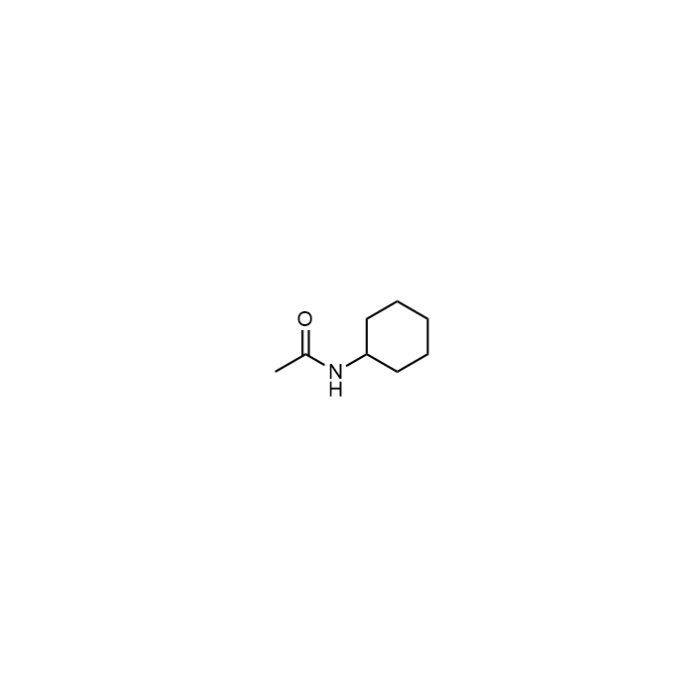
N-Cyclohexylacetamide is a secondary amide featuring an acetyl group bound to an N–cyclohexyl substituent.
Item-specific identifiers (from Product Data)
CAS: 1124-53-4
CID: 14301
InChIKey: 405841 (as provided)
SKU: N693565
Literature/Computed identifiers and descriptors (non-spec for general reference)
Preferred IUPAC name (literature): N-cyclohexylacetamide
Molecular formula (literature): C8H15NO
Molecular weight (literature): ~141.21 g/mol
SMILES (literature): CC(=O)NC1CCCCC1
Structural features (general chemistry description)
Functional groups: one amide (R–CO–NH–R′), with one N–H (H-bond donor) and a carbonyl oxygen (H-bond acceptor).
Ring system: saturated cyclohexyl (chair-conformational, non-aromatic) attached to the amide nitrogen.
Stereochemistry: none (achiral as drawn); conformational isomerism arises from cyclohexane chair flipping and amide bond rotation (restricted by partial double-bond character).
2D description: an acetyl moiety (CH3–CO–) linked via the amide nitrogen to a cyclohexane ring; the carbonyl C=O adjacent to a methyl, and the N bears one hydrogen and one cyclohexyl group.
Synthetic Utility
Key functional elements and their reactivity enable several strategic transformations:
Functional group behavior:
Amide carbonyl: electrophilic yet resonance-stabilized; engages in reductions (to amines) and, after activation, in acyl transfer.
N–H: weakly acidic H-bond donor; can participate in directional H-bonding for supramolecular assembly/crystal engineering.
Cyclohexyl group: hydrophobic, conformationally flexible; useful for tuning lipophilicity and steric environment in structure–property studies.
Retrosynthetic roles:
Precursor to N-cyclohexylethylamine via carbonyl reduction (one-step access to a secondary amine scaffold).
Masked cyclohexylamine: hydrolysis furnishes cyclohexylamine, offering a neutral, crystalline transport form compared with the volatile amine.
Named/related transformations (literature):
Borane-mediated amide reduction (Brown conditions) in THF or 2-MeTHF.
LAH reductions in etheral solvents; careful quench protocols required.
Activation to imidazolides (CDI) enabling subsequent coupling or rearrangement chemistry; though N-substituted amides are less versatile acyl donors without further activation.
Practical considerations:
The amide’s stability allows handling and chromatography without rapid decomposition.
For N-derivatization, pre-activation or use of strong bases/metalation is typically necessary due to low N acidity.
Target Specificity
Not applicable. This product is a small-molecule chemical reagent and does not have antigen/epitope specificity, clone, or species reactivity. No item-specific immunoassay targets are provided in the Product Data.
Frequently Asked Questions
What is the purity of this product?
This product is supplied at ≥95% purity (chemical assay). Lot-specific values are stated on the Certificate of Analysis.
How should this product be stored?
Store at 2–8 °C under argon. It is supplied under an argon blanket; reseal under inert gas after each use.
How is this product shipped?
This product ships chilled on wet ice. Unpack on arrival and transfer it to the storage condition stated above.
What are the CAS number, molecular formula and molecular weight?
The CAS Number is 1124-53-4, the molecular formula is C8H15NO, and the molecular weight is 141.21 g/mol. InChIKey WRAGCBBWIYQMRF-UHFFFAOYSA-N.
What documentation is provided?
Available product documentation, including Certificates of Analysis (COA), Safety Data Sheets (SDS), and specification sheets, is shown in the product document area. Document availability and access follow the current site policy.
We use cookies to ensure the website functions properly and, where permitted, to improve your experience. You can manage your preferences at any time in Settings. Learn more in our Cookie Policy.
Shall we send you a message when we have discounts available?
Remind me later
Thank you! Please check your email inbox to confirm.
Products are supplied to verified businesses, institutions, and qualified professionals for research and development use only. Not for use in humans, animals, diagnosis, or therapy.

 C2610546