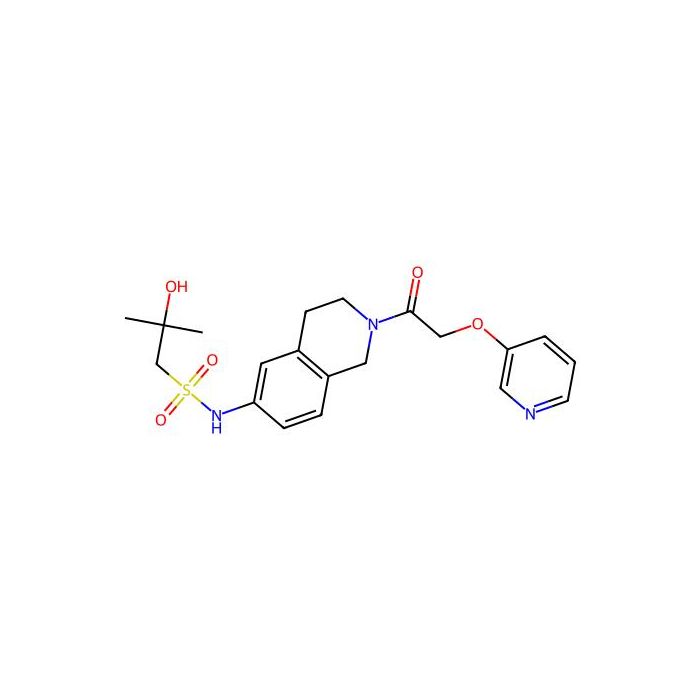
Nampt-IN-1 (LSN3154567) is a potent and selective NAMPT inhibitor. Nampt-IN-1 inhibits purified NAMPT with an IC 50 of 3.1 nM.
In Vitro
To assess its selectivity, specificity, and effects on cellular NAD + levels, LSN3154567 is characterized in various biochemical and cellular assays. LSN3154567 inhibits purified NAMPT with an IC 50 of 3.1 nM. When tested against a panel of human kinases (>100; CEREP Kinase panel), it does not exhibit any significant activity (i.e.: IC 50 ≥1 μM) against the kinases tested except CSF1R (IC 50 ≈0.84 μM). LSN3154567 exhibits a broad spectrum of anticancer activity. To assess its anticancer activity, LSN3154567 is tested against a number of different types of cancer cell lines cultured in the absence or presence of nicotinic acid (NA) (10 μM). LSN3154567 exhibits a potent antiproliferative activity against many cell lines in the absence of NA. MCE has not independently confirmed the accuracy of these methods. They are for reference only.
In Vivo
Nampt-IN-1 (LSN3154567) exhibits good physical chemical properties that allow oral dosing. When dosed orally with 2 mg/kg in mice, it has an exposure of 195 nM*hour in the plasma with a peak concentration of 57 nM (at 0.25 hour) and an oral bioavailability of 39%. When dosed intravenously with 2 mg/kg, it has a hepatic clearance of 158.73 mL/min/kg and a volume of distribution at 7.1 L/kg. The half-life of terminal elimination is estimated to be 2.76 hours. LSN3154567 exhibits a dose-dependent inhibition of NAD + formation with estimated TED 50 value of 2.0 mg/kg. To assess whether LSN3154567 causes retinopathy, rats are treated with LSN3154567 at 20, 40, and 80 mg/kg for 4 days. No apparent retinopathy is observed. The hematological toxicities are observed. When LSN3154567 is dosed at 20, 40, and 80 mg/kg, the plasma exposures obtained are 8,974, 18,061, and 38,327 M*h, respectively. Thus, LSN3154567 exhibits exposure multiples of respective 3-, 7-, and 14-fold over the exposure (2,701 M*h) required for robust efficacy (≈103%) without NA coadministration. Dogs are treated with LSN3154567 at 1 and 2.5 mg/kg. At these dose levels, the retinal toxicity is observed. Degeneration of the outer nuclear layer occurred in all four animals, but is less pronounced in the animals treated with 1 mg/kg. At the 1 and 2.5 mg/kg dose levels, the plasma exposures are determined to be 1,483 and 2,468 nM*h, respectively . MCE has not independently confirmed the accuracy of these methods. They are for reference only.
IC50& Target:IC50: 3.1 nM (NAMPT), 0.84 μM (CSF1R)