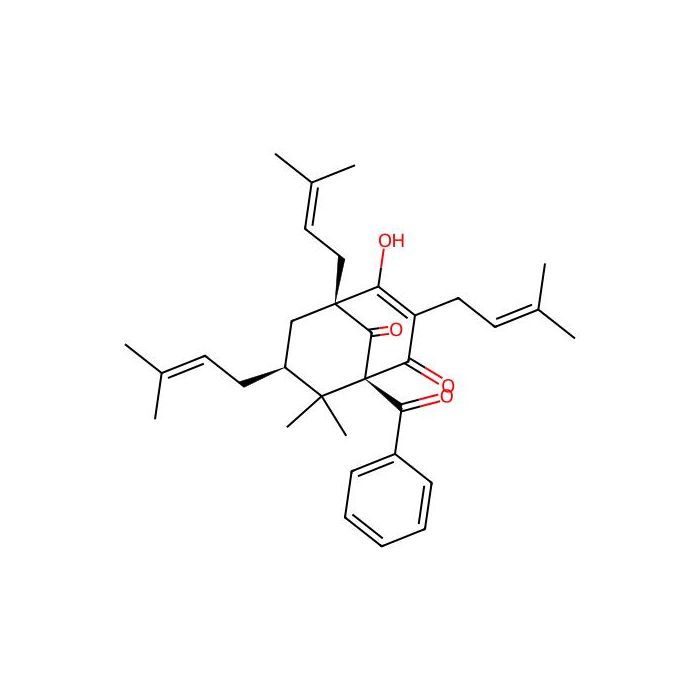
This compound belongs to the class of organic compounds known as alkyl-phenylketones. These are aromatic compounds containing a ketone substituted by one alkyl group, and a phenyl group.
External Descriptors
Not available
1. Djoumbou Feunang Y, Eisner R, Knox C, Chepelev L, Hastings J, Owen G, Fahy E, Steinbeck C, Subramanian S, Bolton E, Greiner R, and Wishart DS. ClassyFire: Automated Chemical Classification With A Comprehensive, Computable Taxonomy. Journal of Cheminformatics, 2016, 8:61.
Determine the necessary mass, volume, or concentration for preparing a solution.
Dilution Calculator
Determine the dilution needed to prepare a stock solution.
Reconstitution Calculator
Reviews
Customer Reviews
Application Protocols
No item-specific, validated application protocols are provided for SKU N950495. As general guidance for handling hydrophobic small molecules in research:
Preparation of stock solutions: dissolve nemorosone in anhydrous DMSO at a convenient concentration (e.g., 10–50 mM). Vortex and, if needed, briefly sonicate. Filter through a 0.22 µm PTFE syringe filter for particulate removal.
Working solutions for assays: dilute the DMSO stock into pre-warmed assay buffer or cell culture medium with vigorous mixing to a final DMSO content commonly ≤0.1–0.5% v/v (method-dependent). Inspect for turbidity/precipitation; if present, increase mixing time, temperature mildly, or include acceptable solubilizers.
Analytical standards: prepare serial dilutions in MeOH, ACN, or MeOH/H2O with formic acid as required by the LC–MS method. Use amber vials; include internal standards if quantifying.
These steps are general best practices; adapt to your assay constraints and verify solubility and stability empirically. For regulated studies, document solution preparation, container materials, and hold times.
Biological Roles
Literature/general description: Nemorosone is a plant secondary metabolite within the family of polyisoprenylated benzophenones, frequently reported from species in the Clusia genus (and related Garcinia taxa). Such metabolites are thought to contribute to:
Chemical defense: the resin/latex of host plants contains polyprenylated benzophenones that deter herbivory and microbial colonization (ecological role; literature).
Storage and localization: often concentrated in exudates and secretory canals; high hydrophobicity promotes association with lipid phases and plant cuticular layers.
Biosynthesis: the scaffold is typically assembled via polyketide pathways (forming a phloroglucinol-like core) followed by multiple prenyltransferase-mediated additions of isoprenyl units and oxidative tailoring steps (literature, general for the class).
Photochemical properties: conjugated benzophenones can absorb UV light; in vivo roles may include photoprotection or redox modulation, though specific functions can vary by species and compound (literature hypotheses).
Research context:
Nemorosone is commonly studied as a chemotaxonomic marker and as a standard in metabolomics of Clusiaceae resins.
Its hydrophobicity and conjugation inform membrane partitioning and spectroscopic signatures (UV-Vis absorption typical of benzophenones). Exact extinction coefficients for this item are not specified; determine empirically for quantitative assays.
Note: The above reflects general biological chemistry of the compound class and published reports; item-specific biological activity is not claimed.
Buffer Applications
Nemorosone is a highly hydrophobic small molecule and is not a buffering agent. It is not typically used to prepare or adjust aqueous buffer systems.
Practical note:
For biochemical assays in buffered media, nemorosone is generally introduced from a concentrated DMSO or ethanol stock into the target buffer. Maintain low final cosolvent concentrations to avoid perturbing pH or protein stability, and monitor for precipitation. Use surfactants or carrier proteins as appropriate to enhance apparent solubility.
Green Alternatives
Nemorosone itself is a target compound rather than a process solvent; “green alternatives” apply to the choice of solvents and workup materials used with it.
Greener solvent choices (literature/general):
Replace dichloromethane with ethyl acetate or 2-MeTHF for extractions and chromatography when resolution permits.
Prefer ethanol or isopropanol over methanol and acetonitrile for stock solutions/sample prep when analytically acceptable.
Use heptane or cyclopentyl methyl ether (CPME) instead of hexane/petroleum ether in normal-phase chromatography.
Illustrative comparison (general):
Dichloromethane vs Ethyl acetate: EtOAc is biodegradable, lower toxicity; DCM offers stronger elution but higher environmental/health burden.
Acetonitrile vs Ethanol: MeCN is excellent for LC–MS but is petro-derived and toxic; ethanol is renewable and safer but may show different ionization and elution behavior.
Hexane vs Heptane/CPME: similar nonpolar performance with improved safety/green profiles for heptane; CPME is versatile with favorable peroxide profile vs typical ethers.
Operational improvements:
Miniaturize assay volumes; adopt solid-phase extraction (SPE) to reduce solvent.
Recover and recycle high-purity solvents where possible.
Use amber glass and inert overlays to extend stock stability, reducing waste from degraded solutions.
Note: Validate any solvent substitution for your specific analytical method to maintain retention, resolution, and ionization performance.
Pharmaceutical Uses
This product is provided strictly for research use only. No clinical or therapeutic claims are made.
Reference standard: may serve as a quantitative/qualitative standard for phytochemical QC of plant-derived raw materials containing polyisoprenylated benzophenones.
Preformulation research: hydrophobic small molecules like nemorosone are studied in early-stage solubilization screens (e.g., cosolvent systems, cyclodextrins, lipidic carriers) to understand delivery behaviors in vitro. Any such work remains nonclinical in scope for this catalog item.
Regulatory status: no pharmacopeial monograph is known for nemorosone; any use in regulated environments would require developing in-house specifications, validated analytical methods, and documented stability data.
Cautions:
Adsorptive losses to plastics and precipitation in aqueous vehicles can confound dose–response relationships; employ glass vials and rigorous mixing during dilution.
Antioxidants or excipients (e.g., BHT, ascorbate, polysorbates) may impact analytical signals and should be justified in method development.
Physical Properties
Item-specific physicochemical specifications (appearance, melting point, exact solubility, refractive index, logP, etc.) are not provided in the Product Data for SKU N950495.
Appearance: Not specified for this item; refer to CoA/Spec Sheet.
Melting point / boiling point: Not specified for this item; refer to CoA/Spec Sheet.
Density / refractive index: Not specified for this item; refer to CoA/Spec Sheet.
Molecular weight and formula: Not specified for this item; refer to CoA/Spec Sheet.
Literature/general characteristics for polyisoprenylated benzophenones like nemorosone:
Physical state: typically isolated as a yellow to orange, nonpolar solid; color arises from extended conjugation (literature, general).
Solubility profile: poor water solubility; readily soluble in organic solvents such as DMSO, DMF, acetone, ethyl acetate, dichloromethane, and alcohols (ethanol, methanol) (literature, general). For biological assays, DMSO stock solutions are customary.
Polarity/partitioning: expected high hydrophobicity (high logP) due to multiple prenyl chains; favors partitioning into nonpolar phases (literature, general).
Stability considerations: conjugated benzophenones can be photosensitive; allylic prenyl chains may be prone to slow oxidative change under air and light. Store under inert atmosphere and protect from light when feasible (good practice; verify with SDS/CoA for this lot).
Note: For regulatory, analytical, or preparative work, rely on certificate of analysis (CoA) values specific to the lot you receive.
Quality & Grades
Grade/Purity: Not specified for this item; refer to CoA/Spec Sheet. The actual purity, assay method (e.g., HPLC area %), and impurity profile are defined on the lot-specific CoA.
Interpretation and implications (general guidance):
Natural product reference material: Nemorosone is commonly used as a phytochemical reference standard. For analytical applications (e.g., HPLC/LC–MS quantitation of plant extracts), preference is for high-purity material with well-defined identity by NMR/HRMS and tight limits on related congeners.
Reporting purity: If only HPLC area % is supplied, be aware it may not capture non-chromophoric or co-eluting impurities; orthogonal methods (qNMR, HRMS) increase confidence for quantitative work.
Stabilizers: None are listed for this item. If stabilizers/antioxidants are required for your application, evaluate compatibility (e.g., BHT can interfere with certain assays). Do not assume the presence of stabilizers unless explicitly stated.
Documentation: CoA should include identity confirmation (1H/13C NMR or MS), chromatographic purity, and storage advice. Request a full specification sheet if method suitability is critical (e.g., pharmacopeial validation, GLP/GMP contexts).
Research-use only: This product is intended solely for laboratory research. It is not for human or veterinary use, nor for diagnostic or therapeutic applications.
Reaction & Applications
As a purchased compound, nemorosone is chiefly used as a reference standard, probe compound, or substrate rather than a general-purpose reagent.
Analytical standard: calibration and method development for HPLC/UPLC–UV and LC–MS quantification of polyisoprenylated benzophenones in plant matrices (Clusia/Garcinia spp.). Establishes retention factors, ionization patterns, and fragmentation signatures.
Probe in biochemical assays: evaluation of interactions with enzymes or membranes; typically delivered from DMSO stocks at micromolar concentrations. Adsorptive losses can occur on plastic; precondition surfaces or use glassware when possible.
Semi-synthesis/derivatization: phenolic O-functionalization (methylation/acylation/carbamate formation) and selective hydrogenation/oxidation of prenyl groups to explore SAR libraries (literature).
Photochemistry: benzophenone cores can display triplet-state photoreactivity and act as photosensitizers; this property has been exploited in crosslinking or mechanistic studies for related scaffolds (general note; verify behavior for nemorosone specifically).
Practical tips:
Dry handling: weigh quickly in low humidity; seal promptly. For solution work, use anhydrous solvents to minimize hydrolytic transformations of sensitive motifs.
Quality control: verify identity by LC–MS and 1H NMR upon first use; highly conjugated materials can isomerize or oxidize on storage.
Purification: if re-purifying, normal-phase silica with gradient hexanes/EtOAc is common; minimize light exposure and extended residence on silica.
Reaction Conditions
No item-specific reaction condition data are provided. The following general conditions illustrate typical modifications applied to polyisoprenylated benzophenones in the literature; they should be optimized for nemorosone after small-scale scouting and verification by LC–MS/NMR.
O-Acetylation/O-Benzoylation: acyl chloride (1.1–2.0 eq), pyridine or Et3N, catalytic DMAP, 0 °C to rt, 1–4 h; monitor by TLC/LC–MS. Quench with aqueous NH4Cl, extract with EtOAc. Expected high conversions for free phenols.
Methylation: MeI (1.5–3 eq) or Me2SO4 (caution toxic), K2CO3 or Cs2CO3, acetone/DMF, rt to 50 °C, 2–16 h. Alternative: TMS-diazomethane in MeOH at 0–25 °C for milder conditions.
Hydrogenation of prenyl C=C: H2 (1–3 atm), Pd/C (5–10 wt%), EtOAc/EtOH, rt to 40 °C, 2–24 h; check for over-reduction of aryl ketone.
Epoxidation: mCPBA (1.1–1.5 eq per C=C), CH2Cl2, 0 °C to rt, 1–6 h; buffer with NaHCO3 to suppress Baeyer–Villiger on the benzophenone.
Benzylic/allylic oxidation: MnO2 (excess), CH2Cl2, rt; or DDQ (1.5 eq), toluene/CH2Cl2, rt to reflux. Monitor closely to avoid over-oxidation.
Photochemistry: UV irradiation (300–365 nm) in degassed solvent (e.g., acetonitrile or isopropanol) under inert gas; benzophenone triplet processes are possible but compound-specific behavior must be verified.
These are literature-style guidelines, not specifications. Always conduct small-scale trials and consult safety documentation for reagents and byproducts.
Safety & Handling
GHS details for this specific item (signal word, hazard statements, pictograms, classification) are not provided in the Product Data. Always consult the product SDS for authoritative hazard and first-aid information.
General laboratory safety guidance for hydrophobic polyisoprenylated benzophenones (literature/practice):
PPE: wear lab coat, safety glasses, and appropriate chemically resistant gloves (e.g., nitrile). Use in a fume hood to avoid inhalation of dust or solvent vapors during handling and solution preparation.
Avoid exposure: minimize skin/eye contact. Prevent dust formation if handling as a dry powder. For solutions, cap tightly to limit volatilization of solvent and ingress of moisture.
Photosensitivity/oxidation: extended conjugation can confer light sensitivity; prenyl chains may undergo slow oxidation. Protect from light and air where practical; purge headspace with inert gas for long-term storage of solutions (good practice; verify with SDS/CoA).
Incompatibilities: strong oxidizers may react with conjugated/allylic systems; strong bases/acids can induce undesired transformations of phenolic/benzylic sites (general caution).
First aid (overview; defer to SDS): if on skin/eyes, rinse with water for several minutes; remove contaminated clothing. If inhaled, move to fresh air. If ingested, rinse mouth and seek medical advice. Provide SDS to medical responders.
Storage and shipping (item-specific):
Storage: Store at -20°C, desiccated (per Product Data). Protect from moisture; use amber containers when possible.
Shipping: Ice chest + ice pads (per Product Data). Do not leave at ambient for extended periods upon receipt.
Solvent Selection
Nemorosone is a highly hydrophobic, polyisoprenylated benzophenone. Solvent choice is primarily driven by dissolution needs for analytics or bioassays.
Preferred solvents (literature/general):
DMSO: most reliable for concentrated stock solutions (e.g., 10–50 mM). Compatible with serial dilution into aqueous media containing surfactants/serum; monitor for precipitation.
Ethanol or methanol: suitable for spectroscopy or preparative work; for biological assays, final alcohol content should be minimized (<1–2% v/v typical practice).
Acetone, ethyl acetate, dichloromethane: effective for sample preparation/extraction and chromatography. Avoid prolonged exposure to silica with strongly acidic/eluting conditions that may promote rearrangements in polyprenylated systems.
Poor solubility in water and most aqueous buffers is expected; use cosolvents or cyclodextrins if an aqueous vehicle is required (general practice).
Selection tips:
For LC–MS standards: prepare in methanol or acetonitrile with 0.1% formic acid only if consistent with your method; assess stability and ionization efficiency.
For bioassays: dissolve in dry DMSO, filter (PTFE, 0.22 µm) if needed, and dilute into pre-warmed media with vigorous mixing to avoid microprecipitates.
Light/air: use amber vials and minimize headspace; consider nitrogen/argon overlay for multi-week storage of stocks.
Comparison (general):
DMSO (max solubility, highest stability) vs ethanol (good solubility, easier evaporation) vs acetonitrile (analytical compatibility, variable solubility). Choose based on end use.
Storage & Reconstitution
Item-specific storage and shipping:
Storage conditions: Store at -20°C, desiccated (per Product Data). Keep container tightly closed. Minimize headspace; consider inert gas overlay.
Shipping: Ice chest + ice pads (per Product Data). Inspect upon receipt and return to cold storage promptly.
Reconstitution and solution handling (general best practices):
Solvents: Use anhydrous DMSO for concentrated stocks; ethanol or methanol can be alternatives for analytical purposes. Water and aqueous buffers are generally unsuitable as primary solvents due to poor solubility.
Stock concentration: Choose based on intended use (e.g., 10–50 mM). Calculate required mass using the exact molecular weight from your CoA. Example formula: mass (mg) = MW (g/mol) × volume (mL) × concentration (mol/L) × 1000.
Light and oxygen: Prepare and store solutions in amber vials; limit exposure to air. Overlay with nitrogen/argon for multi-week storage.
Freeze–thaw: Avoid repeated freeze–thaw of solutions. Aliquot stocks into single-use volumes and keep at −20°C or −80°C as compatible with the solvent.
Stability checks: Verify solution integrity by LC–MS or HPLC before critical experiments; look for new peaks or color changes as indicators of degradation.
Note: Where a solid cake becomes difficult to dissolve after long storage, gently warm to room temperature in a desiccator before opening to minimize moisture condensation.
Structure & Identity
Nemorosone is a polyisoprenylated benzophenone-type natural product commonly reported from Clusia spp. resins (literature). For this catalog item, only certain identifiers are provided; additional identifiers are noted as not specified.
SKU: N950495
Product name: Nemorosone
CAS: 351416-47-2
PubChem CID: 637105 (literature identifier)
InChIKey: 348677 (as provided in Product Data; note: typical InChIKeys are 27 characters — consult CoA/SDS for confirmation)
SMILES: Not specified for this item; refer to CoA/Spec Sheet.
Molecular formula: Not specified for this item; refer to CoA/Spec Sheet.
Molecular weight: Not specified for this item; refer to CoA/Spec Sheet.
Structural features (literature/general description):
Core scaffold: benzophenone (diphenyl ketone) highly substituted by multiple prenyl/isoprenyl chains; many reports describe a polyprenylated phloroglucinol-derived ring coupled to an aryl ring.
Functional groups: aryl ketone (benzophenone carbonyl); phenolic functionalities are commonly present in this class; multiple allylic/isoprenyl C=C double bonds.
Conjugation: extended conjugation across the aryl ketone and prenyl substituents; potential for photoactivity typical of benzophenones (literature, general).
Stereochemistry: Most prenyl substituents are achiral; cyclized or hemiacetal motifs have been noted in some congeners. Item-specific stereochemical details are not specified here.
Synthetic Utility
While nemorosone is most often employed as a reference compound or biological probe, its functional groups allow diverse derivatizations in a synthetic/medicinal chemistry context (literature/general for polyisoprenylated benzophenones):
Phenolic O-functionalization: selective methylation (MeI/Me2SO4, base), acylation (Ac2O or acyl chlorides, DMAP/base), or carbamate formation to modulate polarity and stability.
Aryl ketone chemistry: benzophenone cores can undergo photochemical reactions (e.g., n→π* triplet sensitization) or be reduced (e.g., to benzhydrol derivatives) under hydride conditions. Caution: over-reduction can affect conjugated prenyl chains.
Prenyl group editing: hydrogenation (Pd/C, H2) to saturate allylic bonds; epoxidation (mCPBA), hydroboration–oxidation, or oxidative cleavage (ozonolysis) to access diversified side chains.
Oxidative transformations: DDQ or MnO2 can effect benzylic/allylic oxidations; radical bromination at benzylic/allylic positions enables further substitution.
Conjugate additions: if an enone-like motif is present (varies by congener), soft nucleophiles may add under Lewis acidic conditions.
Utility in retrosynthesis and SAR:
The dense substitution and hydrophobic envelope provide a platform for SAR exploration around phenolic protection patterns and side-chain saturation/oxidation state.
For analytical tagging, installation of chromophores/fluorophores or click handles (e.g., propargyl carbamates) enables target engagement studies.
Note: Confirm exact functional group count/positions for your lot via NMR before planning selective transformations.
Target Specificity
Not applicable. This product is a small-molecule natural product, not an antibody or affinity reagent. No antigen/epitope, clone, isotype, or species reactivity information applies.
We use cookies to ensure the website functions properly and, where permitted, to improve your experience. You can manage your preferences at any time in Settings. Learn more in our Cookie Policy.
Shall we send you a message when we have discounts available?
Remind me later
Thank you! Please check your email inbox to confirm.
Products are supplied to verified businesses, institutions, and qualified professionals for research and development use only. Not for use in humans, animals, diagnosis, or therapy.