GRADE & PURITYMoligand™?Moligand™ — Aladdin's line of ligands and bioactive small molecules. Use for receptor, pathway, and binding studies needing defined small-molecule tools.10 mM in DMSO
Determine the necessary mass, volume, or concentration for preparing a solution.
Dilution Calculator
Determine the dilution needed to prepare a stock solution.
Reconstitution Calculator
Reviews
Customer Reviews
Application Protocols
No vendor-validated biological assay protocols are provided for this SKU. General guidance for small-molecule screening use:
Stock preparation: Dissolve in anhydrous DMSO to 10–50 mM; vortex and, if needed, sonicate briefly. Filter through 0.22 µm PTFE for sterile applications.
Assay dilution: Add to assay buffer while mixing to a final DMSO content ≤1–2% v/v. Confirm absence of precipitation visually and by analytical readout controls.
Controls: Include vehicle control (DMSO), a known positive control for your target/mechanism (e.g., a reference nitroheteroaromatic), and orthogonal readouts to mitigate redox artifacts.
Storage of working plates: Keep sealed and protected from light; minimize freeze–thaw cycles by using single-use aliquots.
For synthetic applications, follow the Reaction Conditions guidance and standard workup/purification protocols; no kit-style protocols are supplied with this item.
Biological Roles
Provided strictly for research context; no medical or clinical claims.
Mechanistic themes (literature/general):
Nitroheteroaromatic scaffolds are classic substrates for nitroreductases and other flavoproteins. One-electron reduction can give nitro radical anions that undergo further chemistry (e.g., formation of hydroxylamines or amines), potentially generating reactive intermediates in biological settings.
The thiazole nitrogen and ring sulfur contribute to heteroaromatic electron distribution, tuning redox potential and interaction with protein active sites.
The cyclic urea (imidazolidin-2-one) can form hydrogen bonds as both donor (NH) and acceptor (C=O), influencing ligand efficiency and binding orientation in protein pockets.
Research uses (general):
Model compound for studying parasite-relevant enzymology and metabolism of nitroheteroaromatics (e.g., reductive activation pathways) and for benchmarking cellular redox responses.
Tool in structure–activity relationship (SAR) campaigns examining the impact of nitro group reduction state, thiazole S-oxidation, or urea N-alkylation on target engagement in biochemical assays.
ADME-relevant features (general):
Net neutral at physiological pH; moderate polarity enables passive diffusion in model systems; nitro group bioreduction can dramatically alter polarity and protein reactivity.
Researchers should characterize assay-specific stability (e.g., in microsomes or in cell culture media) and monitor for redox-driven artifacts when high concentrations or prolonged incubations are used.
Buffer Applications
This compound is not a buffering agent, and it is not typically used to formulate pH-stable buffers. For aqueous work, any dissolution into buffers is generally for biological assays or analytical sample preparation rather than pH control.
Practical note: If preparing aqueous dilutions from DMSO stocks, choose a buffer appropriate to your assay (e.g., PBS, HEPES) and keep final DMSO ≤1–2% v/v to mitigate precipitation and off-target effects.
Solubility in unmodified aqueous buffers may be limited; incorporate a cosolvent or surfactant as needed and verify homogeneity.
Green Alternatives
Choice of solvent and oxidants/reductants dominates the greenness profile for work with nitroheteroaromatics like niridazole. Consider the following greener substitutions where compatible with your objective.
Solvent swaps (general guidance):
Replace DMF/NMP with Cyrene (dihydrolevoglucosenone) or PolarClean for certain coupling/alkylation steps, verifying solubility and stability.
Replace chlorinated solvents (if considered for extraction) with ethyl acetate or 2-MeTHF, which offer better environmental profiles and lower persistence.
For stock solutions, maintain DMSO but minimize volumes and use aliquoting to reduce waste.
Reductions of the nitro group (comparative, literature):
Catalytic hydrogenation (H2, Pd/C) in ethanol or EtOAc is often cleaner and generates water as the primary byproduct; avoid over-reduction by careful monitoring.
Iron powder with ammonium formate or aqueous acetic acid can be lower-toxicity alternatives to tin(II) chloride/HCl, reducing heavy metal waste.
Oxidations at sulfur:
Use Oxone (potassium peroxymonosulfate) or hydrogen peroxide with an appropriate catalyst as alternatives to peracids; control temperature to limit over-oxidation.
Always verify reaction performance and impurity profiles under the greener conditions; adjust base/acid loadings to maintain selectivity on the sensitive nitrothiazole ring.
Pharmaceutical Uses
For research use only. No therapeutic or clinical claims.
Role in pharmaceutical R&D (general):
Employed as a reference standard or positive control in in vitro assays investigating nitroheteroaromatic activation and toxicity mechanisms.
Useful for SAR benchmarking in discovery projects exploring nitrothiazole–urea scaffolds; can help calibrate assay windows, redox response, or off-target risk assessments.
Formulation research context:
Solubilization strategies commonly rely on DMSO concentrates with subsequent dilution into aqueous vehicles; cyclodextrin inclusion or micellar systems may be explored for higher aqueous loading in preclinical assay formats.
Compendial/excipient status: No pharmacopeial excipient role is recognized for this scaffold (literature/general). Any use would be as an analytical or research reference compound.
Confirm identity and purity against a certified reference if using for method validation, impurity profiling, or stability-indicating HPLC development.
Physical Properties
Only item-specific properties listed below are from the Product Data; all other values are literature/general information for reference and should be verified experimentally for this lot.
Appearance (item-specific): Not specified for this item; refer to CoA/Spec Sheet.
Physical state (literature): Typically a solid nitroheteroaromatic compound.
Molecular formula (literature): C6H6N4O3S
Molecular weight (literature): ~214.20 g/mol
Melting point (literature): Reports typically place mp in the 160–190 °C range; exact value varies with polymorph/purity. Verify by DSC.
Boiling point: Not meaningful; compound expected to decompose before boiling (literature/general for nitroheteroaromatics).
Density: Not specified for this item; refer to CoA/Spec Sheet.
Solubility (literature/general):
DMSO: high solubility typical for nitroheteroaromatics; convenient for screening stocks (e.g., 10–50 mM).
DMF, NMP: good solubility; methanol/ethanol: moderate; water: low.
LogP/logD (literature): Expected moderate polarity due to cyclic urea; reported clogP values around 0–1 have been cited for similar nitrothiazole–urea scaffolds. Confirm experimentally for this item.
pKa (literature): No strongly ionizable groups in physiological range; cyclic urea is not appreciably basic; thiazole nitrogen is weakly basic. Net neutral in most media.
UV-Vis (literature): Nitroheteroaromatics absorb in the near-UV (ca. 320–380 nm) with additional bands ~250–300 nm; exact maxima depend on solvent.
All performance-critical parameters (solubility, extinction coefficients) should be established under your specific conditions.
Quality & Grades
Item-specific grade: Moligand™ (as provided in Product Data).
What Moligand™ typically implies (general description):
Sourcing and curation aimed at small-molecule ligand discovery, screening sets, and SAR exploration. Compounds are typically suitable for biochemical, cellular, and target-engagement assays (research use only), with emphasis on identity confirmation and handling suitable for library workflows.
Documentation commonly includes structure identity confirmation (e.g., NMR/LC–MS) and lot-specific purity determination; however, specific analytical thresholds and methods vary by item.
Critical notes for this SKU:
Purity/assay level, residual solvent content, water/peroxide/metal limits, and UV cutoff: Not specified for this item; refer to CoA/Spec Sheet.
Stabilizers/inhibitors: Not specified for this item; refer to CoA/Spec Sheet.
Appearance and form (solid/crystalline/amorphous): Not specified for this item; refer to CoA/Spec Sheet.
Best practices for quality verification on receipt (recommended for screening compounds):
Confirm identity/purity by LC–MS under your method; record retention time and mass-to-charge signature for future reference.
Assess DMSO stock clarity and stability in your intended storage conditions (e.g., -20 °C working aliquots) and check for precipitation on dilution to assay buffer.
For long-term programs, archive a reference spectrum/chromatogram and retain a reserve vial under the vendor-recommended storage conditions.
Reaction & Applications
This scaffold is relevant both as a reference compound in nitroheteroaromatic research and as a transformable handle for medicinal chemistry derivatization.
Research applications (general/literature):
Probe for nitroreductase-mediated bioactivation and redox cycling; useful in mechanistic assays that monitor nitro reduction or thiazole reactivity.
Control compound in studies of heteroaromatic nitro group behavior (electrochemistry, photochemistry, enzymology).
Transformations of the nitrothiazole motif:
Stepwise reductions to N-hydroxylamine and aniline equivalents (on thiazole) under catalytic hydrogenation (Pd/C, H2) or metal/acid systems (Fe/AcOH, SnCl2/HCl). These enable access to amino analogs for SAR.
S-oxidation to sulfoxide/sulfone (m-CPBA, Oxone) modifies electronics and polarity; monitor for ring activation/overoxidation.
Imidazolidin-2-one (cyclic urea) handle:
N-alkylation/acylation at the non-arylated ring nitrogen under basic conditions (e.g., NaH, alkyl halides) to generate analog libraries; ensure chemoselectivity to avoid thiazole substitution.
Carbonyl activation (e.g., CDI coupling) for tether formation, though the cyclic urea is typically robust.
Practical tips:
Nitroaromatics can undergo side reactions in strongly basic media; maintain controlled temperatures and inert atmosphere when reducing or alkylating.
If hydrogenation is used, confirm that the thiazole ring tolerates conditions (avoid excessive pressure/time that may hydrogenate the ring or cleave the N–C linkage).
Use authentic standards and orthogonal analytics (LC–MS, 1H/13C NMR) to distinguish reduction products and S-oxidation states.
Reaction Conditions
The following conditions are literature/general guidance for functional group manipulations on nitrothiazole–urea scaffolds like niridazole. Optimize for your substrate and scale.
Nitro group reduction (aromatic heterocycles):
Catalytic hydrogenation: H2 (1–3 bar), Pd/C (5–10 wt%), EtOH or EtOAc, rt–40 °C, 2–8 h; monitor by TLC/LC–MS. Reported yields for similar substrates: typically 60–90% depending on sensitivity to over-reduction (literature).
Metal/acid: Fe (3–6 equiv) in AcOH/H2O or SnCl2·2H2O (2–4 equiv) in EtOH/HCl, 0–25 °C to reflux, 1–6 h; quench carefully to avoid emulsions. Yields often 50–85% (literature), with tin routes generating hazardous waste.
Sulfur oxidation (thiazole → sulfoxide/sulfone):
m-CPBA (1.1–2.2 equiv) in DCM/MeCN at 0–25 °C; short additions and low temperatures favor sulfoxides. Over-oxidation gives sulfone.
Oxone in MeOH/H2O or acetone/H2O with NaHCO3 buffer, 0–25 °C; greener profile; reaction times 0.5–4 h.
Urea N-alkylation:
Base: NaH (1.1–1.5 equiv) or K2CO3 (2–3 equiv) in DMF/DMSO; alkyl halide (1.2–2.0 equiv), 0–25 °C, 1–16 h. Protect from moisture; inert atmosphere recommended.
Workup/purification tips:
Nitroaromatic reductions may generate polar byproducts; employ acid–base washes judiciously and finish with reversed-phase or normal-phase chromatography as needed.
Monitor for ring integrity; harsh conditions can open the imidazolidinone or hydrogenate the thiazole.
These conditions are guidance only; confirm selectivity and stability for niridazole specifically with small-scale trials and orthogonal analytics.
Safety & Handling
Always consult the SDS for definitive hazard and precautionary statements for this SKU.
GHS classification (item-specific): Not specified for this item; refer to SDS.
Signal word / pictograms / H-statements (item-specific): Not specified for this item; refer to SDS.
General hazard profile (literature/general): Nitroheteroaromatic compounds can present toxicity on ingestion/inhalation/skin contact and may be irritating to eyes/skin. Some nitroaromatics exhibit mutagenicity in certain test systems. Handle with caution and avoid exposure.
PPE and engineering controls:
Wear lab coat, safety glasses or face shield, and appropriate chemically resistant gloves (e.g., nitrile). Use in a chemical fume hood to avoid inhalation of dust or solvent vapors.
Avoid aerosolization; handle powders gently. Employ local exhaust ventilation and spill trays.
Storage incompatibilities and precautions (general):
Keep away from strong reducing agents and strong bases that may promote nitro reduction or ring transformations. Avoid strong oxidizers as well (risk of over-oxidation of sulfur).
Protect from light and moisture; store in original light-protective container if supplied as such.
First-aid overview (general):
Inhalation: Move to fresh air; seek medical attention if symptoms persist.
Skin contact: Wash with soap and water; remove contaminated clothing; seek medical advice for irritation.
Eye contact: Rinse cautiously with water for several minutes; remove contact lenses if easy; seek medical attention.
Ingestion: Rinse mouth; do not induce vomiting; seek medical attention.
Fire and thermal decomposition (general): Combustion may release NOx, SOx, CO/CO2. Use standard extinguishing media (CO2, dry chemical, foam). Avoid dust accumulation.
Solvent Selection
Niridazole is a neutral, moderately polar nitroheteroaromatic with a cyclic urea. This profile favors polar aprotic organic solvents for stock preparation and reaction media.
Polarity/miscibility (literature/general):
Highly soluble: DMSO, DMF, NMP.
Moderate: methanol, ethanol, acetonitrile.
Poor to low: water, alkanes, nonpolar ethers.
Practical recommendations:
Screening stocks: Prepare 10–50 mM in anhydrous DMSO; filter (0.22 µm) if needed. Dilute into assay buffers with a final DMSO content typically ≤1–2% v/v to avoid solubility/biological artifacts.
Synthetic operations: Use DMF/DMSO/NMP for nucleophilic or reductive transformations; alcohols or MeCN for workups or crystallizations depending on solubility.
Dielectric environment (general): Nitroaromatics often display better stability to reduction and fewer aggregation issues in higher dielectric media (DMSO, DMF) compared to protic solvents where hydrogen bonding may alter behavior.
When to choose alternatives:
If DMSO is incompatible with the assay, consider PEG-400, aqueous cosolvent mixes (MeCN or ethanol ≤20% with surfactant), or green dipolar aprotics (e.g., Cyrene) after checking stability.
Comparison (general):
DMSO: maximal solubilization, excellent for freezer-stable stocks.
DMF/NMP: similar solvation but higher volatility/toxicity considerations (DMF) or viscosity (NMP).
MeCN/EtOH: useful for rapid evaporation and formulation trials but may limit maximal concentration.
Confirm solvent choice empirically for your matrix and target concentration.
Storage & Reconstitution
Item-specific storage: Store at -80 °C (per Product Data). Keep container tightly closed. Protect from light and moisture.
Shipping: Shipped on dry ice packs + cold packs (per Product Data) to maintain low temperature and limit thermal excursions.
Stability notes (general): Nitroheteroaromatics and cyclic ureas are typically stable if kept dry and cold. Avoid prolonged exposure to ambient humidity/temperature. Record first-open date and minimize headspace to reduce oxidative processes.
Reconstitution for screening stocks (general best practice):
Prepare concentrated stocks (e.g., 10–50 mM) in anhydrous DMSO.
Aliquot into low-bind, amber vials or plates to create single-use portions; purge with inert gas if feasible.
Store aliquots at −80 °C for long-term and at −20 °C for short-term working use. Avoid repeated freeze–thaw by using small aliquots.
Thawing/handling:
Warm briefly to room temperature to fully dissolve; mix well before use. If precipitation occurs on aqueous dilution, increase mixing time, raise temperature slightly, or adjust cosolvent percentage.
Aqueous solutions: Prepare immediately before use; stability in water/buffer is assay-dependent and should be confirmed empirically.
For all critical applications, consult the CoA/Spec Sheet for any lot-specific stability or handling notes.
Structure & Identity
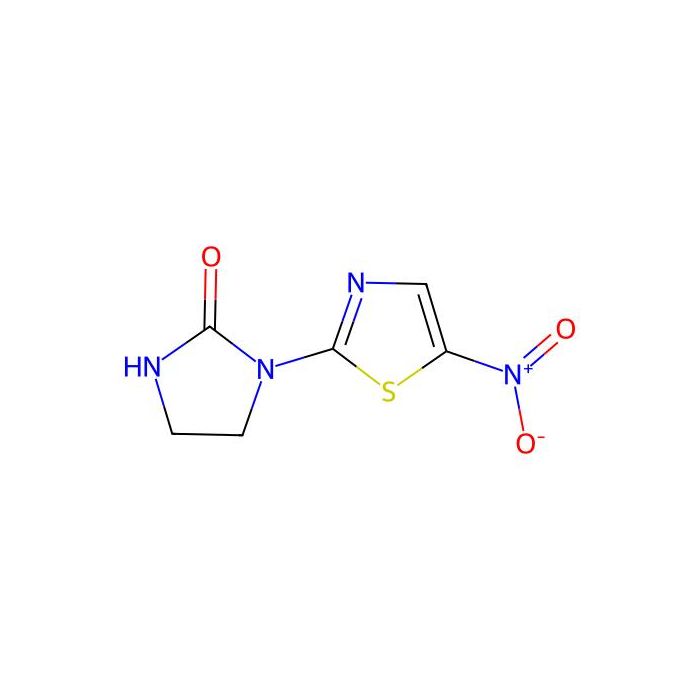
Niridazole is a nitroheteroaromatic urea (imidazolidin-2-one) fused through an N–C bond to a 5-nitro-1,3-thiazol-2-yl moiety.
Item-specific identifiers (from Product Data):
SKU: N1495213
CAS: 61-57-4
Category: Small molecules and compound library (Moligand™)
Structure descriptors:
Molecular formula: Not specified for this item; refer to CoA/Spec Sheet. (Literature: C6H6N4O3S)
Molecular weight: Not specified for this item; refer to CoA/Spec Sheet. (Literature: ~214.20 g/mol)
SMILES: Not specified for this item; refer to CoA/Spec Sheet. (Literature examples describe an imidazolidin-2-one N-linked to 5-nitro-1,3-thiazole)
InChIKey: Not specified for this item; refer to CoA/Spec Sheet.
2D structural description (literature/general):
A five-membered imidazolidin-2-one ring (a cyclic urea) bearing two ring nitrogens; one ring nitrogen is N-alkylated by a 2-yl substituent from a 1,3-thiazole.
The thiazole ring carries a nitro group at the 5-position. Functional groups: cyclic urea (amide-like carbonyl), nitro (–NO2) on an electron-poor thiazole, heteroaromatic sulfur and nitrogen.
No stereocenters; achiral, planar heteroaromatic component with a partially saturated urea ring.
Notes: Values marked as “literature” are provided for context and should be confirmed against the item’s CoA/Spec Sheet for procurement-critical decisions.
Synthetic Utility
Niridazole provides two orthogonal sites of manipulation valuable for analog generation and mechanistic studies:
Nitrothiazole handle:
Reductive transformations (Pd/H2; Fe/AcOH; SnCl2/HCl) to hydroxylamine or amine states enable exploration of electronic effects on the heteroaromatic core. The resulting amino-thiazole can be further acylated or diazotized for diversification (literature/general).
Electrophilic S-oxidation (sulfoxide/sulfone) modulates electron withdrawal and H-bond acceptor strength, tuning physicochemical properties.
Imidazolidin-2-one (cyclic urea):
Deprotonation of the non-arylated nitrogen (e.g., NaH, K2CO3 in DMF/DMSO) followed by alkylation/acylation introduces substituents without perturbing the thiazole core, expanding a library around a constant pharmacophore.
Under stronger activating conditions (e.g., CDI, triphosgene), the urea carbonyl can engage in coupling to craft linkers for PROTAC-like or bifunctional tools; care required to avoid ring opening.
Cross-coupling potential:
While the thiazole ring lacks halogen in this scaffold, prefunctionalization (e.g., thiazol-2-yl halogenation prior to coupling in analogs) is a common route in SAR; niridazole serves as a comparator or end member.
Analytical guidance:
LC–MS readily distinguishes nitro vs amino and sulfoxide vs sulfone states by mass deltas (+16 for sulfoxide, +32 for sulfone; −30/−32 for nitro-to-amine depending on intermediates). NMR chemical shifts of the thiazole C–H and urea NH provide diagnostic signals.
Target Specificity
Not an antibody/biologic product; target specificity data such as antigen, epitope, clone, isotype, and species reactivity are not applicable. For biochemical assays, users should define the target (e.g., nitroreductases or other redox enzymes) and establish specificity empirically.
Frequently Asked Questions
What are the CAS number, molecular formula and molecular weight?
The CAS Number is 61-57-4.
Need help choosing the grade?
Our grade selection guide covers purity, stabilizer status, and application suitability for all variants in our catalog.
We use cookies to ensure the website functions properly and, where permitted, to improve your experience. You can manage your preferences at any time in Settings. Learn more in our Cookie Policy.
Shall we send you a message when we have discounts available?
Remind me later
Thank you! Please check your email inbox to confirm.
Products are supplied to verified businesses, institutions, and qualified professionals for research and development use only. Not for use in humans, animals, diagnosis, or therapy.