GRADE & PURITYAnalytical standard?Analytical standard — certified-purity material for quantitative calibration. Use to prepare calibration standards and validate analytical methods.≥99.7%(GC)
This compound belongs to the class of organic compounds known as alkanes. These are acyclic branched or unbranched hydrocarbons having the general formula CnH2n+2 , and therefore consisting entirely of hydrogen atoms and saturated carbon atoms.
External Descriptors
an alkane
1. Djoumbou Feunang Y, Eisner R, Knox C, Chepelev L, Hastings J, Owen G, Fahy E, Steinbeck C, Subramanian S, Bolton E, Greiner R, and Wishart DS. ClassyFire: Automated Chemical Classification With A Comprehensive, Computable Taxonomy. Journal of Cheminformatics, 2016, 8:61.
Determine the necessary mass, volume, or concentration for preparing a solution.
Dilution Calculator
Determine the dilution needed to prepare a stock solution.
Reconstitution Calculator
Reviews
Customer Reviews
Application Protocols
No assay protocols are specified for this item. As an analytical standard, typical workflows include:
General guidance (literature/practice):
GC-FID setup:
Prepare a homologous n-alkane ladder (e.g., C8–C20) at matched concentrations in GC-grade hexane.
Inject 0.2–1 µL split injections; verify linear response for FID across your concentration range.
Calculate linear retention indices (LRI) using C18, C19, and C20 to bracket mid-range analytes.
GC-MS check:
Use EI 70 eV; spectra show characteristic high-mass alkane fragment series (m/z 57, 71, 85, etc.) with weak molecular ion at m/z 268 (literature) for nonadecane.
Gravimetric standard preparation:
Weigh on cooled, clean weigh boats or prepare by mass-by-difference into solvent-filled volumetric flasks to minimize handling losses near the melting point.
For validated, method-specific instructions, consult your laboratory SOPs. Item-specific recommended dilutions or protocols: Not specified for this item; refer to CoA/Spec Sheet.
Biological Roles
General literature context (not item-specific):
Occurrence: long-chain n-alkanes including C19 are found in epicuticular waxes of plants and in insect cuticular hydrocarbons, contributing to desiccation resistance and chemical communication. Exact natural abundance varies by species and environment.
Biodegradation: many bacteria and fungi can utilize n-alkanes via alkane monooxygenases (e.g., AlkB-type) that initiate terminal oxidation to primary alcohols, followed by aldehydes and fatty acids feeding into β-oxidation pathways.
Physicochemical role: extreme hydrophobicity and low surface energy make long-chain alkanes useful as model hydrophobic surfaces in biophysical studies (e.g., protein adsorption, membrane-mimetic interactions when embedded in matrices).
Toxicology profile: saturated long-chain alkanes generally exhibit low acute toxicity and minimal bioactivity; hazards are associated more with aspiration (for low-viscosity liquids) and chronic exposure to certain shorter-chain mixtures. Nonadecane’s low volatility reduces inhalation exposure at room temperature.
Research use only statement (from Product Data): For research use only. Not for use in diagnostic procedures or therapeutics.
Buffer Applications
Not typically applicable. Nonadecane is a highly hydrophobic hydrocarbon with no acid–base functionality and is not used to prepare aqueous buffers or to control pH.
Practical note: If working with aqueous systems, nonadecane may be used as an immiscible overlay to limit evaporation in microreactions, but it provides no buffering capacity and will not dissolve in standard buffer systems.
Green Alternatives
Context: Nonadecane is most often used as an analytical standard rather than as a reaction solvent or reagent. Green chemistry considerations therefore focus on sourcing, solvent choices for standard preparation, and waste minimization.
Greener considerations (general/literature):
Source/material origin: conventional nonadecane is petroleum-derived. Where feasible, consider bio-based long-chain hydrocarbons produced via fatty-acid decarboxylation/hydrogenation (emerging supply chains) to reduce fossil carbon intensity.
Solvent for standards: prefer greener hydrocarbon solvents (e.g., heptane over hexane due to reduced neurotoxicity concerns) or iso-octane; avoid chlorinated solvents unless required by method performance.
Energy: its melting point near ambient allows liquefaction with mild warming, avoiding high-temperature operations.
Waste: prepare small-volume, on-demand standards to limit expired waste. Consolidate hydrocarbon wastes for energy recovery per local regulations.
Comparison examples (literature/general):
Hexane vs Heptane for GC standard preparation:
Health profile: heptane generally considered less neurotoxic than n-hexane.
Chromatography: hexane elutes slightly faster; heptane often acceptable with minor method adjustments.
Ethers (e.g., diethyl ether) vs Iso-octane:
Ethers form peroxides and are highly flammable; iso-octane avoids peroxide hazards and offers good volatility for GC.
Trade-offs:
Switching solvents may require re-validation of retention indices and detector response factors. Maintain consistency within a validated method unless a change is justified and documented.
Pharmaceutical Uses
Applicability note: Nonadecane itself is not a common standalone pharmaceutical excipient. Saturated hydrocarbons as a class (paraffins, petrolatum, mineral oils) are used in topical formulations as occlusive bases. The following is general, literature-based context and not item-specific.
General formulation context (literature):
Role: long-chain hydrocarbons can contribute to hydrophobic matrices, moisture barriers, or as components in suppository/ointment bases when blended with waxes and oils. Specific pharmacopeial status for nonadecane: Not specified for this item; refer to CoA/Spec Sheet.
Residuals/trace metals: For excipient use, stringent controls apply; for this analytical standard product, no excipient compliance is claimed.
Regulatory/use note:
This product is labeled for research use only (from Product Data) and is not intended for human or animal administration, compounding, or clinical use.
Physical Properties
Item-specific specifications: Not specified for this item; refer to CoA/Spec Sheet.
Literature/general (typical properties for nonadecane):
Appearance: colorless, waxy solid near ambient temperature; becomes a clear, low-viscosity liquid slightly above its melting point.
Melting point: ~32–33 °C (literature)
Boiling point: ~330–333 °C at 1 atm (literature)
Density: ~0.78–0.79 g/mL at 20–25 °C (liquid; literature)
Refractive index (n20 D): ~1.430–1.435 (literature)
Vapor pressure: very low at room temperature; negligible volatility compared to light alkanes (literature)
Solubility: insoluble in water; miscible with nonpolar organic solvents (e.g., hexane, heptane, cyclohexane, toluene, chloroform). Limited solubility in polar aprotic solvents; essentially insoluble in alcohol–water mixtures at high water content (literature)
Partitioning: very hydrophobic; logP (octanol/water) estimated ~9–10 (literature/estimated)
pKa: not applicable (no acidic or basic functionality)
Notes for handling near phase transition (general guidance):
Because the melting range is near room temperature, physical state can change with minor temperature fluctuations. Warm gently to fully liquefy for homogeneous sampling; cool below ~25–30 °C to obtain a solid for weighing, minimizing smearing losses.
Quality & Grades
Item-specific (from Product Data):
Grade/Purity: Analytical standard
What “Analytical standard” implies (general guidance for hydrocarbon standards):
Intended for calibration/qualification in analytical methods (e.g., GC-FID, GC-MS) where retention indices, response factors, and resolution checks depend on well-characterized, high-purity analytes.
Typically supplied with traceability documentation and tight limits on identity and purity (often supported by GC purity, minimal isomeric/branched impurities, and low non-volatile residue). Exact acceptance criteria: Not specified for this item; refer to CoA/Spec Sheet.
UV background is inherently low for saturated hydrocarbons, benefiting detectors sensitive to baseline noise; however, GC-FID is the common detector for n-alkane standards.
Stabilizers: Generally not required for saturated alkanes; absence/presence of any stabilizer for this item: Not specified for this item; refer to CoA/Spec Sheet.
Fit-for-purpose notes (analytical use):
n-Alkane standards spanning C8–C40 are routinely used to construct Kovats and linear retention index (LRI) scales. Nonadecane (C19) bridges mid-range volatility between C18 and C20.
For quantitative use, prepare gravimetrically in high-purity, low-bleed solvents (GC-grade n-hexane, iso-octane, or toluene). Verify baseline resolution from neighboring homologs under your method conditions.
Reaction & Applications
Analytical and materials applications (literature/general):
GC calibration: component of n-alkane homolog series for Kovats/linear retention index (LRI) calibration in GC-FID/GC-MS. Nonadecane (C19) aids indexing of mid-range volatiles (C17–C21 window) in petrochemical and flavor/aroma profiling.
Internal/external standard: used as an internal standard in hydrocarbon analyses where matrix lacks C19 content; verify absence in sample background before IS use.
Thermophysical studies: reference material in phase-change investigations (latent heat, heat capacity) and modeling of dispersion interactions vs chain length.
Surface science: hydrophobic model compound for wettability studies and as a benign diluent in self-assembled monolayer precursor mixtures after derivatization.
Chemical transformations (typical for long n-alkanes; literature):
Radical halogenation: photochemical or thermal halogenation (Cl2/Br2, hv or AIBN/benzoyl peroxide initiation) to access 1- or mixed halo-nonadecanes, which serve as intermediates to surfactants and quaternary ammonium salts.
Catalytic isomerization/cracking: over acidic zeolites or metal catalysts at elevated temperatures to study mechanism and product distributions.
Oxidation (harsh): high-temperature or catalytic oxidation to alcohols/ketones/acids (low selectivity), primarily of mechanistic interest rather than preparative utility.
Practical tips:
For GC standards, prepare gravimetrically and store in crimped vials to minimize solvent loss. Use class-A glassware and verify instrument linearity across the targeted concentration range.
For radical functionalization, maintain anhydrous, oxygen-limited conditions to control side reactions; use UV-transparent glassware for photolysis.
Reaction Conditions
General literature conditions for representative transformations of long-chain n-alkanes (illustrative; not item-specific):
Reagents: Br2 or N-bromosuccinimide (NBS) with radical initiator (AIBN or benzoyl peroxide).
Conditions: reflux in CCl4 or inert hydrocarbon solvent; or photochemical (hv, 300–365 nm). Temperatures typically 60–90 °C (thermal) or ambient under UV. Reaction times 1–8 h depending on light intensity and loading. Mixtures of isomers form; lower temperature and controlled irradiation can favor less substituted positions but complete selectivity is not expected.
Radical chlorination:
Reagents: Cl2 under UV irradiation.
Conditions: gas–liquid photoreactor, careful temperature control to limit over-chlorination; rapid reaction, often minutes to hours.
Isomerization/cracking (mechanistic studies):
Catalysts: acidic zeolites (HZSM-5, HY), Pt/H-beta, etc.
Conditions: fixed-bed flow at 200–450 °C under H2 or inert; WHSV and H2/HC ratios tuned to balance isomerization vs cracking.
Oxidation (autoxidation):
Initiation: O2 with radical initiator at 100–160 °C yields hydroperoxides/alcohols/ketones; low selectivity and overoxidation risk.
Analytical preparation (for GC standards):
Solvents: GC-grade hexane/iso-octane; concentrations commonly 10–1000 µg/mL (method-dependent). Sonication or mild warming facilitates dissolution. Store in crimp-sealed amber vials to minimize solvent loss and oxidation of any co-dissolved analytes.
Safety & Handling
Item-specific hazard information from Product Data:
GHS classification: Not specified for this item; refer to SDS.
Signal word: Not specified for this item; refer to SDS.
H-statements: Not specified for this item; refer to SDS.
Pictograms: Not specified for this item; refer to SDS.
General safety considerations for long-chain n-alkanes (literature/good practice):
Flammability: combustible hydrocarbon; although high flash point relative to light alkanes, avoid ignition sources during heating or when handling hot liquids. Combustion generates CO/CO2 and soot.
Exposure: low vapor pressure minimizes inhalation risk at ambient conditions; avoid prolonged skin contact to prevent defatting. Use in a well-ventilated area if heated.
PPE: safety glasses, lab coat, and nitrile gloves as baseline protection. Use thermal-resistant gloves and face protection when handling above the melt/flash temperature.
First aid (overview; defer to SDS): skin—wash with soap/water; eye—rinse cautiously with water for several minutes; inhalation of hot vapors—move to fresh air; ingestion—rinse mouth, do not induce vomiting; seek medical attention if symptoms persist.
Thermal hazards: molten material can cause burns. Heating in closed systems can lead to pressure buildup.
Environmental: very hydrophobic and persistent; contain spills with inert absorbents and prevent entry into drains.
Always consult the product-specific SDS for authoritative safety, handling, and disposal instructions.
Solvent Selection
Applicability note: Nonadecane is not typically used as a solvent. This section focuses on choosing solvents to dissolve or deliver nonadecane.
Polarity and miscibility (literature):
Polarity: strictly nonpolar; essentially zero dipole moment.
Miscibility/solubility: readily soluble in nonpolar organics (n-hexane, heptane, iso-octane, cyclohexane, toluene, chloroform); insoluble in water and highly polar solvents.
Practical choices for solution preparation:
GC applications: GC-grade n-hexane or iso-octane provide fast elution and low background in FID; toluene offers higher solvating power but longer run times.
Spectroscopic studies (IR/Raman): hexane or CCl4/deuterated analogs (for NMR, CDCl3 or C6D6) if spectral windows are appropriate.
Surface/monolayer studies: dissolve in high-purity alkanes or aromatic solvents; filter through PTFE to remove particulates before deposition.
Comparison (literature, general):
Hexane vs toluene: hexane gives lower viscosity and faster GC rinse-down; toluene better at dissolving waxy residues if sample contains higher n-alkanes.
Iso-octane: superior stability to peroxide formation versus ethers, low UV absorbance for some detection schemes.
Notes:
Warm gently (35–40 °C) to speed dissolution when preparing concentrated stocks. Avoid overheating which can increase evaporative losses of solvent and may introduce decomposition in mixed matrices (nonadecane itself is thermally robust).
Storage & Reconstitution
Item-specific (from Product Data):
Storage conditions: Room temperature
Shipped in: Normal
General handling and storage (good practice for n-alkane standards):
Store tightly closed in a clean, dry container away from strong oxidizers. Because the melting point is near ambient, keep vials upright to prevent creeping/leaking of the molten phase during warm periods.
For solution standards, use crimp-sealed or PTFE-lined screw-cap amber vials filled to minimize headspace. Refrigeration (2–8 °C) can improve stability of volatile solvents; allow to equilibrate before opening to avoid condensation.
Reconstitution/preparation:
Solid to solution: warm gently (35–40 °C) until fully liquefied; pipette or weigh-by-difference directly into GC-grade solvent (e.g., hexane, iso-octane, toluene) and dilute to volume. Mix thoroughly.
Solid handling: if weighing as a solid, cool below ~25–30 °C to ensure a firm wax, minimizing adherence to tools.
Freeze–thaw: not applicable; the neat material is stable across typical laboratory temperature cycles, but repeated heating above the melt can increase contamination risk. Prepare aliquots of solutions to avoid repeated cap openings.
Always refer to the product’s CoA/Spec Sheet and SDS for item-specific stability limits, purity, and handling recommendations.
Structure & Identity
Item-specific (from Product Data):
SKU: N100270
Product name: Nonadecane
CAS: 629-92-5
PubChem CID: 12401
InChIKey: 206286 (as provided)
Grade/Purity: Analytical standard
Literature/Computed (general reference for nonadecane, not item-specific):
Molecular formula: C19H40
Molecular weight: 268.52 g/mol
Preferred IUPAC name: nonadecane
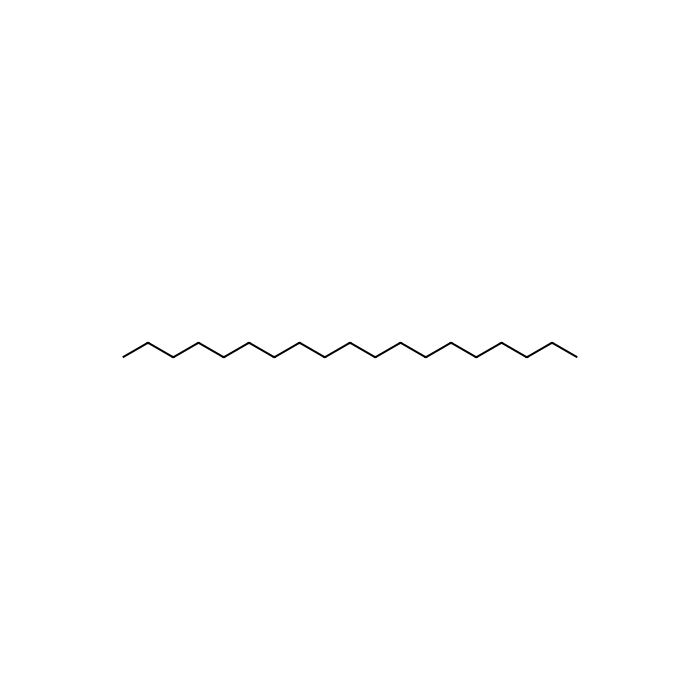
Common structural description: a linear, saturated C19 n-alkane consisting of a continuous chain of nineteen sp3-hybridized carbon atoms capped by terminal methyl groups (CH3–[CH2]17–CH3); no rings, no unsaturation, no heteroatoms, and no stereogenic centers.
Structural features and implications (general chemistry knowledge):
Functional groups: none beyond alkyl C–C and C–H bonds; chemically very inert under non-radical conditions.
Conformation: adopts extended zig-zag conformers in the solid and liquid phases; strong London dispersion interactions increase with chain length, raising mp/bp relative to shorter alkanes.
Polarity: nonpolar; dielectric constant very low; essentially zero dipole moment.
Synthetic Utility
General synthetic perspectives (literature):
Inert hydrocarbon backbone: Nonadecane provides a saturated C19 scaffold that can be selectively activated under radical or catalytic conditions to introduce functionality while preserving chain length, enabling access to C19-based surfactants, quaternary ammonium salts, amines, alcohols, and thiols after appropriate sequences.
Terminal functionalization: Radical bromination/chlorination can afford 1-halononadecanes (with some internal isomers), which serve as electrophiles for SN2 substitution (e.g., to form 1-nonadecanol, 1-nonadecylamine, 1-nonadecylthiol). Subsequent transformations provide ligands for SAMs on Au/Ag (thiols) or for constructing amphiphiles.
Controlled oxidation: Catalytic autoxidation or engineered C–H activation can introduce oxygen functionality (alcohols/ketones), though selectivity is challenging; typically of mechanistic rather than preparative interest.
Cracking/isomerization: Studies over zeolites or bifunctional catalysts use nonadecane as a model substrate to probe β-scission, skeletal isomerization, and hydrogen transfer pathways relevant to hydrocracking.
Analytical utility in synthesis:
Retention index markers: Inclusion of C19 in an n-alkane ladder allows consistent GC retention indexing across batches and laboratories, aiding identification of unknowns in reaction mixtures.
Handling note:
Because the melting point is near room temperature, weigh quickly on a cool surface to avoid smearing; alternatively, prepare solutions gravimetrically by syringe transfer of the molten/liquid phase.
Target Specificity
Not applicable. This product is a small-molecule hydrocarbon standard, not a biological affinity reagent. No antigen/epitope/clone/isotype information applies.
Item-specific note: No target specificity data are provided for this item.
We use cookies to ensure the website functions properly and, where permitted, to improve your experience. You can manage your preferences at any time in Settings. Learn more in our Cookie Policy.
Shall we send you a message when we have discounts available?
Remind me later
Thank you! Please check your email inbox to confirm.
Products are supplied to verified businesses, institutions, and qualified professionals for research and development use only. Not for use in humans, animals, diagnosis, or therapy.

 G2103227