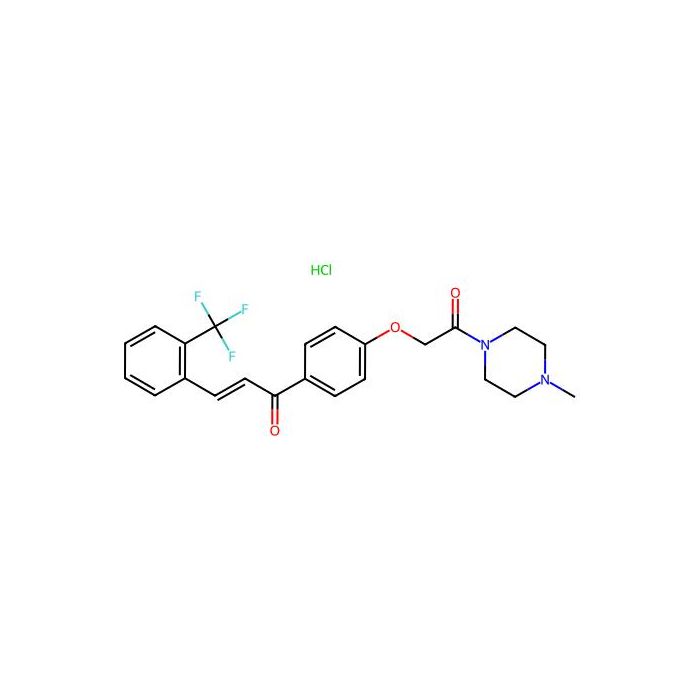
≥98% for sensitive chromatographic and analytical workflows requiring minimal baseline interference.
🌡
Storage & shipping
Store at 2-8°C,Protected from light,Desiccated Ships Wet ice Check lot-specific COA for exact specifications.
📋
Quality documents
SDS, COA, datasheet, and spec sheet available for download. Lot-specific COA accessible via lot number lookup.
📚
Literature proof
Cited in 0 peer-reviewed publications across chromatography, organic synthesis, and cross-coupling reactions.
Overview
Nrf2 activator-4 (Compound 20a) is a highly potent, orally active Nrf2 activator with an EC 50 of 0.63 µM. Nrf2 activator-4 suppresses reactive oxygen species against oxidative stress in microglia. Nrf2 activator-4 effectively recovers the learning and memory impairment in a scopolamine-induced mouse model
Form:Solid
IC50& Target:EC 50 : 0.63 µM (Nrf2)
Specifications
Specifications & Purity
≥98%
Biochemical and Physiological Mechanisms
Nrf2 activator-4 (Compound 20a) is a highly potent, orally active Nrf2 activator with an EC 50 of 0.63 µM. Nrf2 activator-4 suppresses reactive oxygen species against oxidative stress in microglia. Nrf2 activator-4 effectively recovers the learning and me
Storage
Store at 2-8°C,Protected from light,Desiccated
Shipped In
Wet ice
This product requires cold chain shipping. Ground and other economy services are not available.
Action Type
INHIBITOR
Purity
≥98%
Names and Identifiers
Molecular Weight
468.90
Documentation
📋 Safety Data Sheet (SDS)
Comprehensive hazard, handling, storage, and regulatory compliance document.
Determine the necessary mass, volume, or concentration for preparing a solution.
Dilution Calculator
Determine the dilution needed to prepare a stock solution.
Reconstitution Calculator
Reviews
Customer Reviews
Application Protocols
Only item-specific, vendor-tested protocols may be listed; none are provided in the Product Data for this SKU.
Item-specific recommended applications: Not specified for this item; refer to CoA/Spec Sheet.
Suggested starting points (general research guidance)
Prepare a sterile-filtered DMSO stock (e.g., 10–50 mM) if compatible; store as small aliquots at 2–8°C protected from light and moisture.
Perform an initial dose–response (e.g., 8–12 points, half-log spacing) with an ARE-reporter assay and qPCR confirmation of Nrf2 targets (NQO1, HMOX1) at 4–24 h.
Include vehicle controls and a literature positive control to benchmark performance.
These general steps are provided for planning only; consult your institutional protocols and this item’s CoA/SDS for definitive instructions.
Biological Roles
General pathway context (literature)
Nrf2 (NFE2L2) is a transcription factor that drives antioxidant response element (ARE)-regulated genes controlling redox homeostasis, xenobiotic metabolism, and proteostasis. Under basal conditions, Nrf2 is ubiquitinated by the Keap1–Cul3–Rbx1 complex and degraded. Nrf2 activators typically stabilize Nrf2 by modifying Keap1 cysteines or disrupting the Nrf2–Keap1 interface, increasing nuclear Nrf2 and ARE-driven transcription.
Experimental readouts (general)
Upregulation of NQO1, GCLM/GCLC, HMOX1, and AKR family members at mRNA/protein levels.
Functional biomarkers: increased glutathione pools (GSH/GSSG ratio), reduced ROS under stress, and elevated ARE-reporter activity.
Selectivity considerations (general)
Electrophilic activators may react with diverse cysteine-containing proteins; interpret phenotypes alongside counterscreens and genetic controls (Nrf2 or Keap1 perturbation).
Noncovalent PPI inhibitors (Keap1–Nrf2) can show distinct kinetics and may require different dosing paradigms.
Item-specific biological data
None provided in Product Data (no EC50, target engagement, or selectivity panel). Users should determine potency and specificity under their assay conditions.
This information is provided for research planning only; no clinical or therapeutic claims are made or implied.
Buffer Applications
This product is a bioactive small molecule and not a buffering reagent. Consequently:
It is not used to set or maintain pH and has no defined buffering range.
Prepare working solutions by diluting concentrated stocks (commonly in DMSO) into your chosen biological buffer (e.g., PBS, HBSS, culture media) while keeping final organic solvent content minimal and constant across controls.
For experiments requiring stable pH during Nrf2 pathway assays, select an established buffer system appropriate for your model (e.g., HEPES- or MOPS-buffered media) and validate that the chosen buffer does not interfere with your readouts.
Green Alternatives
This product is a bioactive small molecule rather than a process solvent. “Green alternative” considerations thus focus on solvent and handling choices during use, not on replacing the active itself.
Greener solvent considerations (general)
Prefer aqueous buffers with minimal DMSO (≤0.1–0.5% v/v) where assay tolerance allows.
When organic co-solvent is required, select lower-toxicity options (ethanol) at minimal percentages, balancing solubility and biological compatibility.
For LC sample prep, use water/ethanol or water/acetonitrile on short gradients to minimize solvent consumption.
Waste minimization
Prepare small, single-use aliquots to avoid discard from repeated freeze–thaw.
Scale assays to microplate formats (96/384-well) to reduce reagent and solvent volumes.
Comparison (general)
DMSO vs ethanol: DMSO offers superior solvency for hydrophobic molecules but carries higher environmental persistence; ethanol is greener but may not dissolve all scaffolds.
ACN vs MeOH for LC: ACN has favorable viscosity and UV cutoffs; MeOH is more benign but may compromise separation depending on method.
Because the exact structure is undisclosed here, no life-cycle or hazard-based substitution recommendations can be made for the active compound itself. Consult your EHS group to tailor greener workflows for your application.
Pharmaceutical Uses
This product is supplied strictly for research use only and is not intended for human or veterinary use.
Formulation/excipient status
No pharmacopeial monograph or excipient designation is provided for this item. Do not use in pharmaceutical manufacturing.
Laboratory formulation context (research only)
When needed for in vivo research models, investigators typically prepare DMSO-based concentrates diluted into biocompatible vehicles (e.g., PEG400/saline, 10–20% Captisol, or 0.5% methylcellulose for oral gavage). Selection must be justified and validated by the end user; this catalog does not endorse or specify such uses.
Compliance
Not for clinical, diagnostic, or therapeutic applications. No medical claims are made. Consult institutional IACUC/IRB and EHS guidelines for any nonclinical in vivo work.
Physical Properties
Item-specific (from Product Data)
Appearance: Not specified for this item; refer to CoA/Spec Sheet.
Molecular weight: Not specified for this item; refer to CoA/Spec Sheet.
Molecular formula: Not specified for this item; refer to CoA/Spec Sheet.
Melting point: Not specified for this item; refer to CoA/Spec Sheet.
Boiling point: Not specified for this item; refer to CoA/Spec Sheet.
Density: Not specified for this item; refer to CoA/Spec Sheet.
Refractive index: Not specified for this item; refer to CoA/Spec Sheet.
Solubility: Not specified for this item; refer to CoA/Spec Sheet.
LogP/LogD, pKa: Not specified for this item; refer to CoA/Spec Sheet.
Practical guidance (general; for small-molecule screening compounds)
Many Nrf2-pathway activators are hydrophobic and prepared as concentrated DMSO stocks (e.g., 10–50 mM) for bioassays; verify actual solubility for this item before preparation.
If aqueous work is required, consider co-solvent systems (DMSO 0.1–1% v/v final in assay buffer) or cyclodextrin inclusion as appropriate. Always confirm compatibility with your biological system.
Verification
For definitive physical constants and chromatographic identity criteria (HPLC/UPLC, NMR), consult the CoA for the specific lot supplied. Do not treat literature values for other Nrf2 activators as applicable to this material.
Quality & Grades
Item-specific grade/purity
Grade/Purity: Not specified for this item; refer to CoA/Spec Sheet.
What to expect for small-molecule screening compounds
Screening-grade bioactives are typically supplied with identity confirmation (e.g., 1H NMR, LC-MS, HPLC purity). Exact analytical methods and acceptance criteria are lot-specific—verify in the CoA.
If low-UV background is critical for optical assays, request chromatograms/spectra to ensure suitability.
Stabilizers and additives
Not specified for this item; refer to CoA/Spec Sheet. If present, stabilizers will be listed on the CoA/SDS and may influence assay design (e.g., BHT for oxidative stability, residual solvent content).
Fit-for-purpose guidance
For target validation or high-content screening, confirm HPLC purity and identity by orthogonal methods if needed (NMR/HRMS).
For quantitative biochemistry, verify water content (Karl Fischer) and residual solvent profile where matrix-sensitive assays are planned.
Documentation
This product is designated For research use only. No clinical or diagnostic use. Request lot-specific CoA and Spec Sheet for definitive acceptance criteria and analytical results.
Reaction & Applications
Item-specific applications from catalog: Not provided.
Research applications (general for Nrf2-activating small molecules; non-clinical)
Mechanistic studies of the Nrf2/Keap1–ARE pathway: quantify induction of downstream antioxidant/detox genes (e.g., NQO1, GCLC) via qPCR, reporter assays, or proteomics.
Chemical biology: probe covalent or noncovalent disruption of the Nrf2–Keap1 interaction using biophysical assays (TR-FRET, FP) or activity-based protein profiling.
Oxidative stress models: pre-treatment paradigms in cell culture to study redox-responsive signaling and metabolic reprogramming; monitor ROS, glutathione, and ARE-driven transcription.
Phenotypic screening: evaluate cytoprotective pathways, electrophile response, and metabolic adaptation using high-content imaging and transcriptomics.
Practical tips (general)
Prepare concentrated DMSO stock; verify solubility at working concentrations and monitor for precipitation after dilution into media/buffer.
For covalent activators, preincubation times (e.g., 0.5–2 h) can be critical for target engagement; optimize dose–response and time-course.
Include controls: vehicle control (DMSO), positive control Nrf2 activator (literature standard), and Nrf2/Keap1 perturbation controls (e.g., siRNA/CRISPR) to confirm pathway specificity.
Consider off-target electrophile reactivity; run counterscreens (e.g., for cytotoxicity, thiol reactivity) to contextualize results.
Note: No item-specific potency (EC50) or selectivity data are provided in the Product Data.
Reaction Conditions
Not typically applicable. This product is provided as a bioactive small molecule for biological assays, not as a reagent for chemical synthesis.
If you plan chemical modification or conjugation of this compound, you must first obtain the precise structure and functional-group profile from the CoA/Spec Sheet. Only then can appropriate reaction solvents, temperatures, catalysts, and workups be defined.
For biological experiments (general handling conditions)
Stock solution: commonly prepared in DMSO at 10–50 mM (optimize based on actual solubility for this item).
Working concentrations: establish dose–response spanning submicromolar to tens of micromolar, with pathway-relevant readouts and cytotoxicity counterscreens.
Incubation: preincubation 0.5–2 h is typical for covalent pathway activators; verify kinetics in your system.
No item-specific synthetic reaction conditions are available in the Product Data.
Safety & Handling
Item-specific hazard data
Signal word: Not specified for this item; refer to SDS.
GHS classification: Not specified for this item; refer to SDS.
Pictograms/H-statements: Not specified for this item; refer to SDS.
General laboratory precautions (for research small molecules)
Use in a chemical fume hood; avoid inhalation, ingestion, and skin/eye contact.
Since many Nrf2 activators can be electrophilic, avoid contact with reducing agents, free thiols, and amines unless required by protocol; minimize exposure time and cap containers promptly.
First-aid overview (general)
Skin/eye contact: Rinse with water for at least 15 minutes; remove contaminated clothing; seek medical attention as needed.
Inhalation: Move to fresh air; seek medical attention if symptoms occur.
Ingestion: Rinse mouth; do not induce vomiting; seek medical attention.
Handling and incompatibilities (general)
Protect from light and moisture (per storage guidance). Use dry, inert conditions when preparing stock solutions if stability is unknown.
Avoid strong oxidizers or nucleophiles unless specified by your protocol.
Always consult the item’s SDS for authoritative hazard and response information. Dispose of waste according to institutional and local regulations.
Solvent Selection
Because the exact structure is not disclosed here, solvent recommendations are provided as general guidance for small-molecule Nrf2-pathway activators.
Polarity and miscibility (general)
DMSO: Broadly useful for hydrophobic bioactives; miscible with water and most organic solvents; typical stock 10–50 mM.
DMF/NMP: Alternative high-boiling polar aprotic solvents when DMSO is incompatible; ensure biocompatibility at final assay concentrations.
Ethanol/Acetonitrile: Useful co-solvents for HPLC preparation and certain biochemical assays; monitor final % in aqueous media.
Aqueous buffers: Often require ≤1% v/v organic co-solvent for solubilization; consider surfactant-free approaches first to avoid biological confounders.
Practical selection tips
Start with DMSO for primary stock, then dilute into assay buffer to achieve ≤0.1–0.5% DMSO final if possible.
If precipitation occurs on dilution, consider: warm to room temperature, add in small aliquots with mixing, or include minimal ACN/EtOH as a co-solvent.
For long-term reference stocks, aliquot and store cold, protected from light and moisture; avoid repeated freeze–thaw.
Small comparison (general)
DMSO: highest solvency, acceptable in most cell assays at ≤0.1–0.5%.
ACN: volatile, LC-friendly, but poorer solvency for nonpolar compounds vs DMSO.
EtOH: biocompatible at low % but may affect membrane integrity above ~0.5–1%.
Always confirm solvent compatibility with your specific assay and this item’s CoA/SDS.
Storage & Reconstitution
Item-specific storage (from Product Data)
Store at 2–8°C, protected from light, desiccated.
Shipped on wet ice.
General reconstitution guidance (for small-molecule bioactives)
Allow container to equilibrate to room temperature in a desiccator before opening to avoid moisture condensation.
Prepare a concentrated stock in an anhydrous, compatible solvent (commonly DMSO) after confirming solubility for this specific item.
Filter sterilize if required for cell-based assays (compatible solvent permitting) using PTFE or PVDF syringe filters.
Aliquot stocks into amber vials or light-protective tubes to minimize photodegradation; avoid repeated freeze–thaw cycles.
Stability notes
Exact stability, hygroscopicity, and light-sensitivity parameters are not specified for this item; refer to CoA/Spec Sheet and SDS. When in doubt, maintain cold, dry, and dark conditions and monitor by HPLC.
Disposal
Dispose of unused material and solutions according to institutional chemical waste procedures and local regulations.
Research use only.
Structure & Identity
Brief overview: This listing is a research small molecule designated “Nrf2 activator-4,” supplied for screening and mechanistic studies related to the Nrf2/Keap1 antioxidant response pathway.
Item-specific (from Product Data)
CAS: 2383016-68-8
Molecular formula: Not specified for this item; refer to CoA/Spec Sheet.
Molecular weight: Not specified for this item; refer to CoA/Spec Sheet.
SMILES: Not specified for this item; refer to CoA/Spec Sheet.
InChIKey: Not specified for this item; refer to CoA/Spec Sheet.
Synonyms: Not specified for this item; refer to CoA/Spec Sheet.
Structural features (general context for Nrf2 activators; literature)
Many small-molecule Nrf2 activators function by modifying sensor cysteines on Keap1 (e.g., electrophilic Michael acceptors, isothiocyanates, dithiolethiones). Specific functional groups for this item are not provided.
The Nrf2 pathway is controlled by the Keap1–Cul3–Rbx1 E3 ligase complex; activators often disrupt Nrf2–Keap1 interaction or alter Keap1 redox state.
2D structure description
Not available for this catalog item. Obtain structure from the CoA/Spec Sheet or inquire with Technical Support.
Notes
Because the exact structure is not disclosed here, do not infer functional groups, stereochemistry, or ionization behavior without consulting the item’s CoA/SDS.
Synthetic Utility
This catalog item is positioned as a bioactive “Nrf2 activator-4” for screening and mechanistic studies, not as a general synthetic building block.
Applicability to synthesis
Without a disclosed structure, no functional-group guidance or reactivity profile can be provided for use as a reagent, coupling partner, or intermediate.
If users intend to derivatize or immobilize the compound, obtain the structure and purity profile from the CoA/Spec Sheet and evaluate compatibility with planned transformations.
General note (chemical biology)
Researchers sometimes append reporter tags or linkers to Nrf2-activator scaffolds for pull-downs or imaging. Such derivatization requires knowledge of structure–activity relationships to avoid abolishing pathway engagement; this information is not available for the present item.
Conclusion: Treat this product as a finalized probe/ligand for biological investigation rather than a synthetic precursor, unless detailed structural information is obtained from the supplier.
Target Specificity
Only item-specific information is permitted here. The Product Data provide no target-binding, epitope, or selectivity panel for this compound.
Item-specific
Target/Mechanism: Not specified for this item; refer to CoA/Spec Sheet.
Off-target profile: Not specified for this item; refer to CoA/Spec Sheet.
Note: While the product name suggests activity in the Nrf2 pathway, users must verify target engagement and specificity experimentally within their assay system.
Frequently Asked Questions
What is the purity of this product?
This product is supplied at ≥98% purity (chemical assay). Lot-specific values are stated on the Certificate of Analysis.
How should this product be stored?
Store at 2–8 °C, protected from light, desiccated. Keep the container tightly closed with desiccant — the material is moisture-sensitive.
How is this product shipped?
This product ships chilled on wet ice. Unpack on arrival and transfer it to the storage condition stated above.
What are the CAS number, molecular formula and molecular weight?
The CAS Number is 2383016-68-8, the molecular formula is C23H24ClF3N2O3, and the molecular weight is 468.90 g/mol.
What documentation is provided?
Available product documentation, including Certificates of Analysis (COA), Safety Data Sheets (SDS), and specification sheets, is shown in the product document area. Document availability and access follow the current site policy.
We use cookies to ensure the website functions properly and, where permitted, to improve your experience. You can manage your preferences at any time in Settings. Learn more in our Cookie Policy.
Shall we send you a message when we have discounts available?
Remind me later
Thank you! Please check your email inbox to confirm.
Products are supplied to verified businesses, institutions, and qualified professionals for research and development use only. Not for use in humans, animals, diagnosis, or therapy.