GRADE & PURITYMoligand™?Moligand™ — Aladdin's line of ligands and bioactive small molecules. Use for receptor, pathway, and binding studies needing defined small-molecule tools.≥98%
Potent KCa3.1 channel blocker (IC50values are 9, 14 and 15 nM for rat, human and mouse erythrocyte KCa3.1 channels respectively). Exhibits ~ 50% inhibition of KCa1.1, KV1.3, and KV11.1 channels, noradrenaline and dopamine transporters, L-type Ca2+channels
Storage
Store at -20°C
Shipped In
Ice chest + Ice pads
This product requires cold chain shipping. Ground and other economy services are not available.
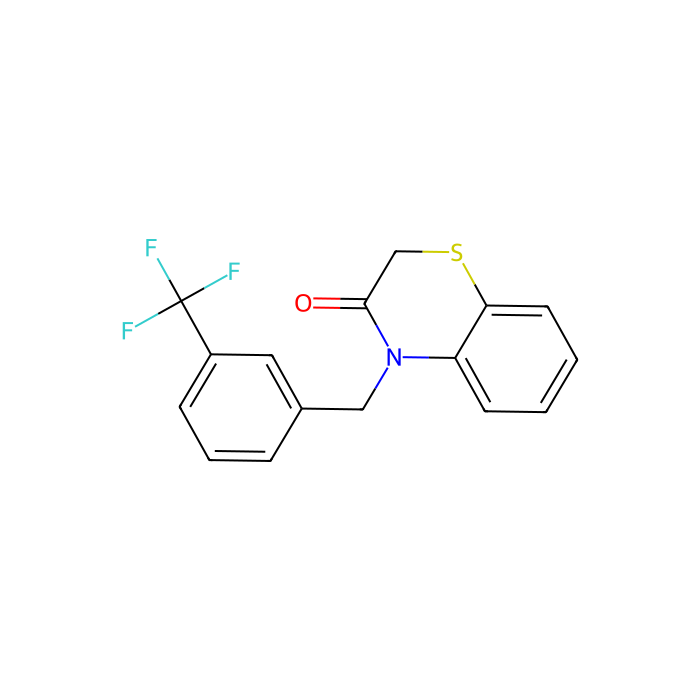
This compound belongs to the class of organic compounds known as benzothiazines. These are organic compounds containing a benzene fused to a thiazine ring (a six-membered ring with four carbon atoms, one nitrogen atom and one sulfur atom).
External Descriptors
Not available
1. Djoumbou Feunang Y, Eisner R, Knox C, Chepelev L, Hastings J, Owen G, Fahy E, Steinbeck C, Subramanian S, Bolton E, Greiner R, and Wishart DS. ClassyFire: Automated Chemical Classification With A Comprehensive, Computable Taxonomy. Journal of Cheminformatics, 2016, 8:61.
Solvent:DMSO, Max Conc. mg/mL: 32.33, Max Conc. mM: 100; Solvent:ethanol, Max Conc. mg/mL: 32.33, Max Conc. mM: 100
Molecular Weight
323.300 g/mol
XLogP3
4.000
Hydrogen Bond Donor Count
0
Hydrogen Bond Acceptor Count
5
Rotatable Bond Count
2
Exact Mass
323.059 Da
Monoisotopic Mass
323.059 Da
Topological Polar Surface Area
45.600 Ų
Heavy Atom Count
22
Formal Charge
0
Complexity
415.000
Isotope Atom Count
0
Defined Atom Stereocenter Count
0
Undefined Atom Stereocenter Count
0
Defined Bond Stereocenter Count
0
Undefined Bond Stereocenter Count
0
The total count of all stereochemical bonds
0
Covalently-Bonded Unit Count
1
Solution Calculators
Molarity Calculator
Determine the necessary mass, volume, or concentration for preparing a solution.
Dilution Calculator
Determine the dilution needed to prepare a stock solution.
Reconstitution Calculator
Reviews
Customer Reviews
Application Protocols
Only product data may be reported in this section.
Tested applications: Not specified for this item; refer to CoA/Spec Sheet.
Recommended concentrations/dilutions: Not specified for this item; refer to CoA/Spec Sheet.
Positive controls/standards: Not specified for this item; refer to CoA/Spec Sheet.
General note: When developing new assays with small-molecule tool compounds, establish vehicle controls, concentration–response curves, and orthogonal readouts to confirm on-target activity.
Biological Roles
General literature context (not product-specific claims):
NS 6180 is cited in the literature as a small-molecule modulator used in ion-channel research, commonly associated with studies of intermediate-conductance Ca2+-activated K+ channels (KCa3.1, gene KCNN4). Investigators employ such compounds to probe channel function, membrane potential regulation, and Ca2+-dependent signaling in various cell types.
Typical research applications include: dissecting roles of K+ flux in immune cell activation, epithelial transport, and vascular or hematopoietic cell physiology; benchmarking selectivity against related channels to understand off-target liabilities.
As with all tool compounds, context-specific potency, selectivity, and functional effects depend on species, expression system, and assay conditions; verify primary literature and your batch CoA before critical experiments.
Important notes:
For research use only. Not for human or veterinary use, diagnostic procedures, or clinical applications.
No claims are made here about therapeutic efficacy or safety. Users should establish their own experimental conditions and controls.
Buffer Applications
This item is a small-molecule research tool rather than a buffering agent. It is not used to set or maintain pH.
Practical guidance for assay buffers (general):
Prepare compound stocks in DMSO and dilute into assay buffer (e.g., HEPES, PBS) maintaining a constant vehicle percentage across conditions.
Pre-screen for precipitation by visual inspection and, if critical, by nephelometry or light scattering.
Maintain pH and ionic strength appropriate for your biological readout; include serum or protein carriers (e.g., 0.1% BSA) if nonspecific binding is an issue.
Green Alternatives
Because NS 6180 is a research tool compound rather than a solvent or reagent, “green alternative” considerations center on solvent and process choices for handling and assays.
Greener handling strategies (general guidance):
Prefer water and aqueous buffers with minimal DMSO content (≤0.1–0.2% v/v) when solubility and assay design allow.
Replace DMF/NMP with DMSO or ethanol where feasible due to lower toxicity profiles and easier waste management.
Minimize halogenated solvent use (e.g., dichloromethane) for any purification or sample prep; consider ethyl acetate, isopropanol, or methyl tert-butyl ether when compatible.
Scale-down screening volumes (96/384/1536-well formats) to reduce solvent use and waste.
Illustrative comparison (general; not item-specific):
DMSO vs DMF/NMP: DMSO typically offers a better balance of solvency and biocompatibility; DMF/NMP present higher EHS concerns.
Ethanol vs methanol: ethanol is generally preferred from a safety standpoint, provided assay tolerance and solubility are acceptable.
Waste and EHS:
Segregate DMSO/organic solvent waste; avoid mixing with oxidizers. Consult local regulations for disposal to minimize environmental impact.
Pharmaceutical Uses
No pharmacopeial/excipient role is specified for this catalog item. NS 6180 is supplied for research use only as a small-molecule tool compound.
General notes for formulation research (non-clinical, not item-specific):
For in vitro work, DMSO stocks diluted into aqueous buffers are common; for nonclinical in vivo method development, cosolvent systems (e.g., PEG400/ethanol/saline) or cyclodextrin inclusion complexes are sometimes evaluated—but such use requires dedicated safety review and is outside the scope of this catalog listing.
This product is not manufactured to GMP standards and is not intended for therapeutic, diagnostic, or human/animal administration.
Physical Properties
Item-specific constants:
Appearance: Not specified for this item; refer to CoA/Spec Sheet.
Melting/boiling point: Not specified for this item; refer to CoA/Spec Sheet.
Density: Not specified for this item; refer to CoA/Spec Sheet.
Solubility: Not specified for this item; refer to CoA/Spec Sheet.
LogP/logD: Not specified for this item; refer to CoA/Spec Sheet.
pKa: Not specified for this item; refer to CoA/Spec Sheet.
Refractive index/UV cutoff: Not specified for this item; refer to CoA/Spec Sheet.
General/literature guidance for small-molecule screening compounds (not item-specific):
Many tool compounds are sparingly water-soluble and are commonly prepared as concentrated DMSO stocks (e.g., 10–50 mM) and diluted into assay buffers to ≤0.1–0.5% DMSO final.
Solubility can depend strongly on salt form and polymorph; verify the lot-specific form in the CoA.
If UV–Vis studies are required, determine the compound’s absorption profile experimentally to avoid interference near assay wavelengths.
Quality & Grades
Grade: Moligand™ (as provided). Moligand designates Aladdin Scientific’s small-molecule ligand/tool compound line, intended for research and screening use.
Purity: Not specified for this item; refer to CoA/Spec Sheet.
Stabilizers/inhibitors: Not specified for this item; refer to CoA/Spec Sheet.
What this means for your work (general guidance):
Moligand products are intended for target engagement, probe validation, and SAR studies. Lots typically include LC–MS purity data and may include NMR on request; confirm on the lot-specific CoA.
Chromatographic cleanliness and low residual solvent levels are important for biological assays; verify residual solvent and impurity profiles if your assay is sensitive.
For quantitative pharmacology or biophysics, request batch analytical data (purity %, identity, water content, counterion/solid form) to ensure reproducibility.
Documentation to consult:
Batch CoA (purity assay, identity confirmation, form).
SDS (hazards, handling, disposal).
Reaction & Applications
This product is offered as a small-molecule research tool (Moligand™ line) rather than as a synthetic reagent. Consequently, it is not typically used to promote or participate in named organic transformations in preparative chemistry.
Applications (general, literature-oriented for NS 6180 as a tool compound):
Utilized in ion-channel research as a selective small-molecule probe in cell-based and electrophysiological assays to study K+ channel function and downstream signaling. Verify exact target and selectivity in primary sources for your application.
Employed in pharmacology and chemical biology studies for target validation, SAR benchmarking, off-target profiling, and comparative potency analyses.
Practical guidance:
Prepare high-quality DMSO stocks, verify concentration by UV–Vis or quantitative NMR if needed, and confirm stability over your assay timeframe.
Use appropriate controls (vehicle, inactive analogs, and positive controls) and perform concentration–response experiments to determine potency and efficacy in your assay system.
If your goal is synthetic derivatization or scaffold modification, consult the structure on the CoA and literature precedents; this catalog item is not positioned primarily as a building block.
Reaction Conditions
Not typically applicable. NS 6180 is supplied as a research tool compound, not as a reagent for promoting chemical reactions.
Assay preparation conditions (general best practices, not item-specific):
Stock solutions: Dissolve in anhydrous DMSO (e.g., 10–50 mM). Warm gently and sonicate if needed. Filter (0.2 µm) to remove particulates for biophysical assays.
Working concentrations: Prepare serial dilutions to span expected potency; maintain constant vehicle percentage across wells/samples.
Stability: Minimize light and moisture exposure during handling; verify stability over the assay duration by analytical spot checks when feasible.
Storage/aliquoting: Store frozen aliquots to avoid repeated freeze–thaw; see Storage tab for item-specific storage temperature.
Safety & Handling
Hazard information (as provided for this item):
Signal word: Not specified for this item; refer to SDS.
H-statements: Not specified for this item; refer to SDS.
GHS classification/pictograms: Not specified for this item; refer to SDS.
General laboratory safety (not item-specific; follow your institutional EHS policies):
Use in a chemical fume hood; avoid inhalation, ingestion, and skin/eye contact.
Avoid incompatible materials until SDS is reviewed; typical precautions include keeping away from strong oxidizers and bases/acids unless stability is known.
First aid (overview; defer to SDS): rinse eyes/skin with water for ≥15 minutes if exposed; remove contaminated clothing; seek medical evaluation if symptoms persist; if inhaled, move to fresh air; if ingested, do not induce vomiting unless directed by medical personnel.
Spill/cleanup: absorb liquids with inert media; collect solids with minimal dust generation; dispose of waste according to local regulations.
Always consult the product’s SDS for authoritative hazard, toxicological, and disposal guidance.
Solvent Selection
Item-specific solubility is not provided for this catalog entry. The following are general best practices for small-molecule tool compounds used in screening and biophysical assays:
Primary stock solvents:
DMSO: preferred for initial 10–50 mM stocks due to broad solvating power and biological compatibility at ≤0.1–0.5% v/v in assays.
DMF or NMP: optional for difficult solutes; verify assay compatibility and cytotoxicity.
Ethanol (absolute) or methanol: useful for intermediate stocks if aqueous precipitation occurs; check assay tolerance.
Aqueous vehicles:
Use co-solvent strategies (e.g., DMSO 0.1–1% + buffer, or DMSO + PEG400 + saline) to mitigate precipitation.
Include surfactants (e.g., 0.01–0.05% Tween-80 or Triton X-100) only if validated for your readout.
pH considerations:
If the compound is ionizable, modest pH adjustments can enhance solubility; confirm pKa from literature or experimentally.
Practical tips:
Warm and sonicate DMSO stocks to aid dissolution; filter 0.2 µm if needed.
DMSO vs DMF: DMSO is generally less volatile and better tolerated biologically; DMF may solubilize some hydrophobic scaffolds more effectively but is often less assay-compatible.
Storage & Reconstitution
Item-specific conditions (as provided):
Storage conditions: Store at -20°C.
Shipped in: Ice chest + ice pads.
Appearance: Not specified for this item; refer to CoA/Spec Sheet.
Reconstitution solvent/concentration: Not specified for this item; refer to CoA/Spec Sheet.
General best practices (not item-specific):
Upon receipt, allow the sealed container to equilibrate to room temperature before opening to prevent condensation. Reseal promptly under dry conditions.
For small-molecule tool compounds, prepare concentrated DMSO stocks (e.g., 10–50 mM) and aliquot into single-use vials to avoid freeze–thaw cycles.
Store aliquots at -20°C (or as directed on CoA); protect from light and moisture. Avoid repeated warming; thaw on ice and use immediately.
If preparing aqueous working solutions, use freshly the same day or confirm stability by LC–MS.
Always consult the batch CoA and SDS for any additional, lot-specific instructions.
Structure & Identity
Product name: NS 6180 (SKU: N288469)
CAS: 353262-04-1
PubChem CID: 11837221 (identifier reference; verify structure in primary databases)
InChIKey: 466708 (as provided; note this is not a standard-length InChIKey)
Molecular formula: Not specified for this item; refer to CoA/Spec Sheet.
Molecular weight: Not specified for this item; refer to CoA/Spec Sheet.
SMILES: Not specified for this item; refer to CoA/Spec Sheet.
NS 6180 is cited in the literature as a small-molecule ion-channel modulator used as a research tool compound. Detailed functional groups, ring systems, and stereochemical elements should be confirmed against the current CoA/SDS for this catalog lot.
Notes for identity confirmation (general best practice):
Verify by orthogonal identifiers (CAS, CID, vendor SKU) and, where available, by LC–MS, 1H/13C NMR, and HRMS against the CoA.
Ensure the batch-specific CoA provides structure-defining data (purity trace, mass spectrum, and, when applicable, NMR).
Synthetic Utility
This product is offered as a finished research tool compound and is not positioned as a synthetic building block.
General considerations if derivatization is contemplated (literature/generic guidance):
Consult the verified structure (CoA/SDS or primary database) to identify modifiable positions and functional groups amenable to late-stage diversification (e.g., aryl halides for cross-coupling, amines/amides for acylation or sulfonylation, heterocycles for N-oxidation/alkylation). Applicability depends entirely on the actual scaffold.
For SAR exploration, retain motifs critical for target binding while varying peripheral substituents to tune solubility, lipophilicity, and metabolic stability.
Employ robust analytical confirmation (LC–MS, NMR, HRMS) for any analogs.
If your goal is to use NS 6180 as a reagent or catalyst, note that such use is atypical; consider procuring dedicated reagents designed for the intended transformation.
Target Specificity
Only product data may be reported in this section.
Target/antigen: Not specified for this item; refer to CoA/Spec Sheet.
Species reactivity/selectivity: Not specified for this item; refer to CoA/Spec Sheet.
Assay-validated targets or off-targets: Not specified for this item; refer to CoA/Spec Sheet.
Note: For literature context on potential biological targets of NS 6180, please consult peer-reviewed sources; such details are not included here because they are not specified in the product data.
Need help choosing the grade?
Our grade selection guide covers purity, stabilizer status, and application suitability for all variants in our catalog.
We use cookies to ensure the website functions properly and, where permitted, to improve your experience. You can manage your preferences at any time in Settings. Learn more in our Cookie Policy.
Shall we send you a message when we have discounts available?
Remind me later
Thank you! Please check your email inbox to confirm.
Products are supplied to verified businesses, institutions, and qualified professionals for research and development use only. Not for use in humans, animals, diagnosis, or therapy.

 J2129934