Perfluoro(methylcyclohexane) can be used as: A reactant to synthesize perfluoro-2-methylcyclohex-1-enolate by photochemical reaction with tetrabutylammonium iodide in water. A fluorous solvent to synthesize polynorbornene via ring-opening metathesis polymerization (ROMP) of norbornene using fluorous Grubbs′ second-generation catalyst. It can also be used as a solvent to investigate fluorophilicity of a series of hydrocarbon and fluorocarbon-functionalized nicotinic acid esters.
This compound belongs to the class of organic compounds known as cyclohexyl halides. These are organohalogen compounds containing a monocyclic cyclohexane moiety that is substituted at one or more positions by an halogen atom.
External Descriptors
Not available
1. Djoumbou Feunang Y, Eisner R, Knox C, Chepelev L, Hastings J, Owen G, Fahy E, Steinbeck C, Subramanian S, Bolton E, Greiner R, and Wishart DS. ClassyFire: Automated Chemical Classification With A Comprehensive, Computable Taxonomy. Journal of Cheminformatics, 2016, 8:61.
Determine the necessary mass, volume, or concentration for preparing a solution.
Dilution Calculator
Determine the dilution needed to prepare a stock solution.
Reconstitution Calculator
Reviews
Customer Reviews
Application Protocols
No assay/application protocols are provided for this item. As a general laboratory solvent/medium, procedures are application-specific. For fluorous biphasic work, a typical workflow (literature/general) is:
Charge the reactor with substrate in an organic solvent and the fluorous-tagged catalyst dissolved in perfluoro(methylcyclohexane) (2-phase system, 1:1 to 1:4 v/v PFMC:organic).
Stir vigorously (interfacial area) at the selected temperature until conversion is complete (monitor by GC or NMR).
Allow phases to separate; retain the PFMC phase to recycle catalyst. Wash and replenish PFMC as required.
For any other use cases (heat transfer, cleaning, microfluidics), consult method-specific SOPs and materials-compatibility charts. Always defer to the SDS and CoA for handling and quality details.
Biological Roles
Perfluoro(methylcyclohexane) is a fully fluorinated hydrocarbon with no natural biological role.
General biochemical considerations (literature/general):
Inertness: Lacks functional groups for enzyme interaction; not metabolized under normal biological conditions.
Solubility behavior: Extremely hydrophobic and lipophobic, leading to negligible solubility in aqueous media and limited partitioning into lipid phases compared with hydrocarbons.
Gas transport: Like other perfluorocarbons, exhibits high capacities for dissolved gases (e.g., O2, CO2). This property is of research interest in studying gas transfer phenomena and emulsions, but no clinical or therapeutic claims are made or implied here.
Toxicology: Typically low acute systemic toxicity in laboratory animals has been reported for related perfluorocarbons; main hazards are physical (aspiration/ventilation displacement) and decomposition products at high temperature (HF, COF2) (literature/general).
Usage note: This product is for research use only. It is not intended for food, drug, household, or cosmetic applications.
Buffer Applications
Not typically applicable. Perfluoro(methylcyclohexane) is a nonpolar, water-immiscible solvent with no acid/base buffering capacity. For aqueous work, select appropriate buffer systems (e.g., phosphate, Tris, HEPES) detailed elsewhere; for this product, see the Solvent Selection and Reaction & Applications sections for relevant uses in biphasic and fluorous systems.
Green Alternatives
Environmental profile (general): Perfluorocarbons (PFCs) are persistent, bioaccumulative-resistant, and often have high global warming potentials (GWP). While PFMC is chemically inert and non-ozone-depleting, its persistence suggests minimizing emissions and solvent loss.
Potential alternatives and tradeoffs (literature/general):
Pros: Very low GWP; non-ozone-depleting; good physical properties for cleaning/heat-transfer.
Cons: Can be mildly flammable or form flammable blends; less inert, different materials compatibility; limited miscibility profile for fluorous-tagged chemistry.
Alternative: Perfluorohexane (C6F14) or perfluorodecalin
Pros: Similar inertness; choose bp/viscosity to optimize process; widely documented.
Cons: Still PFCs with persistence and high GWP.
Best practices for greener use of PFMC (general):
Employ closed-loop systems with efficient condensers to minimize vapor release.
Recycle/reuse via simple phase separations and fractional distillation.
Use the minimum effective volume; consider HFEs/HFOs when complete fluorous-phase behavior is not required.
Capture and treat off-gases; verify local regulations for PFCs.
Pharmaceutical Uses
No pharmacopeial/excipient status or formulation role is specified for this item.
General process-related context (non-therapeutic; literature/general):
Specialty processing aid: Perfluorocarbons are sometimes used as inert media for equipment leak testing, heat-transfer fluids for low-temperature operations, or as dense phases in device manufacturing. Such uses are process utilities rather than formulation components.
Cleaning/media displacement: Employed in some microelectronic or device fabrication workflows to displace water from intricate geometries due to low surface tension and chemical inertness.
Compliance note:
This product is supplied strictly for research and laboratory use. It is not intended for use in human or veterinary applications, drug formulations, or clinical procedures.
Physical Properties
Item-specific physico-chemical specifications were not provided in the product data. The following are typical literature/general properties for perfluoro(methylcyclohexane) (C7F14); do not treat these as product specifications.
Physical state/appearance: Typically a colorless, clear liquid (literature/general).
Boiling point: often reported in the mid-70s °C range at 1 atm (literature; values around ~76–78 °C are commonly cited for C7F14 isomers). Not specified for this item; refer to CoA/Spec Sheet.
Melting point: generally below room temperature (literature; exact values depend on isomer purity). Not specified for this item; refer to CoA/Spec Sheet.
Density: perfluorocarbons are characteristically dense; values for C7F14 are commonly ~1.75–1.80 g/mL at 25 °C (literature). Not specified for this item; refer to CoA/Spec Sheet.
Refractive index: low (typical nD ~1.28–1.30 for perfluoroalkanes; literature). Not specified for this item; refer to CoA/Spec Sheet.
Vapor pressure/volatility: moderate at ambient temperature (literature). Not specified for this item; refer to CoA/Spec Sheet.
Solubility: essentially immiscible with water and most polar organics; miscible with many perfluorinated solvents and some chlorofluorocarbons (literature). Not specified for this item; refer to CoA/Spec Sheet.
LogP/logS: conventional logP is of limited relevance; perfluorocarbons are both hydrophobic and lipophobic (literature/general).
Practical notes (general):
Very low surface energy and high gas solubility (O2, CO2) relative to hydrocarbons; useful for gas-transfer studies and biphasic systems.
Quality & Grades
Grade/Purity: Not specified for this item; refer to CoA/Spec Sheet.
Appearance: Not specified for this item; refer to CoA/Spec Sheet.
Context and implications (general guidance for perfluorocarbon solvents):
Research grade perfluorocarbons are typically distilled and filtered to remove particulates and adventitious metal ions; water content is inherently low due to immiscibility but can be controlled by phase separation and gas sparging.
Low-UV or HPLC grade specifications are uncommon for perfluorocarbons used as inert media; when present, they indicate low absorbance in the 200–300 nm range and tight controls on non-volatile residue.
Stabilizers/inhibitors: Perfluoroalkanes generally do not require stabilizers. If any stabilizer is present for a specific lot, it will be listed on the CoA/Spec Sheet (none specified here).
What to check on receipt:
Confirm identity by GC or 19F NMR if your application is sensitive to isomeric purity.
Review the CoA for assay (area %), water by Karl Fischer (if reported), non-volatile residue, acidity/fluoride (if reported), and density at 20/25 °C. If not listed, treat those as not specified for this item.
Reaction & Applications
Although chemically inert and not typically a reagent, perfluoro(methylcyclohexane) (PFMC) is valuable as a specialized reaction medium and process aid.
Representative applications (literature/general):
Fluorous biphasic catalysis: PFMC is used as the fluorous phase to solubilize perfluoroalkyl-tagged catalysts (e.g., fluorous versions of Wilkinson-type or palladium complexes). After reaction in contact with an organic phase, the catalyst partitions into PFMC, enabling facile separation and reuse.
Phase-switchable synthesis and scavenging: perfluoro-tagged reagents or scavengers are reacted in a conventional organic phase, then extracted into PFMC for removal, simplifying workup.
Gas–liquid reactions and mass transfer: exceptional O2 and CO2 solubility in perfluorocarbons can enhance gas delivery in biphasic oxidations or fermenter off-gas capture studies (research context only).
Heat-transfer and photochemistry medium: high transparency into the near-UV and thermal stability make perfluorocarbons suitable as inert immersion/irradiation media for photochemical apparatus (check material compatibility).
Practical tips:
Drying/degassing: water miscibility is negligible; routine drying is often unnecessary. For sensitive uses, sparge with dry N2/Ar and/or pass through activated alumina. Degas by vacuum/nitrogen cycling.
Partition control: adjust temperature and add small amounts of a co-solvent (fluorinated ether or HFE) to tune solubility of fluorous-tagged species if needed.
Materials compatibility: compatible with PTFE, FEP, PFA, glass, and many metals; can swell some elastomers—verify with manufacturer data.
Note: PFMC itself is not a typical reactant and generally does not participate in bond-forming chemistry under standard conditions.
Reaction Conditions
No item-specific reaction condition data are provided. The following general conditions are drawn from literature on fluorous biphasic catalysis and processing using perfluorocarbon solvents; treat these as guidance, not specifications.
Temperature: Ambient to ~120 °C is common for biphasic catalysis with perfluoro-tagged systems. Select temperature based on catalyst and desired rate; ensure operation below the solvent’s normal boiling point when using open systems.
Pressure: Typically atmospheric for liquid–liquid operations; apply inert gas back-pressure for gas–liquid reactions to control gas uptake and maintain phase volumes.
Solvent pairing: Combine PFMC with an organic phase (e.g., toluene, THF, acetonitrile) containing substrates. Add a small amount (1–10%) of a fluorous co-solvent (e.g., HFE) if increased solubility of perfluoro-tagged species is needed.
Catalysts: Fluorous-tagged Rh, Pd, and Ru complexes have been used for hydrogenations, hydrosilylations, and cross-couplings (literature). Homogeneous, but phase-separable via PFMC partitioning.
Workup: After reaction, allow phases to disengage; separate PFMC to retain catalyst, wash, and recycle. Distill the organic phase to isolate product as usual.
Yields/time: Highly system-dependent; typical small-molecule transformations proceed in 1–24 h with yields comparable to conventional homogeneous catalysis when mass transfer is optimized (literature/general).
Cautions:
Avoid strong nucleophiles or highly reducing metals at elevated temperature, which can promote defluorination of perfluorocarbons.
Verify elastomer compatibility (seals, septa) and use PTFE-lined components to prevent swelling and leaks.
Safety & Handling
GHS/SDS classifications were not provided in the product data for this item. Always review the SDS for authoritative hazard, response, and regulatory information.
General safety characteristics of perfluorocarbons (literature/general):
Typically regarded as having low acute toxicity and low chemical reactivity. However, they can displace air in confined spaces; treat as an asphyxiation hazard if large volumes are used without ventilation.
Thermal decomposition can generate toxic/corrosive species (e.g., HF, carbonyl fluoride, perfluoroisobutylene-like fragments). Avoid contact with hot surfaces, open flames, and strong reducing metals at elevated temperature.
Handling and PPE (good laboratory practice):
Use in a well-ventilated area or fume hood.
Wear appropriate PPE: safety glasses or splash goggles, lab coat, and chemical-resistant gloves (e.g., nitrile). For bulk handling, consider face shield.
Avoid aerosol formation; heavier-than-air vapors may accumulate in low areas.
Storage and incompatibilities:
Storage (product data): Room temperature; keep Cool and Desiccated. Store tightly closed to minimize uptake of atmospheric gases and moisture contamination.
Shipped in (product data): Normal conditions.
Incompatibilities (general): reactive alkali metals at elevated temperature, strong Lewis acids under forcing conditions, and strong oxidizers at high temperature.
First-aid overview (general):
Inhalation: move to fresh air; seek medical attention if symptoms persist.
Skin/eye contact: rinse with water for several minutes; remove contaminated clothing.
Ingestion: rinse mouth; do not induce vomiting; seek medical advice.
Defer to the SDS supplied with the product for definitive hazard and response guidance.
Solvent Selection
Perfluoro(methylcyclohexane) is a dense, highly inert, nonpolar perfluorocarbon solvent suited for specialized separations and biphasic reaction media.
Key solvent characteristics (literature/general):
Polarity: extremely low; virtually zero hydrogen-bond donor/acceptor capability.
Dielectric behavior: very low dielectric constant typical of perfluoroalkanes; poor solvator for ions and most organics.
Miscibility: immiscible with water and most hydrocarbons/ethers; miscible with other perfluorinated liquids and some chlorofluorocarbons.
Density/volatility: high density (sinks below water and hydrocarbons) with moderate volatility—use closed systems when possible.
When to choose PFMC:
As an inert, immiscible fluorous phase in fluorous biphasic catalysis or for phase-switchable separations of perfluoro-tagged reagents/catalysts.
For density-based separations (e.g., microfluidic droplet systems, flotation/sedimentation contrasts).
As a heat-transfer or cooling bath fluid where chemical inertness and electrical non-conductivity are desired (observe facility safety rules).
Comparison (general):
PFMC vs perfluorohexane (C6F14): PFMC has similar inertness with slightly different boiling range and viscosity; selection is often based on desired bp and handling.
PFMC vs perfluorodecalin: perfluorodecalin is higher boiling and more viscous; better for elevated temperature stability, less convenient for rapid solvent removal.
PFMC vs hydrocarbons (e.g., heptane): hydrocarbons dissolve many organics; PFMC is purposely poor at solvating organics but excels at dissolving fluorous-tagged compounds and gases.
Storage & Reconstitution
Storage conditions (product data): Room temperature; keep Cool and Desiccated. Store tightly sealed in inert-compatible containers (glass or fluoropolymer) to avoid contamination. Protect from excessive heat and ignition sources.
Shipped in (product data): Normal conditions.
Reconstitution: Not applicable; this product is supplied ready-to-use as a neat liquid solvent (appearance not specified).
Practical handling (general):
Keep container tightly closed to limit vapor losses and uptake of airborne particulates.
If ultra-low dissolved gas levels are desired, degas by sparging with high-purity nitrogen/argon or by freeze–pump–thaw cycles. For further purification, simple distillation under inert atmosphere is effective.
Drying: Water is immiscible; routine drying is unnecessary. If needed, separate any visible aqueous phase, then pass through activated alumina or fluoropolymer-compatible columns. Avoid reactive desiccants (e.g., sodium, potassium) that can react with perfluorocarbons at elevated temperature.
Minimize headspace to reduce evaporation; use PTFE-lined caps and fluoropolymer tubing/gaskets where possible.
Always consult the CoA/Spec Sheet for any lot-specific guidance and the SDS for safety-related storage information.
Structure & Identity
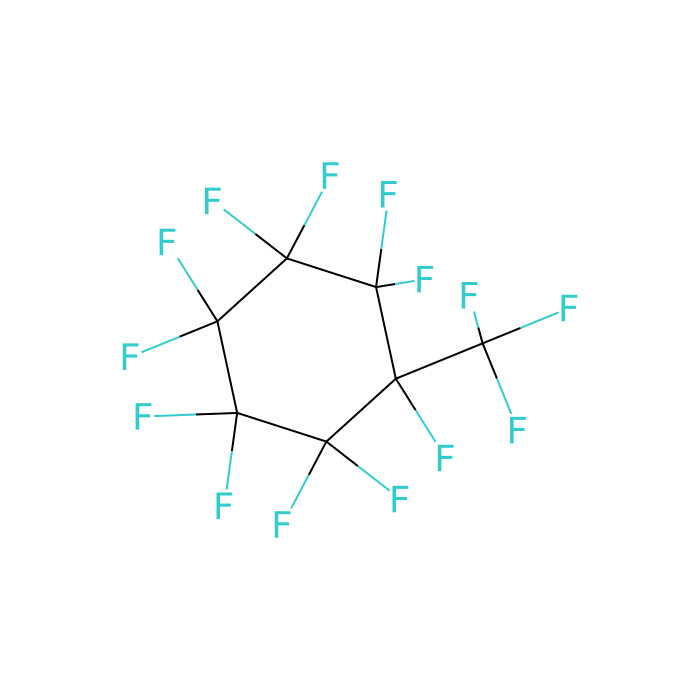
Perfluoro(methylcyclohexane) is a fully fluorinated cycloalkane bearing a perfluoromethyl substituent (a CF3 group) on a perfluorocyclohexane ring; all C–H bonds of methylcyclohexane are replaced by C–F.
Item identifiers (product data):
SKU: P407437
CAS: 355-02-2
PubChem CID: 9637
InChIKey: Not specified for this item; refer to CoA/Spec Sheet.
SMILES: Not specified for this item; refer to CoA/Spec Sheet.
Structure (descriptive):
Carbon framework: a cyclohexane ring (six sp3 carbons) bearing one methyl substituent; perfluorination yields C7 fully substituted with fluorine (no C–H bonds).
Functional groups: none in the classical sense; composed exclusively of strong C–C and C–F bonds. Contains a terminal –CF3 and multiple –CF2– units.
Stereochemistry: conformationally flexible chair/boat interconversion as in cyclohexanes; no stereocenters.
Formula and formula mass (literature/general):
Molecular formula (literature): C7F14
Molecular weight (literature): ~350.05 g/mol
Notes:
Identity strings (SMILES/InChIKey) for this specific item are not supplied in the product data; consult the CoA/Spec Sheet for the exact representations used for this lot.
Synthetic Utility
While not a reactive building block, perfluoro(methylcyclohexane) provides unique leverage in synthesis as a separations-enabled medium.
Key utilities (literature/general):
Fluorous phase for tagged reagents/catalysts: By appending perfluoroalkyl chains (e.g., C8F17–) to catalysts or reagents, products remain in the organic phase while the tagged species partition into PFMC, simplifying recovery and reuse.
Fluorous scavenging: Perfluoro-tagged scavengers (e.g., isocyanates, sulfonyl chlorides, thiols) capture residual reactants/impurities in the organic phase and are then extracted into PFMC.
Orthogonal solubility engineering: PFMC’s refusal to dissolve most organics enables orthogonal phase management—useful in multi-step telescoped processes where rapid phase switching is needed without additional reagents.
Physical chemistry advantages: High gas solubility can accelerate certain gas–liquid transformations by staging gas in the PFMC phase while reactions occur in contact with an organic phase at the interface.
Operational guidance:
Choose perfluoro-tag length to ensure sufficient PFMC affinity at process temperature.
Control interfacial area (stirring/shear) to balance mass transfer and ease of phase disengagement.
Use fluoropolymer tubing/liners to minimize contamination and maintain phase purity.
Target Specificity
Not applicable. This product is a small-molecule solvent and does not possess biological target specificity (no antigen/epitope, clone, isotype, or species reactivity).
We use cookies to ensure the website functions properly and, where permitted, to improve your experience. You can manage your preferences at any time in Settings. Learn more in our Cookie Policy.
Shall we send you a message when we have discounts available?
Remind me later
Thank you! Please check your email inbox to confirm.
Products are supplied to verified businesses, institutions, and qualified professionals for research and development use only. Not for use in humans, animals, diagnosis, or therapy.

 K2204941