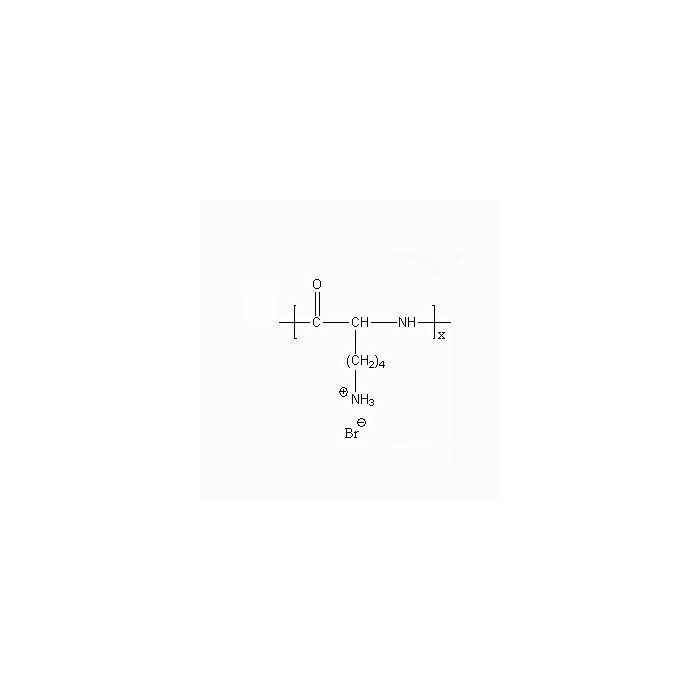
Poly-D-lysine hydrobromide is a positively charged synthetic polyamino acid having one HBr per lysine unit. It is a crystalline solid soluble in water. Poly-D-lysine hydrobromide is widely used as a coating to enhance cell attachment and adhesion to both plasticware and glass surfaces. This polycation is resistant to enzymatic degradation and has been used to culture a wide variety of cell types. Other applications for poly-D-lysine include the conjugation to active molecules for improved activities, the layer-by-layer deposition techniques, and the complexation with nucleic acids for gene expression.For cell culture applications, poly-D-lysine hydrobromide with a molecular weight greater than 30,000 Da is recommended. The poly-D-lysine hydrobromide (MW=52,000 Da) is easier to use because it is less viscous in solution, however the poly-D-lysine hydrobromide with an higher molecular weight (MW=84,000 Da) has more attachement sites per polymer chain available to the cells. Both poly-D-lysine hydrobromide and poly-L-lysine hydrobromide can be used as a coating substrate, however certain cells digest poly-L-lysine hydrobromide. In this case, poly-D-lysine, as the attachment factor, is necessary to prevent cell disruption by excessive uptake of L-lysine.Our poly-D-lysine hydrobromide has been purified by dialysis, sterile-filtered on 0.2um, lyophilized, and stored under Ar.
Product Specification Reference Number:
article
number
Number of repeating units (x value)
MW=(Da)
P489854-x30
x=30
6300
P489854-x100
x=100
21000
P489854-x250
x=250
52000
P489854-x400
x=400
84000
Specifications
Stability And Storage
Store poly-D-lysine hydrobromide under the condition of flushing with argon and protecting from light, and below -20°C.
Storage
Protected from light, Store at -20°C, Argon charged
Shipped In
Ice chest + Ice pads
This product requires cold chain shipping. Ground and other economy services are not available.
This compound belongs to the class of organic compounds known as d-alpha-amino acids. These are alpha amino acids which have the D-configuration of the alpha-carbon atom.
External Descriptors
Not available
1. Djoumbou Feunang Y, Eisner R, Knox C, Chepelev L, Hastings J, Owen G, Fahy E, Steinbeck C, Subramanian S, Bolton E, Greiner R, and Wishart DS. ClassyFire: Automated Chemical Classification With A Comprehensive, Computable Taxonomy. Journal of Cheminformatics, 2016, 8:61.
1.Hai-Mu Ye, Shu-Fang Yao. (2017) Supernucleating Role of Poly(ω-pentadecalactone) during the Crystallization of Poly(ε-caprolactone) Composites. INDUSTRIAL & ENGINEERING CHEMISTRY RESEARCH, [PMID:][10.1021/acs.iecr.7b03322]
Solution Calculators
Molarity Calculator
Determine the necessary mass, volume, or concentration for preparing a solution.
Dilution Calculator
Determine the dilution needed to prepare a stock solution.
We use cookies to ensure the website functions properly and, where permitted, to improve your experience. You can manage your preferences at any time in Settings. Learn more in our Cookie Policy.
Shall we send you a message when we have discounts available?
Remind me later
Thank you! Please check your email inbox to confirm.
Products are supplied to verified businesses, institutions, and qualified professionals for research and development use only. Not for use in humans, animals, diagnosis, or therapy.