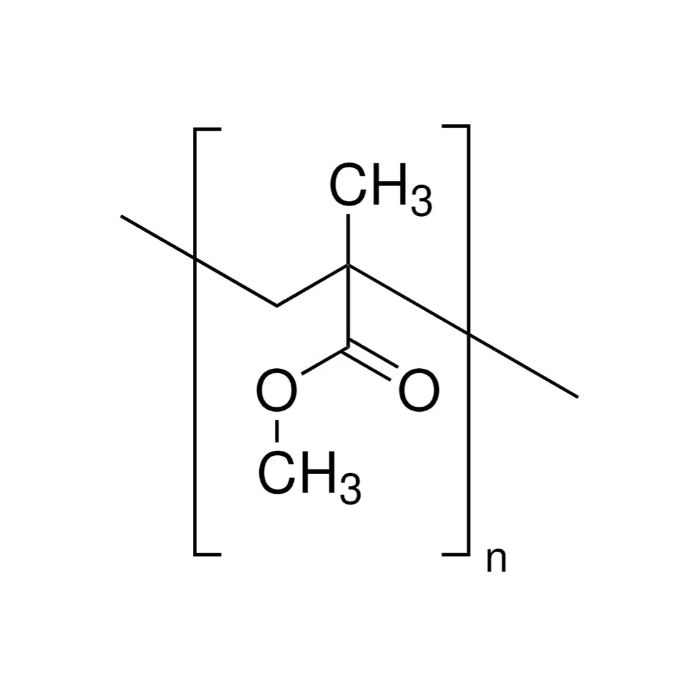
Poly(methyl methacrylate)(PMMA) - Heat resistant injection grade , CAS No.9011-14-7

CAS: 9011-14-7 Cat. No.: P141443 Formula: [C5H8O2]n EC Number: 618-466-4
AVAILABLE TO ORDER
GRADE & PURITY Heat resistant injection grade
Synonyms
PMMA|2-methylacrylic acid methyl ester|2-Methyl-acrylic acid methyl ester|Metakrylan metylu|Methylester kyseliny methakrylove [Czech]|RCRA waste no. U162|METHYL METHACRYLATE [HSDB]|Methyl ester of 2-methyl-2-propenoic acid|Methyl methacrylate (MMA)|NA 1247 (Salt/Mix)|Kallocryl A|Methacrylic Acid Methyl Ester (stabilized|Metil metacrilato [Italian]|Acrylic resins (PMMA)|METHYL 2-METHYL-2-PROPENOATE [FHFI]|Methacrylic acid, methyl ester|Methacrylsaeuremethyl ester|2-(Methoxycarbonyl)-1-propene|Methyl methacrylate, stabilized|Eudragit|Methyl .alpha.-methylacrylate|2-Methyl-2-propenoic acid methyl ester|Methacrylate de methyle [French]|Methyl 2-methyl-2-propenoate|METHYL METHACRYLATE [VANDF]|Methylmethacrylate|METHYL METHACRYLATE [INCI]|Simplex P|Acryester M|Methyl methacrylate monomer|METHYLMETHACRYLATE [WHO-DD]|Acrylic acid, 2-methyl-, methyl ester|Diakon|Metil metacrilato|Methacrylsaeuremethyl ester [German]|Plexiglass|2-Propenoic acid, 2-methyl-, methyl ester|METHYL METHACRYLATE [IARC]|Methyl-methacrylat|Methyl meth-d3-acrylate|Methacrylate de methyle|Monocite methacrylate monomer|monocite' Methacrylate monomer|Methylester kyseliny methakrylove|Methacrylic acid methyl ester|Methyl methacrylate monomer, inhibited|Methyl methylacrylate|TEB 3K|Methyl 2-methylpropenoate|Metaplex|METHYL METHACRYLATE|Methacrylic acid-methyl ester|METHYLMETHACRYLATE [MART.]|METHACRYLIC ACID METHYL ESTER [MI]|Methyl 2-methylacrylate #|2-Methylacrylic acid, methyl ester|Methylmethacrylaat|Methyl 2-methylacrylate|Methyl-methacrylat [German]|METHYL METHACTRYLATE|Rcra waste number U162|MMA (stabilized)|methyl 2-methylprop-2-enoate|Methyl-.alpha.-methacrylate|Methylmethacrylaat [Dutch]
Storage
Room temperature
Shipped In
Normal
★
Size
USA
Germany (EU)*
Price
Qty
100g
P141443-100g
In stock ≥10
In stock ≥10
$19.90
500g
P141443-500g
3 In stock
—
$75.90
Enter a quantity for the sizes you want to add.

Specifications

Synonyms
PMMA | 2-methylacrylic acid methyl ester | 2-Methyl-acrylic acid methyl ester | Metakrylan metylu | Methylester kyseliny methakrylove [Czech] | RCRA waste no. U162 | METHYL METHACRYLATE [HSDB] | Methyl ester of 2-methyl-2-propenoic acid | Methyl methacrylate (MMA) | NA 1247 (Salt/Mix) | Kallocryl A | Methacrylic Acid Methyl Ester (stabili Show more
Specifications & Purity
Heat resistant injection grade
Storage
Room temperature
Shipped In
Normal
Product Line
P141443-100g
Names and Identifiers
Pubchem Sid
SMILES
CC(=C)C(=O)OC
IUPAC Name
methyl 2-methylprop-2-enoate
InChIKey
VVQNEPGJFQJSBK-UHFFFAOYSA-N
InChI
1S/C5H8O2/c1-4(2)5(6)7-3/h1H2,2-3H3
Isomeric SMILES
CC(=C)C(=O)OC
RTECS
TR0400000
Reaxys
605459
Reaxys-RN_link_address
https://www.reaxys.com/reaxys/secured/hopinto.do?context=S&query=IDE.XRN=605459&ln=

Advanced Data

Taxonomic Classification

Taxonomy Tree

KingdomOrganic compounds
SuperclassOrganic acids and derivatives
ClassCarboxylic acids and derivatives
SubclassCarboxylic acid derivatives
Intermediate Tree Nodes Carboxylic acid esters - Alpha,beta-unsaturated carboxylic esters
Direct ParentEnoate esters
Alternative Parents Methyl esters  Monocarboxylic acids and derivatives  Organic oxides  Hydrocarbon derivatives  Carbonyl compounds  
Molecular FrameworkAliphatic acyclic compounds
Substituents Enoate ester - Methyl ester - Monocarboxylic acid or derivatives - Organic oxygen compound - Organic oxide - Hydrocarbon derivative - Organooxygen compound - Carbonyl group - Aliphatic acyclic compound
DescriptionThis compound belongs to the class of organic compounds known as enoate esters. These are an alpha,beta-unsaturated carboxylic ester of general formula R1C(R2)=C(R3)C(=O)OR4 (R4= organyl compound) in which the ester C=O function is conjugated to a C=C double bond at the alpha,beta position.
External Descriptors enoate ester
3D Structure
Interactive Chemical Structure Model


Associated Targets(Human)
ALDH1A1 Tchem Aldehyde dehydrogenase 1A1 (77053 Activities)
Activity TypeRelationActivity valueUnitsAction TypeJournalPubMed IddoiAssay Aladdin ID
Associated Targets(non-human)
Tetrahymena pyriformis (68 Activities)
Activity TypeRelationActivity valueUnitsAction TypeJournalPubMed IddoiAssay Aladdin ID
Mechanisms of Action
Certificates (CoA,COO,BSE/TSE and Analysis Chart)
C of A & Other Certificates(BSE/TSE, COO):
Analytical Chart:

Find and download the COA for your product by matching the lot number on the packaging.

14 results found

Lot NumberCertificate TypeDateItem
B2303874B2303874Certificate of AnalysisNov 18, 2026 P141443
K2225829K2225829Certificate of AnalysisSep 04, 2026 P141443
D2616506D2616506Certificate of AnalysisApr 07, 2026 P141443
D2616507D2616507Certificate of AnalysisApr 07, 2026 P141443
D2616511D2616511Certificate of AnalysisApr 07, 2026 P141443
F2209240F2209240Certificate of AnalysisMar 11, 2026 P141443
F2302274F2302274Certificate of AnalysisMay 19, 2023 P141443
F2302275F2302275Certificate of AnalysisMay 19, 2023 P141443
F2302276F2302276Certificate of AnalysisMay 19, 2023 P141443
I2511158I2511158Certificate of AnalysisMay 19, 2023 P141443
K2225806K2225806Certificate of AnalysisNov 09, 2022 P141443
K2225807K2225807Certificate of AnalysisNov 09, 2022 P141443
F2209216F2209216Certificate of AnalysisMar 18, 2022 P141443
F2209217F2209217Certificate of AnalysisMar 18, 2022 P141443
Chemical and Physical Properties
Refractive Index1.49
Flash Point>250 ℉
Flash Point>121.11℃
Molecular Weight100.12
XLogP31.400
Hydrogen Bond Donor Count0
Hydrogen Bond Acceptor Count2
Rotatable Bond Count2
Exact Mass100.052 Da
Monoisotopic Mass100.052 Da
Topological Polar Surface Area26.300 Ų
Heavy Atom Count7
Formal Charge0
Complexity94.300
Isotope Atom Count0
Defined Atom Stereocenter Count0
Undefined Atom Stereocenter Count0
Defined Bond Stereocenter Count0
Undefined Bond Stereocenter Count0
The total count of all stereochemical bonds0
Covalently-Bonded Unit Count1
Safety and Hazards(GHS)
Pictogram(s)
Signal
Warning
Hazard Statements

H316:Causes mild skin irritation

H371:May cause damage to organs

Precautionary Statements

P201:Obtain special instructions before use.

P202:Do not handle until all safety precautions have been read and understood.

P260:Do not breathe dust/fume/gas/mist/vapors/spray.

P264:Wash hands [and …] thoroughly after handling.

P270:Do not eat, drink or smoke when using this product.

P281:Use personal protective equipment as required.

P308+P313:IF exposed or concerned: Get medical advice/attention.

P332+P313:IF SKIN irritation occurs: Get medical advice/attention.

P309+P311:IF exposed or if you feel unwell: call a POISON CENTER or doctor/physician.

P405:Store locked up.

P501:Dispose of contents/container to an approved waste disposal plant.

RTECS
TR0400000
Reaxys
605459
Reaxys-RN_link_address
https://www.reaxys.com/reaxys/secured/hopinto.do?context=S&query=IDE.XRN=605459&ln=
Documents & Articles
Common Modification Strategies for Lithium Battery Separators
Nanowires: Properties, Preparation Routes, and Process Selection (Comprehensive Analysis of Top-Down and Bottom-Up Approaches with Recommended Aladdin Reagents)
SOFC Solid Oxide Fuel Cells: From “What It Is and How It Generates Power” to a Key Materials Map, Application Scenarios, and Selection Navigation (Electrolytes / Electrodes / Interconnects / Sealing)
A Panorama Guide to Synthetic Resins: Definitions & Polymerization Mechanisms, Classification Frameworks, Common Resins and Applications, Packaging Codes, and a Selection Roadmap (Tables 1–3)
Optical & Optoelectronic Materials Selection Guide:Positioning materials, key metrics, and validation paths along “Generation → Guiding → Control → Readout” (with product navigation and Tables 1–4)
Biomedical Polymer Insights: Role-Based Task Map, Six Key Material Levers, and a Risk-Driven Evidence Chain (including the Product Navigation Guide and Product Tables 1–3)
uide to Hydrophobic Polymers and Hydrophobic Surfaces: Wetting Models, Evaluation Metrics, and Task-Oriented Material Selection (including Tables 1–3)
Applications of Self-Assembled Monolayers (SAMs), Microcontact Printing, and Soft Lithography in Surface Functionalization and Micro/Nanopatterning
How Matting Agents in Coatings Build Low-Gloss Coating Surfaces: Mechanisms, Formulation Trade-Offs, and Product Selection
PVDF, FEVE and Functional Fluororesins: System Differences and Application Selection in Fluorocarbon Coatings
Fluorocarbon Resin Coating Formulation Design: Resin Selection, Supporting Systems, and Key Application Control Points
When Should You Choose Silicone Resin? Selection Comparison with Epoxy, Acrylic, Polyurethane, Fluororesin, and Other Coating Resins
Formulation Design of Chlorinated Rubber Coatings: Component Synergy and Performance Control
Applicability Boundaries, Failure Risks, and Alternative System Selection for Chlorinated Rubber Resin in Coatings
Mechanism, Diagnosis, and Control of Coating Lifting: Solvent Penetration, Film Swelling, and Interlayer Instability
Resin Polarity in Coating Formulations: From Molecular Structure to Dissolution, Compatibility, Interfacial Interactions, and Formulation Design
Color-Development Mechanisms, Formulation Forms, and Selection/Application Logic of Colorants in Personal Care Products
Structure, Properties, and Mechanisms of Powdered Fragrances and Fragrance Delivery Materials: Stability, Release Mechanisms, and Selection Logic
UVA Absorption Mechanism of Avobenzone: Keto–Enol Tautomerism, Photochemical Instability, and Formulation Photostabilization Strategies
Citations of This Product
Solution Calculators
Reviews

Customer Reviews

Shall we send you a message when we have discounts available?

Remind me later

Thank you! Please check your email inbox to confirm.

Oops! Notifications are disabled.