
Determine the necessary mass, volume, or concentration for preparing a solution.
| Activity Type | Activity Value -log(M) | Mechanism of Action | Activity Reference | Publications (PubMed IDs) |
|---|
Moligand™, 10mM in DMSO Moligand™ for sensitive chromatographic and analytical workflows requiring minimal baseline interference.
Store at -80°C Ships Dry ice packs + Cold packs Check lot-specific COA for exact specifications.
SDS, COA, datasheet, and spec sheet available for download. Lot-specific COA accessible via lot number lookup.
Cited in 4 peer-reviewed publications across chromatography, organic synthesis, and cross-coupling reactions.
Information
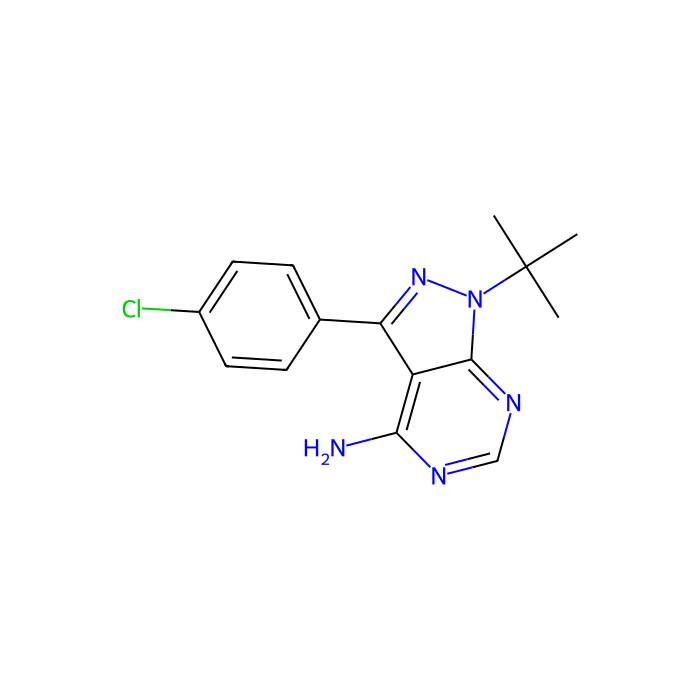
PP2 PP2 (AG 1879, AGL 1879), a Src family kinase inhibitor, potently inhibits Lck/Fyn with IC50 of 4 nM/5 nM in cell-free assays, ~100-fold less potent to EGFR, inactive for ZAP-70, JAK2 and PKA.
In vitro
PP2 inhibits Src by binding to an area of the molecule that does not overlap with the ATP binding domain. PP2 (20 μM) induces 40-50% growth inhibition of HT29 cells, this concentration reduces the Src activity as early as 1 hour and maintains a 35% inhibition of Src activity for 2 days. PP2 (100 mM) decreases the Src activity of HT29 cells in a dose-dependent manner. PP2 (1 mM-100 mM) causes a dose-dependent growth inhibition of human colon cancer cells (HT29, SW480, and PMCO1), liver cancer cells (PLC/PRF/5, KYN-2, Li7, and HepG2), and breast cancer cells (MCF-7, MDA-MB-468, and BT-474). PP2 (20 μM) significantly increases aggregation in most of the cancer cells (HT29, SW480, PMCO1, PLC/PRF/5, KYN-2, Li7, MCF-7, and MDA-MB-468) in E-cadherin dependent manner. PP2 (20 μM) enhances E-cadherin expression and also strongly increases E-cadherin’s association with the actin cytoskeleton in cancer cells. PP2 (20 μM) increases the expression of α-catenin, β-catenin, and γ-catenin in HT29 cells, whereas in PLC/PRF/5 and MCF-7 cells, the total protein level of α-catenin does not change, but the levels of β- catenin and γ-catenin increases slightly. PP2 inhibits proliferation of two cervical cancer cells (HeLa and SiHa) in a time- and dose-dependent manner. PP2 (10 μM) down-regulates pSrc-Y416, pEGFR-Y845, and -Y1173 expression levels in HeLa and SiHa cells. PP2 (10 μM) could modulate cell cycle arrest by up-regulating p21(Cip1) and p27(Kip1) in both HeLa and SiHa cells and down-regulating expression of cyclin A, and cyclin dependent kinase-2, -4 (Cdk-2, -4) in HeLa and of cyclin B and Cdk-2 in SiHa.
In vivo
PP2 (5 mg/kg/day) induces some slowing in the growth rate of the primary tumors relative to the control treated with vehicle in SCID mice inoculated HT29 cells in the spleen. PP2 (5 mg/kg/day) induces some slowing in the growth rate of the primary tumors relative to the control treated with vehicle in SCID mice inoculated HT29 cells in the spleen. PP2 (5 mg/kg/day) significantly reduces the relative liver weight and liver metastasis volume compared with the controls in SCID mice inoculated HT29 cells in the spleen. PP2 (1.5 mg/kg i.p.) treated rats show approximately 50% reduction of infarct size on T2-weighted MRI and in TTC staining compared with controls in rats with focal ischemic brain injury. PP2 (1.5 mg/kg i.p.) results in better the neurological score than controls in rats with focal ischemic brain injury.
Cell Data
cell lines:CEM/VLB100, P388/ADR, MCF7/ADR, 2780AD, and UCLA-P3.OO3VLB cells
Concentrations:~100 μM
Incubation Time:2 days
Powder Purity:≥99%
| Isomeric SMILES | CC(C)(C)N1C2=NC=NC(=C2C(=N1)C3=CC=C(C=C3)Cl)N |
|---|---|
| Alternate CAS | 172889-27-9 |
| MeSH Entry Terms | 4-amino-5-(4-chlorophenyl)-7-(t-butyl)pyrazolo(3,4-d)pyrimidine;AG 1879;AG1879;PP2 cpd;Src family kinase inhibitor PP2 |
| Molecular Weight | 301.77 |
| Reaxy-Rn | 9409964 |
| Reaxys-RN_link_address | https://www.reaxys.com/reaxys/secured/hopinto.do?context=S&query=IDE.XRN=9409964&ln= |
Comprehensive hazard, handling, storage, and regulatory compliance document.
Download SDS →Lot-specific quality data. Enter your lot number to retrieve the exact COA.
Look up COA →Full quality attributes and acceptance criteria for this grade.
View spec sheet →| Activity Type | Activity Value -log(M) | Mechanism of Action | Activity Reference | Publications (PubMed IDs) |
|---|
| Activity Type | Activity Value -log(M) | Mechanism of Action | Activity Reference | Publications (PubMed IDs) |
|---|
| Activity Type | Activity Value -log(M) | Mechanism of Action | Activity Reference | Publications (PubMed IDs) |
|---|
| Activity Type | Activity Value -log(M) | Mechanism of Action | Activity Reference | Publications (PubMed IDs) |
|---|
| Activity Type | Activity Value -log(M) | Mechanism of Action | Activity Reference | Publications (PubMed IDs) |
|---|
| Activity Type | Activity Value -log(M) | Mechanism of Action | Activity Reference | Publications (PubMed IDs) |
|---|
| Activity Type | Activity Value -log(M) | Mechanism of Action | Activity Reference | Publications (PubMed IDs) |
|---|
Find and download the COA for your product by matching the lot number on the packaging.
| Lot Number | Certificate Type | Date | Item |
|---|---|---|---|
 G2403699 G2403699 | Certificate of Analysis | May 19, 2026 | P408365 |
| Refractive Index | 1.68 |
|---|---|
| Boil Point(°C) | 493.54° C at 760 mmHg |
| Melt Point(°C) | 193.32°C |
| 1. Yijun Li, Xinyu Wen, Min Nie, Qi Wang. (2017) Toward Subtle Manipulation of Fine Dendritic β-Nucleating Agent in Polypropylene. ACS Omega, [PMID:31457299] [10.1021/acsomega.7b01036] |
| 2. Haiping Liu, Haixiang Ma, Xingyue Zeng, Chengyan Wu, Srijan Acharya, Sarabjeet Kour Sudan, Xiaohan Zhang. (2023) Ubiquitination of GRK2 Is Required for the β-Arrestin-Biased Signaling Pathway of Dopamine D2 Receptors to Activate ERK Kinases. INTERNATIONAL JOURNAL OF MOLECULAR SCIENCES, 24 (12): (10031). [PMID:37373182] [10.3390/ijms241210031] |
| 3. Xiaoming Lin, Guangfei Wang, Ping Liu, Lei Han, Tong Wang, Kaili Chen, Yonglin Gao. (2021) Gallic acid suppresses colon cancer proliferation by inhibiting SRC and EGFR phosphorylation. Experimental and Therapeutic Medicine, 21 (6): (1-11). [PMID:33968169] [10.3892/etm.2021.10070] |
| 4. Wu Chengyan, Hu Li, Liu Bing, Zeng Xingyue, Ma Haixiang, Cao Yongkai, Li Huijun, Zhang Xiaohan. (2024) TRAF6-mediated ubiquitination of AKT in the nucleus is a critical event underlying the desensitization of G protein-coupled receptors. Cell Communication and Signaling, 22 (1): (1-21). [PMID:38566235] [10.1186/s12964-024-01592-z] |
Our grade selection guide covers purity, stabilizer status, and application suitability for all variants in our catalog.
View Moligand™ grade guide →