≥98% for sensitive chromatographic and analytical workflows requiring minimal baseline interference.
🌡
Storage & shipping
Store at -20°C Ships Ice chest + Ice pads Check lot-specific COA for exact specifications.
📋
Quality documents
SDS, COA, datasheet, and spec sheet available for download. Lot-specific COA accessible via lot number lookup.
📚
Literature proof
Cited in 0 peer-reviewed publications across chromatography, organic synthesis, and cross-coupling reactions.
Overview
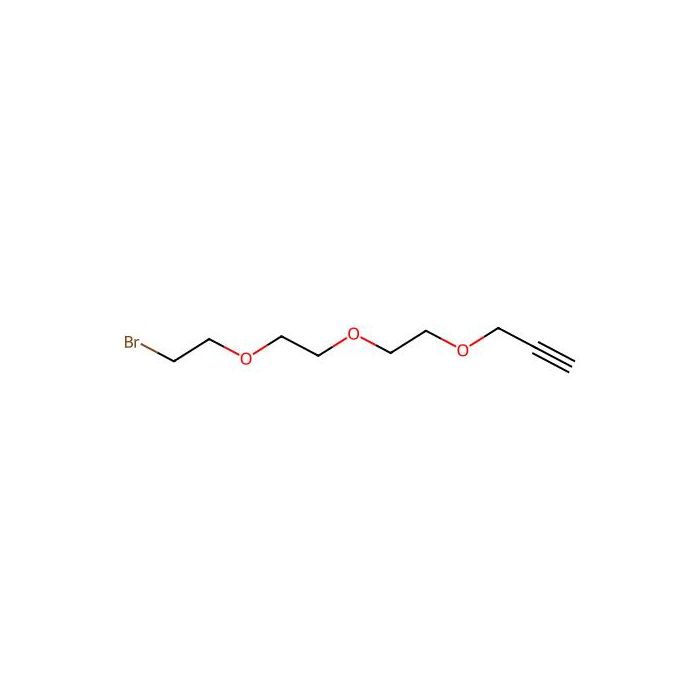
Propargyl-PEG3-bromide is a PEG derivative containing a propargyl group and a bromide group. The propargyl group can be reacted with azide-bearing compounds or biomolecules via copper catalyzed azide-alkyne Click Chemistry to yield a stable triazole linkage. The bromide (Br) is a very good leaving group for nucleophilic substitution reactions. The hydrophilic PEG spacer increases solubility in aqueous media.
Specifications
Specifications & Purity
≥98%
Storage
Store at -20°C
Shipped In
Ice chest + Ice pads
This product requires cold chain shipping. Ground and other economy services are not available.
Purity
≥98%
Names and Identifiers
Molecular Weight
251.1
Documentation
📋 Safety Data Sheet (SDS)
Comprehensive hazard, handling, storage, and regulatory compliance document.
Determine the necessary mass, volume, or concentration for preparing a solution.
Dilution Calculator
Determine the dilution needed to prepare a stock solution.
Reconstitution Calculator
Reviews
Customer Reviews
Application Protocols
No assay-validated protocols are provided for this listing. General workflow suggestions for this class of reagent:
Two-step conjugation
Install the linker onto a nucleophile-bearing substrate (thiol/amine/alcohol) via SN2 in anhydrous organic solvent with mild base.
Perform CuAAC on the terminal alkyne with an azide-bearing partner in mixed aqueous/organic media with Cu(I) catalysis.
Workup and purification
Small molecules: silica gel chromatography using gradients from ethyl acetate/hexanes to MeOH/CH2Cl2; PEGylated products may require higher polarity.
Polymers/biomolecules: dialysis, spin filtration, or precipitation; remove copper with EDTA or scavenger resins after CuAAC.
Analytical confirmation
Monitor by LC–MS, 1H NMR (disappearance of –CH2–Br region; retention of alkyne proton ~2–2.5 ppm), and, after click, triazole signatures in NMR/MS.
For detailed, application-specific parameters, consult primary literature and optimize for your substrate.
Biological Roles
This product is a synthetic PEG linker and does not possess inherent biological activity.
Role in bioconjugation (general)
PEG3 spacers increase hydrophilicity and reduce aggregation or nonspecific binding when appended to biomolecules or surfaces.
The propargyl terminus provides a bioorthogonal handle for CuAAC with azide-bearing probes under mild, aqueous-compatible conditions after the linker is installed.
Metabolism/biocompatibility (general)
Short PEG segments are generally considered chemically inert in biological buffers, but the alkyl bromide is an electrophile and should not be exposed to proteins/cells prior to intended conjugation.
No clinical or therapeutic claims are made; this reagent is provided strictly for research use only.
Buffer Applications
Not a buffering agent. This reagent does not establish pH or ionic strength.
Practical note
Perform the SN2 installation step in organic media (e.g., DMF, MeCN) or biphasic PTC systems. After conjugation to a biomolecule, subsequent click reactions can be executed in mixed aqueous/organic buffers (e.g., PBS:t-BuOH) compatible with CuAAC.
If working with proteins, ensure the alkylation step is carried out under controlled conditions that preserve protein function (pH 7–8.5 for thiol/amine availability) using water-miscible organic cosolvents.
Green Alternatives
Greener choices can be considered at two levels: solvent selection and electrophile choice.
Solvent alternatives (general)
Replace DMF/DMSO with acetonitrile, 2-methyltetrahydrofuran (2-MeTHF), cyclopentyl methyl ether (CPME), or acetone where kinetics and solubility permit.
For CuAAC after linker installation, use water/t-BuOH or water/ethanol mixtures when substrate solubility allows.
Comparison (general guidance)
Parameter | Conventional | Greener alternative | Trade-offs
SN2 solvent | DMF/DMSO | MeCN, 2-MeTHF, acetone | May require higher temp or longer time
Electrophile | Alkyl bromide | Alkyl mesylate/tosylate | Often less hazardous; sometimes lower SN2 rate
Process tips
Run solvent screens at small scale to balance rate, selectivity, and ease of workup.
Minimize excess linker; use stoichiometric control and in situ FTIR/LC to determine endpoint to reduce waste.
Pharmaceutical Uses
As a research-grade linker, Propargyl-PEG3-bromide can serve in preclinical development and medicinal chemistry as a tool compound.
Typical roles (general, non-clinical)
Linker for probe/drug conjugates during hit-to-lead optimization to improve solubility or enable modular late-stage diversification via CuAAC.
Surface modification of assay plates, resins, or nanoparticles to tune pharmacochemical properties in screening platforms.
Regulatory status and compendia
No pharmacopeial monograph is implied. Any GMP or clinical use would require appropriate qualification; this listing is for research use only.
Formulation note
For in vitro assays or materials work, prepare stock solutions in anhydrous DMSO or DMF and dilute into the compatible assay medium after conjugation; do not introduce the free alkyl bromide into biological systems.
Physical Properties
Item-specific specifications such as appearance, exact density, and refractive index are not provided for this product listing and should be verified on the CoA.
Appearance: Not specified for this item; refer to CoA/Spec Sheet.
Boiling point, melting point, density, refractive index: Not specified for this item; refer to CoA/Spec Sheet.
Solubility (general/literature expectations for PEG3 alkyl bromides)
High solubility in polar aprotic solvents (DMF, DMSO, acetonitrile) and common organic solvents (THF, dichloromethane, acetone).
Limited miscibility with water; PEG3 segment confers some hydrophilicity, but primary alkyl bromide typically remains poorly water-soluble.
Partitioning and ionization (general/literature)
pKa: not applicable (no ionizable acidic/basic centers; alkyne pKa ~25, not deprotonated under neutral conditions).
logP: expected moderate due to PEG ether chain; exact value depends on terminal group and is not specified.
Volatility and stability (general/literature)
Typically low volatility; alkyl bromides can hydrolyze slowly in moist environments and can undergo elimination under strong base.
The terminal alkyne is stable but can be metal-catalyzed to participate in addition/coupling; avoid strong bases if alkyne integrity must be preserved.
Quality & Grades
Grade/Purity: Not specified for this item; refer to CoA/Spec Sheet.
Interpretation and best practices (general guidance):
For bioconjugation or click chemistry, materials are often supplied at high chemical purity with low residual solvents and controlled halide content. If HPLC or “bioconjugation grade” is required, review the CoA for analytical data (NMR, HPLC/LC–MS, water content) before use in sensitive applications.
Stabilizers: Not specified for this item; refer to CoA/Spec Sheet. Alkyl bromides are typically supplied neat without stabilizers; if a stabilizer is present, confirm its compatibility with downstream reactions.
Trace specifications (water, peroxides, metals, UV cutoff): Not specified for this item; refer to CoA/Spec Sheet.
QC considerations for this class of reagent (general)
Identity: 1H/13C NMR showing propargyl signals (≈2.4–2.6 ppm, 4.1–4.7 ppm for O–CH2, terminal alkyne ≈2.0–2.5 ppm) and PEG methylenes (≈3.4–3.8 ppm); MS consistent with [M+H]+ and characteristic isotopic pattern for bromine.
Purity: HPLC or GC (if volatile), water by Karl Fischer for moisture-sensitive applications.
Functionality: Titration by model SN2 or CuAAC can confirm reactivity when critical.
Reaction & Applications
Propargyl-PEG3-bromide is a versatile, orthogonally reactive linker widely used in materials science, bioconjugation, and medicinal chemistry workflows.
Dual functional handles
Alkyl bromide: undergoes SN2 with soft nucleophiles (thiol > amine > alcohol) to install a propargyl-PEG3 group onto substrates (R–Nu → R–Nu–PEG3–propargyl).
Propargyl: enables Cu(I)-catalyzed azide–alkyne cycloaddition (CuAAC) to attach azide-bearing tags, polymers, dyes, or biomolecules.
Typical applications (general/literature)
Surface and polymer modification: grafting propargyl-PEG spacers to improve hydrophilicity and reduce nonspecific adsorption.
Small-molecule SAR: introducing a solubilizing PEG3 spacer with a latent click handle for diversified libraries.
Bioconjugation workflows: first install the linker via SN2 onto thiols/primary amines; then perform CuAAC to append probes/labels.
Practical notes
Use dry solvents and exclude water for SN2 steps. Primary bromide minimizes elimination but strong base can cause side reactions; prefer mild bases (K2CO3, DIPEA, NaHCO3) and moderate temperatures.
Protect other nucleophilic sites on complex substrates to control mono-alkylation.
After conjugation, remove excess linker by precipitation, dialysis (for polymers/biomolecules), or silica chromatography as appropriate.
Reaction Conditions
General literature guidance for installing Propargyl-PEG3-bromide onto nucleophiles and for subsequent click reactions:
Thiol alkylation (SN2)
Solvent: acetone, MeCN, or DMF (anhydrous).
Base: K2CO3 or NaHCO3 (1–2 equiv); catalytic KI can accelerate if needed.
Temperature/time: rt–50 °C, 2–16 h. Monitor by LC–MS or TLC.
Notes: Minimize oxygen if thiolate formation is required to reduce disulfide formation.
Amine alkylation (SN2)
Solvent: DMF or MeCN.
Base: DIPEA or K2CO3 (1–3 equiv).
Temperature/time: 25–60 °C, 4–24 h.
Notes: Use of excess amine can suppress dialkylation; protect other nucleophilic sites where selectivity is critical.
Alcohol O-alkylation
Solvent: dry DMF/THF.
Base: NaH (0.5–1.2 equiv relative to ROH) or K2CO3 for less hindered alcohols.
Temperature/time: 0 °C to rt for NaH, then warm to 40–60 °C as required, 2–18 h.
Notes: Avoid strong base if elimination becomes competitive; primary bromide minimizes E2.
CuAAC on the propargyl terminus
Solvent: t-BuOH/H2O or DMF/H2O.
Catalyst: CuSO4·5H2O (1–10 mol%) with sodium ascorbate (reducing agent) or CuI (1–5 mol%) with appropriate ligands (e.g., TBTA) for enhanced rates.
Temperature/time: rt, 0.5–6 h depending on partners.
Notes: Remove copper by chelation (EDTA) or solid scavengers after reaction, especially for biological applications.
Safety & Handling
Follow good laboratory practices. No item-specific GHS data were provided for this listing.
GHS/Classification for this item: Not specified; consult the product SDS for authoritative information.
Common hazards for related materials (general)
Primary alkyl bromides: alkylating agents; may cause skin/eye irritation, respiratory irritation; potential lachrymators.
Terminal alkynes and organic ethers: combustible; vapors may form flammable mixtures with air.
Personal protective equipment (PPE)
Lab coat, safety glasses or chemical splash goggles, and appropriate chemical-resistant gloves (e.g., nitrile). Work in a fume hood.
Handling guidance
Use anhydrous techniques for moisture-sensitive reactions (SN2). Keep containers tightly closed; minimize exposure to light and air.
Avoid contact with strong bases (risk of elimination) and strong nucleophiles unless intended for reaction.
Incompatibilities (general)
Strong bases, strong oxidizers, and moisture for prolonged storage/use.
First aid (general overview; refer to SDS)
Skin/eye contact: rinse with water for at least 15 minutes; remove contaminated clothing; seek medical attention.
Inhalation: move to fresh air; seek medical attention if symptoms persist.
Ingestion: rinse mouth; do not induce vomiting; seek medical attention.
Fire safety
Use CO2, dry chemical, or foam. Combustion may release HBr and carbon oxides.
Solvent Selection
This reagent is typically used in polar aprotic media that enhance SN2 reactivity and maintain alkyne integrity.
Polarity/miscibility (general for PEG3 bromides)
Highly soluble in DMF, DMSO, acetonitrile, acetone; good solubility in THF and dichloromethane.
Limited solubility in water; PEG3 chain improves wettability but not full aqueous miscibility.
Choosing a solvent by application
SN2 alkylation of amines/thiols/alcohols: DMF, DMSO, or acetonitrile. Acetone can be advantageous for thiol alkylation with K2CO3 due to byproduct precipitation.
Phase-transfer alkylations: biphasic toluene/CH2Cl2 and aqueous base with a PTC (e.g., TBAB) if water-tolerant nucleophiles are used.
CuAAC on the propargyl terminus (post-installation): t-BuOH/H2O or DMF/H2O for the click step after the linker is attached.
Quick comparison (general)
DMF/DMSO: highest SN2 rates, excellent solubility; more challenging workup.
MeCN: good kinetics, easier removal; lower solubility for some nucleophiles.
THF/Acetone: easier evaporation; may require heating or higher base loading.
Storage & Reconstitution
Storage conditions (item-specific)
Store at -20°C.
Shipped in: Ice chest + Ice pads.
Stability and handling (general for PEG alkyl bromides)
Protect from moisture and prolonged exposure to air; alkyl bromides can hydrolyze or darken over time. Keep tightly sealed under inert gas if possible.
Avoid sustained exposure to strong bases to prevent elimination or side reactions.
Reconstitution and use
Prepare stock solutions in anhydrous DMF, DMSO, acetonitrile, or THF. Typical concentrations: 10–100 mM depending on application.
For weighed solids or viscous liquids, warm gently to room temperature and vortex to ensure homogeneity before aliquoting.
If used for bioconjugation, perform SN2 in organic media first; then carry out CuAAC in mixed aqueous/organic solvent after excess linker is removed.
Shelf life
Not specified for this item; refer to CoA/Spec Sheet. As a best practice, aliquot upon receipt to minimize freeze–thaw and headspace exposure.
Research use note
For research use only.
Structure & Identity
Propargyl-PEG3-bromide is a bifunctional PEG linker bearing a terminal propargyl (terminal alkyne) at one end and a primary alkyl bromide at the other. It enables orthogonal conjugation: CuAAC at the alkyne and SN2 alkylation at the bromide.
Item-specific identifiers
CAS: 203740-63-0
SKU: P595930
Molecular formula: Not specified for this item; refer to CoA/Spec Sheet.
Molecular weight: Not specified for this item; refer to CoA/Spec Sheet.
SMILES: Not specified for this item; refer to CoA/Spec Sheet.
InChIKey: Not specified for this item; refer to CoA/Spec Sheet.
Structural features (general/literature description)
Topology: linear, flexible PEG3 spacer (~11–12 atoms between termini), providing hydrophilicity and spatial separation.
2D depiction in words: propargyl–O–(CH2–CH2–O)×3–(CH2)n–Br, where the PEG3 chain bridges the propargyloxy terminus to a primary bromoalkyl terminus.
Stereochemistry: none (achiral, no stereocenters expected).
Synthetic Utility
This linker is an orthogonally reactive building block enabling convergent synthesis.
Functional group reactivity
Bromide end: SN2 alkylation of soft nucleophiles (thiols, amines, alcohols) to furnish propargyl-PEG3–substrate conjugates.
Propargyl end: Subsequent CuAAC with azides yields a stable 1,2,3-triazole linkage; RuAAC or radical additions are also possible in specialized settings.
Retrosynthetic value
Provides a preinstalled propargyl handle, avoiding terminal-alkyne introduction on sensitive scaffolds.
PEG3 spacer imparts flexibility and hydrophilicity, improving solubility and reducing steric congestion around the site of attachment.
R–OH (activated or deprotonated) + Propargyl-PEG3–Br → R–O–PEG3–propargyl (NaH or K2CO3, dry DMF/THF, 0–25 °C then warm as needed).
Target Specificity
Not applicable. This product is a small-molecule linker, not a biological targeting reagent. No antigen/epitope specificity, clone, isotype, or species reactivity applies.
Frequently Asked Questions
What is the purity of this product?
This product is supplied at ≥98% purity (chemical assay). Lot-specific values are stated on the Certificate of Analysis.
How should this product be stored?
Store at ?20 °C. Freezer storage is required to maintain the specified shelf life.
How is this product shipped?
This product ships in an insulated container with ice pads. Unpack on arrival and transfer it to the storage condition stated above.
What are the CAS number, molecular formula and molecular weight?
The CAS Number is 203740-63-0, the molecular formula is C9H15BrO3, and the molecular weight is 251.1 g/mol.
What documentation is provided?
Available product documentation, including Certificates of Analysis (COA), Safety Data Sheets (SDS), and specification sheets, is shown in the product document area. Document availability and access follow the current site policy.
We use cookies to ensure the website functions properly and, where permitted, to improve your experience. You can manage your preferences at any time in Settings. Learn more in our Cookie Policy.
Shall we send you a message when we have discounts available?
Remind me later
Thank you! Please check your email inbox to confirm.
Products are supplied to verified businesses, institutions, and qualified professionals for research and development use only. Not for use in humans, animals, diagnosis, or therapy.