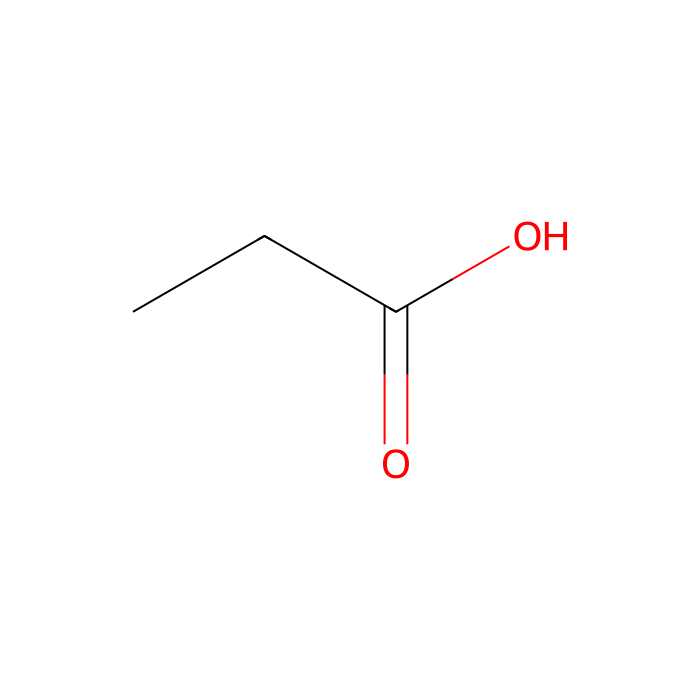
Propionic acid - analytical standard, used for Propionic acid has been used as a standard for the gas chromatogrsphic (GC) analysis of short chain fatty acids obatined from Lactobacillus reuteri SK24.003 and α-D-glucan. various applications , Agonist of F, Agonist of FFA2 receptor;Agonist of FFA3 receptor

CAS: 79-09-4 Cat. No.: P110446 Formula: C3H6O2 Molecular Weight: 74.08 Beilstein Registry Number: 506071 EC Number: 201-176-3
AVAILABLE TO ORDER
GRADE & PURITY Analytical standard ? Analytical standard — certified-purity material for quantitative calibration. Use to prepare calibration standards and validate analytical methods.
Synonyms
EPA Pesticide Chemical Code 077702 | GTPL1062 | INS NO.280 | Tox21_304030 | LMFA01010003 | methylacetic acid | PROPIONIC-2,2-D2 ACID | Propionic acid, for synthesis, 99.5% | PROPIONIC ACID [FCC] | Propionic acid grain preserver | EINECS 201-176-3 | Lupris
Storage
Room temperature
Shipped In
FedEx DG Service
★
Size
USA
Germany (EU)*
Price
Qty
1ml
P110446-1ml
5 In stock
—
$39.90
5ml
P110446-5ml
Made to order · 8–12 wks
$119.90
Enter a quantity for the sizes you want to add.
🧪
Why this grade

analytical standard Analytical standard for sensitive chromatographic and analytical workflows requiring minimal baseline interference.

🌡

Storage & shipping

Room temperature Ships FedEx DG Service Check lot-specific COA for exact specifications.

📋

Quality documents

SDS, COA, datasheet, and spec sheet available for download. Lot-specific COA accessible via lot number lookup.

📚

Literature proof

Cited in 531 peer-reviewed publications across chromatography, organic synthesis, and cross-coupling reactions.

Overview

Propionic acid (PA) is a naturally occurring carboxylic acid, which in its pure state exists as a colorless corrosive liquid with an unpleasant odor. It is miscible in water. Industrially it is produced by hydrocarboxylation of ethylene in presence nickel carbonyl as a catalyst. PA has been found to reduce food intake, lower the fatty acids content in plasma and liver, might improve tissue insulin sensitivity and exerts immunosuppressive actions. Propionic acid is an excellent raw material as it is stable, cheap and safe and can even be used as a food additive.

Specifications

Synonyms
EPA Pesticide Chemical Code 077702 | GTPL1062 | INS NO.280 | Tox21_304030 | LMFA01010003 | methylacetic acid | PROPIONIC-2,2-D2 ACID | Propionic acid, for synthesis, 99.5% | PROPIONIC ACID [FCC] | Propionic acid grain preserver | EINECS 201-176-3 | Lupris
Specifications & Purity
analytical standard
Application
Propionic acid has been used as a standard for the gas chromatogrsphic (GC) analysis of short chain fatty acids obatined from Lactobacillus reuteri SK24.003 and α-D-glucan.
Storage
Room temperature
Shipped In
FedEx DG Service
Grade
Analytical standard
Action Type
AGONIST
Mechanism of action
Agonist of FFA2 receptor;Agonist of FFA3 receptor
Names and Identifiers
Pubchem Sid
Pubchem Sid Url
https://pubchem.ncbi.nlm.nih.gov/substance/508811723
Canonical Smiles
CCC(=O)O
IUPAC Name
propanoic acid
InChIKey
XBDQKXXYIPTUBI-UHFFFAOYSA-N
INCHI
1S/C3H6O2/c1-2-3(4)5/h2H2,1H3,(H,4,5)
Isomeric SMILES
CCC(=O)O
WGK Germany
1
RTECS
UE5950000
Alternate CAS
79-09-4,68990-37-4,68937-68-8,557-28-8 (zinc salt)
UN Number
3463
Packing Group
II
MeSH Entry Terms
chromium propionate;ethylformic acid;lithium propanoate;Monoprop;potassium propionate;propionic acid;propionic acid, zinc salt;zinc propionate
Molecular Weight
74.08
Beilstein
506071
Reaxy-Rn
506071
Reaxys-RN_link_address
https://www.reaxys.com/reaxys/secured/hopinto.do?context=S&query=IDE.XRN=506071&ln=

Documentation

📋 Safety Data Sheet (SDS)

Comprehensive hazard, handling, storage, and regulatory compliance document.

Download SDS →

✅ Certificate of Analysis (COA)

Lot-specific quality data. Enter your lot number to retrieve the exact COA.

Look up COA →

📊 Datasheet

Quick-reference summary of product specifications and applications.

View datasheet →

🔬 Specification Sheet

Full quality attributes and acceptance criteria for this grade.

View spec sheet →

Advanced Data

Taxonomic Classification

Taxonomy Tree

KingdomOrganic compounds
SuperclassOrganic acids and derivatives
ClassCarboxylic acids and derivatives
SubclassCarboxylic acids
Intermediate Tree Nodes Not available
Direct ParentCarboxylic acids
Alternative Parents Monocarboxylic acids and derivatives  Organic oxides  Hydrocarbon derivatives  Carbonyl compounds  
Molecular FrameworkAliphatic acyclic compounds
Substituents Monocarboxylic acid or derivatives - Carboxylic acid - Organic oxygen compound - Organic oxide - Hydrocarbon derivative - Organooxygen compound - Carbonyl group - Aliphatic acyclic compound
DescriptionThis compound belongs to the class of organic compounds known as carboxylic acids. These are compounds containing a carboxylic acid group with the formula -C(=O)OH.
External Descriptors Straight chain fatty acids
3D Structure
Interactive Chemical Structure Model


Associated Targets(Human)
FFAR2 Tchem Free fatty acid receptor 2 (0 Activities)
Activity TypeActivity Value -log(M)Mechanism of ActionActivity ReferencePublications (PubMed IDs)
FFAR3 Tchem Free fatty acid receptor 3 (0 Activities)
Activity TypeActivity Value -log(M)Mechanism of ActionActivity ReferencePublications (PubMed IDs)
K562 (73714 Activities)
Activity TypeRelationActivity valueUnitsAction TypeJournalPubMed IddoiAssay Aladdin ID
HCT-116 (91556 Activities)
Activity TypeRelationActivity valueUnitsAction TypeJournalPubMed IddoiAssay Aladdin ID
SLC16A1 Tchem Monocarboxylate transporter 1 (146 Activities)
Activity TypeRelationActivity valueUnitsAction TypeJournalPubMed IddoiAssay Aladdin ID
FFAR3 Tchem Free fatty acid receptor 3 (304 Activities)
Activity TypeRelationActivity valueUnitsAction TypeJournalPubMed IddoiAssay Aladdin ID
FFAR2 Tchem Free fatty acid receptor 2 (545 Activities)
Activity TypeRelationActivity valueUnitsAction TypeJournalPubMed IddoiAssay Aladdin ID
POLK Tbio DNA polymerase kappa (8653 Activities)
Activity TypeRelationActivity valueUnitsAction TypeJournalPubMed IddoiAssay Aladdin ID
POLL Tbio DNA polymerase lambda (184 Activities)
Activity TypeRelationActivity valueUnitsAction TypeJournalPubMed IddoiAssay Aladdin ID
FIBCD1 Tbio Fibrinogen C domain-containing protein 1 (33 Activities)
Activity TypeRelationActivity valueUnitsAction TypeJournalPubMed IddoiAssay Aladdin ID
Associated Targets(non-human)
HD1 Histone deacetylase (38 Activities)
Activity TypeRelationActivity valueUnitsAction TypeJournalPubMed IddoiAssay Aladdin ID
Saccharomyces cerevisiae (19171 Activities)
Activity TypeRelationActivity valueUnitsAction TypeJournalPubMed IddoiAssay Aladdin ID
Candida albicans (78123 Activities)
Activity TypeRelationActivity valueUnitsAction TypeJournalPubMed IddoiAssay Aladdin ID
Mus musculus (284745 Activities)
Activity TypeRelationActivity valueUnitsAction TypeJournalPubMed IddoiAssay Aladdin ID
RAW264.7 (28094 Activities)
Activity TypeRelationActivity valueUnitsAction TypeJournalPubMed IddoiAssay Aladdin ID
Slc22a20 Solute carrier family 22 member 20 (86 Activities)
Activity TypeRelationActivity valueUnitsAction TypeJournalPubMed IddoiAssay Aladdin ID
Slc22a6 Solute carrier family 22 member 6 (141 Activities)
Activity TypeRelationActivity valueUnitsAction TypeJournalPubMed IddoiAssay Aladdin ID
SARS-CoV-2 (38078 Activities)
Activity TypeRelationActivity valueUnitsAction TypeJournalPubMed IddoiAssay Aladdin ID
Mechanisms of Action
Certificates(CoA,COO,BSE/TSE and Analysis Chart)
C of A & Other Certificates(BSE/TSE, COO):
Analytical Chart:

Find and download the COA for your product by matching the lot number on the packaging.

4 results found

Lot NumberCertificate TypeDateItem
H2111290Certificate of AnalysisOct 09, 2026 P110446
H2607086Certificate of AnalysisAug 13, 2026 P110446
H2607088Certificate of AnalysisAug 12, 2026 P110446
J2218209Certificate of AnalysisSep 27, 2022 P110446
Chemical and Physical Properties
SensitivityMoisture sensitive.
Refractive Indexn20/D 1.386 (lit.)
Flash Point(°C)58℃
Boil Point(°C)141.1°C
Melt Point(°C)−24-−23 °C (lit.)
Molecular Weight74.080 g/mol
XLogP30.300
Hydrogen Bond Donor Count1
Hydrogen Bond Acceptor Count2
Rotatable Bond Count1
Exact Mass74.0368 Da
Monoisotopic Mass74.0368 Da
Topological Polar Surface Area37.300 Ų
Heavy Atom Count5
Formal Charge0
Complexity40.200
Isotope Atom Count0
Defined Atom Stereocenter Count0
Undefined Atom Stereocenter Count0
Defined Bond Stereocenter Count0
Undefined Bond Stereocenter Count0
The total count of all stereochemical bonds0
Covalently-Bonded Unit Count1
Documents & Articles
Fatty Acids from Basics to Lab Practice: Structural Classification, Research Uses, and Selection Tips (with an Aladdin Representative Product Quick-Reference Table)
Inulin: Structural Features, Physicochemical Properties, Application Development, and Research Progress in Experimental Settings
How Organic Acids “Stabilize a System”: Selection Logic via the pH Window, Salt Forms, and Metal-Ion Management (with a navigation guide to Tables A–E)
Experimental Research on Candidate Probiotics: From Strain Identification and Mechanistic Evaluation to Product Selection
Why Are Preservative Systems in Daily Chemical Products Effective? Common Types, Mechanisms of Action, and Factors Affecting Preservation Efficacy
Probiotics, Prebiotics, and Postbiotics in Skin Care: Conceptual Distinctions, Mechanisms of Action, and Their Applications in the Care of Dry, Itchy, and Rough Skin
Potential Mechanisms of Succinic Acid in Acne Care: From Dicarboxylic Acid–Base Equilibria to Metabolic Antagonism Among Skin Microorganisms
Citations of This Product
Solution Calculators
Reviews

Customer Reviews

Shall we send you a message when we have discounts available?

Remind me later

Thank you! Please check your email inbox to confirm.

Oops! Notifications are disabled.