GRADE & PURITYMoligand™?Moligand™ — Aladdin's line of ligands and bioactive small molecules. Use for receptor, pathway, and binding studies needing defined small-molecule tools.10 mM in DMSO
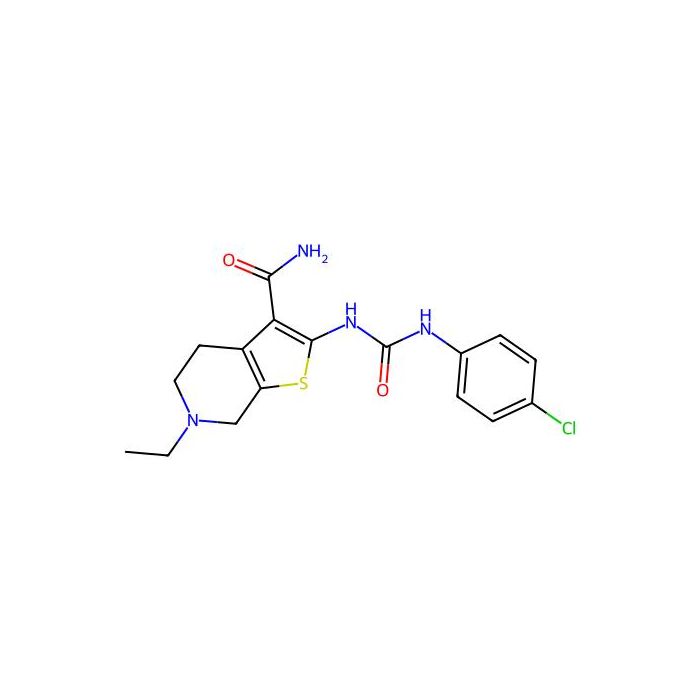
PROTO-1 is a hair cell protector and can be used in studies of ototoxicity-induced hair cell death.
Specifications
Specifications & Purity
Moligand™, 10 mM in DMSO
Storage
Store at -80°C
Shipped In
Dry ice packs + Cold packs
This product requires cold chain shipping. Ground and other economy services are not available.
Grade
Moligand™
Product Properties
ALogP
2.8
Names and Identifiers
Isomeric SMILES
CCN1CCC2=C(C1)SC(=C2C(=O)N)NC(=O)NC3=CC=C(C=C3)Cl
PubChem CID
1069493
Molecular Weight
378.9
Advanced Data
Certificates (CoA,COO,BSE/TSE and Analysis Chart)
C of A & Other Certificates(BSE/TSE, COO):
Analytical Chart:
Solution Calculators
Molarity Calculator
Determine the necessary mass, volume, or concentration for preparing a solution.
Dilution Calculator
Determine the dilution needed to prepare a stock solution.
Reconstitution Calculator
Reviews
Customer Reviews
Application Protocols
No validated application protocols are included in the Product Data for PROTO-1. The following outlines a generic approach for preparing and using a small-molecule research reagent; adapt to your assay and consult the CoA/SDS.
Generic stock preparation
Allow vial to equilibrate briefly on dry ice/cold block to avoid condensation. Warm just enough to handle.
Open under dry conditions. If lyophilized/solid, prepare a concentrated stock (e.g., 10–50 mM) in a suitable solvent determined by your solubility screen (commonly DMSO for discovery work).
Filter through a low-binding syringe filter if particulate persists.
Aliquot into single-use, inert tubes; store at −80°C.
Assay use (examples)
Biochemical assays: dilute stock into assay buffer to desired concentrations, keeping final DMSO ≤0.5–1% v/v; include solvent controls.
Biophysical assays (SPR/ITC/BLI): match cosolvent in sample and reference. Degas buffers for ITC.
Cell-based assays: verify vehicle tolerance; pre-screen for cytotoxicity of vehicle alone.
Documentation
Record lot number, preparation date, solvent, concentration, and number of freeze–thaw cycles. Discard aliquots after one thaw unless stability is demonstrated.
For item-specific instructions, refer to the CoA/Spec Sheet supplied with your lot.
Biological Roles
No biological function, target class, or pathway information is provided for PROTO-1 in the Product Data. Do not infer mechanism or activity without validated data.
What is known (item-specific)
Category: Life Science research reagent.
Research Use Note: For research use only.
General considerations for small-molecule ligands/tools
Putative roles are determined experimentally (e.g., binding to proteins, nucleic acids, or membranes). Use orthogonal assays to confirm activity and specificity (biophysical + biochemical + cellular readouts).
If the compound is intended as a probe, establish on-target engagement (e.g., CETSA, NanoBRET) and off-target liabilities (broad counterscreens).
Evaluate aggregation or redox artifacts (e.g., detergent sensitivity, redox cycling assays) before drawing mechanistic conclusions.
Data package to build
Identity/purity confirmation (LC–MS, NMR as applicable).
Potency and selectivity in primary assays with solvent-matched controls.
Without structure or literature references in the Product Data, no specific biological roles can be assigned. Consult the CoA/Spec Sheet and your internal data before using PROTO-1 as a mechanistic probe.
Buffer Applications
PROTO-1 is not described as a buffering agent in the Product Data, and no pKa information is provided. Therefore, there are no item-specific buffer recipes or pH ranges to recommend.
If you need to use buffers with this material (general guidance)
Dissolution for biochemical assays: prepare concentrated DMSO or ethanol stocks, then dilute into assay buffer (e.g., HEPES, phosphate, Tris) while maintaining final cosolvent levels compatible with the assay.
pH considerations: in absence of pKa, evaluate compound stability across pH 5.5–8.0 to identify suitable conditions. Monitor by LC–MS for decomposition or adsorption losses.
Protein-binding assays (SPR/ITC): match buffer composition (including cosolvent) between sample and reference to mitigate RI/heat-of-dilution artifacts.
Documentation
Record buffer composition, pH, ionic strength, and any additives (detergent, co-solvent) used for each experiment to ensure reproducibility.
Item-specific buffer capacity or preparation instructions are not available; refer to the CoA/Spec Sheet if such guidance is provided with your lot.
Green Alternatives
Item-specific solvent and process choices are not defined. The following are general green chemistry considerations when handling small-molecule ligands in discovery settings.
Greener dissolution and assay media (general)
Prefer aqueous buffers when feasible; use biocompatible co-solvents (ethanol, propylene glycol) over high-toxicity solvents where assay-compatible.
If DMSO is required, minimize volumes via high-concentration stocks and microscale assay formats.
Comparison of common dissolution solvents (general guidance)
DMSO: Excellent solvency; high boiling point and persistence. Tradeoff: worker exposure and waste burden; aim for minimal volumes and closed handling.
Ethanol: Safer, renewable; limited solvency for highly lipophilic compounds.
2-MeTHF or CPME (for synthesis/processing): greener alternatives to THF/ether under certain conditions; confirm compound stability.
Operational levers
Miniaturization (384/1536-well) to reduce solvent usage and waste.
Use of aqueous-compatible formulations (cyclodextrins, mild surfactants) when this does not perturb the biology of interest.
Note
Because no structural details are provided, these are generic recommendations. For any process change, verify compound stability, assay performance, and data reproducibility.
Pharmaceutical Uses
No pharmacopeial status, excipient role, or formulation guidance is provided for PROTO-1. The product is designated For research use only and is not intended for human or veterinary applications.
Research-oriented formulation notes (general)
If used as a reference material or screening tool in preclinical labs, prepare analytically verified stocks (document concentration by weight and, where appropriate, by quantitative NMR or UV if an extinction coefficient is known).
For in vitro work, select vehicle systems with proven biological compatibility (e.g., ≤1% DMSO in cell assays). For any in vivo research, ensure institutional approval and internal qualification of vehicle, but note that this product is not supplied for clinical use.
Regulatory note
No claims of GMP manufacture, compendial compliance (USP/EP/JP), or clinical suitability are made or implied by the Product Data. For any regulated development pathway, procure material with explicit compliance documentation and a detailed CoA.
Summary
Pharmaceutical use cases are not applicable for this item as listed. Treat PROTO-1 strictly as a research reagent.
Physical Properties
Item-specific physicochemical constants are not present in the Product Data. Do not treat the following placeholders as specifications.
Appearance: Not specified for this item; refer to CoA/Spec Sheet.
Molecular weight: Not specified for this item; refer to CoA/Spec Sheet.
Molecular formula: Not specified for this item; refer to CoA/Spec Sheet.
Melting point / Boiling point: Not specified for this item; refer to CoA/Spec Sheet.
Density, refractive index: Not specified for this item; refer to CoA/Spec Sheet.
LogP/logD, pKa: Not specified for this item; refer to CoA/Spec Sheet.
Solubility: Not specified for this item; refer to CoA/Spec Sheet.
Initial solubility screen: test DMSO, DMF, methanol, ethanol, isopropanol, acetonitrile, and water (with and without buffer at pH 5.5/7.4/9). Start at 1–10 mg/mL, sonicate 5–10 min, and inspect for clarity/precipitation.
Aqueous enablement: if insoluble in water, prepare a concentrated DMSO stock and dilute into buffer keeping final DMSO ≤0.5–1% v/v for biochemical assays.
Stability cues: the specified storage at −80°C suggests potential thermal or hydrolytic lability. Minimize time at ambient temperature; avoid repeated freeze–thaw cycles.
Light/moisture: in absence of details, handle under low light and keep tightly closed with desiccant until the CoA confirms stability profile.
For authoritative numbers used in specifications or regulatory filings, consult the item’s CoA/Spec Sheet and SDS.
Quality & Grades
Grade/purity for this item is listed as Moligand™. No additional numeric purity or stabilizer information is provided in the Product Data.
What Moligand™ implies (general description)
Moligand™ is our research-focused designation for small molecules or ligands intended for discovery biology, screening, or chemical biology use. It highlights suitability for research workflows rather than clinical applications. Specific analytical criteria (e.g., purity by HPLC/NMR, residual solvents, water content) are batch-dependent.
Item-specific quality data
Purity, identity confirmation methods, stabilizers, and residual solvent limits: Not specified for this item; refer to CoA/Spec Sheet.
Practical guidance
For high-sensitivity applications (biophysics, MS-based assays), request and review the batch CoA for identity (e.g., 1H NMR, LC–MS), purity assay, and any additives.
If UV transparency is required (e.g., optical assays), confirm UV–Vis profile from the CoA/SDS; do not assume low UV background.
If you intend to use in medicinal chemistry or SAR, consider re-analysis upon receipt (LC–MS purity check) and document lot-to-lot consistency.
Compliance
Research use only. Not for human or veterinary use. For any regulated workflow, rely on the CoA and SDS from the shipped lot for definitive grade details.
Reaction & Applications
Manufacturer application notes are not provided in the Product Data. The Moligand™ designation and Life Science category suggest research utility as a small-molecule tool or ligand; specific chemistry reactions cannot be recommended without structure.
Representative research applications (general, non-exhaustive)
Biochemical assays: enzyme inhibition/activation screens, kinetic characterization, and mechanism studies with appropriate solvent controls.
Cellular workflows: target engagement (e.g., CETSA), phenotypic screens, or reporter assays at sub-cytotoxic solvent levels.
Profiling: solubility, permeability (PAMPA), and microsomal stability as part of early ADME triage (research context only).
Practical considerations
Because storage requires −80°C, plan single-use aliquots to avoid freeze–thaw degradation.
Confirm identity/purity (LC–MS/HPLC) on receipt if results will be decision-driving.
Establish light and moisture sensitivity before prolonged room-temperature manipulations.
Not applicable at this time
Without structural information, recommendations on named organic reactions, catalysts, or synthetic transformations are not applicable. If you intend to derivatize or conjugate this material, request structural details and stability guidance from the CoA before planning chemistry.
Reaction Conditions
No reaction conditions are specified or inferable from the Product Data because the chemical structure and functional groups are not provided.
If planning transformations (general, non-item-specific)
Solvent: select based on solubility and stability (screen DMSO, DMF, MeCN, alcohols, and greener options where possible). Verify that the compound is stable to the intended temperature and pH.
Temperature: begin with ambient to 40°C; escalate only after confirming thermal stability, especially given the −80°C storage requirement.
Atmosphere: use inert conditions (N2/Ar) when handling potentially air- or moisture-sensitive compounds; add desiccant where appropriate.
Time and monitoring: favor short reaction times with real-time LC–MS/HPLC monitoring to detect degradation.
Expected yields and catalysts
Not applicable for this item due to missing structural context. Do not extrapolate from unrelated literature without validation.
Recommendation
Request structural and stability details from the CoA/Spec Sheet before undertaking any synthetic modifications.
Safety & Handling
GHS/SDS fields are not provided in the Product Data; treat this section as general laboratory guidance only.
GHS information (item-specific)
Signal word: Not specified for this item; refer to SDS.
Hazard statements (H-): Not specified for this item; refer to SDS.
Pictograms: Not specified for this item; refer to SDS.
GHS classification: Not specified for this item; refer to SDS.
General laboratory precautions
PPE: lab coat, safety glasses, and appropriate chemical-resistant gloves (e.g., nitrile). Work in a chemical fume hood until volatility and toxicity are known.
Avoid inhalation of dust/aerosols; prevent skin and eye contact. Use secondary containment to avoid spills during −80°C storage and transfer.
Storage incompatibilities: unknown; segregate from acids, bases, oxidizers, and reducing agents until compatibility is confirmed from the SDS.
First-aid overview (general)
Inhalation: move to fresh air; seek medical attention if symptoms occur.
Skin/eye contact: rinse with water for ≥15 minutes; remove contaminated clothing; seek medical attention as needed.
Ingestion: rinse mouth; do not induce vomiting; seek medical attention.
Special risks and handling notes
The required −80°C storage implies potential instability; keep cold during handling (pre-chilled racks/blocks) and minimize freeze–thaw events by aliquoting upon first thaw.
Always defer to the official SDS for authoritative hazard, disposal, and firefighting information.
Solvent Selection
No solubility profile is provided in the Product Data, so solvent choice must be established empirically for your use-case.
General strategy for unknown small-molecule solubility
Primary screen: DMSO, DMF, methanol, ethanol, isopropanol, acetonitrile, water, and phosphate or HEPES buffers (pH 6–8). Start at 10 mg/mL for organics and 1–5 mg/mL for water. Sonicate and gently warm (≤40°C) if allowed by stability.
Secondary screen: if poorly soluble, test mixtures (e.g., 50% DMSO/water, 10–20% ethanol/water) and surfactant-enabled systems (0.01–0.1% Tween-20) as assay permits.
Assay compatibility: keep final cosolvent (especially DMSO) ≤0.5–1% v/v in biochemical assays and ≤0.1–0.2% v/v in cell assays unless validated.
Polarity class and dielectric constant
Not specified for this item; refer to CoA/Spec Sheet.
Selection examples (general)
For binding assays (SPR/ITC): prepare a concentrated DMSO stock, dilute into running buffer with DMSO matching to the reference channel.
For enzymology: confirm that the solvent does not inhibit the target; include solvent controls throughout the concentration range.
Documentation
Record the exact solvent system and preparation steps in your ELN. If precipitation occurs on dilution, reduce stock concentration or increase premixing time.
For specifications suitable for GMP/QC contexts, consult the item’s CoA.
Storage & Reconstitution
Storage and logistics for PROTO-1 are specified in the Product Data; reconstitution details are not.
Item-specific storage and shipping
Storage Conditions: Store at −80°C.
Shipped In: Dry ice packs + Cold packs.
General handling and reconstitution guidance
Upon receipt: verify package integrity; transfer immediately to −80°C storage. Avoid prolonged exposure to ambient temperatures.
Aliquoting: on first use, bring the vial to a cold, dry environment (ice/dry ice block). Open quickly to minimize moisture uptake. Prepare single-use aliquots to avoid repeated freeze–thaw.
Solvent choice: Not specified for this item; refer to CoA/Spec Sheet. If unknown, perform a small solubility screen (e.g., DMSO, ethanol, water/buffer) and select the minimal-toxic vehicle for your assay.
Reconstitution: Gently vortex and, if needed, brief sonication. Avoid heating unless stability is confirmed. If sterility is required, sterile-filter using appropriate low-binding membranes.
Light and moisture: In absence of data, protect from light and store tightly capped with desiccant.
Stability notes
Discard any aliquot showing discoloration, precipitation, or unexpected LC–MS profile versus the fresh standard.
For definitive instructions (solution stability, concentration limits, re-freeze tolerance), consult the lot-specific CoA/Spec Sheet.
Structure & Identity
Concise identifiers for PROTO-1 as supplied in our catalog. Item-specific structural descriptors are not available in the Product Data.
SKU: P1498783
Product Name: PROTO-1
CAS: 312951-85-2
PubChem CID: 1069493
Grade: Moligand™ (research use)
Category: Life Science (研究/实验用)
Structural descriptors
Molecular formula: Not specified for this item; refer to CoA/Spec Sheet.
Molecular weight: Not specified for this item; refer to CoA/Spec Sheet.
SMILES: Not specified for this item; refer to CoA/Spec Sheet.
InChIKey: Not specified for this item; refer to CoA/Spec Sheet.
Structural features (general guidance)
Functional groups, ring systems, and stereochemistry cannot be summarized because no structural representation is provided in the Product Data. If your application requires SAR or substructure information, please request the CoA/Spec Sheet or use the CAS/CID to retrieve literature data.
2D/3D depiction (general)
Without SMILES/InChI, a 2D description cannot be provided. If needed, we recommend generating a structure from the CAS/CID in cheminformatics tools (e.g., PubChem, RDKit) and verifying against the CoA prior to use in modeling or docking workflows.
Synthetic Utility
Synthetic roles cannot be assigned without structural information. The Product Data provide no functional group or reactivity details for PROTO-1.
General guidance if derivatization is intended
Obtain the structure and functional group map from the CoA/Spec Sheet before planning coupling, protection/deprotection, or late-stage diversification.
If a handle for conjugation is present (e.g., amine, carboxyl, halide), validate chemoselectivity on milligram scale and check stability against the reaction conditions (base, acid, oxidants/reductants).
For bioconjugation, confirm aqueous solubility or design mixed solvent systems compatible with the biomolecule and the putative reactive handle.
Analytical controls
Track reactions by LC–MS/HPLC; verify identity of products by MS and, where feasible, NMR. Assess residual starting material and impurities, especially if the product will be used in biology assays.
Bottom line
With no disclosed structure in the Product Data, treat PROTO-1 as a finished research reagent rather than a building block, unless you have structural details and a justification from your internal program.
Target Specificity
No target, epitope, or binding specificity information is provided for PROTO-1 in the Product Data.
Item-specific status
Tested applications, target class, species reactivity, clone/isotype (if biological): Not specified for this item; refer to CoA/Spec Sheet.
General guidance for establishing specificity (research context)
Combine orthogonal assays (biophysical + biochemical + cellular) to confirm on-target engagement and rule out assay interference.
Include broad counterscreens (e.g., aggregate detection, PAINS filters, redox cycling checks) and physicochemical controls (solubility, stability) to avoid false positives.
Conclusion
Target specificity cannot be asserted. Treat PROTO-1 as an unlabeled research reagent unless you have supporting data from your program files or the supplier’s documentation.
Frequently Asked Questions
What is Moligand??
Moligand? is one of Aladdin Scientific's premium product lines, formulated for high-purity applications across multiple workflows. Compared to standard grades in the same workflow, Moligand? products typically offer tighter specifications, more rigorous QC, and stronger lot-to-lot consistency.
How should this product be stored?
Store at ?80 °C. Ultra-low temperature storage is required to maintain the specified shelf life.
How is this product shipped?
This product ships frozen with dry ice and cold packs. Unpack on arrival and transfer it to the storage condition stated above; handle dry ice with insulated gloves in a ventilated area.
What are the CAS number, molecular formula and molecular weight?
The CAS Number is 312951-85-2, the molecular formula is C17H19ClN4O2S, and the molecular weight is 378.9 g/mol.
What documentation is provided?
Available product documentation, including Certificates of Analysis (COA), Safety Data Sheets (SDS), and specification sheets, is shown in the product document area. Document availability and access follow the current site policy.
Need help choosing the grade?
Our grade selection guide covers purity, stabilizer status, and application suitability for all variants in our catalog.
We use cookies to ensure the website functions properly and, where permitted, to improve your experience. You can manage your preferences at any time in Settings. Learn more in our Cookie Policy.
Shall we send you a message when we have discounts available?
Remind me later
Thank you! Please check your email inbox to confirm.
Products are supplied to verified businesses, institutions, and qualified professionals for research and development use only. Not for use in humans, animals, diagnosis, or therapy.