
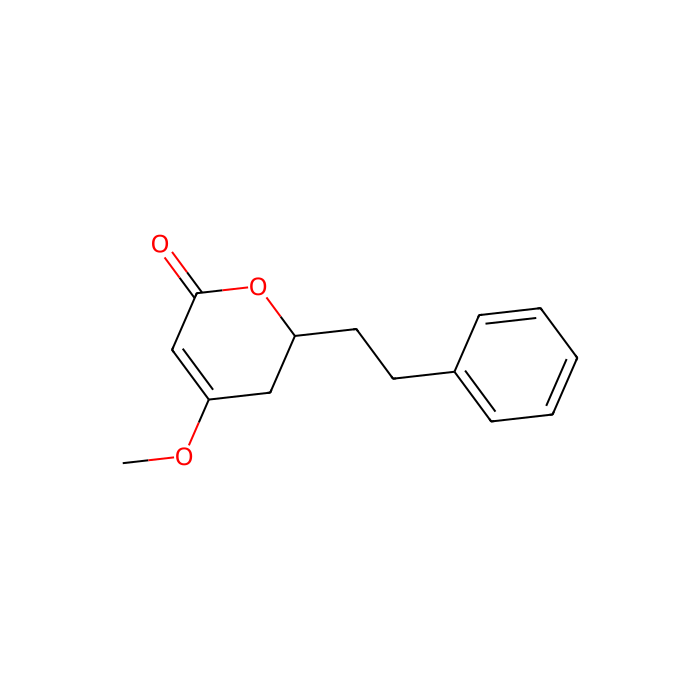
 B23281017
Determine the necessary mass, volume, or concentration for preparing a solution.
| Activity Type | Relation | Activity value | Units | Action Type | Journal | PubMed Id | doi | Assay Aladdin ID |
|---|
analytical standard, ≥95%(HPLC) Analytical standard for sensitive chromatographic and analytical workflows requiring minimal baseline interference.
Store at 2-8°C Ships Wet ice Check lot-specific COA for exact specifications.
SDS, COA, datasheet, and spec sheet available for download. Lot-specific COA accessible via lot number lookup.
Cited in 0 peer-reviewed publications across chromatography, organic synthesis, and cross-coupling reactions.
product application:
food and beverages
| Canonical Smiles | COC1=CC(=O)OC(C1)CCC2=CC=CC=C2 |
|---|---|
| IUPAC Name | (2S)-4-methoxy-2-(2-phenylethyl)-2,3-dihydropyran-6-one |
| InChIKey | VOOYTQRREPYRIW-LBPRGKRZSA-N |
| INCHI | 1S/C14H16O3/c1-16-13-9-12(17-14(15)10-13)8-7-11-5-3-2-4-6-11/h2-6,10,12H,7-9H2,1H3/t12-/m0/s1 |
| Isomeric SMILES | COC1=CC(=O)O[C@H](C1)CCC2=CC=CC=C2 |
| PubChem CID | 10220256 |
| Molecular Weight | 232.28 |
| Beilstein | 15362 |
Comprehensive hazard, handling, storage, and regulatory compliance document.
Download SDS →Lot-specific quality data. Enter your lot number to retrieve the exact COA.
Look up COA →Full quality attributes and acceptance criteria for this grade.
View spec sheet →Taxonomy Tree
| Kingdom | Organic compounds |
|---|---|
| Superclass | Phenylpropanoids and polyketides |
| Class | Kavalactones |
| Subclass | Not available |
| Intermediate Tree Nodes | Not available |
| Direct Parent | Kavalactones |
| Alternative Parents | Dihydropyranones Benzene and substituted derivatives Vinylogous esters Enoate esters Lactones Oxacyclic compounds Monocarboxylic acids and derivatives Organic oxides Hydrocarbon derivatives Carbonyl compounds |
| Molecular Framework | Aromatic heteromonocyclic compounds |
| Substituents | Kavalactone - Dihydropyranone - Monocyclic benzene moiety - Pyran - Benzenoid - Vinylogous ester - Alpha,beta-unsaturated carboxylic ester - Enoate ester - Lactone - Carboxylic acid ester - Monocarboxylic acid or derivatives - Carboxylic acid derivative - Organoheterocyclic compound - Oxacycle - Carbonyl group - Organooxygen compound - Organic oxide - Organic oxygen compound - Hydrocarbon derivative - Aromatic heteromonocyclic compound |
| Description | This compound belongs to the class of organic compounds known as kavalactones. These are lactones, which is structurally characterized by a benzene ring and a pyranone moiety, linked to each other to form a 4-methoxy-6-(2-phenylethyl)-2H-pyran-2-one skeleton. |
| External Descriptors | Not available |
| Activity Type | Relation | Activity value | Units | Action Type | Journal | PubMed Id | doi | Assay Aladdin ID |
|---|
| Activity Type | Relation | Activity value | Units | Action Type | Journal | PubMed Id | doi | Assay Aladdin ID |
|---|
| Activity Type | Relation | Activity value | Units | Action Type | Journal | PubMed Id | doi | Assay Aladdin ID |
|---|
| Activity Type | Relation | Activity value | Units | Action Type | Journal | PubMed Id | doi | Assay Aladdin ID |
|---|
| Activity Type | Relation | Activity value | Units | Action Type | Journal | PubMed Id | doi | Assay Aladdin ID |
|---|
| Activity Type | Relation | Activity value | Units | Action Type | Journal | PubMed Id | doi | Assay Aladdin ID |
|---|
| Specific Rotation[α] | [α]/D 29±2°, c = 0.5 in methanol |
|---|---|
| Molecular Weight | 232.270 g/mol |
| XLogP3 | 2.800 |
| Hydrogen Bond Donor Count | 0 |
| Hydrogen Bond Acceptor Count | 3 |
| Rotatable Bond Count | 4 |
| Exact Mass | 232.11 Da |
| Monoisotopic Mass | 232.11 Da |
| Topological Polar Surface Area | 35.500 Ų |
| Heavy Atom Count | 17 |
| Formal Charge | 0 |
| Complexity | 290.000 |
| Isotope Atom Count | 0 |
| Defined Atom Stereocenter Count | 1 |
| Undefined Atom Stereocenter Count | 0 |
| Defined Bond Stereocenter Count | 0 |
| Undefined Bond Stereocenter Count | 0 |
| The total count of all stereochemical bonds | 0 |
| Covalently-Bonded Unit Count | 1 |
Our grade selection guide covers purity, stabilizer status, and application suitability for all variants in our catalog.
View Analytical standard grade guide →